
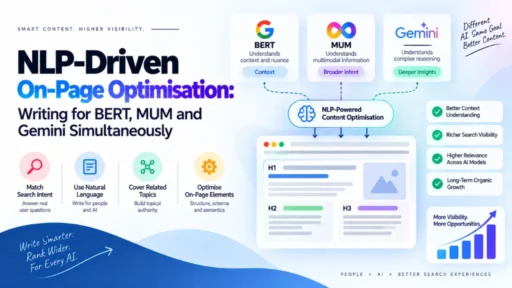
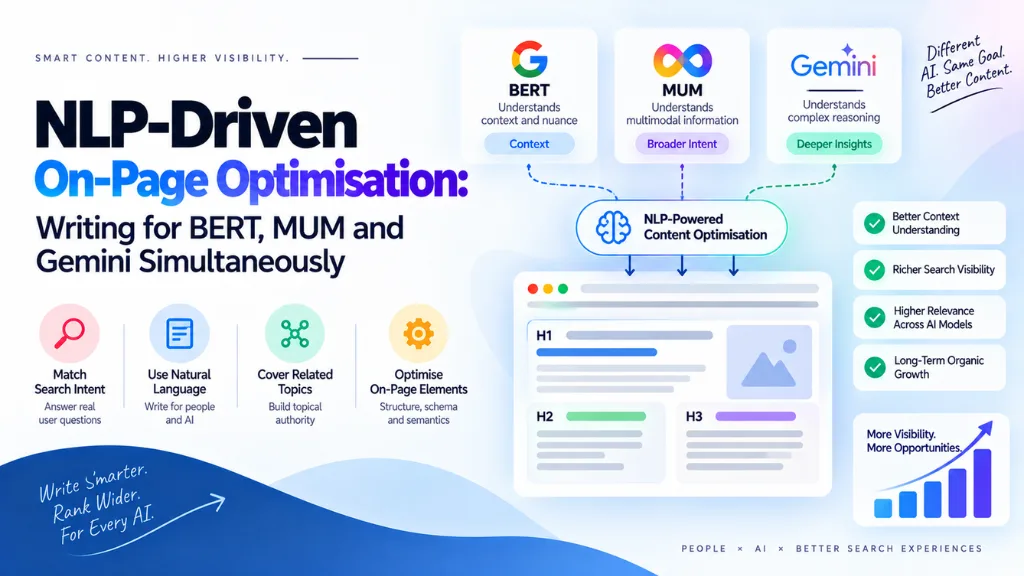

Google hasn’t matched search queries against page text for years – it interprets both as language, extracts meaning, and evaluates how well a page actually answers the question behind the words. NLP-driven on-page optimisation is the practice of writing with that reality in mind, structuring content so BERT, MUM, and Gemini-powered systems can all extract clear meaning from it, rather than optimizing for keyword frequency and hoping the language models figure out the rest.
This article explains what each of these NLP systems actually does inside Google’s search stack, what “writing for NLP” means in practical terms, and how to structure on-page content so it performs well across classic search, AI Overviews, and chatbot-driven discovery at the same time.
What Is NLP-Driven On-Page Optimisation?
NLP-driven on-page optimisation is the practice of writing and structuring content so that natural language processing systems can accurately extract entities, context, and intent from it – rather than optimizing primarily for how often an exact keyword phrase appears. Where traditional on-page SEO focused on keyword placement, density, and exact-match phrasing, NLP-driven optimisation focuses on semantic clarity: whether the language itself communicates meaning as precisely to a model as it would to an attentive human reader.
This shift didn’t happen instantly. Google introduced BERT in October 2019, describing it as one of the most significant improvements to search understanding in the company’s history, with an initial impact on roughly 10% of English-language queries – particularly ones where small words like prepositions changed the meaning of the whole query. Google followed with MUM (Multitask Unified Model) in 2021, which the company described as roughly 1,000 times more powerful than BERT and capable of understanding context across multiple languages and formats simultaneously, including text, images, and video. Gemini now powers much of the language generation behind AI Overviews, drawing on the same underlying entity and context understanding these earlier models established.
How BERT, MUM, and Gemini Each Process Content Differently
What Does BERT Actually Do?
BERT (Bidirectional Encoder Representations from Transformers) reads a sentence in both directions at once, using the words before and after a term to determine its meaning, rather than processing text strictly left to right. This bidirectional approach is what lets Google correctly interpret small connecting words – “to,” “for,” “without” – that previous keyword-matching approaches often treated as irrelevant filler but that can completely change a query’s intended meaning. BERT operates primarily at the word and passage level, refining how individual queries and sections of content are understood in context.
What Does MUM Add Beyond BERT?
MUM extends this understanding across languages and content formats simultaneously, allowing Google’s systems to draw on information from a source in one language or format (a video, an image, a foreign-language article) to inform results served in a completely different language or format. For most day-to-day on-page optimisation, MUM’s practical implication is narrower than its multitasking capabilities suggest: the same signals that help BERT understand context – comprehensive, clearly written coverage of a topic – are what feed MUM’s broader topical assessment, so optimizing specifically “for MUM” separately from good NLP writing generally isn’t necessary.
How Does Gemini Fit Into This?
Gemini underpins the language generation behind AI Overviews and Google’s broader AI-powered search features, synthesizing information across multiple sources into a single generated answer. Where BERT and MUM primarily shape how Google’s core ranking systems interpret queries and content, Gemini’s role is more visible to searchers directly – it’s the system actually producing the summarized answer text that appears above traditional search results, drawing on the same entity and context understanding these earlier models help establish.
Entity Salience: The Core NLP Concept Behind On-Page Writing
Entity salience is a measurable concept in natural language processing – including in Google’s own publicly documented Cloud Natural Language API – that scores how prominent a given entity is within a piece of text, typically on a scale from 0 to 1. A page that mentions a topic once in passing has low salience for that entity; a page that structures its content clearly around that entity as the central subject has high salience. Salience scores are relative across all entities on a page, meaning entities effectively compete for prominence within the same piece of content.
Why Does Entity Salience Matter More Than Keyword Density?
Entity salience matters more than keyword density because it measures whether a topic is genuinely central to a page’s content and structure, not just how many times a specific phrase appears. A page can mention a target keyword phrase repeatedly while still failing to establish clear entity salience if the surrounding content is thin, unfocused, or fails to address the topic’s actual subtopics – while a page using varied, natural phrasing throughout can achieve strong salience if it comprehensively and clearly covers the subject.
Writing Principles for NLP-Aware Content
Use Natural Language and Vocabulary Variation
Content that reads naturally, with varied vocabulary and phrasing, is easier for NLP models to parse as genuine expertise than content built around rigid, repetitive keyword insertion. Rather than repeating an exact target phrase throughout an article, using natural synonyms and related terminology – the way a genuine subject-matter expert would write – signals topical understanding more effectively than forced repetition, since NLP systems are specifically designed to recognize related concepts and terms as connected, not just exact string matches. This is also where solid keyword research still earns its place: it maps the full vocabulary a topic actually uses, so natural variation has real search-demand terms to draw from rather than synonyms picked at random.
Write in Clear, Complete Sentence Structures
Because bidirectional models like BERT interpret meaning from surrounding words in both directions, ambiguous or fragmented sentence structures make it harder for these systems to extract a clear, confident interpretation. Complete sentences with clear subject-verb-object relationships give NLP models a cleaner signal than clipped, keyword-stuffed phrasing that reads awkwardly to a human and, correspondingly, parses less cleanly for a language model.
Answer Questions Directly Before Elaborating
Content structured to directly answer a likely question in the first sentence or two after a heading, before expanding with supporting detail, gives NLP systems – and Gemini specifically, when compiling an AI Overview – a clean, extractable passage to draw from. This is the same structural principle behind featured snippet optimisation, and it works for the same underlying reason: a self-contained, direct answer is easier for a model to lift and cite accurately than an answer buried in the middle of a longer paragraph – a pattern Search Savvy builds into content briefs by default, not as an afterthought layered on at the editing stage.
Establish Entities Explicitly, Then Reinforce Them Naturally
Introducing the central entity or topic of a page clearly and early, then reinforcing it through varied but recognizably related language throughout the rest of the content, helps establish strong entity salience without relying on repetition. Structured data – Article, FAQ, and relevant entity schema – reinforces this explicitly, giving NLP systems an unambiguous, machine-readable declaration to cross-reference against what they infer from the prose itself. This is the same underlying discipline behind broader content strategy and topical authority work – comprehensive coverage naturally produces the kind of content NLP systems interpret as authoritative.
Structuring Pages for Multiple NLP Systems at Once
| Structural Element | Why It Helps NLP Processing |
| Descriptive H2/H3 headings | Give models clear topic boundaries within a page, improving passage-level extraction |
| Answer-first paragraphs | Provide self-contained, directly extractable content for AI Overview synthesis |
| Natural vocabulary variation | Signals genuine topical depth rather than repetitive keyword targeting |
| Structured data (schema) | Provides explicit, machine-readable entity declarations alongside natural-language content |
| Complete, unambiguous sentences | Give bidirectional models a clean context window to interpret meaning correctly |
| Comprehensive subtopic coverage | Builds entity salience and feeds topical completeness assessments used by MUM-adjacent systems |
None of these elements are exclusive to one specific model. Writing this way benefits BERT’s passage-level interpretation, MUM’s broader topical assessment, and Gemini’s ability to extract clean, citable content for AI Overviews simultaneously – the same discipline covered under AI search optimization for AEO and GEO – which is the practical meaning of “writing for BERT, MUM, and Gemini at once”: there isn’t a separate technique for each system, just a consistently higher standard of semantic clarity that serves all of them.
Common Mistakes in NLP-Driven Optimisation
- Treating NLP optimisation as a keyword-density adjustment. Swapping exact-match repetition for synonym repetition without actually improving topical depth misses the underlying principle.
- Writing unnaturally to hit perceived “NLP-friendly” patterns. Content engineered to look semantically rich to a model, at the cost of reading naturally to a human, generally fails both audiences.
- Ignoring structured data as a complement to natural language. Schema markup and well-written prose reinforce each other; relying on either alone leaves ambiguity the other could have resolved.
- Assuming MUM requires separate, distinct optimisation from BERT. The signals that support strong BERT-level interpretation – clarity, context, comprehensive coverage – are largely the same signals that support MUM’s broader assessment.
- Burying direct answers inside long paragraphs. Content that eventually answers a question, several sentences into a paragraph, is harder for both users and AI systems to extract cleanly than an answer-first structure.
- Neglecting entity salience in favor of topic breadth. Covering many loosely related ideas without a clearly established central entity dilutes salience rather than building it.
Search Savvy applies these principles as a standard part of content marketing delivery, since NLP-aware structure has become as fundamental to on-page writing as basic readability was a decade ago.
Frequently Asked Questions
Do I need to write differently for BERT versus MUM versus Gemini? No. The underlying principles – clear entity establishment, natural language, comprehensive topical coverage, and answer-first structure – support all three systems simultaneously. There isn’t a distinct writing technique required for each one individually.
Does keyword density still matter at all? Not in the way it once did. Google’s NLP-based systems evaluate context and entity relevance rather than counting exact-phrase repetition, so unnatural keyword density can actually work against content by making it read less like genuine expertise.
What is entity salience and how do I improve it? Entity salience measures how central a given topic or entity is within a piece of content. Improving it means clearly establishing the entity early, structuring the content around it comprehensively, and reinforcing it with varied, natural language and supporting structured data rather than repetition alone.
How does structured data relate to NLP-driven optimisation? Structured data (schema markup) gives search engines an explicit, machine-readable declaration of a page’s entities and relationships, which complements the implicit understanding NLP models extract from natural-language content. The two work together rather than substituting for one another.
Does writing for NLP mean avoiding SEO keywords entirely? No. Keywords still matter for signaling relevance and matching search demand – the shift is toward using them naturally alongside synonyms and related terminology, rather than relying on repetitive exact-match phrasing as the primary optimisation lever.
Is NLP-driven optimisation relevant to AI Overview visibility specifically? Yes. Gemini-powered AI Overviews synthesize answers from sources it can extract clean, well-structured, self-contained passages from, which is exactly what answer-first paragraphs and clear entity establishment are designed to provide.
Bottom Line
NLP-driven on-page optimisation isn’t a separate discipline layered on top of good writing – it’s what good writing looks like once you account for the fact that Google’s core systems, and the AI features built on top of them, interpret content the way an attentive reader would rather than counting keyword occurrences. Write clearly, establish the central topic early, use varied and natural language, structure content to answer questions directly, and reinforce entity signals with structured data. Do that consistently, and the same content performs well whether it’s being parsed by BERT, assessed by MUM, or synthesized into an AI Overview by Gemini – because all three are, at their core, trying to understand the same thing: what your content actually means.