Brand Equity Measurement Frameworks: Quantifying Intangible Assets for Board-Level Reporting
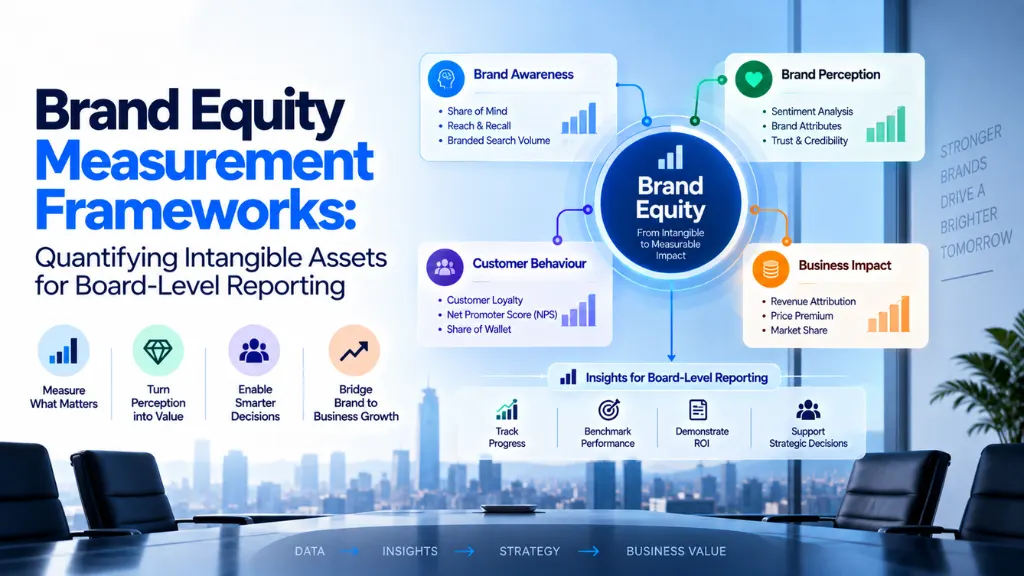

Ask a board member what the company’s brand is actually worth, and you’ll usually get one of two unsatisfying answers: a follower count from marketing, or a shrug from finance. Neither is wrong, exactly – they’re just answering different questions. Brand equity measurement frameworks exist precisely to close that gap, turning something genuinely intangible into numbers a board can actually act on, whether that’s a diagnostic score for marketing strategy or a monetary figure that holds up in an M&A negotiation.
In this article10 sections
Jeff Bezos put the intangible side of this plainly: “Your brand is what people say about you when you’re not in the room.” That’s a useful gut-check for any board discussion, but it’s also exactly why brand equity is so hard to measure – you’re trying to quantify a conversation happening entirely outside your control. This guide, shaped by the brand measurement work we do for clients at Search Savvy, walks through the frameworks that make that quantification possible, what each is actually good for, and how to build a board-level report that connects perception to real financial value.
What Is a Brand Equity Measurement Framework?#
A brand equity measurement framework is a structured method for assessing the value a brand’s name, reputation, and associations add – either in terms of customer perception and behavior, or as a monetary figure suitable for financial reporting. It exists because brand value, while genuinely intangible, demonstrably affects pricing power, customer acquisition cost, and how much a buyer will pay in an acquisition.
Brand Equity vs. Brand Value: What’s the Difference?#
This distinction trips up a lot of board conversations. Brand equity refers to the perceptions and behaviors that exist in customers’ minds – awareness, associations, loyalty, perceived quality. Brand value is a monetary figure, the kind that shows up in M&A transactions, licensing deals, and published brand rankings. The two are related but answer different questions: brand equity explains why a company can charge more for a product than an unbranded equivalent; brand value puts a number on how much that difference is worth. A credible board report generally needs to show both, rather than treating either one alone as sufficient.
The Core Customer-Based Frameworks: Aaker and Keller#
Two frameworks, both developed in the early 1990s, remain the foundation nearly every brand measurement approach builds on.
David Aaker’s model, first laid out in his 1991 book Managing Brand Equity, treats brand equity as a set of assets tied to a brand’s name and symbols. Aaker has continued refining how he frames the concept over the decades; in a 2019 interview, he described his current summary of brand equity around three core dimensions, starting with what he calls “visibility and credibility, the basis of being relevant” – a framing that emphasizes relevance and recognition as the foundation everything else builds on, alongside associations and differentiation. Aaker’s framework works well as a diagnostic tool – it helps a marketing team identify which specific asset is strong or weak, rather than producing a single overall score.
Kevin Keller’s Customer-Based Brand Equity (CBBE) pyramid takes a more sequential view, arguing that brand strength builds in stages: salience (does the customer know you exist?), performance and imagery (what do they think you deliver?), judgments and feelings (how do they react emotionally?), and finally resonance (do they form deep loyalty and active engagement?).
Neither model produces a dollar figure on its own, and that’s by design. They’re diagnostic instruments meant to guide brand strategy and marketing investment decisions. For board-level reporting, they’re most useful as the perception layer underneath a financial valuation, showing why the number is moving, not just that it is.
Financial Valuation Frameworks: Turning Brand Into a Number#
This is where brand equity measurement gets directly relevant to board reporting, because boards ultimately need figures that connect to enterprise value, not just perception scores.
ISO 10668 is the international standard for monetary brand valuation, published to bring consistency to a field that previously had none. It requires three types of analysis before a valuation opinion is issued: a legal analysis of the brand’s protectable rights, a behavioural analysis of how stakeholders respond to the brand, and a financial analysis using one or more of three recognized approaches – market, cost, and income. Valuations used for cross-border tax, licensing, or transactional purposes increasingly need to demonstrate ISO 10668 compliance to be taken seriously by counterparties and auditors.
Three organizations publish the brand valuation rankings that regularly appear in business press, and each uses a distinct methodology: Interbrand, Kantar BrandZ, and Brand Finance. This is precisely why the same brand can show up with meaningfully different values across the three lists in the same year – they’re not measuring identically, even when they’re measuring the same underlying asset. Brand Finance’s Global 500 ranking for 2026, for example, places Apple at roughly $607.6 billion, Microsoft at $565.2 billion, Google at $433.1 billion, and Amazon just under $370 billion, with NVIDIA climbing into the top five after overtaking established consumer giants. Interbrand, meanwhile, has separately estimated that brand can account for somewhere between 30% and 50% of total enterprise value for many companies – a range that alone should justify board-level attention to how that figure is being tracked internally.
Why Do Different Brand Valuation Reports Show Different Numbers for the Same Brand?#
Because “brand value” isn’t a single, universally agreed calculation – it’s the output of a chosen methodology applied to a specific definition of what counts as “brand” versus broader intangibles like patents, customer relationships, or proprietary technology. Interbrand, Kantar BrandZ, and Brand Finance each weight financial performance, customer perception data, and forward-looking brand strength differently, and each defines the boundary of “brand” slightly differently too. None of this makes the figures meaningless, but it does mean a board should ask which methodology produced a number before treating it as comparable across sources.
What Actually Belongs in a Board-Level Brand Equity Report?#
A useful board report generally needs three layers working together, not one number in isolation:
- Perception data, tracked over time. This is where Aaker- and Keller-style diagnostics earn their place – awareness, perceived quality, loyalty indicators, and sentiment tracked consistently against a baseline and against named competitors, not as a one-off snapshot.
- A directional financial estimate, methodologically transparent. Boards don’t necessarily need a full ISO 10668-compliant appraisal every quarter, but any monetary figure presented should be traceable to a stated methodology, ideally one that could stand up to that standard if the company ever needed a formal valuation for an acquisition, licensing deal, or impairment review.
- An honest note on accounting treatment. This is a nuance worth stating plainly in any board report: under both IFRS and US GAAP, internally generated brand value generally cannot be capitalized on the balance sheet – only brand value acquired through a business combination gets recognized as an intangible asset, typically under standards like IFRS 3 or ASC 805. A board unfamiliar with this distinction can otherwise mistakenly expect an internally tracked brand value figure to reconcile with the balance sheet, and it won’t, by design.
How AI Search Is Reshaping What “Brand Awareness” Even Means#
One genuinely new wrinkle in 2026 worth flagging for any board-level framework: brand salience – the foundational layer in Keller’s pyramid and a core component of Aaker’s model – is no longer just about popping into a customer’s head while they’re shopping. Increasingly, it’s about whether a brand gets referenced when someone asks an AI system a category question, whether that’s Google’s AI Overviews, ChatGPT, Gemini, or Perplexity. If a brand’s digital footprint and authoritative mentions aren’t strong enough for an AI system to cite it in a relevant answer, that’s a genuine gap in modern brand equity, even if traditional survey-based awareness metrics still look healthy. It’s a modern, algorithmic version of the exact dynamic Bezos was describing – what gets said about your brand when you have zero control over the conversation.
This is a trend we track closely at Search Savvy, because it means brand equity measurement frameworks built purely around traditional awareness surveys are starting to miss a real and growing part of the picture. If your board reporting doesn’t yet account for AI-mediated visibility, our AI and Search blog category is a useful place to start building that literacy internally.
Building a Practical, Board-Ready Brand Equity Dashboard#
None of this requires commissioning a full formal valuation every quarter. A workable approach looks like this:
- Pick a customer-based framework as your perception baseline – Aaker for product-led, asset-heavy businesses; Keller for emotionally driven, relationship-based brands – and track it consistently rather than switching models year to year.
- Layer in continuous social listening to catch sentiment and narrative shifts between formal survey waves, rather than relying solely on periodic research.
- Benchmark against named competitors, not just your own historical trend. A brand that’s improving in isolation can still be losing relative ground if competitors are moving faster.
- Commission a methodologically sound financial estimate periodically, aligned in spirit with ISO 10668 even if a full formal appraisal isn’t warranted every cycle, so the figure would hold up if the board ever needed it for a transaction.
- Report the trend, not a static number. A board cares far more about direction and rate of change than about a single point-in-time figure that has no context.
At Search Savvy, this is exactly the kind of layered reporting we help brands build – pairing ongoing perception tracking with the kind of analytics discipline a board actually trusts. Our Analytics & Performance Reporting services page covers how we typically structure that reporting cadence, and our branding and identity glossary is a useful shared reference if your board and marketing team need to align on terminology before the first report goes out.
FAQ: Brand Equity Measurement Frameworks#
What is the difference between brand equity and brand value? Brand equity refers to the perceptions, associations, and loyalty that exist in customers’ minds. Brand value is a monetary figure derived from that equity, used in contexts like M&A transactions, licensing, and published brand rankings.
Which brand equity framework should a company use – Aaker or Keller? Aaker’s model tends to suit product-led, asset-heavy businesses where perceived quality and differentiation matter most, while Keller’s CBBE pyramid works well for brands built more on emotional connection and customer relationships. Many organizations use elements of both.
Can internally built brand value appear on a company’s balance sheet? Generally, no. Under both IFRS and US GAAP, internally generated brand value typically cannot be capitalized as an asset. Only brand value acquired through a business combination is recognized on the balance sheet, usually under standards like IFRS 3 or ASC 805.
What is ISO 10668 and why does it matter for brand valuation? ISO 10668 is the international standard for monetary brand valuation, requiring legal, behavioural, and financial analysis before a valuation opinion is issued. It matters because valuations used in cross-border tax, licensing, or transactional contexts increasingly need to demonstrate compliance with it to be considered credible.
Why do Interbrand, Kantar BrandZ, and Brand Finance publish different values for the same brand? Each organization uses a distinct methodology and defines the boundary of “brand” differently relative to other intangible assets, which is why their published rankings can diverge meaningfully for the same company in the same year.
How is AI search changing brand equity measurement? Brand salience increasingly includes whether AI systems like AI Overviews, ChatGPT, or Gemini reference a brand when answering category-relevant questions, adding a new dimension to awareness measurement that traditional survey-based tracking doesn’t fully capture yet.
The Bottom Line#
Brand equity measurement doesn’t need to choose between marketing’s perception metrics and finance’s need for a defensible number – a credible board-level framework combines both, tracked consistently over time and benchmarked against competitors. Start by picking a customer-based diagnostic model that fits your business, layer in continuous listening between formal research cycles, and be honest with your board about what a brand figure does and doesn’t represent on the balance sheet. Bezos was right that you don’t control what people say about your brand when you’re not in the room – but with the right framework, you can at least measure it.