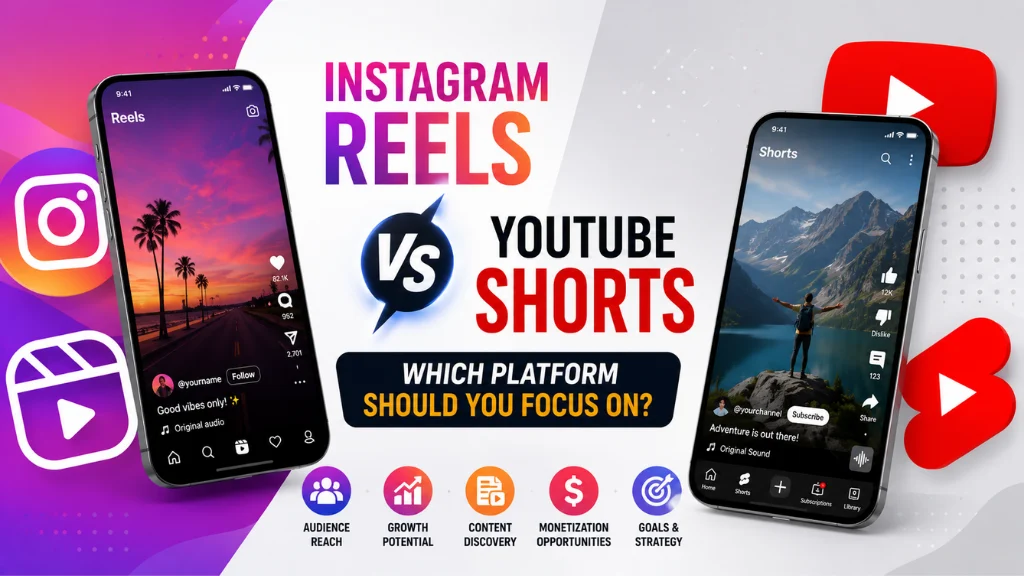
Instagram Reels vs YouTube Shorts: Which Platform Should You Focus On?

Short-form video is not optional anymore – it is the format carrying most of the engagement weight across social platforms in 2026. Short-form video now drives roughly 2.5 times more engagement than long-form content, and that gap keeps widening year over year, according to Teleprompter’s 2026 short-form video report.
In this article8 sections
Instagram Reels vs YouTube Shorts is the question every creator, marketer, and business owner eventually has to answer, because the two platforms look nearly identical on the surface but reward completely different behaviour underneath. Vertical video, short runtime, swipeable feed – the format is the same. The algorithm, audience, and payout are not.
At Search Savvy, we help Indian brands decide where to place their short-form video budget and effort, and the honest answer is rarely “just pick one.” This guide breaks down exactly how each platform works, what the 2026 data shows, and which one deserves your focus first based on your specific goals.
Why Does the Instagram Reels vs YouTube Shorts Decision Matter So Much in 2026?#
Instagram Reels vs YouTube Shorts matters because the two platforms now represent fundamentally different content ecosystems, not just two places to upload the same video.
Reels live inside Instagram’s social graph, integrated with Stories, Shopping, and your existing follower base. Shorts live inside YouTube’s discovery engine, feeding a search-and-recommendation system built for long-term findability. Treating them as interchangeable upload targets means missing what each one actually optimises for – Reels reward trend participation and visual polish, while Shorts reward value density and watch time, per ASDM’s 2026 platform comparison.
India makes this decision especially consequential. Instagram Reels’ largest single market globally is India, with 362 million users, according to Flowshorts’ 2026 Instagram statistics report. YouTube’s Shorts format was also launched first in India, immediately after the 2020 TikTok ban created a content vacuum that both platforms rushed to fill.
People Also Ask: Are Instagram Reels and YouTube Shorts the same thing? Short Answer: No. Both are vertical short-form video formats, but they run on different algorithms, serve different discovery mechanics, and reward different creator behaviour – Reels favour trend-driven engagement, while Shorts favour watch time and long-term discoverability.
How Does the Instagram Reels Algorithm Actually Work?#
Instagram Reels vs YouTube Shorts starts with understanding what each algorithm is actually scoring, and Reels prioritises early engagement signals above almost everything else.
A new Reel is first shown to a small seed audience. The algorithm watches for early signals – especially watch time in the first few seconds, rewatches, and how quickly viewers interact – before deciding whether to expand distribution further, according to a 2026 breakdown of Reels algorithm mechanics. Instagram places a much stronger emphasis on trend adoption and shareability than YouTube does.
Reels also command the platform’s best organic reach by a wide margin. Reels achieve a 30.81% average reach rate – more than double that of carousels or static image posts – and now account for roughly 46% of all time spent on Instagram in the US, per DigitalApplied’s 2026 short-form strategy report. In India specifically, Reels generate three times more engagement than static posts, according to Vavo Digital’s 2026 influencer marketing analysis.
People Also Ask: Why do Instagram Reels get more reach than regular posts? Short Answer: Instagram’s algorithm actively prioritises Reels distribution over static posts and carousels, pushing them into the Explore tab and Reels feed regardless of whether the viewer follows the account, which drives significantly higher average reach.
How Does the YouTube Shorts Algorithm Actually Work?#
Instagram Reels vs YouTube Shorts looks different again once you factor in how YouTube treats new content, because Shorts are evaluated independently of your existing channel size.
YouTube Shorts generally offers greater reach potential for new and small accounts because each Short is judged on its own merits rather than boosted or limited by follower count, according to Conbersa’s 2026 platform comparison. This gives creators starting from zero a genuinely fair shot at discovery – something Reels, which tends to favour accounts with an already-engaged following, does not offer as readily.
Shorts also currently leads all major short-form platforms on raw engagement rate. YouTube Shorts leads with a 5.91% engagement rate and roughly 73% average viewer retention, generating 200 billion daily views across 2 billion monthly users, per DigitalApplied’s 2026 data. A 2026 algorithm update also began weighting viewer satisfaction surveys more heavily than raw watch time alone, and YouTube expanded Shorts monetization eligibility to more creators.
People Also Ask: Is YouTube Shorts better for new creators than Instagram Reels? Short Answer: Often, yes. YouTube Shorts evaluates each video independently of channel size, giving new creators a genuine discovery opportunity. Instagram Reels tends to favour accounts that already have an established, engaged following.
Which Platform Pays Creators More: Reels or Shorts?#
Instagram Reels vs YouTube Shorts becomes a much clearer decision once monetization enters the conversation, and the gap between the two is significant.
YouTube Shorts offers a structured revenue-sharing program through the YouTube Partner Program, where eligible creators earn a share of advertising revenue placed between Shorts. For Indian creators specifically, YouTube Shorts RPM (revenue per 1,000 views) typically ranges from ₹0.50 to ₹3, translating to roughly ₹500–₹3,000 for a video that reaches one million views, according to Shuvadip Mondal’s 2026 India earnings analysis. That is modest compared to long-form YouTube, but it is a direct, predictable payout structure.
Instagram Reels monetization, by contrast, remains inconsistent. Meta’s Reels Play Bonus program has been “on, off, regionally limited, and invitation-only,” with no comparable built-in ad-revenue-sharing model currently active for most creators, according to PostEverywhere’s 2026 platform comparison. Reels’ real monetization path is indirect – driving traffic to your profile, Shopping tags, and brand partnerships rather than paying per view.
- YouTube Shorts – direct ad-revenue sharing via YPP; modest but predictable per-view payout
- Instagram Reels – indirect monetization via traffic, Shopping, and brand deals; inconsistent bonuses
- Both platforms – brand partnerships remain the highest-earning path for established creators
People Also Ask: Which platform pays more per view, Reels or Shorts? Short Answer: YouTube Shorts offers a more structured, direct payout through the YouTube Partner Program’s ad-revenue sharing. Instagram Reels’ bonus programs have been inconsistent and are not currently a reliable built-in monetization source for most creators.
Why Does SEO and Discoverability Favour YouTube Shorts?#
Instagram Reels vs YouTube Shorts also plays out very differently in search visibility, and this is where Shorts holds a structural advantage most creators underestimate.
YouTube Shorts appear directly inside Google Search results. When users search how-to content, product reviews, or trending topics, a Shorts carousel can surface on page one of Google itself, according to CrawlVision’s 2026 SEO comparison. Shorts also feed directly into YouTube’s long-form recommendation engine, meaning a single Short can act as a discovery funnel that pulls new viewers into your entire channel over time.
Instagram Reels, by comparison, are discoverable primarily within Instagram’s own ecosystem – the Explore tab, hashtag pages, and the Reels feed – with far less crossover into external search engines. This makes Shorts the stronger long-term SEO and discoverability asset, while Reels remains the stronger in-app social distribution tool.
People Also Ask: Do YouTube Shorts show up in Google Search? Short Answer: Yes. YouTube Shorts can appear directly in Google Search results, particularly for how-to, review, and trending-topic queries, giving them a discoverability advantage that Instagram Reels – largely confined to Instagram’s own app – does not have.
Which Platform Should You Choose Based on Your Content Goals?#
Instagram Reels vs YouTube Shorts ultimately comes down to what you are trying to achieve, not which platform is objectively “better” in isolation.
According to Search Savvy’s insights from running short-form strategy for Indian brands, the right platform depends entirely on your content type and business goal. A fashion or lifestyle brand chasing fast trend visibility usually gets more value from Reels. An educational, tutorial, or expertise-driven brand building long-term authority usually gets more value from Shorts.
Here is a practical breakdown by goal:
- Fast trend-driven reach and a younger, lifestyle audience – choose Instagram Reels
- Long-term discoverability, SEO, and educational content – choose YouTube Shorts
- Direct, predictable ad-revenue monetization – choose YouTube Shorts
- Social commerce and Shopping integration – choose Instagram Reels
- Building from zero with no existing audience – choose YouTube Shorts
- Leveraging an existing engaged Instagram following – choose Instagram Reels
At Search Savvy, we recommend most brands avoid picking just one – the two platforms serve different funnel stages, and repurposing the same core video across both is often the most efficient use of production effort.
Why Do Most Brands End Up Using Both Platforms?#
Instagram Reels vs YouTube Shorts does not have to be an either-or decision, and for most brands in 2026, it genuinely should not be.
Most successful creators and brands adopt a multi-platform approach, tailoring the same core content to each platform’s specific audience and algorithm expectations, according to Adox Global’s 2026 short-form marketing comparison. The compound value of a YouTube channel combining Shorts for audience growth with long-form video for revenue conversion is difficult to replicate through Instagram alone, per PostEverywhere’s 2026 analysis.
According to Search Savvy’s experience working with Indian D2C and service brands, the most efficient workflow is “create once, adapt for each platform” – shoot vertical video with both audiences in mind, then adjust captions, hooks, and calls-to-action per platform rather than producing entirely separate content pipelines.
FAQ: Instagram Reels vs YouTube Shorts#
Q1: Which platform is easier for beginners – Reels or Shorts? A: Instagram Reels is generally easier to start with because it is supported by Meta’s mature ad ecosystem and existing social tools. YouTube Shorts has a steeper initial learning curve but offers more reliable long-term discovery for accounts with zero following.
Q2: Should a small business focus on Reels or Shorts first? A: It depends on the business type. Local, visual, or lifestyle-driven businesses usually see faster traction on Reels. Businesses built around expertise, tutorials, or products with a consideration cycle often perform better long-term on Shorts due to SEO discoverability.
Q3: Can the same video work on both Instagram Reels and YouTube Shorts? A: Yes, with adjustments. The same core clip can be repurposed for both platforms, but hooks, captions, and calls-to-action should be tailored – Reels rewards trend cues and shareability, while Shorts rewards clear value delivery and retention.
Q4: Do Instagram Reels or YouTube Shorts have a longer content shelf life? A: YouTube Shorts generally last longer. Because Shorts feed into YouTube’s search and recommendation engine, a well-performing Short can continue generating views for months, while Reels’ visibility is more heavily tied to recency and trend relevance.
Q5: Is YouTube Shorts monetization available to Indian creators? A: Yes. Indian creators can join the YouTube Partner Program and earn ad-revenue share on Shorts, though per-view RPM in India is modest – typically ₹0.50 to ₹3 per 1,000 views.
Q6: Which platform is better for driving website or product traffic? A: Instagram Reels currently has stronger native commerce integration through Shopping tags and link-in-bio tools. YouTube Shorts relies more on description links and channel-level calls-to-action, making Reels the more direct traffic-to-purchase path for now.
Not sure which short-form platform deserves your team’s time and budget? Visit Search Savvy to speak with a digital marketing expert who can build a Reels-and-Shorts strategy tailored to your brand’s goals.