Google Ads vs Facebook Ads: Which Is Better for Your Business?

Every business with a marketing budget eventually asks the same question: should the money go to Google or to Facebook? The honest answer is rarely as simple as “whichever is cheaper” – and treating cost per click as the deciding factor is one of the most common mistakes we see.
In this article8 sections
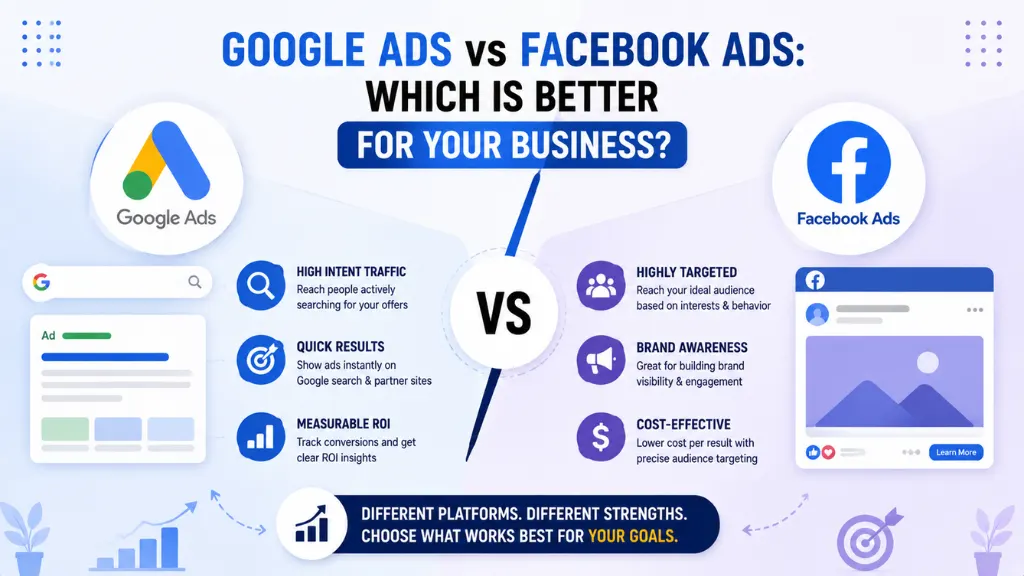
Google Ads vs Facebook Ads is really a question about intent versus interruption. Google captures people who are already searching for a solution. Facebook places your offer in front of people who were not looking for it at all. That single difference shapes almost everything else about how each platform performs.
At Search Savvy, we manage paid campaigns for Indian businesses across e-commerce, local services, and B2B, and the platform choice almost always comes down to where your customer already is in their buying journey. This guide breaks down exactly how each platform works, what the 2026 cost data shows, and how to decide which one deserves your first rupee.
Why Does the Google Ads vs Facebook Ads Decision Matter So Much in 2026?#
Google Ads vs Facebook Ads matters because getting it wrong does not just waste ad spend – it can cost months of misread performance data before you realise the platform was never right for your funnel stage.
The core difference remains intent versus interruption. Google captures demand from users actively searching for solutions, while Facebook creates demand by placing ads in front of users based on behavioural and demographic signals, according to Stackmatix’s 2026 platform comparison. That gap has narrowed somewhat in 2026 as both platforms expand into each other’s territory.
For Indian businesses, this decision carries real weight because budgets are tighter and margins for error are smaller. According to Search Savvy’s insights from running campaigns across Indian SMBs, choosing the wrong platform for your funnel stage is the single most common reason paid campaigns get abandoned within the first month.
People Also Ask: Is Google Ads or Facebook Ads better for small businesses? Short Answer: It depends on intent. Google Ads works best when customers are actively searching for what you offer. Facebook Ads works best for building awareness among people who have not yet started looking – both can work for small businesses, but for different goals.
How Does Google Ads Actually Work?#
Google Ads vs Facebook Ads starts with understanding that Google operates on an auction system tied directly to search intent, not audience targeting.
Every time someone searches a keyword you are bidding on, Google runs a real-time auction to decide which ads appear and in what position, according to VGraple’s 2026 Google Ads India pricing guide. You pay only when someone clicks, and your position depends on both bid amount and Quality Score – a measure of ad relevance and landing page experience that directly lowers your cost when optimised well.
Google Ads consistently converts at a higher rate because the user has already expressed intent. Google Search Ads convert at an average of 4.40% across industries, compared to 1.85% for Facebook Ads overall, according to Come Together Media’s 2026 platform analysis. This is why Google tends to work best for local services, high-intent purchases, and anything someone would actively type into a search bar.
People Also Ask: Why does Google Ads convert better than Facebook Ads? Short Answer: Because Google users are actively searching for a solution, while Facebook users are scrolling content passively. That built-in intent gives Google Search Ads a significantly higher average conversion rate – 4.40% versus 1.85% for Facebook, per 2026 data.
How Does Facebook Ads Actually Work?#
Google Ads vs Facebook Ads shifts entirely once you understand that Facebook’s model is built around interruption, not search – it inserts ads into a feed based on interests, behaviour, and lookalike audiences rather than typed intent.
Facebook’s pricing model focuses on reach and engagement rather than search intent, giving brands access to lower cost-per-thousand-impressions and highly scalable audience targeting, according to VibeMyAd’s 2026 ROI comparison. This makes Facebook a strong fit for products people did not know they wanted yet – visually compelling, impulse-driven, or genuinely new-to-market offers.
Facebook’s average CPC sits meaningfully lower than Google’s. Facebook’s average CPC is $1.14 globally, compared to Google’s $2.69, based on a 2026 analysis of $3 billion in ad spend from AllAble’s 2026 platform comparison. But lower CPC does not automatically mean lower cost per customer – that depends entirely on your conversion rate once the click lands.
People Also Ask: Is Facebook Ads cheaper than Google Ads? Short Answer: Per click, usually yes – Facebook’s average CPC runs well below Google’s. However, Facebook’s lower conversion rate can offset that advantage, so cost per acquisition, not cost per click, is the number that actually determines which platform is cheaper for you.
What Do Google Ads and Facebook Ads Actually Cost in India in 2026?#
Google Ads vs Facebook Ads pricing in India looks different from global benchmarks, and the spread within each platform is wide enough that industry-specific numbers matter far more than national averages.
Google Ads in India ranges roughly from ₹5 to ₹150 per click depending on industry and competition, with e-commerce averaging ₹15–₹40 and finance running ₹40–₹120 or higher, according to StartUpMandi’s 2026 Google Ads India breakdown. Highly competitive verticals like legal and finance can push past ₹150–₹600 per click, per 8Spark’s 2026 industry CPC guide.
Facebook Ads in India runs considerably lower per click but varies by objective. Meta Ads in India cost roughly ₹0.50–₹8 CPC, ₹30–₹300 CPM, and ₹100–₹2,000 cost-per-lead depending on industry and targeting precision, according to VGraple’s 2026 Facebook Ads India cost guide.
A rough side-by-side for Indian small businesses:
- Google Ads (search) – ₹5–₹150+ CPC; higher for finance, legal, real estate
- Google Ads (recommended monthly budget) – ₹15,000–₹30,000 minimum for meaningful data
- Facebook Ads – ₹0.50–₹8 CPC; ₹100–₹2,000 cost per lead depending on funnel
- Facebook Ads (recommended daily budget) – as low as ₹500–₹1,000/day for early testing
People Also Ask: How much should a small business in India budget for Google Ads or Facebook Ads? Short Answer: For Google Ads, ₹15,000–₹30,000 per month is a reasonable starting point for meaningful data. For Facebook Ads, testing can begin with as little as ₹500–₹1,000 per day, scaling once you identify winning audiences and creative.
Why Does Cost Per Click Alone Mislead Advertisers?#
Google Ads vs Facebook Ads decisions go wrong most often when advertisers compare raw CPC without accounting for conversion rate – and the math can flip the “cheaper” platform entirely.
A $4 Google click converting at 6% produces a $67 cost per acquisition. A $0.80 Facebook click converting at 1.5% produces a $53 cost per acquisition – a far smaller gap than the CPC difference alone would suggest, according to Stackmatix’s 2026 cost analysis. This is exactly why Search Savvy always evaluates cost per acquisition and full-funnel economics, not headline CPC, before recommending a platform to a client.
The same principle applies to attribution windows. Facebook’s default attribution window undercounts conversions that happen after its typical 7-day click window closes, while Google’s longer attribution window can over-attribute results to branded search, per the same Stackmatix analysis. Incrementality testing – measuring the sales that would not have happened without the ads – gives a more honest picture on either platform.
People Also Ask: Should I compare CPC or CPA between Google Ads and Facebook Ads? Short Answer: Cost per acquisition (CPA), not cost per click. A platform with a higher CPC can still deliver a lower CPA if its conversion rate is high enough – CPC alone tells you almost nothing about actual return on ad spend.
Which Platform Should You Choose Based on Your Business Type?#
Google Ads vs Facebook Ads ultimately comes down to what stage of the buying journey your ideal customer is in when you want to reach them – not which platform is objectively cheaper.
According to Search Savvy’s insights from managing paid media across Indian verticals, the decision usually maps cleanly onto business type:
- Local services (plumbers, dentists, lawyers) – Google Ads; people search when they need you
- New or impulse-driven products (fashion, gadgets, subscription boxes) – Facebook Ads
- E-commerce and D2C with established demand – both, but weight Google for bottom-funnel
- B2B and high-consideration purchases – Google for capturing research-stage intent
- Visually compelling, awareness-first brands – Facebook for demand generation
- Finance, insurance, and legal services – Google, despite high CPC, due to strong intent-to-value match
At Search Savvy, we recommend most established businesses running both platforms once budget allows, splitting effort by funnel stage – Facebook to build awareness and remarketing pools, Google to convert the demand that awareness campaigns help create.
Why Do Most Growing Businesses End Up Using Both Platforms?#
Google Ads vs Facebook Ads does not have to be a permanent either-or choice, and for most businesses beyond the very early stage, running both tends to outperform running either alone.
Many successful advertisers run both platforms simultaneously, using Facebook to build awareness and capture interest, then Google to convert high-intent searchers who later look up the brand by name, according to Stackmatix’s 2026 Facebook-versus-Google FAQ. Facebook’s remarketing pools built from awareness campaigns often become some of Google’s cheapest, highest-converting traffic once branded search volume increases.
A commonly cited threshold for splitting budget across both platforms is a combined monthly spend of at least $3,000–$5,000 – below that, most 2026 guidance recommends focusing on one platform and doing it well before splitting resources, according to AdsGo’s 2026 platform comparison. That threshold scales down for Indian budgets, but the principle holds: do not split a small budget too thin across two unproven channels at once.
FAQ: Google Ads vs Facebook Ads#
Q1: Which platform is better for lead generation – Google Ads or Facebook Ads? A: Google Ads generally produces higher-intent leads because users are actively searching. Facebook Ads can produce lower-cost leads at higher volume, but lead quality is often lower and needs stronger qualification, such as lead-form screening questions.
Q2: Can a small business with a limited budget run both platforms? A: Yes, but most 2026 guidance recommends focusing on one platform first if your total monthly budget is very small. Once you have a proven, profitable campaign on one platform, add the second rather than splitting a small budget across both from day one.
Q3: Is Google Ads or Facebook Ads better for brand-new products? A: Facebook Ads is usually better for new or unfamiliar products, because Google requires existing search demand – if nobody is searching for your product yet, Google cannot capture that demand. Facebook can create awareness and interest from a cold audience.
Q4: Do Google Ads and Facebook Ads costs change during festive seasons in India? A: Yes, significantly. Google CPCs for commercial keywords can rise 50–200% during peak periods like Diwali and end-of-year sales, while Facebook CPMs typically rise 30–80% during the same windows, so plan and bid accordingly ahead of major shopping seasons.
Q5: Which platform is easier for a beginner to manage? A: Facebook Ads generally has a lower learning curve and lower minimum budgets, making it more beginner-friendly. Google Ads requires more upfront keyword research and bid strategy knowledge, though its structured certifications help newcomers get up to speed.
Q6: How do I know which platform is actually working better for my business? A: Compare cost per acquisition and, ideally, run incrementality testing on both platforms rather than relying on each platform’s self-reported attribution. Self-reported numbers from Google and Facebook both tend to overclaim credit for the same conversion.
Not sure whether Google Ads, Facebook Ads, or both make sense for your budget and goals? Visit Search Savvy to speak with a paid media expert who can build a platform strategy tailored to your business.