Google Algorithm Updates: A Complete History and What to Do After Each
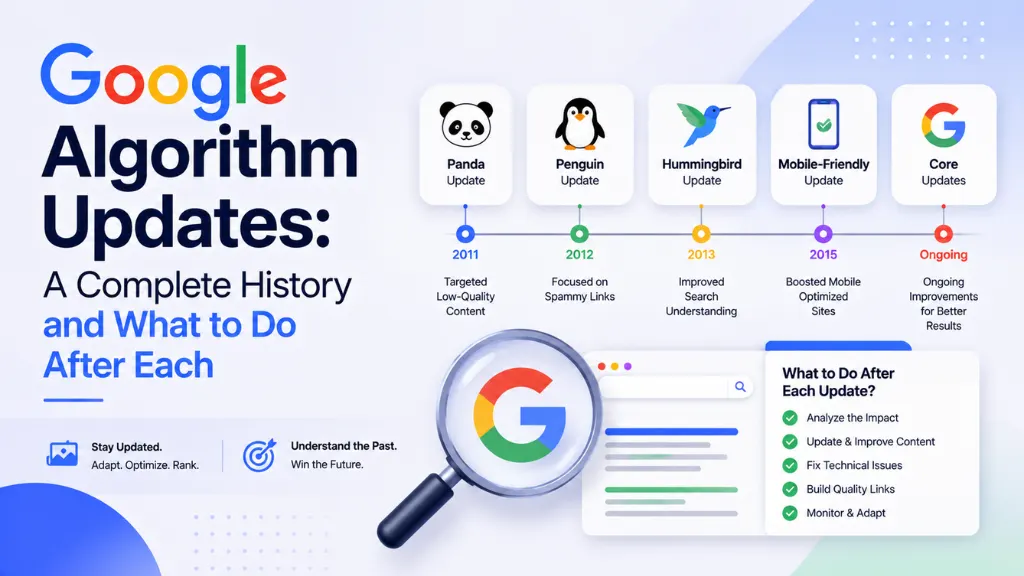

If your traffic dropped for no obvious reason last month, there is a good chance a Google algorithm update is the reason – and you would not be alone. Google shipped its 4th confirmed algorithm update of 2026 in July, following a pace of roughly one every ten to twelve weeks, according to Obsidian Pinnacle’s 2026 update recovery guide.
In this article8 sections
Google algorithm updates have moved from a twice-a-year event to something closer to a continuous background process. Core updates now roll out roughly every three months instead of the historical twice-yearly cadence, according to DigitalApplied’s 2026 update timeline. Understanding what changed, when, and why is no longer optional knowledge for anyone running a website – it is a basic requirement for protecting your traffic.
At Search Savvy, we track every confirmed Google algorithm update and diagnose client impact within days of each rollout completing. This guide walks through the complete history of major updates, what each one actually changed, and a practical framework for what to do after any future update lands.
Why Do Google Algorithm Updates Happen So Often Now?#
Google algorithm updates have accelerated because Google is continuously refining how it identifies genuinely useful, expert content versus content built primarily to rank – and that refinement never really stops.
Google confirmed five updates between February and June 2026 alone, meaning ranking volatility is the new normal rather than a rare, disruptive event, according to Lasso Up’s 2026 core update guide. Since March 2024, the Helpful Content signal has lived permanently inside Google’s core ranking system as a site-wide signal, meaning a pile of thin, low-value pages can drag down the rankings of your genuinely strong content elsewhere on the same domain.
Google algorithm updates are also compounding in effect. A site that lost rankings in 2024 and never fully recovered faces steeper losses in subsequent 2025 and 2026 updates, per DigitalApplied’s 2026 analysis. This is exactly why reacting to a single update in isolation, without understanding the broader pattern, tends to leave sites structurally vulnerable to the next one.
People Also Ask: How often does Google update its search algorithm in 2026? Short Answer: Roughly every ten to twelve weeks for major confirmed core updates, alongside smaller, unannounced adjustments that happen continuously. Google confirmed at least five major updates between February and July 2026 alone.
What Is the Complete Timeline of Recent Google Algorithm Updates?#
Google algorithm updates each target specific quality signals, and understanding the sequence helps explain why cumulative, compounding effects matter more than any single event.
Here is the confirmed 2024–2026 timeline:
- August 2024 Core Update (Aug 15–Sep 3) – surfaced useful content from small and independent sites while reducing content made primarily to perform well on Search
- November 2024 Core Update (Nov 11–Dec 5) – a typical core update, less volatile than August, per Search Engine Journal’s update history
- December 2024 Core Update (Dec 12–18) – arrived a week after November’s update completed, targeting different core ranking systems, per 6Smarketers’ complete history
- March 2025 Core Update (Mar 13–27) – comparable in volatility to December 2024
- June 2025 Core Update (Jun 30–Jul 17) – a standard core update refining ranking quality
- December 2025 Core Update (Dec 11–29) – Google’s final major update of the year, rewarding “Information Gain” – unique, first-hand content over generic material
- February 2026 Discover Update (Feb 5–27) – Google’s first-ever core update specifically for Discover, prioritising local relevance and penalising sensational clickbait
- March 2026 Core Update (Mar 27–Apr 8) – introduced holistic Core Web Vitals scoring, aggregating LCP, INP, and CLS into one composite score, per DigitalApplied’s 2026 timeline
- May 2026 Core Update (May 21–Jun 2) – rewarded unique, first-hand expertise; mass-produced lists and thin affiliate content took a heavy hit
- June 2026 Spam Update (Jun 24–26) – a global spam-focused update, distinct from a quality-focused core update
- July 2026 Core Update (completed Jul 9) – Google’s 4th confirmed update of 2026, following 11 days of significant ranking volatility, per Obsidian Pinnacle’s 2026 recovery guide
People Also Ask: What was the most recent confirmed Google algorithm update? Short Answer: The July 2026 core update, which finished rolling out on July 9 after 11 days of ranking volatility. It was Google’s fourth confirmed algorithm update of 2026, continuing the roughly quarterly cadence established over the past two years.
How Do Core Updates Differ From Spam Updates and Discover Updates?#
Google algorithm updates are not all the same type of change, and confusing one type for another leads to the wrong diagnosis and the wrong fix.
A core update broadly reassesses how useful and reliable results are across the entire ranking system, while a spam update is tied specifically to systems that identify practices conflicting with Google’s spam policies, according to Phil Carr’s 2026 recovery playbook. Discover updates are narrower still, affecting only the Discover feed rather than standard web search results.
- Core updates – broad quality reassessment across all of Search; affects rankings site-wide
- Spam updates – targeted at manipulative practices like link schemes, cloaking, or scraped content
- Discover updates – affect only the Discover feed; prioritise local relevance and originality
- Helpful Content signal – now built directly into core ranking since March 2024, rather than operating as a separate classifier
People Also Ask: How do I know if a core update or a spam update caused my traffic drop? Short Answer: Check Google’s Search Status Dashboard for the exact update type and dates. Core updates tend to cause broader, gradual ranking shifts across many pages, while spam updates typically cause sharper drops concentrated on pages using manipulative or policy-violating tactics.
What Should You Do Immediately After a Google Algorithm Update?#
Google algorithm updates trigger an understandable instinct to act immediately – rewrite the page that dropped, delete the one that tanked, publish new content to signal freshness. Almost none of that is useful in the first week or two.
Give it two to three full weeks post-rollout before treating any ranking change as real, and track the trend line rather than a single day’s snapshot, according to Obsidian Pinnacle’s 2026 guidance. Google’s own official advice reinforces this: there are no specific actions guaranteed to recover rankings, and a negative impact does not necessarily signal anything is wrong with your pages, per Dataslayer’s 2026 core update guide.
A practical immediate-response sequence:
- Confirm the update actually happened via Google’s Search Status Dashboard before assuming causation
- Wait at least one full week after the update completes before comparing Search Console data
- Compare the 14 days before versus 14 days after the rollout, not arbitrary date ranges
- Separate technical and seasonal changes from genuine ranking movement before reacting
- Avoid panic edits – reactive rewrites in the first two weeks often make things worse, not better
People Also Ask: Should I make immediate changes to my website right after a core update? Short Answer: No. Google recommends waiting at least one to two weeks after a core update completes before drawing conclusions, since rankings often continue shifting during and shortly after the rollout window. Premature changes can add noise rather than clarity.
How Do You Diagnose Which Pages an Update Actually Affected?#
Google algorithm updates rarely affect an entire site uniformly, so diagnosis needs to happen at the page and query level, not just by watching overall traffic totals.
An impressions drop of 30% or more, an average position fall of 10 or more spots, or declining clicks alongside stable impressions are all clear signals of genuine update impact, according to Eclipse Marketing’s 2026 core update guide. Fluctuations under 10% are generally normal variance and likely unrelated to the update itself.
According to Search Savvy’s insights from diagnosing client sites across recent 2026 updates, the most useful exercise is grouping affected pages by common characteristics – thin content, outdated information, weak topical depth, or missing first-hand expertise – rather than treating each dropped page as an isolated case.
People Also Ask: What counts as a real ranking drop versus normal fluctuation? Short Answer: Fluctuations under 10% in clicks or impressions are typically normal and not update-related. A 30% or greater impressions drop, or an average position fall of 10 or more spots, is a stronger signal that a specific update genuinely affected that page.
How Long Does Recovery From a Google Algorithm Update Actually Take?#
Google algorithm updates do not come with a guaranteed recovery path or timeline, but general patterns from recent updates give a realistic expectation range.
Recovery from a core update typically takes three to six months, since reacting only after a loss means roughly half a year of reduced traffic before the next major reassessment, according to DigitalApplied’s 2026 analysis. That said, sites making genuine content improvements have regained 60–70% of lost traffic within six to eight weeks in some cases, per Eclipse Marketing’s 2026 recovery data – meaning waiting passively for the next update is not the only path forward.
Full recovery generally follows this pattern:
- Weeks 1–3 – ranking volatility continues; avoid drawing conclusions or making major changes
- Weeks 4–8 – rankings begin stabilising; this is when to start implementing real improvements
- 2–3 months out – Google recrawls and reassesses genuinely improved content
- Next core update – full recovery, when it happens, most often coincides with the following major update cycle, roughly three to four months later
People Also Ask: Can a site recover from a core update before the next one rolls out? Short Answer: Partially, yes. Google does release smaller, unannounced core updates on an ongoing basis, which can produce ranking improvements between major confirmed updates. However, full recovery most often coincides with the next broad core update.
What Should You Actually Fix After a Google Algorithm Update Hits Your Site?#
Google algorithm updates consistently reward the same underlying qualities across nearly every update since 2024 – genuine expertise, first-hand experience, and depth – which means the fix is rarely a quick technical patch.
Winning back rankings requires injecting undeniable first-hand evidence into content – proprietary data, original case studies, or expert human bylines – rather than simply rewriting existing generic material, according to Ignite Visibility’s 2026 update history. Tactical fixes like disavowing links or lightly rewriting thin pages address symptoms, not the systemic quality signals Google actually rewards, per DigitalApplied’s 2026 analysis.
According to Search Savvy’s insights from managing recovery efforts across multiple 2026 updates, the sites that hold their rankings treat content as an ongoing system, not a stack of one-off posts written to chase the most recent update’s specific focus.
At Search Savvy, we recommend this practical recovery checklist:
- Audit affected pages for thin content, outdated data, or generic, undifferentiated copy
- Add genuine first-hand expertise – original research, case studies, or named expert authors
- Strengthen E-E-A-T signals sitewide, not just on individually affected pages
- Fix technical Core Web Vitals issues, since March 2026 introduced holistic CWV scoring
- Avoid reactive, cosmetic rewrites that do not address the underlying quality gap
FAQ: Google Algorithm Updates#
Q1: How many Google algorithm updates happen in a typical year? A: Google confirmed five major updates between February and June 2026 alone, and the pattern suggests roughly four to six confirmed core and spam updates per year, plus continuous smaller, unannounced adjustments.
Q2: Is a ranking drop after a core update the same as a manual penalty? A: No. A core update re-rates your content against the rest of the web based on evolving quality signals – it is not a penalty and does not appear as a manual action in Search Console. The fix is better content, not correcting a policy violation.
Q3: Should small or independent sites worry more about algorithm updates? A: Not necessarily. Several 2026 updates, including the March 2026 core update, specifically showed specialist niche sites with demonstrated expertise gaining visibility regardless of domain size. Genuine topical authority matters more than site scale.
Q4: How do I know when the next Google algorithm update is coming? A: Google does not announce updates in advance, but the pattern has held to roughly every ten to twelve weeks since 2024. Following Google’s official Search Status Dashboard is the most reliable way to get confirmation as soon as an update begins.
Q5: Can I appeal a ranking drop caused by a core update? A: No. Unlike manual actions, there is no appeal process for core update impact. Recovery is an algorithmic re-rating, most often reflected at the next major update, driven by genuine content and quality improvements rather than a formal review request.
Q6: What is the single most important thing to do after every Google algorithm update? A: Wait for reliable data before reacting, then focus on genuine content quality – first-hand expertise, depth, and accuracy – rather than tactical, symptom-level fixes. This approach has remained consistent across nearly every confirmed update since 2024.
Not sure whether a recent Google algorithm update affected your site? Visit Search Savvy to speak with an SEO expert who can diagnose the cause and build a recovery plan tailored to your website.