


Personalized content and SEO have historically pulled in opposite directions. Personalize a page based on a visitor’s location, language, or behavior, and you often end up serving search crawlers a generic, stripped-down version instead – or worse, triggering the same detection logic Google uses to catch actual cloaking. Edge computing is the technical fix that’s finally closing that gap: running your personalization logic at the CDN layer, close to the user, so the HTML that reaches both a visitor and Googlebot is complete, fast, and consistent.
This isn’t the same thing as the CDN caching your site has probably used for years, and it’s a distinction we spend a lot of time clarifying for clients at Search Savvy. Edge computing means executing real code – geolocation checks, A/B test logic, structured data injection, even full page assembly – at edge nodes distributed globally, rather than relying entirely on a single origin server. For SEO teams, that unlocks something genuinely useful: personalization that doesn’t cost you crawlability.
What Is Edge Computing for SEO, Exactly?
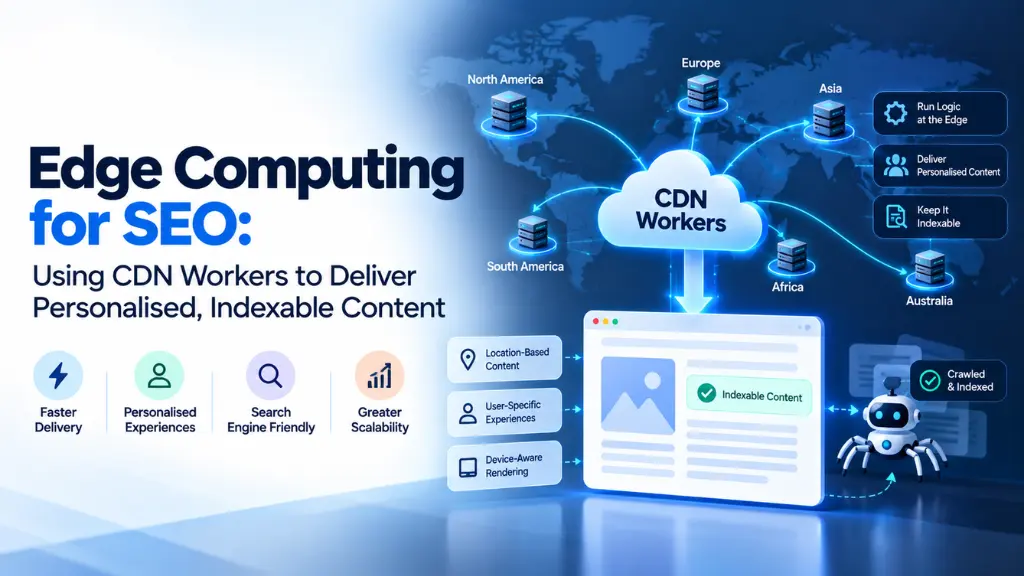
Edge computing for SEO refers to running application logic on a content delivery network’s distributed servers – the “edge” nodes positioned close to users worldwide – rather than solely on a centralized origin server, in order to deliver content that’s both personalized and fully indexable. Platforms like Cloudflare Workers, Fastly Compute, and Akamai EdgeWorkers make this possible by letting developers deploy actual JavaScript or WebAssembly code to run at each edge location, not just cached static files.
Cloudflare’s own framing of this shift, when it opened its Workers platform to developers, captures the core idea well: the company described the move as opening up the ability for anyone to run applications directly on the edge, making it possible to build the kind of app-level logic that previously required being a Cloudflare employee. That’s the meaningful distinction – a traditional CDN just serves files faster; an edge computing platform lets you run decision-making code at that same close-to-the-user layer.
What’s the Difference Between a CDN and Edge Computing?
A traditional CDN caches and serves pre-existing static content – images, CSS, cached HTML – from servers geographically close to a visitor, reducing latency for content that doesn’t change per request. Edge computing goes a step further by executing actual code at those same locations: rendering HTML dynamically, making API calls, querying data, and personalizing content in real time, all before the response ever leaves the edge node. In practical terms, a CDN speeds up delivery of what already exists; edge computing lets you decide what to deliver, on the fly, at the same low-latency layer.
The SEO Problem Edge Computing Actually Solves
The traditional way to personalize a page – client-side JavaScript reading cookies, geolocation, or browsing history after the page loads – creates a structural mismatch. Search crawlers often see a generic or incomplete version of the page before that personalization logic finishes running, particularly if the personalization depends on third-party scripts or delayed API calls. That mismatch can mean missed opportunities to rank for locally or contextually relevant content, and in more extreme implementations, it edges dangerously close to the kind of user-agent-based content switching Google’s spam policies explicitly treat as cloaking.
Edge-side rendering solves this by moving the personalization decision earlier in the pipeline – before the HTML is ever sent to either a browser or a crawler. The edge worker evaluates the relevant signal (visitor location, language preference, an active A/B test cohort) and assembles the complete, personalized HTML at that point, so whoever requests the page – a real visitor or Googlebot – receives a fully rendered, complete response reflecting the same underlying logic.
How Edge-Side Rendering Actually Works
The request path looks different from a conventional setup. Instead of every request traveling all the way to a single origin server, DNS routes the request to the nearest edge location, the edge worker executes its logic there – checking geolocation, assembling personalized elements, injecting structured data – and returns complete HTML immediately, without a round trip to the origin server for content that doesn’t require it. Because that entire process happens physically closer to the user, the latency savings can be substantial; industry estimates commonly cite savings in the range of 150 to 750 milliseconds per page load compared to routing every request through a distant origin server, depending on the visitor’s location relative to the origin.
Does Edge Rendering Actually Help Core Web Vitals?
Yes, in ways that connect directly to ranking-relevant metrics. Time to First Byte improves because the response is generated and returned from a nearby edge node rather than a potentially distant origin server. Largest Contentful Paint benefits for the same reason – the main content arrives faster because it isn’t waiting on a long-distance round trip. And when JavaScript execution that would otherwise run client-side gets handled at the edge instead, Interaction to Next Paint can improve too, since less work is left competing for the browser’s main thread after the page loads.
Practical Use Cases: What Can You Actually Build With CDN Workers?
This is where edge computing moves from theoretical to genuinely useful for SEO teams working within slow deployment cycles:
- Real-time meta tag and title updates – adjusting titles, meta descriptions, or canonical tags at the edge without waiting for a CMS release or developer sprint.
- Hreflang and geolocation-based content delivery – serving the correct language or regional variant based on the visitor’s location, resolved once at the edge rather than through client-side redirects.
- Structured data injection – adding or modifying JSON-LD schema markup at the edge layer, useful for large sites where updating every template individually isn’t practical.
- Redirect management – implementing 301 redirects instantly at the edge, bypassing origin server deployment cycles entirely, which matters enormously during migrations or URL restructuring.
- A/B testing without duplicate content risk – serving test variants as complete server-rendered HTML rather than client-side content swaps, avoiding the flicker and inconsistency that can confuse both users and crawlers.
- Bot management – identifying and filtering unwanted scraper traffic at the edge before it ever reaches origin infrastructure, preserving server resources for real users and legitimate crawlers.
This kind of edge-level flexibility is exactly why technical SEO practitioners increasingly describe it as a way to implement changes at the network layer without waiting on a full development cycle – a genuinely practical advantage for large sites where every CMS deployment competes with a long engineering backlog.
Avoiding Cloaking: The Line Between Personalization and Deception
This is the part that deserves real caution, because getting it wrong risks a manual action, not just a missed opportunity. The principle that matters most: whatever HTML your edge logic serves should be based on legitimate, consistent signals – a visitor’s actual location, their selected language, their logged-in state – applied the same way regardless of whether the requester is a real user or a search crawler. Cloaking, as Google’s spam policies define it, is specifically about showing search engines different content than what real users see, in order to manipulate rankings. Personalizing content at the edge based on genuine visitor context is not the same thing, provided the same personalization logic applies consistently and isn’t specifically designed to show crawlers a more optimized version than actual visitors ever see.
Is Personalized Content at the Edge Considered Cloaking?
Not inherently. The distinguishing factor is intent and consistency, not the mere fact that content varies by visitor. Serving a French-language version to a visitor detected in France, including to Googlebot crawling from a French IP range, is legitimate geotargeting. Deliberately serving a content-rich, keyword-optimized version specifically and only to crawler user agents, while showing real visitors something materially different, is cloaking regardless of the technology used to implement it. Edge computing doesn’t change that boundary – it just makes it possible to personalize responsibly without breaking indexability in the process.
Choosing an Edge Platform
Cloudflare Workers, Fastly Compute, and Akamai EdgeWorkers are the three most established options, each with a global network of edge locations and reasonably similar core capabilities for SEO-relevant use cases like header manipulation, redirects, and dynamic HTML assembly. The right choice generally depends more on your existing infrastructure and CDN relationship than on dramatic feature differences between platforms – if your site already runs behind one of these providers for CDN and security purposes, extending into their edge compute product is usually the path of least resistance.
Getting Started Without Breaking Anything
Start with lower-risk, high-value use cases before attempting full personalization: redirect management, header manipulation, and structured data injection are excellent first projects because they carry minimal risk of unintended content mismatches. Test thoroughly in a staging environment that mirrors production edge behavior, monitor Google Search Console closely for crawl anomalies or rendering errors after any edge-level change goes live, and always build a fallback path so an edge worker failure degrades gracefully to the origin server’s default response rather than breaking page delivery entirely.
This is exactly the kind of technical implementation work we help clients navigate at Search Savvy – the combination of infrastructure decisions and search visibility isn’t something most teams get to practice often, so getting a second set of eyes on it matters. Get it right and you gain real agility; get it wrong and you risk exactly the kind of crawler-visible inconsistency Google’s guidelines exist to catch. Our Technical SEO services page covers how we typically structure this kind of rollout, our Technical SEO blog category has more on the crawling and rendering fundamentals that edge computing builds on, and our SEO glossary is a good starting point if some of this terminology is new to your team.
FAQ: Edge Computing for SEO
What’s the difference between a CDN and edge computing? A CDN caches and delivers existing static content from servers close to users. Edge computing executes actual code at those same locations, allowing dynamic rendering, personalization, and decision-making to happen at the edge rather than solely at a central origin server.
Does edge rendering improve Core Web Vitals? Yes. Time to First Byte and Largest Contentful Paint typically improve because content is served from a nearby edge location rather than a distant origin server, and Interaction to Next Paint can benefit when JavaScript execution is offloaded to the edge as well.
Is personalizing content at the edge considered cloaking by Google? Not if the same personalization logic applies consistently to both real users and crawlers, based on legitimate signals like location or language. Cloaking specifically involves showing search engines meaningfully different content than real visitors see, in order to manipulate rankings.
Which edge computing platforms are commonly used for SEO? Cloudflare Workers, Fastly Compute, and Akamai EdgeWorkers are the most established options, each offering similar core capabilities for redirects, header manipulation, and dynamic content assembly at the network edge.
Can edge computing help implement SEO fixes faster on large sites? Yes. Because edge workers operate independently of the origin server and CMS, technical SEO changes like redirects, meta tag updates, or structured data injection can often be deployed without waiting for a full development release cycle.
Do I need to rebuild my whole site to use edge computing for SEO? No. Most teams start with targeted, lower-risk use cases like redirect management or header manipulation, rather than moving an entire site’s rendering to the edge all at once.
The Bottom Line
Edge computing gives SEO teams something that’s been genuinely hard to get right for years – and something we’re increasingly asked about at Search Savvy as more sites move personalization to the network layer: personalization that doesn’t cost you crawlability. As Google’s Marissa Mayer put it plainly back when she first shared Google’s own speed research, users really respond to speed – and edge rendering delivers that speed while keeping the door open to real, crawler-visible personalization at the same time. Start with the low-risk technical wins, keep your personalization logic consistent for bots and humans alike, and the architecture pays off well beyond a faster load time.