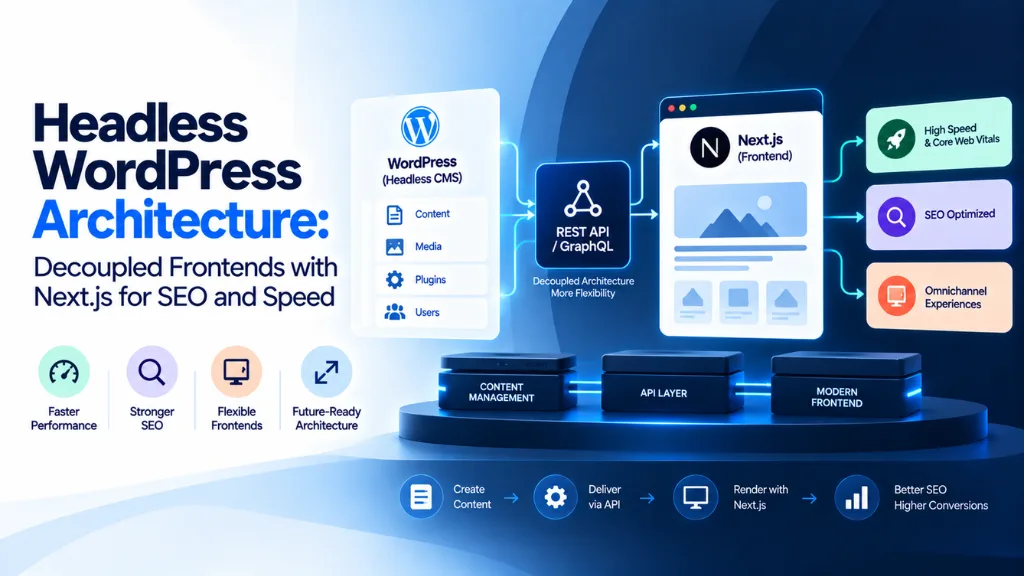

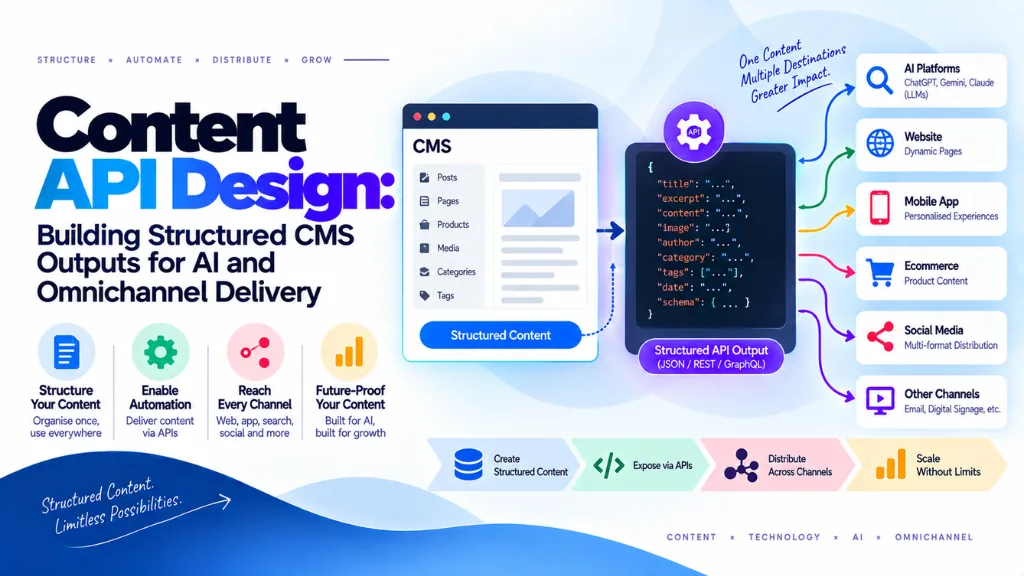

A blog post used to have exactly one destination: a page template. In 2026, the same piece of content needs to render on a website, populate a mobile app, feed a digital signage display, and – increasingly – answer a question posed directly to an AI agent that never renders a page at all. Content API design is the discipline of structuring a CMS’s outputs so a single source of content can serve all of these destinations correctly, rather than being shaped for one channel and awkwardly repurposed for the rest.
This isn’t a niche concern anymore. The global headless CMS market is projected to grow from $4.38 billion in 2025 to $20.93 billion by 2033, and a large share of that growth is driven specifically by the need to treat AI agents as a first-class content destination alongside websites and apps, not an afterthought bolted on with a scraper – a shift Search Savvy sees reflected directly in client requests for AI-citable content infrastructure over the past year. This article covers what good content API design actually requires, and the specific standards emerging in 2026 for making structured content genuinely usable by AI systems.
What Is Content API Design?
Content API design is the practice of structuring how a content management system exposes its content – as reusable, well-modeled data objects delivered through APIs – rather than as pre-rendered, page-shaped output tied to a single presentation layer. A headless CMS decouples content management from content delivery specifically to enable this: content is stored and managed in a centralized repository, then delivered via API to any frontend or agent that requests it, whether that’s a website, a mobile app, or an AI system querying for a specific fact.
The distinction between a good and a poor content API rarely comes down to the technology stack. It comes down to whether the underlying content model treats a product, an FAQ, an author, or a testimonial as a genuinely reusable structured entity – or as a chunk of a page that happens to be reachable through an API.
Why Content Modeling Comes Before API Design
The most common mistake in content API design is starting with the API surface before fixing the content model underneath it. Good content modeling means defining reusable entities – products, FAQs, authors, features, testimonials – as structured objects with clearly named fields, not as page-shaped blobs of rich text that happen to render correctly on one specific template.
This distinction matters enormously for omnichannel delivery and automation. A structured FAQ entity with a question field, an answer field, and a topic tag can be queried, filtered, and repurposed across a website, a support chatbot, and an AI agent’s response without any manual reformatting. A paragraph of rich text buried inside a page body requires a human – or increasingly fragile scraping logic – to extract the same information for a different channel. Structured content also standardizes translations, permissions, and regional compliance language far more reliably than page-based content, since each field can carry its own governance rules independent of how it’s ultimately displayed.
Designing for a New Endpoint: AI Agents
The newest addition to the omnichannel destination list is the AI agent itself, and it comes with its own emerging structured data standards rather than fitting neatly into the API patterns built for websites and apps.
| Standard | What It Does | Adoption Signal |
| llms.txt | A markdown file at a site’s root that guides AI models toward high-value resources, using structured, machine-readable summaries | Adopted by Anthropic, Cloudflare, Docker, and Stripe |
| Model Context Protocol (MCP) | A standardized framework, introduced by Anthropic in late 2024, for AI systems to discover and interact with external data sources and tools | Adopted by OpenAI, Google DeepMind, and the Linux Foundation; over 97 million monthly SDK downloads by 2026 |
| WebMCP | An emerging browser-level protocol, previewed by Google and Microsoft through the W3C in February 2026, that lets ordinary web pages expose agent-usable capabilities directly | Early Chrome Canary preview stage as of 2026 |
The practical distinction between these matters for content API design specifically: llms.txt standardizes documentation and content discovery for AI systems reading your site passively, while MCP standardizes how an agent can query or act on your content programmatically and autonomously, without a human developer writing custom integration code for each connection. WebMCP extends this same model into the browser itself, letting a live webpage expose its own capabilities to any visiting agent. A content API strategy built for 2026 needs to account for all three layers, even if full MCP implementation isn’t a current priority.
Do I Need to Implement MCP Today to Benefit From Structured Content?
No. The trajectory toward structured, authenticated, real-time interfaces for AI-to-brand data exchange is clear, but enterprise content API standards specific to MCP are still maturing. Building a well-modeled content API with clean, versioned endpoints now positions an organization to adopt MCP or similar protocols later without a costly re-architecture, even if full implementation isn’t the immediate priority.
The Three-Layer Architecture for AI-Ready Content APIs
A practical way to think about building toward this future is as three layers, each building on the one before it:
- Structured fact sheets using JSON-LD. This is the foundational layer – machine-readable, schema-marked-up facts about products, services, or organizational details, embedded directly in page markup.
- An llms.txt file. This layer provides a curated, machine-readable map pointing AI systems toward the site’s highest-value resources, without requiring an agent to crawl and interpret an entire site’s HTML.
- Versioned content API endpoints. This is where the architecture moves from passive markup into active infrastructure. An endpoint that returns structured, timestamped, and attributed responses – for instance, a specific FAQ topic filtered and returned as JSON – is a categorically different signal to an AI agent than a static file that may or may not reflect current information.
The third layer is what separates a genuinely machine-validated content source from a well-marked-up but essentially static one. A JSON-LD fact sheet or an llms.txt file tells an AI system what exists; a live, queryable content API lets that system verify the information is current and retrieve exactly the piece it needs, which matters directly for whether an AI system treats a claim as citable and trustworthy.
Practical Principles for Designing a Content API
- Model content as entities, not page fragments. Define clear, reusable schemas for products, FAQs, articles, and other recurring content types before building the API layer that exposes them.
- Version every endpoint from day one. Omnichannel and AI consumers depend on stability; a breaking change to an unversioned endpoint can silently corrupt every downstream channel consuming it.
- Timestamp and attribute every response. An AI agent evaluating whether to cite a piece of content weighs recency and clear sourcing heavily – a response with no timestamp or attribution field is a weaker signal than one that carries both.
- Paginate with machine consumers in mind, not just human ones. Returning small, well-bounded result sets – a handful of items per request rather than an entire content type dumped at once – prevents context-window overflow for AI systems querying the API directly.
- Publish a companion llms.txt alongside the API, so AI systems have a lightweight discovery layer pointing toward the structured endpoints, rather than needing to infer their existence by crawling the site.
- Treat structured data as a governance layer, not just a delivery format. Clean, relationship-mapped content also improves the quality of embeddings if that content later feeds a retrieval-augmented generation system, since structured input produces sharper representations than undifferentiated prose.
Search Savvy’s AI search optimization (AEO/GEO) services build exactly this kind of layered structured-data strategy into a client’s content infrastructure, treating JSON-LD, llms.txt, and API-level structure as complementary parts of the same system rather than separate, disconnected tasks.
Common Mistakes in Content API Design
- Building the API before fixing the content model. An API layered on top of page-shaped content just moves the same structural problem to a different interface, without solving it.
- Treating AI agents as an afterthought. Content APIs designed only for websites and apps miss the fastest-growing consumer category of structured content in 2026.
- Skipping timestamps and attribution on API responses. These fields matter more for AI-mediated trust than for human-facing display, and are easy to omit if the API was designed with only human consumers in mind.
- Returning unbounded result sets. Large, unpaginated responses can overflow an AI system’s context window, effectively making an otherwise well-structured API unusable for that consumer.
- Assuming llms.txt and a content API are interchangeable. llms.txt is a discovery and documentation layer; a content API is the live, queryable infrastructure behind it. Both matter, and neither replaces the other.
The Bottom Line
Content API design in 2026 has to account for a genuinely new class of consumer – AI agents querying structured content directly, alongside the websites and apps that have always relied on it. Getting the underlying content model right, structuring entities rather than page fragments, and layering JSON-LD, llms.txt, and versioned API endpoints together gives an organization a content architecture that serves every channel from a single, well-governed source of truth.
The practical next step is auditing your current CMS output for page-shaped content that should be reusable structured entities, before building or expanding an API layer on top of a model that isn’t ready for it. Search Savvy’s technical SEO services and website design and development services help teams build this kind of structured, API-first content foundation, so content is genuinely omnichannel-ready rather than repurposed after the fact.
Frequently Asked Questions
What is content API design? It’s the practice of structuring how a CMS exposes content – as reusable, well-modeled data entities delivered through APIs – so a single source of content can correctly serve websites, apps, and increasingly AI agents, rather than being built for one channel and repurposed for the rest.
What’s the difference between llms.txt and MCP? llms.txt is a markdown file that helps AI systems discover and understand a site’s high-value content passively. MCP (Model Context Protocol) is a standardized framework that lets AI agents query and interact with external data sources programmatically and autonomously, without a human writing custom integration code for each connection.
Do I need to implement MCP right now for my content API? Not necessarily. Enterprise content API standards specific to MCP are still maturing, but building a well-modeled, versioned content API now positions an organization to adopt MCP or similar protocols later without a costly re-architecture.
Why does content modeling matter more than the API technology itself? An API built on top of poorly modeled, page-shaped content simply moves the same structural problem to a new interface. Defining reusable entities with clear fields – for FAQs, products, or testimonials – is what actually enables reliable omnichannel and AI-agent delivery, regardless of which API technology delivers it.
Why do timestamps and attribution matter in a content API response? AI agents evaluating whether to cite a piece of content weigh recency and clear sourcing heavily. A structured API response with an explicit timestamp and attribution field is a stronger, more citable signal than a static page or an untimestamped response.
What is WebMCP, and how is it different from MCP? WebMCP is an emerging browser-level protocol, previewed by Google and Microsoft through the W3C in early 2026, that extends the MCP model directly into web pages – letting a live website expose its own capabilities to any visiting AI agent, rather than requiring a separate, dedicated protocol server.