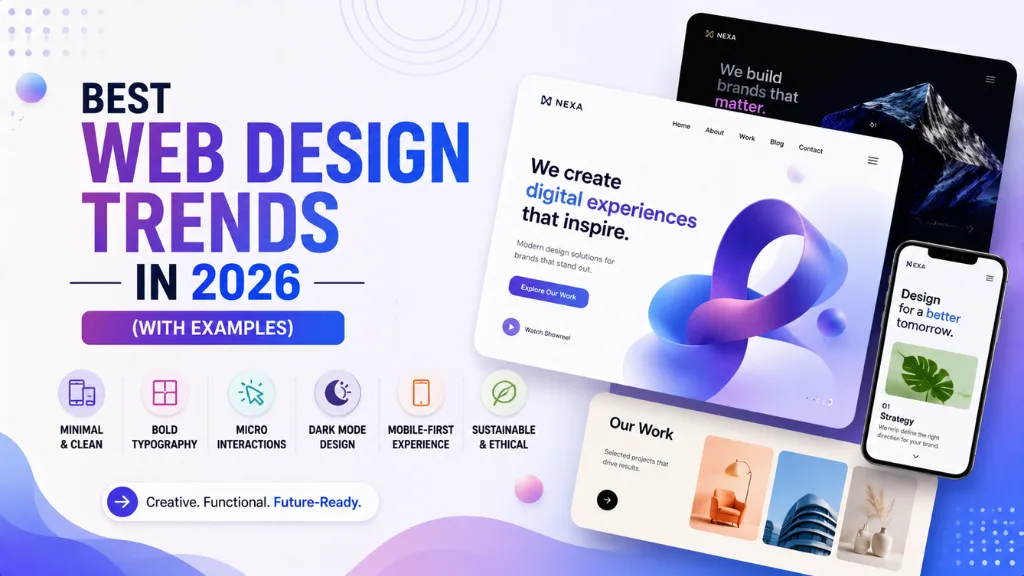
Best Web Design Trends in 2026 (With Examples)

Here is what separates websites gaining traffic and conversions in 2026 from those quietly haemorrhaging both: design decisions made with current user expectations in mind, not templates built three years ago.
In this article15 sections
Web design trends in 2026 have taken a clear and somewhat surprising direction. After years of glassmorphism, heavy gradients, and animated everything, the dominant shift is toward clarity with personality – interfaces that are faster, calmer, and more intentional, while still feeling distinctly human rather than algorithmically generic.
Web design trends in 2026 also matter more for SEO than in previous years. Google’s Core Web Vitals, AI Overview eligibility, and the technical signals that determine whether a page gets indexed and cited by AI tools are all deeply connected to how a site is built and what it does to a user’s browser when they land on it.
Web design trends in 2026 affect not just aesthetics but discoverability, trust, and conversion – which is why staying current with them is a business decision, not just a creative one.
At Search Savvy, every website we recommend or audit is evaluated against current design standards alongside technical SEO performance, because a site that looks outdated converts worse and ranks lower simultaneously. This guide covers the ten most significant web design trends shaping 2026, with real-world examples.
Why Do Web Design Trends in 2026 Matter for SEO and Conversions?#
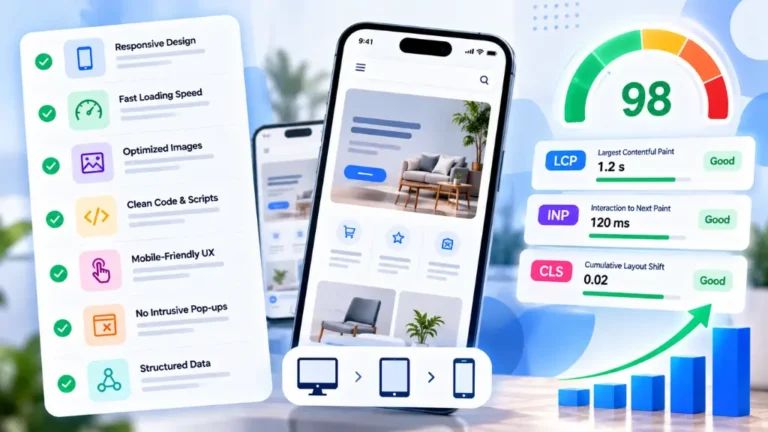
Web design trends in 2026 matter because design and search performance have become genuinely inseparable. Google’s Core Web Vitals – Largest Contentful Paint, Interaction to Next Paint, and Cumulative Layout Shift – are confirmed ranking signals, and every design decision that affects page speed, visual stability, or interactivity affects these scores directly.
Web design trends in 2026 also shape AI search eligibility. Websites using question-based headings, concise explanations, data-backed sections, and clear information architecture are more likely to be cited in Google AI Overviews, ChatGPT, Gemini, and Perplexity – making structural design decisions as much an SEO consideration as keyword placement.
People Also Ask: Do web design trends affect SEO rankings in 2026? Short Answer: Yes. Modern web design trends directly affect Core Web Vitals scores, mobile usability, crawlability, and AI Overview eligibility – all of which influence Google rankings. A site with clean code, fast load times, clear structure, and accessible navigation consistently outperforms a visually heavy, slow competitor, even with equivalent content.
What Are the Biggest Web Design Trends in 2026?#
Web design trends in 2026 can be grouped into three broad movements: the shift toward intentional simplicity, the rise of AI-native interfaces, and the return of bold visual identity. Each trend has a different driver, but they work together to define what “modern” means on the web right now.
Trend 1: Clarity Over Decoration – The Calm Interface Era#
Web design trends in 2026 are marking the end of the noisy, animation-heavy site as a credibility signal. This year’s mood has shifted toward making things simple, keeping overwhelmed brains at ease through UX and UI that focuses on gentle, easy flows and removing flashy elements that prioritise decoration over convenience.
2026 marks the end of noisy, overly animated websites. Users want fast, simple, clear, and distraction-free layouts. Good design is now clarity, not decoration.
Example: Apple’s Mac product pages consistently exemplify this – spacious layouts, generous whitespace, bold product imagery, and almost no decorative clutter. The design gets out of the way of the product.
Trend 2: Tactile Brutalism – Engineered Precision Replacing Soft UI#
Web design trends in 2026 include a decisive move away from the floating, heavily rounded, blurred soft UI aesthetic that dominated the early 2020s. The replacement is tactile brutalism – an aesthetic that is intentionally raw but executed with precision, using sharp geometry, 1px solid borders, and stark typography to project engineered precision.
Web design trends in 2026 driven by tactile brutalism reject visual elements that make things appear to float. Interfaces built this way feel physical, structured, and – crucially – fast, since they strip out the heavy JavaScript and shadow-rendering that slowed soft UI implementations.
Example: Linear’s product site uses a precise, dark-mode grid with razor-clean typography and minimal ornament – engineering aesthetic as a trust signal, not just a visual choice.
Trend 3: Dopamine Design – Saturated Colour and Bold Palettes#
Web design trends in 2026 include a counterpoint to calm minimalism: the return of saturated colour. Bright, saturated colour palettes are making a comeback fuelled by Y2K nostalgia and “dopamine design” aesthetics. Neon gradients, high-contrast pairings, and playful hues are replacing minimal or muted tones, especially for lifestyle, beauty, and youth-focused brands.
Web design trends in 2026 place these two aesthetics – calm clarity and saturated boldness – alongside each other because different brands and audiences genuinely need different approaches. The dopamine palette trend is not replacing minimalism; it is asserting that visual confidence is a legitimate brand strategy for the right audience.
Example: Lush Cosmetics and Starface both use high-saturation, high-contrast colour systems that instantly communicate brand personality before a single headline is read.
Trend 4: Typography as the Primary Architecture#
Web design trends in 2026 are elevating typography from a supporting element to the primary structural and identity layer of a page. Oversized headlines, expressive fonts, and animated type are no longer secondary elements – they are becoming the foundation of modern web design. A bold headline or unexpected font pairing instantly conveys personality, mood, and brand voice before the user reads another word.
Web design trends in 2026 using kinetic or expressive typography also benefit from a performance angle: heavy imagery can be replaced by font-driven design, reducing server requests and improving load speed without sacrificing visual impact.
Example: The New York Times’ long-form feature pages use typography as a narrative guide, with large titles and elegant typeface pairings that make complex content approachable without visual overload.
Trend 5: AI-First Interfaces – The Thoughtful Copilot Model#
Web design trends in 2026 include the maturation of AI as a UI element. One of the most important UI design trends of 2026 is a shift away from AI as an all-knowing autopilot toward AI as a thoughtful copilot – present, optional, and respectful of human context.
Web design trends in 2026 in AI-native design place the assistant in sidebars, overlays, and collapsible panels rather than disrupting the main content flow. The principle: AI augments context rather than hijacking it.
Example: Google Gemini’s new Chrome interface handles contextual queries in a side panel that overlays the existing page rather than replacing it – serving assistance without interrupting the user’s original intent.
People Also Ask: How is AI changing web design in 2026? Short Answer: According to Figma’s State of the Designer 2026 report, 72% of designers now use generative AI in their workflows, and 91% say it improves quality rather than just speed. AI is changing web design through faster layout generation, personalised user journeys, AI-assisted chatbots in sidebars, and dynamic content that adapts to individual user behaviour.
Trend 6: Dynamic Personalisation – Adaptive Experiences#
Web design trends in 2026 include behaviour-driven personalisation moving from enterprise-only functionality into mainstream web design. Dynamic personalisation adapts the experience based on behaviour, segment, or lifecycle stage – so first-time visitors of a website may see explainer content and proof points, while returning visitors see shortcuts to pages they have already explored and more direct calls to action.
Web design trends in 2026 driven by personalisation improve conversion by making the right content visible at the right moment without requiring users to search for it. This is particularly powerful for e-commerce, SaaS products, and service businesses with distinct buyer segments.
Trend 7: Accessibility as Standard Infrastructure#
Web design trends in 2026 have firmly moved accessibility from an optional feature to a baseline design requirement. Modern UX design in 2026 assumes variation in vision, motor ability, cognition, devices, and environments. Built-in accessibility – including high-contrast modes, keyboard navigation, reduced motion, and clear language – is built into systems from the start.
Web design trends in 2026 frame accessibility not as a constraint but as a performance advantage – accessible sites load faster, have cleaner code structures, and are more easily crawled by both Googlebot and AI systems, making accessibility and SEO genuinely aligned goals.
- High-contrast colour modes built in from the design stage, not added later
- Keyboard-navigable interfaces that do not depend on hover or mouse interactions
- Reduced motion options that respect user system preferences
- Screen reader-compatible content structures and alt text as standard
Trend 8: Purpose-Driven Micro-Animations#
Web design trends in 2026 are moving micro-animations from decoration to deliberate communication. In 2026, motion earns its keep not by flashing but by guiding – animations are used to communicate state, structure, and system intent rather than to add visual interest.
Web design trends in 2026 in this space specifically include giving users control over motion, since users with vestibular disorders or attention differences can find excessive animation harmful rather than delightful. Respecting the prefers-reduced-motion CSS media query has moved from an edge case to a design standard.
Example: A form submission that shows a brief, purposeful loading state and then a clear success confirmation communicates exactly what happened and builds trust – infinitely more useful than a decorative bounce animation.
Trend 9: Scroll Storytelling – Navigation as Narrative#
Web design trends in 2026 include the evolution of scroll into a narrative device rather than simply a way to stack content. Smooth transitions, smart snapping, and scroll-triggered reveals create a sense of progression through a page that flat, static layouts cannot replicate.
Web design trends in 2026 using scroll storytelling work particularly well for product launches, brand campaigns, and service explanation pages where the order in which information is revealed is part of the communication itself.
Example: Many tech product launches use scroll-triggered animation to reveal features progressively, building anticipation and context as the user moves down the page rather than presenting everything at once.
Trend 10: Sustainable and Performance-First Design#
Web design trends in 2026 increasingly include digital sustainability as a design value. Leaner code, optimised images, and low-impact hosting help reduce the carbon footprint of digital products while simultaneously improving Core Web Vitals scores.
Web design trends in 2026 that prioritise sustainability and performance are directly aligned with SEO performance – a faster, lighter site scores better on Core Web Vitals, improves mobile usability, and provides a better user experience across varying network conditions.
People Also Ask: What is sustainable web design and why does it matter in 2026? Short Answer: Sustainable web design refers to building sites with leaner code, optimised assets, and efficient hosting to reduce digital carbon footprint. In 2026, it matters both ethically and practically: sustainable design choices directly improve Core Web Vitals scores and site speed, which are confirmed Google ranking signals.
How Should Indian Businesses Apply Web Design Trends in 2026?#
Web design trends in 2026 matter significantly for Indian businesses given how mobile-dominant the market is. The calm interface trend, performance-first design, and reduced animation approach all directly benefit Indian users accessing sites on mid-range Android devices over varying network conditions.
Web design trends in 2026 for Indian e-commerce and service businesses should prioritise Interaction to Next Paint performance above visual complexity. A site that loads and responds instantly on a 4G connection in a tier-2 city will consistently outperform a visually impressive site that lags on the same connection.
According to Search Savvy’s insights from auditing Indian SMB websites, the most common gap is the inverse of what the 2026 trends recommend: too many heavy decorative elements, too little structural clarity, and accessibility that was never considered during the original build.
Conclusion: Design for Clarity, Speed, and Trust#
Web design trends in 2026 point toward the same destination from multiple directions: users want clarity, speed, and genuine usefulness over visual theatre. The brands executing this well look confident rather than templated, fast rather than flashy, and accessible rather than excluding.
Search Savvy evaluates websites against 2026 design and technical standards as part of every SEO audit, because how a site is built determines whether it ranks, gets cited by AI tools, and converts the visitors it does attract.
FAQ: Web Design Trends in 2026 – Your Questions Answered#
Q1: What is the most important web design trend for SEO in 2026? Performance-first design – specifically optimising for Core Web Vitals (LCP, INP, and CLS) – has the most direct SEO impact. Clean, lean code with optimised images, minimal render-blocking scripts, and fast server response times directly improves ranking eligibility and AI Overview discoverability.
Q2: Should every brand follow dopamine design and saturated colours in 2026? No. The dopamine design trend works for lifestyle, beauty, and youth-focused brands where bold colour communicates energy and personality. For B2B, professional services, and trust-sensitive industries like finance or healthcare, calm, clarity-driven design with purposeful typography performs better and communicates more credibility.
Q3: How is AI used in web design in 2026? AI in web design is used in two ways: by designers (for faster layout generation, copy variation testing, and prototype creation) and within interfaces themselves (as contextual assistants in sidebars or overlays). The current design standard treats AI as an optional copilot that augments rather than replaces the user’s primary experience.
Q4: Does accessibility really affect Google rankings? Yes, indirectly but meaningfully. Accessible design requires clear structure, semantic HTML, fast-loading assets, and keyboard-navigable layouts – all of which are also signals Google’s crawlers evaluate. Sites built accessibly tend to perform better on Core Web Vitals and are more easily indexed than sites that treat accessibility as an afterthought.
Q5: What is tactile brutalism in web design? Tactile brutalism is a 2026 design aesthetic that replaces the floating, rounded, blurred elements of soft UI with sharp geometry, 1px solid borders, high-contrast typography, and raw structural layouts that feel engineered rather than decorative. It is associated with tech and SaaS brands signalling precision and performance.
Q6: How often should a website be redesigned to stay current? Most websites benefit from a significant design refresh every two to three years, with smaller iterative updates annually. The more important benchmark is functional: if your Core Web Vitals are failing, your mobile experience is poor, or your conversion rate has declined without a content reason, design is likely contributing to the problem regardless of age.
Not sure whether your website’s design is helping or hurting your rankings and conversions in 2026? Visit Search Savvy for a website audit that evaluates design, performance, and technical SEO together in a single, actionable report.