What Makes a Good Website? 10 Elements Every Site Needs
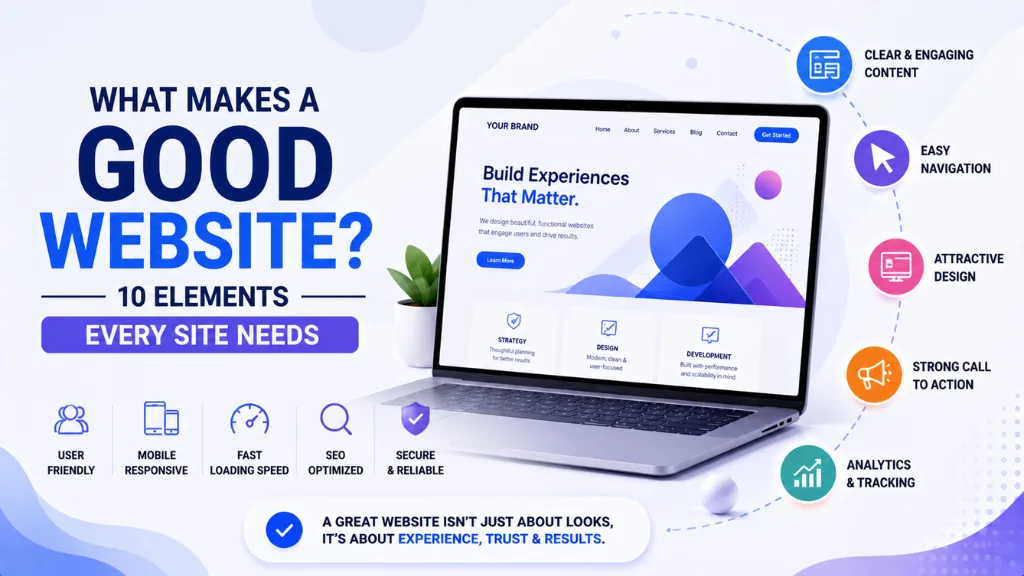

Here is a number that should concentrate the mind immediately: users form an opinion about a website in just 0.05 seconds. Not a few minutes of browsing. Not a careful read of the homepage. Half a tenth of a second.
In this article14 sections
A good website does not get a slow start and recover. It either captures trust, communicates value, and guides action from the very first moment – or it does not, and 88% of users who leave after a poor experience will not return.
A good website is not the most visually complex site in your category. It is the most useful one. Websites that prioritise user experience can achieve a 400% higher visit-to-lead conversion rate compared to poorly designed sites, and every $1 invested in UX returns up to $100 – an implied ROI of 9,900%. Those numbers explain exactly why design is a business decision and not an aesthetic preference.
A good website in 2026 also needs to satisfy an audience beyond human readers. Google’s crawlers, AI Overviews, ChatGPT, and Perplexity all evaluate the same signals your human visitors respond to – speed, structure, credibility, and clarity – making good website design and good SEO genuinely the same pursuit at their core.
At Search Savvy, website quality is the starting point for every SEO engagement we run, because a technically brilliant backlink strategy and excellent content still cannot compensate for a site that users abandon in under a second. This guide covers the ten elements that define a good website in 2026.
What Does a Good Website Need in 2026?#
A good website in 2026 needs to satisfy three overlapping audiences simultaneously: human visitors seeking fast, clear answers; search engine crawlers evaluating technical quality and structure; and AI systems determining whether the site is credible enough to cite in generated answers.
A good website meets all three criteria through the same underlying decisions – fast loading, clear navigation, genuine credibility signals, and content that directly addresses the questions visitors actually arrive with.
People Also Ask: What is the most important feature of a good website? Short Answer: 94% of online users say easy navigation is the most important website feature, and 94% of users form their initial opinion about a business based on its website design in 0.05 seconds. Together, these make clear that a good website must be both easy to move through and immediately visually credible – neither compensates for the other.
Element 1: Speed That Meets User Expectations#
A good website loads fast enough that users never have to wait and wonder. 47% of users expect a page to load within two seconds, and bounce rates rise 32% when load time increases from one to three seconds. On mobile, 53% of users abandon sites that take more than three seconds to load – a threshold most image-heavy, unoptimised sites routinely miss.
A good website’s speed performance in 2026 is measured through Google’s Core Web Vitals, specifically Largest Contentful Paint (LCP), Interaction to Next Paint (INP), and Cumulative Layout Shift (CLS). These are confirmed Google ranking signals, meaning speed is simultaneously a user experience and an SEO requirement.
- LCP target: under 2.5 seconds (time for main content to load)
- INP target: under 200ms (page responsiveness to clicks and taps)
- CLS target: under 0.1 (visual stability while loading)
Use Google PageSpeed Insights to measure your current scores and identify the specific issues slowing your site down.
Element 2: Mobile-First Design#
A good website treats mobile as the primary platform, not a secondary adaptation. Mobile users are 67% more likely to make a purchase from a mobile-friendly site, and mobile-optimised websites experience up to 40% higher conversion rates than non-optimised ones.
A good website is also expected by its users to be consistent across devices. Approximately 85% of adults expect a company’s mobile website to be as good as or better than its desktop version, making a poor mobile experience not just a usability problem but a credibility one.
66% of mobile sites place tappable elements too close together, and 32% of sites have tappable elements that are too small – meaning the majority of websites are actively failing this test right now. A good website sets minimum tap target sizes of 44×44 pixels and maintains sufficient spacing between interactive elements.
People Also Ask: What makes a website mobile-friendly in 2026? Short Answer: A mobile-friendly website uses responsive design that adapts layout to any screen size, loads in under three seconds on mobile connections, uses large enough tap targets, avoids horizontal scrolling, and ensures text is readable without zooming. Google’s mobile-first indexing means mobile-friendliness is also a direct factor in how pages are crawled and ranked.
Element 3: Clear and Intuitive Navigation#
A good website makes finding information effortless rather than requiring effort. 94% of online users say easy navigation is the most important website feature, and 38% of visitors look at navigational links when they first arrive at a website – making navigation the first thing many users evaluate before deciding whether to stay.
A good website structures navigation around what users need to find, not around internal organisational charts. The practical test: can any page on your site be reached within three clicks of the homepage? If not, pages buried deeper are losing the link equity and user attention they need to perform.
- Limit main navigation to five to seven primary categories maximum
- Use clear, descriptive labels rather than creative or internal jargon
- Include a site search function for any site with more than twenty pages
- Make the navigation identical or clearly adapted across all devices
Element 4: A Clear, Specific Value Proposition#
A good website communicates what it does, who it is for, and why it is the right choice – in the hero section, before the user scrolls. A headline like “We help growing Indian D2C brands rank on Google and get cited by AI tools” communicates more in one sentence than three paragraphs of “dedicated to excellence in digital solutions.”
A good website value proposition answers the single question every visitor arrives with: “Is this site for me?” The longer that question goes unanswered, the more likely the user is to leave and check a competitor instead.
Element 5: Strong, Visible CTAs#
A good website makes the next step obvious at every point in the user journey. 70% of small business websites fail to include a call to action, potentially losing valuable leads and sales.
A good website’s CTA placement matters as much as its copy. CTAs placed above the fold are 73% more visible than those placed below it, and centre-aligned CTAs receive 682% more clicks than left-aligned ones. Personalised CTAs outperform generic ones by 202%, making segmented or behaviour-triggered calls to action one of the highest-leverage conversion improvements available.
People Also Ask: What makes a call to action effective on a website? Short Answer: An effective CTA is specific (“Start your free audit”), placed prominently above the fold, centre-aligned, and visually distinct from surrounding content through colour and whitespace. Generic CTAs like “Learn More” or “Click Here” consistently underperform specific, benefit-driven alternatives.
Element 6: Trust Signals and Credibility#
A good website builds trust before asking for a decision. 75% of people judge a website’s credibility based on its design, and 89% of shoppers will switch to a competitor following a bad interaction – making credibility signals not just reassuring but revenue-critical.
A good website includes the trust signals users actively look for when evaluating a brand they have not bought from before:
- Genuine customer testimonials with full names, companies, or photos
- Case study metrics and real results, not vague success claims
- Industry certifications, press mentions, or recognisable client logos
- A clear privacy policy and HTTPS security certificate
- Transparent contact details including a real address or phone number
Element 7: Quality Content That Satisfies Intent#
A good website publishes content that genuinely helps the people it is trying to reach – not content designed primarily to rank for keywords or to look comprehensive without adding real insight.
A good website answers the specific questions its visitors arrive with, which requires understanding what those questions actually are. Use Google Search Console to see which queries are bringing people to your site, then evaluate whether each landing page genuinely satisfies the intent behind those queries.
If given 15 minutes, 67% of people prefer reading from a website with good design rather than a plain page – which means content quality and presentation quality are inseparable in practice.
Element 8: Clean, Consistent Visual Design#
A good website applies consistent design decisions across every page – colours, typography, spacing, and component styles – so users feel oriented rather than disoriented as they move through the site.
A good website’s colour and design consistency has measurable commercial impact. Presenting a brand consistently across all platforms can increase revenue by up to 23%, and the right colours can boost brand recognition by up to 80% – making design consistency a revenue decision alongside an aesthetic one.
A good website also avoids visual clutter. Cluttered pages cut conversions by up to 95%, since overwhelming users with too many competing visual elements prevents them from identifying and acting on the thing the page is actually asking them to do.
People Also Ask: Does website design really affect conversions? Short Answer: Significantly. A well-designed UI can boost conversion rates by 200%, and a strong UX strategy can push that to 400% over a poorly designed competitor. Cluttered pages cut conversions by up to 95%, and 88% of users will not return after a bad experience – making design among the highest-leverage conversion variables available.
Element 9: Technical SEO Foundations#
A good website is built on technical fundamentals that search engines and AI crawlers can read, index, and evaluate accurately. The most important elements:
- Clean, semantic HTML that structures content meaningfully for crawlers
- An accurate XML sitemap submitted through Google Search Console
- A robots.txt file that does not accidentally block important pages
- Schema markup that helps AI and search engines interpret content accurately
- HTTPS security – a confirmed Google ranking signal since 2014
- Canonical tags that prevent duplicate content from splitting authority
A good website treats technical SEO as infrastructure, not a one-time setup. Regular audits catch broken links, crawl errors, and indexing gaps before they compound into ranking problems.
Element 10: Accessibility Built In from the Start#
A good website is usable by everyone, regardless of vision, motor ability, device, or network speed. Approximately 94.8% of website home pages have accessibility failures – making accessibility one of the most widespread and most easily fixed gaps in web quality.
A good website in 2026 treats accessibility as infrastructure rather than a bolt-on. High-contrast colour modes, keyboard navigability, alt text on all images, clearly labelled form fields, and captions on video are the baseline, not advanced features.
Accessibility and SEO are also genuinely aligned. Clean, semantic markup required for screen readers is the same markup that helps crawlers parse content accurately, meaning every accessibility improvement is a technical SEO improvement at the same time.
Why Do These Elements Matter for Indian Businesses Specifically?#
A good website matters especially for Indian businesses competing in a market where mobile usage is exceptionally high, network conditions vary significantly across city tiers, and trust signals carry extra weight in categories like financial services, healthcare, and legal.
A good website for the Indian market prioritises Core Web Vitals performance on mid-range Android devices and 4G connections, since this represents a significant portion of real users. Pages that load quickly and navigate smoothly in these conditions convert consistently better than visually impressive pages that lag under the same constraints.
According to Search Savvy’s insights from auditing Indian SMB and D2C websites, the three most common gaps that combine to suppress both traffic and conversions are: missing or unclear CTAs, poor mobile speed, and absent trust signals on service and product pages. Fixing all three in sequence produces the fastest measurable improvement in both rankings and conversion rates.
Conclusion: A Good Website Is a Business Asset, Not a Vanity Project#
A good website in 2026 is not the prettiest site in your industry. It is the fastest, clearest, most trustworthy, and most useful one – built for the specific people trying to solve specific problems who land on it every day.
Search Savvy evaluates every one of these ten elements across every site we audit, because the difference between a website that generates leads consistently and one that looks good but underperforms almost always comes down to which of these fundamentals are missing.
FAQ: What Makes a Good Website – Your Questions Answered#
Q1: How fast should a good website load in 2026? A good website should load its main content (LCP) within 2.5 seconds, respond to user interactions (INP) within 200 milliseconds, and maintain visual stability (CLS) below 0.1. On mobile specifically, 53% of users abandon sites that take longer than three seconds – making speed one of the highest-priority conversion levers available.
Q2: How many pages should a good website have? There is no ideal page count. A good website has exactly as many pages as it needs to answer every question a prospective customer might arrive with, organised clearly enough that any page is reachable within three clicks of the homepage. Quality and organisation matter far more than volume.
Q3: Does web design really affect Google rankings? Yes. Website design decisions directly affect Core Web Vitals scores, mobile usability, accessibility, and technical crawlability – all of which are confirmed or indirect Google ranking signals. A site that provides a genuinely good experience ranks more consistently than a technically identical competitor that frustrates users.
Q4: How often should a website be updated or redesigned? Most websites benefit from a design refresh every two to three years, with ongoing content updates and technical monitoring throughout. The clearest signals that a redesign is needed are declining conversion rates, failing Core Web Vitals, increasing bounce rates, or user feedback indicating confusion or frustration.
Q5: What trust signals matter most on a business website? Genuine testimonials with real names and photos, case study results with specific metrics, recognisable client or partner logos, HTTPS security, transparent contact information, and clearly stated policies are the trust signals that most directly influence whether a first-time visitor decides to take action.
Q6: Can a small business website compete with a large brand’s site? Yes. Large brand websites often carry technical debt, slow load times, and bureaucratic design processes that keep them behind current standards. A small business that invests in fast loading, clear navigation, genuine trust signals, and specific, helpful content can consistently outperform a larger competitor that neglects these fundamentals.
Not sure which of these ten elements your website is missing – or which gaps are costing you the most in rankings and conversions? Visit Search Savvy for a website audit that evaluates all ten and prioritises exactly where to focus first.