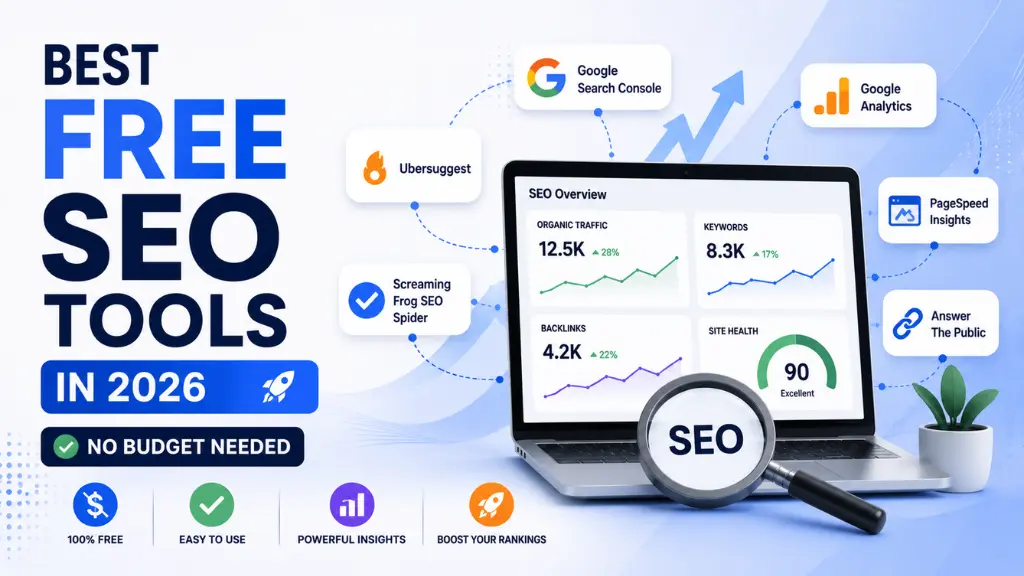
Best Free SEO Tools in 2026 (No Budget Needed)

Three years ago, a genuinely professional SEO workflow required $200 to $400 per month in software subscriptions – just to access the data needed to make sound decisions about keywords, backlinks, and technical health.
In this article16 sections
In 2026, that is no longer true. The gap between free and paid SEO tools has closed faster than most professionals expected, and the beneficiaries are anyone who knows which free tools to actually use.
Free SEO tools matter in 2026 for a simple, documented reason: 61.4% of pages ranking in Google’s top 10 were optimized using at least one free tool as their primary keyword research source, according to a Semrush industry study. These are not amateur sites scraping by – they are pages winning competitive organic positions, built on workflows that cost nothing at the tool level.
A freelancer or small business owner in 2026 has access to tools that would have cost $300 or more per month just three years ago. Three forces drove this: Google itself releasing increasingly powerful free tools, companies building free tool suites to demonstrate expertise, and established players expanding their free tiers to compete for market share.
At Search Savvy, free tools form the foundation of how we approach initial site analysis – and there is a specific, well-defined set of them that together cover the overwhelming majority of what most websites actually need. This article gives you that set, with honest assessments of what each one does, where its limits are, and how to use them together as a coherent professional workflow.
Why Are Free SEO Tools Genuinely Viable for Professional SEO in 2026?#
Free SEO tools have crossed a threshold in 2026 that makes them genuinely sufficient – not “good enough given the budget,” but actually capable of handling real professional work – for the majority of sites.
Google Search Console added Core Web Vitals segmentation in February 2026, giving free users data that cost $99/month on third-party platforms just 18 months earlier. That shift made free tools viable for professional-grade SEO work.
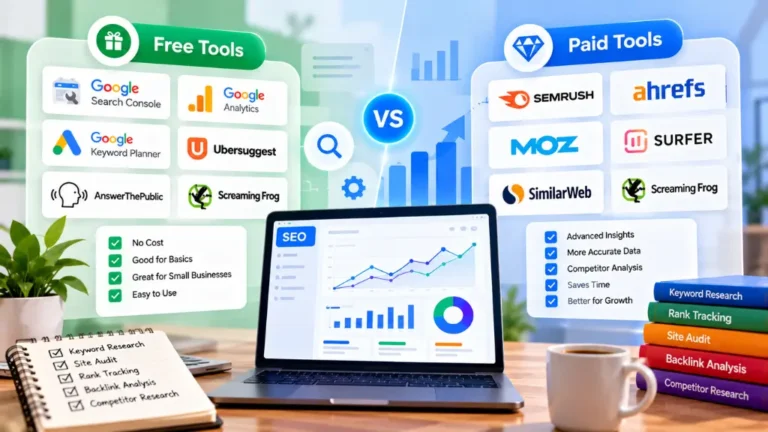
The gap between free and paid mostly shows up in scale, depth, and speed – not in the core ability to do SEO. Free SEO platforms handle a wider range of tasks than most people expect.
If your site has fewer than 50,000 monthly visitors, free tools handle roughly 80% of your SEO needs. The areas where paid tools genuinely pull ahead are specific and worth knowing: historical keyword data going back years, crawl volumes above 500 URLs (Screaming Frog free limit), deep competitor keyword and traffic analysis across thousands of queries, large-scale rank tracking with daily updates, and API access for programmatic data pulls.
Outside those specific requirements, the gap between free and paid mostly shows up in scale, depth, and speed, not in the core ability to do SEO.
People Also Ask: Can I do professional SEO with only free tools in 2026? Short Answer: Yes. Free tools cover keyword research and technical audits well enough for most small and mid-size sites. If your site has fewer than 50,000 monthly visitors, free tools handle roughly 80% of your SEO needs. The main limitations are in competitor research depth, large-scale rank tracking, and crawling sites above 500 pages – all of which require paid tools or creative workarounds.
What Are the Best Free SEO Tools Available in 2026?#
Free SEO tools cover five core areas: search performance monitoring, keyword research, technical auditing, backlink analysis, and content optimisation. Here are the tools that do real work across every one of those categories.
Tool 1: Google Search Console – The Non-Negotiable Starting Point#
Free SEO tools begin and end here. Google Search Console shows you how Google sees your website: which queries are driving impressions and clicks, which pages are indexed, which pages have errors, which backlinks Google has discovered, when your Core Web Vitals fail, and when your sitemap has errors. I have been using Google Search Console since it was called Google Webmaster Tools. The data here is primary source, verified Google data. Everything else (Ahrefs, Semrush, Moz) is an estimate.
Google Search Console is permanently free with no usage limits. Set it up for every website before any other tool – it is the only source of true, verified first-party search performance data, and everything else is a third-party approximation of what it shows directly.
The February 2026 Core Web Vitals segmentation update makes it even more valuable: you can now filter performance data by device type and page experience category without any additional cost.
Tool 2: Google Analytics 4 – The Conversion and Behaviour Layer#
Free SEO tools for understanding what visitors actually do after arriving on your site have one clear answer. Google Analytics 4 tracks real-world visitor behaviour – sessions, engagement time, conversion events, scroll depth, and traffic source breakdown – at no cost with no page-view limits.
Where Search Console shows what happens in Google (impressions, clicks, rankings), GA4 shows what happens on your website (engagement, conversion, retention). The two tools together answer the full performance picture that either one alone cannot provide.
Tool 3: Ahrefs Webmaster Tools – Backlink Intelligence at No Cost#
Free SEO tools for backlink analysis have one standout option. Ahrefs Webmaster Tools is one of the most generous free tiers in the SEO industry. After verifying site ownership, you get access to Ahrefs’ backlink index, including referring domains, top pages by links, anchor text distribution, and broken backlinks. The Site Audit feature crawls up to 5,000 pages and flags over 170 technical issues.
Ahrefs Webmaster Tools was relaunched in October 2025 with expanded crawl limits, significantly improving its free tier. The main limitation is scope: Ahrefs Webmaster Tools only works for sites you verify, so you cannot use it for competitive research. For your own site’s technical and backlink data, it is excellent.
Tool 4: Google Keyword Planner – Reliable Search Volume Data#
Free SEO tools for keyword research have Google’s own keyword database as the most authoritative starting point. Google Keyword Planner is free through a Google Ads account and provides volume estimates, seasonal trends, and related keyword suggestions drawn directly from Google’s actual search data.
Google Keyword Planner is the most reliable for search volume data, AnswerThePublic surfaces question-based and long-tail variations, and Keyword Surfer overlays volume directly on SERPs. The limitation: volume data is shown in ranges rather than exact figures unless you run active Google Ads campaigns – but the ranges are sufficient for prioritisation decisions on most standard keyword research projects.
Tool 5: Google PageSpeed Insights – Core Web Vitals Diagnostics#
Free SEO tools for page performance analysis have a clear, no-cost solution. Google PageSpeed Insights provides both real-world field data (from actual Chrome users via the CrUX dataset) and laboratory simulation data for any URL, without requiring any account or login.
Field data is what actually matters for Core Web Vitals ranking signals – it reflects your real visitors’ experience, not an idealised test environment. No paid tool provides a more authoritative source on this than PageSpeed Insights, because the data comes directly from Google’s own Chrome User Experience Report.
Tool 6: Screaming Frog SEO Spider – Technical Audit Crawling#
Free SEO tools for technical SEO have one essential crawler. Screaming Frog SEO Spider is free up to 500 URLs and detects broken links, missing title tags, redirect chains, and duplicate content alongside dozens of other technical issues.
The 500-URL free limit suits most small business sites entirely – a website with fewer than 500 pages can be fully crawled on the free version with no restrictions on what data is surfaced. For larger sites, you can export crawl data to ChatGPT for pattern analysis and prioritisation of fixes, extending the value of even a partial free crawl.
Tool 7: AnswerThePublic – Question-Based Keyword Discovery#
Free SEO tools for understanding exactly how people phrase their searches have a specific tool purpose-built for it. AnswerThePublic visualises the questions, comparisons, and prepositions people use when searching around any seed topic – making it particularly useful for finding long-tail, conversational, and voice-search-optimised keyword targets.
The free version provides three searches per day, which is sufficient for focused, session-based keyword research. The question-based keyword clusters it surfaces are especially valuable for FAQ content, featured snippet targeting, and AI Overview citation opportunities – all high-priority in 2026’s search landscape.
Tool 8: Moz Link Explorer – Domain Authority Benchmarking#
Free SEO tools for assessing link authority use a metric that has become the most widely recognised benchmark across the SEO industry. Moz invented Domain Authority (DA), and DA remains the most widely recognized link authority metric across the SEO industry.
Moz Link Explorer’s free tier provides 10 queries per month – sufficient for periodic spot checks rather than ongoing monitoring. It is particularly useful for comparing domain authority between your site and a competitor before a link-building campaign, or for reviewing a potential link partner’s backlink profile before outreach.
The MozBar Chrome extension is a separate free tool that displays Domain Authority and Page Authority directly in search results as you browse, enabling quick competitor strength assessment during SERP analysis without opening any external dashboard.
Tool 9: Microsoft Clarity – Behaviour and Heatmap Data#
Free SEO tools for understanding how visitors interact with your pages have a free, unlimited option that most teams underuse. Microsoft Clarity provides heatmaps, click maps, scroll depth tracking, and session recordings with no usage limits and no cost – data that informs both UX decisions and the engagement signals that increasingly influence SEO performance.
Microsoft Clarity provides behavioral analysis that confirms whether your content is being read, where visitors exit, and which page elements receive genuine attention versus being scrolled past without engagement. This directly informs page structure decisions that improve dwell time – a confirmed ranking signal.
Tool 10: Bing Webmaster Tools – A Genuinely Underused Free Tool#
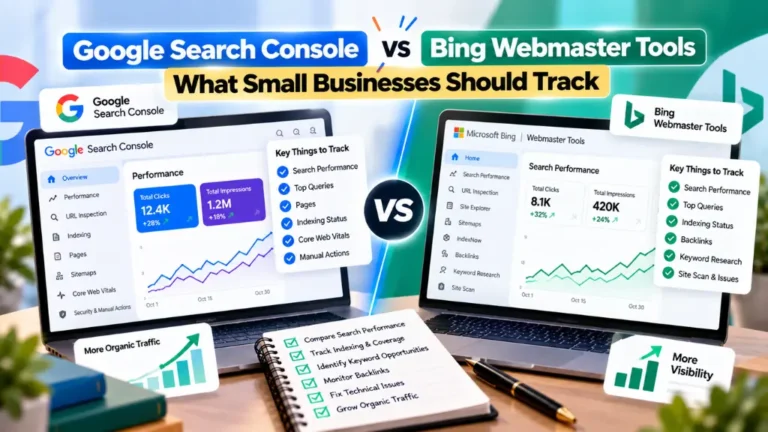
Free SEO tools that most businesses have not set up but should: Bing Webmaster Tools is completely free and provides its own search performance data, keyword research tools, site audit capabilities, and in-depth performance data, backlink analysis, and keyword research capabilities.
Beyond its direct Bing-traffic value, Bing Webmaster Tools has particular 2026 relevance: as ChatGPT and Microsoft Copilot draw increasingly from Bing’s index for their AI-generated answers, the indexation and search performance data it provides is becoming relevant to AI citation visibility, not just traditional Bing search.
People Also Ask: What are the must-have free SEO tools for a beginner in 2026? Short Answer: Google Search Console is the best starting point for any beginner. It requires no configuration beyond site verification and immediately shows which keywords drive impressions and clicks. Pair it with Google Keyword Planner to find new keyword targets. Both tools are free, maintained by Google, and updated continuously. Start with Search Console before adding any other tool to your workflow.
How Do You Build a Complete Free SEO Workflow Using These Tools?#
Free SEO tools are most powerful when used in a structured sequence rather than independently. Marketing teams should adopt a phased approach to free SEO tool implementation.
The three-phase implementation sequence that covers the full scope of professional SEO without any tool spend:
Phase 1 – Foundational Monitoring (Week 1)
Set up Google Search Console and Google Analytics 4 before anything else. These two tools establish baseline performance visibility and surface critical technical issues before you invest effort in keyword research or content production. Verify your site in Ahrefs Webmaster Tools at the same time – the setup takes under 10 minutes and unlocks the most valuable free backlink and technical audit data available.
Phase 2 – Competitive and Keyword Intelligence (Week 2)
Phase two adds competitive intelligence through Semrush’s free tier, Google Keyword Planner and AnswerThePublic. These tools enable strategic content planning based on actual search demand and competitive positioning.
Use Google Keyword Planner to validate search volume for target terms. Use AnswerThePublic to surface the long-tail, question-based variations that often have lower competition and clearer intent. Use Screaming Frog to crawl your own site and identify any technical issues before you build your content plan on a structurally broken foundation.
Phase 3 – Ongoing Optimisation (Monthly Cadence)
Phase three incorporates specialized optimization tools including Screaming Frog for technical audits, Microsoft Clarity for behavioral analysis. Establish regular monitoring cadences – schedule monthly technical audits through Screaming Frog and Ahrefs Webmaster Tools.
Monthly Screaming Frog crawls catch new technical issues before they compound. Monthly Ahrefs Webmaster Tools backlink reviews identify lost links and new linking opportunities. Ongoing Search Console monitoring tracks Core Web Vitals trends, indexation changes, and query performance shifts – providing the early-warning data that prevents small issues from becoming ranking crises.
People Also Ask: How many free SEO tools do I actually need for a complete workflow? Short Answer: Five tools provide a genuinely complete professional SEO workflow at zero cost: Google Search Console (search performance and indexation), Google Analytics 4 (on-site behaviour and conversion), Ahrefs Webmaster Tools (backlinks and technical audit), Google Keyword Planner (search demand and keyword research), and Screaming Frog (technical crawl, free up to 500 URLs). Adding AnswerThePublic, MozBar, and Microsoft Clarity extends coverage into question-based keyword discovery, quick authority benchmarking, and user behaviour analysis without any additional cost.
What Are the Honest Limitations of Free SEO Tools?#
Free SEO tools are genuinely powerful – and genuinely limited in specific, well-defined areas that are worth understanding before you assume free tools are always sufficient.
Paid tools earn their price in a few specific areas. Historical keyword data going back years is almost never available in free tiers. Crawl volumes above 500 URLs require a paid Screaming Frog license. Deep competitor keyword and traffic analysis – the kind that shows exactly which pages a competing site ranks for across thousands of queries – requires Ahrefs or Semrush paid plans. Large-scale rank tracking across hundreds of keywords with daily updates is also typically locked behind a paywall.
There is also a category of “freemium tools with useless free tiers” worth actively avoiding. These are tools where the free version shows you data exists but blurs the numbers, or limits you to 1 result per day. These create the impression of functionality without providing actual value – their real function is demonstrating how much you are missing rather than genuinely helping you work.
Free tiers work well for individual sites. Managing multiple clients or large sites with more than 1,000 pages exceeds free tool capacities. Agencies and teams managing multiple large sites at scale typically need paid tooling – the workflow time cost of working around free tier limitations at that scale outweighs the subscription cost of removing them.
According to Search Savvy’s insights from using both free and paid SEO tools across client work, the clearest signal that it is time to upgrade from free tools is when competitor research becomes a regular strategic need rather than an occasional reference. Free tools give you excellent visibility into your own site’s performance – but the comprehensive competitor gap analysis that identifies which specific content opportunities to prioritise requires paid tool access to your competitors’ keyword rankings. Until that need is routine, free tools are genuinely sufficient.
People Also Ask: What can free SEO tools NOT do that paid tools can? Short Answer: Free SEO platforms cannot handle crawl volumes above 500 URLs (without a paid Screaming Frog license), provide historical keyword data going back years, deliver deep competitor keyword analysis across thousands of queries, or support large-scale rank tracking with daily updates. Competitive research is the clearest gap – free tools like Ahrefs Webmaster Tools only analyse your own verified sites, making it impossible to research competitor keyword rankings or traffic estimates without a paid subscription or creative workarounds.
How Do Free SEO Tools Help With AI Search Visibility in 2026?#
Free SEO tools support AI search visibility in 2026 through the same foundation they build for traditional SEO – and several now include specific AI-oriented features at no cost.
Indirectly, tools like Search Console, Ahrefs and Screaming Frog strengthen the technical and authority signals AI systems lean on when deciding what to cite. Directly, some platforms focus on how brands appear in AI-generated responses, helping you identify where you are not being mentioned, what topics competitors “own,” and where your content lacks the depth or structure that answer engines prefer.
Yes. Bing Webmaster Tools offers AI-powered content suggestions, Rank Math’s free version includes AI-assisted scoring for WordPress, and ChatGPT’s free tier helps with outlines and FAQs.
The AI search readiness improvements that free tools directly support: structured data implementation (Rich Results Test is free), technical indexation health (Search Console is free), content structure analysis for AI extractability (Screaming Frog surfaces the heading hierarchy and meta data issues that make content harder for AI systems to parse), and page speed that meets AI eligibility thresholds (PageSpeed Insights is free).
People Also Ask: Can free SEO tools help me appear in Google’s AI Overviews? Short Answer: Yes, indirectly. Tools like Search Console, Ahrefs Webmaster Tools, and Screaming Frog strengthen the technical and authority signals AI systems lean on when deciding what to cite. Google’s Rich Results Test validates schema markup that supports AI citation eligibility at no cost. PageSpeed Insights confirms Core Web Vitals scores that affect both traditional rankings and AI feature eligibility. The technical foundation that free tools help build is the same foundation that AI systems evaluate when selecting which content to cite.
FAQ: Free SEO Tools – Your Questions Answered#
Q1: Is Google Search Console really as powerful as paid SEO tools? For your own site’s performance data, it is actually more authoritative than any paid tool – because it shows real, first-party Google data rather than a third-party estimate of that data. The data here is primary source, verified Google data. Everything else (Ahrefs, Semrush, Moz) is an estimate. Where paid tools outperform Search Console is in competitor research, historical data depth, and bulk analysis – not in the accuracy of data about your own site.
Q2: Does Ahrefs Webmaster Tools require a credit card? No. Ahrefs Webmaster Tools (AWT) is permanently free and requires no payment. AWT is a permanently free tier that gives you site audit and backlink analysis for any domain you verify in Google Search Console. No payment required, no trial clock ticking. The $7 paid trial unlocks the full platform – Keywords Explorer, Site Explorer, Content Explorer – for 7 days, which can be valuable for a focused competitor research session, but the free tier itself is fully functional for your own site’s analysis.
Q3: What is the best free keyword research tool beyond Google Keyword Planner? AnswerThePublic for question-based, long-tail, and conversational keyword discovery (three free searches per day). Google Search Console’s Performance report for existing query data – it shows exactly which queries your current pages are already receiving impressions for, often revealing new keyword opportunities hiding in your existing content. Google autocomplete and the “People Also Ask” boxes on SERPs are genuinely useful zero-cost research tools for identifying natural-language variations around any seed keyword.
Q4: Are there any free SEO tools that include AI features in 2026? The top free AI SEO software tools in 2026 are Google Search Console, ChatGPT, Claude, AIOSEO Analyzer, and seo.ai – all free with no credit card required for core features. ChatGPT’s free tier assists with keyword brainstorming, content outlines, FAQ generation, and schema markup creation. Claude’s free tier is useful for content structure analysis. Rank Math’s free WordPress plugin includes AI-assisted content scoring. Bing Webmaster Tools includes AI-powered content suggestions at no cost.
Q5: How often should I run free SEO audits on my website? Establish regular monitoring cadences – schedule monthly technical audits through Screaming Frog and Ahrefs Webmaster Tools. For active, frequently updated sites, monthly crawls catch new issues before they compound. For smaller, more static sites, quarterly crawls are typically sufficient. Google Search Console should be checked weekly at minimum – it surfaces critical issues like manual actions, indexation drops, and Core Web Vitals failures in real time, and catching these early prevents significant ranking damage from compounding undetected.
Q6: What is the one thing free SEO tools cannot replace that paid tools genuinely provide? Competitor keyword research at depth. Free tools give excellent visibility into your own site’s performance across all dimensions – keywords, backlinks, technical health, and user behaviour. Ahrefs Webmaster Tools wins for website owners who want to audit their own sites and understand their backlink profiles. The limitation is that you cannot use it for competitive research. Understanding exactly which pages a specific competitor ranks for, which keywords are driving their organic traffic, and which content gaps in their strategy represent your best opportunities requires paid tool access that no free tier currently provides.
Running your SEO on a tight budget and not sure if you are getting everything possible out of the free tools available? Visit Search Savvy for an honest audit of your current setup – and a clear recommendation on exactly which free tools your workflow should be using, and when paid tooling would actually justify its cost.