Will AI Replace SEO? The Honest Answer in 2026

If you have read any SEO newsletter in the last twelve months, you have encountered some version of the same apocalyptic headline: “AI is killing SEO.” “Organic traffic is collapsing.” “Google is over.” The claims are dramatic. The data behind many of them, when you actually read the primary sources, is considerably more nuanced.
In this article9 sections
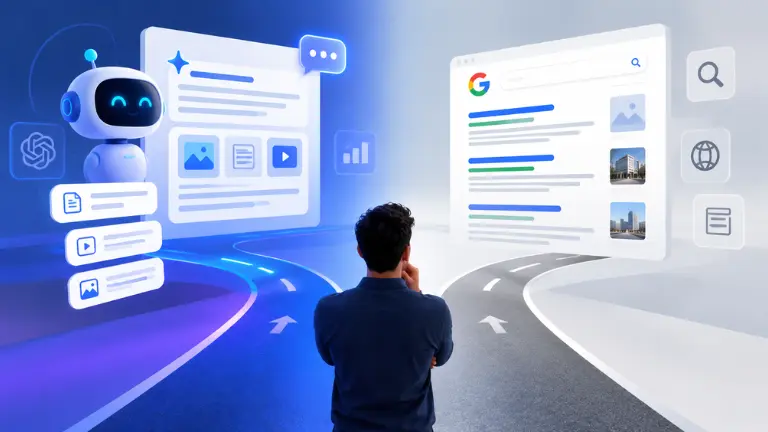
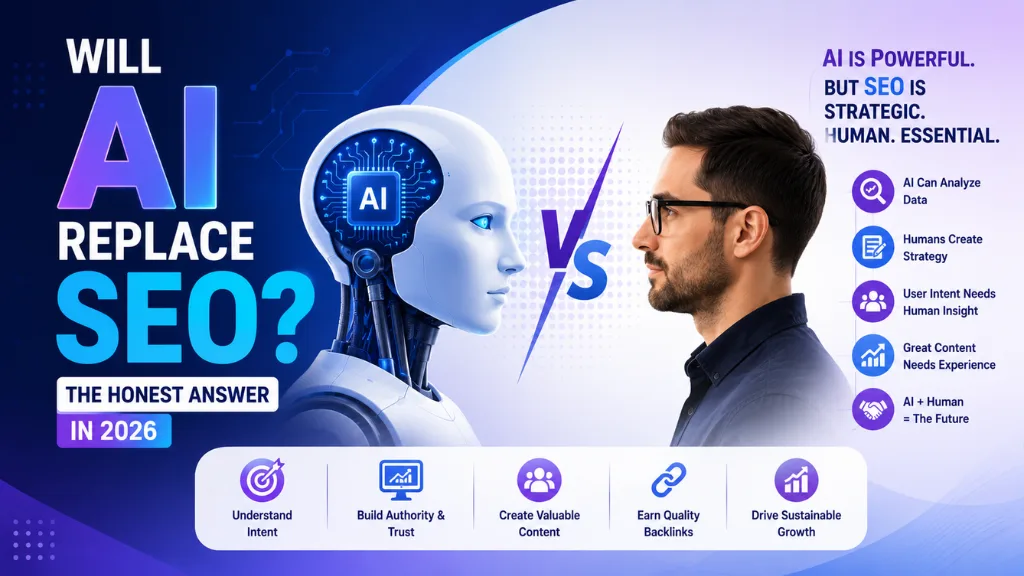
Can AI replace SEO? The honest answer is: no – but AI is forcing SEO to become something genuinely bigger than it was, and the gap between those two things is where most of the confusion lives.
Here is the reality. Graphite and Similarweb analysed the top 40,000 US websites and found organic search traffic from Google is down just 2.5% year-over-year – not 25%, not 50%. At the same time, total search usage – traditional plus AI combined – is up 26% globally since ChatGPT launched. The pie is not shrinking. It is changing shape. And the SEO discipline that earns visibility within that new shape looks meaningfully different from the one that worked in 2023.
At Search Savvy, we have watched this shift play out in real time across dozens of client accounts – and the businesses that are thriving in 2026 are not the ones who panicked about AI replacing SEO, nor the ones who ignored the shift entirely. They are the ones who understood precisely what changed and adapted their strategy accordingly. This article gives you the honest version of that understanding.
What Does the Actual Data Say – Is AI Replacing SEO in 2026?#
Will AI replace SEO based on the numbers that matter most? The short answer is that the data tells a far more complicated story than most headlines suggest – and reading the primary sources carefully reveals important nuances that disappear entirely in second-hand summarising.
When an AI Overview appears, organic position 1 click-through rate drops from an average of 1.76% to 0.61% – a 61% decline. That number is real, and it is frequently cited as evidence that AI is destroying organic search. But Seer Interactive’s own analysis – the actual source of that figure – tracked 3,119 queries across 42 organisations over 15 months, specifically focused on informational and educational queries. Seer’s sample specifically tracked informational and educational queries – the query type most vulnerable to AI Overviews. Commercial and transactional queries, where the actual money is made, are far less affected.
SEO isn’t dying: organic search traffic is down slightly by 2.5% between February 2024 and November 2025, not 25% or 50% like some people predict. This is the number that should anchor every conversation about AI replacing SEO – actual, measured traffic decline, not projected worst-case scenarios.
The narrative that AI is cannibalising search assumes a fixed pie. The pie isn’t fixed. It’s growing. Traditional search volume has stayed roughly flat while AI search has added an entirely new layer of query behaviour on top.
The crucial flip side of the CTR decline data: brands cited in AI Overviews saw a 35% higher organic CTR and 91% higher paid CTR than non-cited brands on the same queries. The clicks aren’t disappearing. They’re consolidating around the brands that AI engines trust enough to reference.
People Also Ask: Is SEO dying because of AI in 2026? Short Answer: No. Actual organic traffic data shows only a 2.5% year-over-year decline – not the 25–50% collapse many headlines imply. Total search volume (traditional plus AI combined) is up 26% globally. The real shift is not that SEO is dying, but that visibility now requires being present across AI surfaces, not just traditional blue-link rankings. Brands cited in AI Overviews see 35% higher organic CTR than non-cited competitors on the same queries – AI is concentrating clicks, not eliminating them.
How Has AI Actually Changed the SEO Landscape in 2026?#
Will AI replace SEO, or is it more accurate to say AI has expanded what SEO needs to address? The evidence clearly supports the second framing – but the expansion is genuinely significant and requires specific adaptations.
Google AI Overviews appear as large AI-generated answer blocks at the very top of search results – above all ranked pages – for an estimated 48% of all queries as of early 2026, with coverage exceeding 70% for informational and how-to searches.
This is the structural change that demands a response from every SEO strategy. 60% of searches in traditional search engines end without a click due to AI summaries. For businesses whose revenue depends on informational traffic – definitions, explanations, how-to answers – this is a genuine threat that requires strategic adjustment.
Three specific things have changed most consequentially:
The Traffic That Arrives Converts Differently#
Users who do click through from AI citations convert at up to 23 times the rate of standard search visitors. The traffic is smaller. The intent is dramatically higher. This single data point reframes the entire “AI is killing SEO” narrative. Volume is declining in certain query categories. Value per visit is increasing. The commercial mathematics of this shift are not necessarily negative – they are different.
AI search visitors are 16% more likely to convert compared to non-AI traffic sources. This consistency across multiple independent studies reinforces the same conclusion: the clicks that survive the AI filter are higher quality, not lower quality.
Rankings and AI Citations Are No Longer the Same Thing#
Only 38% of cited pages overlap with top-10 rankings – meaning you can rank number one and still be invisible in AI-generated answers, which now appear above your ranking anyway.
76.1% of URLs cited in AI Overviews also rank in the top 10 of Google search results. These two statistics exist in healthy tension with each other: ranking well significantly helps your chances of being cited, but it does not guarantee citation – and citation eligibility requires meeting additional criteria that ranking alone does not satisfy.
AI Systems Draw From a Broader Source Set Than Your Website#
LLMs pull heavily from Reddit, YouTube, and Wikipedia. Brands that focus exclusively on their own website and backlink profile are missing a growing share of the signals that AI systems use to assess brand authority.
YouTube and Reddit combined account for 78.2% of AI social media citations. YouTube was cited in 31.8% of cases, second only to Reddit at 46.4%.
People Also Ask: How are AI Overviews affecting organic search traffic in 2026? Short Answer: The impact is highly dependent on query type. Informational queries (definitions, how-to, explanations) are the hardest hit, with AI Overviews appearing on more than 70% of those results pages and CTR dropping significantly when they appear. Commercial and transactional queries are considerably less affected. The key nuance: brands cited within AI Overviews see 35% higher organic CTR than non-cited brands on the same queries – making AI citation a source of traffic advantage, not just traffic loss.
Why Does SEO Still Matter – And What Specifically Cannot AI Replace?#
Will AI replace SEO’s core function of connecting a relevant audience with relevant content? This is the question that cuts through the noise – and the answer is unambiguously no, for structural reasons that are worth understanding precisely.
By 2026, SEO will no longer be defined by position on a results page. It will be defined by presence within AI-generated answers and citations. This is not SEO dying – it is SEO expanding its scope to encompass AI visibility as a first-class outcome alongside traditional rankings.
The skills and disciplines that remain essential regardless of how the search interface changes:
Technical accessibility. If search engines and AI crawlers cannot access, render, and index your pages, none of the content or citation strategy matters. Crawlability, page speed, mobile responsiveness, Core Web Vitals, and structured data all remain prerequisites for visibility in both traditional and AI search surfaces. AI agents such as GPTBot and PerplexityBot do not simply crawl and index – they extract and compare claims, and increasingly shape decision-making before a human visitor interacts directly with your site.
Content quality and expertise. Excellent SEO in 2026 no longer optimises just for individual search queries but orchestrates the entire user experience along a three-dimensionally mapped customer journey – cross-channel, platform-aware, and thought far beyond Google. AI systems select sources that demonstrate genuine expertise, specific evidence, and original perspective – the same attributes that have always distinguished well-ranking content from thin content.
E-E-A-T and brand trust. Websites with strong brand signals and presence on various platforms are more resistant to Google updates. Brands earning the most web mentions earn up to 10X more mentions in AI Overviews. Brand authority – built through genuine expertise, community presence, and reputation – is both a traditional SEO signal and an AI citation signal simultaneously.
Strategic intent analysis. AI tools can assist with content production, but determining which topics deserve investment, which audience segments to prioritise, and which commercial opportunities are worth pursuing requires human business judgment that no current AI system can exercise on your behalf.
People Also Ask: Can AI tools do SEO automatically without a human strategy? Short Answer: AI tools can accelerate specific SEO tasks – keyword research, content drafting, technical audits, and competitive analysis. But the strategic decisions that determine which opportunities are worth pursuing, which content investments align with commercial objectives, and how to build genuine brand authority across channels require human judgment. Treating AI as a strategy-generator rather than a strategy-accelerator consistently produces lower-quality SEO decisions and weaker long-term outcomes.
What Has Actually Changed About SEO in 2026 – And What Is Exactly the Same?#
Will AI replace SEO tactics that worked before? Some tactics have become significantly less effective. Others are more important than ever. The distinction matters for anyone deciding where to invest their SEO effort and budget in 2026.
What has become less effective or needs rethinking:
- Pure informational content at volume. Informational queries saw 30–40% organic traffic declines as zero-click AI responses mean users never scroll to organic results, devastating sites that depend on informational search traffic. A strategy built primarily on high-volume informational content without commercial differentiation is significantly more exposed to AI Overviews than one anchored to genuine expertise, first-hand experience, and commercially relevant content.
- Treating your own website as your only SEO channel. Your content strategy must integrate more strongly with platforms like Reddit, LinkedIn, or industry-specific forums – where LLMs get their knowledge. Community presence, authentic user-generated content, and participation in professional discussions are now organic search strategy inputs, not social media afterthoughts.
- Traditional click-focused reporting as the complete picture. Traditional SEO metrics – rankings, impressions, CTR – are insufficient for 2026. With 60% of searches ending without a click, high impressions and low CTR can actually indicate that AI Overviews are intercepting your traffic, not that your content is underperforming.
What is more important than ever:
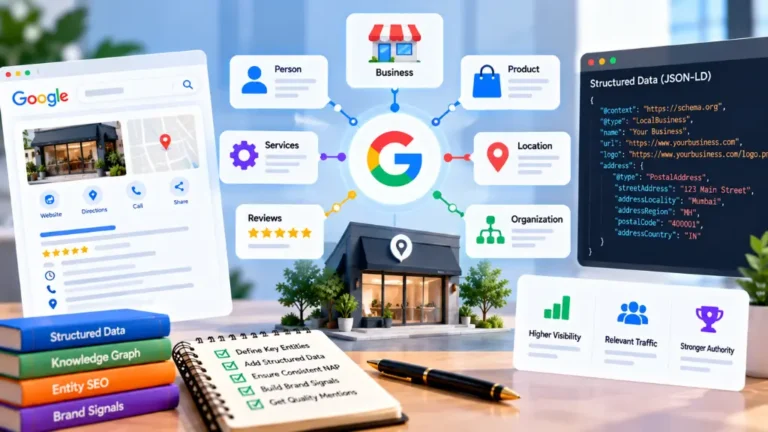
- Technical SEO fundamentals. The foundation remains the same. Crawlability, indexation, Core Web Vitals, and schema markup matter as much or more in 2026 because they also determine AI citation eligibility, not just traditional rankings.
- E-E-A-T and genuine authority building. The most important SEO trend in 2026 is that brand building becomes more important: websites with strong brand signals and presence on various platforms are more resistant to Google updates.
- Commercial and transactional content. In 2026, SEO success depends not just on rankings, but on aligning content with commercial intent, where clicks still happen. AI Overviews are less prevalent and less disruptive in transactional search – the queries closest to purchase intent – making this category more valuable, not less.
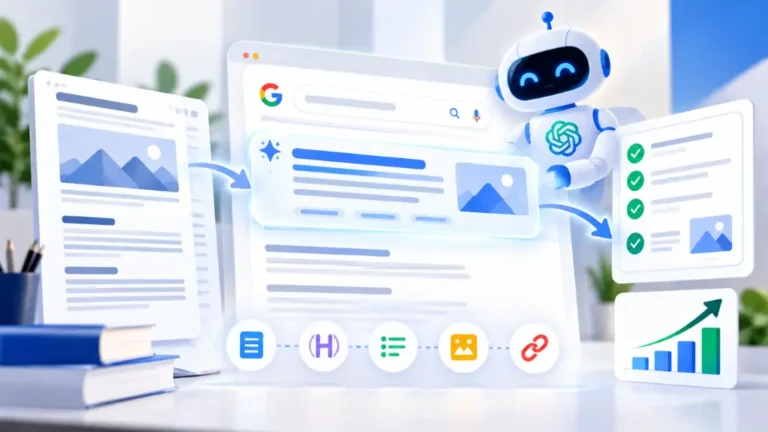
- Structured, extractable content. Generative AI systems retrieve content in modular chunks, not entire pages. If a section depends on surrounding paragraphs for context, it risks misinterpretation. Schema mark-up and FAQ formatting enable AI systems to identify contextual units with greater accuracy.
People Also Ask: Is traditional SEO still worth investing in for 2026? Short Answer: Yes, particularly for commercial and transactional queries, where AI Overviews have less impact and organic clicks remain consistent. Traditional SEO fundamentals – technical accessibility, content quality, E-E-A-T signals, and structured data – also directly support AI citation eligibility, meaning strong traditional SEO and strong AI visibility are built on the same underlying infrastructure. Businesses that maintain strong SEO alongside GEO practices are significantly better positioned than those who abandon one for the other.
What Does the Evolved SEO Strategy Look Like in 2026?#
Will AI replace SEO’s strategic scope? The evidence suggests it has expanded it. 76% of practitioners describe the future of SEO in 2026 as one where visibility depends less on ranking position and more on presence across AI search, SERP features, and intent-driven surfaces.
The evolved strategy has six components, built on a clear budget framework that reflects where value actually resides:
One research-backed allocation dedicates 40% to core SEO (technical, on-page, link building), 25% to digital PR (brand authority and AI citation signals), 20% to data and reporting (AI visibility tracking, revenue attribution), 10% to training, and 5% to experimentation (emerging platforms, new schema types).
Maintain the technical foundation. Core Web Vitals, crawlability, structured data, and mobile performance remain prerequisites for both traditional and AI search visibility. These elements are not optional add-ons for the AI era – they are table stakes for being eligible in either system.
Build genuine E-E-A-T and brand presence. Named expert authors, original research, first-hand case studies, and authentic community participation are now simultaneously traditional SEO signals and AI citation criteria. Investing in genuine brand authority serves both channels from the same underlying effort.
Track AI-specific metrics alongside traditional ones. Add AI-specific metrics to your reporting: AI citation frequency, AI referral traffic and its conversion rate, brand mention sentiment in AI responses, and share of voice in AI-generated answers for your key topic clusters.
Expand to off-site platforms where AI trains. Reddit, YouTube, LinkedIn, and industry forums are where AI systems increasingly source their training and retrieval data. Genuine participation in these communities – not promotional content disguised as community contribution – builds the off-site presence that AI systems recognise as authority signals.
Prioritise commercial content. The informational content most affected by AI Overviews typically sits at the top of the funnel. Commercial-stage content – comparison articles, service pages, case studies, pricing guides – remains closer to where purchase decisions are made and is considerably less disrupted by zero-click AI behaviour.
Structure content for AI extraction. Short paragraphs, clear headers, answer-first section structure, FAQ formatting, and schema markup all improve how readily AI systems can extract and cite your content – while also improving readability for human visitors.
According to Search Savvy’s insights from managing SEO strategies through this transition, the businesses most exposed to AI’s disruption are the ones who built their traffic entirely on high-volume informational content and never developed the brand authority, commercial content depth, or technical SEO foundation that would make them the kind of source AI systems trust enough to cite. The businesses least exposed already had all three – and the shift to AI has, paradoxically, improved their relative competitive position by disadvantaging competitors who were generating clicks through volume rather than genuine authority.
People Also Ask: What is the most important thing to do for SEO in 2026 given AI changes? Short Answer: Build genuine brand authority and presence across multiple platforms, not just your own website. Brands earning the most web mentions earn up to 10 times more mentions in AI Overviews – making brand-building the single most direct investment in both traditional SEO resilience and AI citation eligibility simultaneously. Combine this with strong technical foundations, commercial-intent content focus, and AI-specific metrics tracking to ensure you are measuring and optimising for the full scope of your current search visibility.
FAQ: Will AI Replace SEO? – Your Questions Answered#
Q1: Is it worth still investing in SEO in 2026 given the rise of AI search? Yes – with an evolved scope that encompasses AI visibility alongside traditional rankings. Around 80% of search users now rely on AI-written summaries for at least 40% of their searches, while 39% of Americans verify AI-generated information using Google – confirming that traditional search and AI search are complementary rather than competing behaviours. Abandoning SEO investment because of AI growth is the equivalent of abandoning a distribution channel that is still generating most of your traffic because a new channel is growing rapidly alongside it.
Q2: Which types of businesses should be most concerned about AI replacing their SEO traffic? B2B technology faces the most severe exposure because its query landscape is dominated by informational searches. E-commerce remains largely protected because Google has strong financial incentives to preserve product search as a click-driven, ad-supported experience. News, health information, cooking, and entertainment content are among the categories seeing the steepest informational traffic declines. Service businesses with a strong commercial-intent content focus, and e-commerce brands, are considerably less exposed to AI Overview disruption than pure-content publishers.
Q3: How do I measure if AI search is affecting my organic traffic? Monitor your Google Search Console for changes in impressions versus CTR – a growing gap often signals AI Overview interception. Set up Google Analytics segments for AI referral traffic to measure conversion rates from AI-driven clicks. Track AI citation frequency manually by querying ChatGPT, Perplexity, Gemini, and Google AI Mode with your target keywords and noting whether and how your brand is cited. These AI-specific metrics, alongside traditional ranking and CTR data, give you the complete picture that traditional reporting alone increasingly misses.
Q4: Should I create different content specifically for AI engines versus human readers? Most current GEO advice falls into two categories. The first is standard SEO best practices repackaged as novel GEO tactics – harmless but unoriginal. The second is recommendations that don’t actually impact AI visibility but can meaningfully damage your existing SEO if you follow them. The most reliable approach is building content that is genuinely excellent for human readers – specific, well-structured, expert-attributed, and factually precise – and then ensuring it is technically accessible and schema-marked for AI extraction. A separate, parallel “AI content” strategy is generally unnecessary and sometimes counterproductive.
Q5: Will AI replace the role of SEO professionals? AI will automate specific, repetitive SEO tasks – keyword clustering, technical audit data collection, rank tracking, and routine content drafting. The future doesn’t belong to those who cling to old SEO tactics and cry about AI Overviews, but to those who understand the bigger picture and adapt flexibly. The strategy work – determining which opportunities are worth pursuing, building genuine brand authority, interpreting the relationship between AI visibility and business outcomes, and adapting to a constantly evolving landscape – remains a fundamentally human discipline. SEO professionals who treat AI as a capability-expander rather than a threat to resist are significantly better positioned than those who treat it as either an existential crisis or an irrelevant development.
Q6: What is the realistic timeline for AI to significantly reshape search behaviour? AI search engines and assistants – ChatGPT, Gemini, Perplexity, Claude, Copilot – are growing traffic at 50–100%+ year-on-year, collectively handling more queries and, by some forecasts, overtaking traditional search as a traffic driver around 2028. The structural shift is already underway, but the timeline is measured in years, not months – and even at 2028, the projection is that AI search rivals traditional search, not that it replaces it entirely. The practical implication for businesses: act now to build AI visibility alongside traditional SEO, but avoid any dramatic pivot that abandons strategies still generating demonstrably real results simply because a speculative headline suggested the world was ending.
Trying to separate the noise from the genuinely important changes in how SEO works right now – and figure out exactly what your strategy needs to do differently? Visit Search Savvy for an SEO and GEO audit that gives you an honest, data-driven picture of your current search visibility and a clear plan for what to do next.