Web Design vs Web Development: What’s the Difference?

Ask ten business owners to explain the difference between a web designer and a web developer, and most will describe roughly the same person doing roughly the same job. In practice, these are two genuinely distinct disciplines, and hiring the wrong one for your specific need is one of the most common, avoidable mistakes in building a website.
In this article7 sections
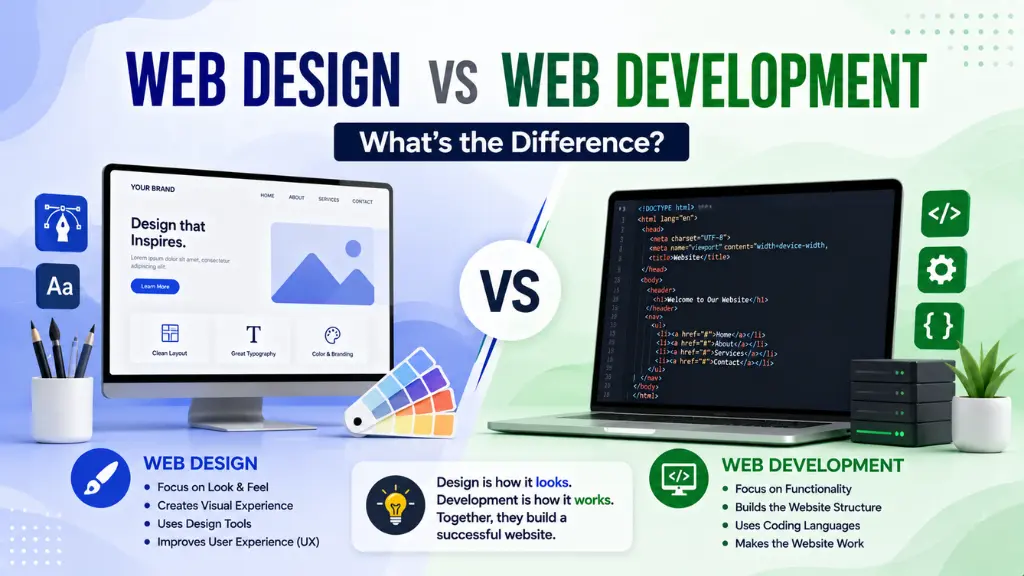
Web design vs web development comes down to one clean distinction that holds up well: web design is strategy – what to build and why – while web development is engineering – making it actually work in a browser, according to Dixie Raiz-Pacheco’s 2026 breakdown. Web designers create the visual design and user experience of a website, while web developers build its underlying structure and functionality, per Coursera’s 2026 comparison guide.
At Search Savvy, clients frequently come to us unsure which service they actually need for their project, and getting this distinction right upfront saves real time and budget. This guide breaks down web design vs web development clearly, including 2026 salary data, skill overlap, and how the two roles work together in practice.
Web Design vs Web Development: What Does Each Role Actually Do?#
Web design vs web development splits along a clear line of responsibility: designers focus on how a site looks and feels, while developers focus on how it functions and performs technically.
Web designers handle visual layout, colour theory, typography, user experience flow, and overall aesthetic direction – essentially, everything a visitor sees and interacts with on the surface. Web developers handle the code, database structure, server logic, and functionality that make those visual designs actually work in a live browser, according to Coursera’s 2026 guide. The cognitive demands genuinely differ: designers think spatially, negotiating subjective stakeholder preferences against objective usability data, while developers operate in more deterministic environments – logic, data structures, and performance metrics with clearer right-and-wrong answers, according to Dixie Raiz-Pacheco’s 2026 analysis.
Web design vs web development is officially recognised as a meaningful distinction by labour statistics too, not just industry convention. The U.S. Bureau of Labor Statistics tracks these as separate occupations, grouped together under “Web Developers and Digital Designers” but distinguished individually within that category, according to GeekExtreme’s 2026 BLS salary analysis.
People Also Ask: Is a web designer the same thing as a web developer? Short Answer: No. A web designer focuses on visual layout, user experience, and aesthetic direction, while a web developer focuses on the code and technical functionality that makes a design work in a browser. They are related, overlapping roles, but genuinely distinct disciplines.
Do Web Designers and Web Developers Earn Different Salaries in 2026?#
Web design vs web development salary data genuinely varies by source in 2026, and the numbers tell a more nuanced story than the common assumption that developers simply earn more across the board.
BLS government data shows digital designers actually out-earning web developers at the median – $98,090 versus $90,930 – but Glassdoor’s total compensation figures, which include bonuses and equity, flip that to a roughly $15,000 developer advantage, at $100,000 versus $85,000, according to GeekExtreme’s 2026 salary breakdown. At the senior level specifically, top-tier designers can reach $192,180 compared to developers’ $162,870 – a genuine $29,000 ceiling advantage for designers that challenges the common assumption that development always pays more, per the same source.
Entry-level trajectories diverge more clearly than senior-level ones. Developers typically start higher, around $80,000, compared to roughly $56,000 for entry-level designers, and climb faster toward senior roles, according to GeekExtreme’s BLS analysis. Freelance rates follow a similar pattern – freelance developers charge roughly $75 per hour versus designers’ $60 per hour, a meaningfully larger premium over employee-equivalent pay than designers see, according to the same source.
People Also Ask: Do web developers always earn more than web designers? Short Answer: Not consistently – it depends on the data source and compensation structure. BLS median salary data actually favours designers slightly, while Glassdoor’s total compensation figures, including bonuses, favour developers. At the senior level, top designers can out-earn top developers.
Why Does Web Design vs Web Development Overlap So Much in Practice?#
Web design vs web development is not as sharply divided in real-world job listings and daily work as the formal job titles suggest – genuine skill overlap has become the norm rather than the exception.
Designers routinely know HTML, CSS, and even JavaScript, and many can prototype or tweak functionality directly, while developers routinely contribute to design decisions, especially around feasibility and performance, according to GeekExtreme’s 2026 skills analysis. A designer who loves a particular animation library still needs a developer to flag that it adds two seconds of load time and needs optimising or replacing – good web design is consistently described as a genuinely collaborative process, not a one-directional handoff.
Web design vs web development career paths also flow more fluidly between each other than the titles imply. The overlap between these roles means a designer who learns more advanced front-end coding can become a developer, and a developer who picks up user experience skills can move into design roles, per the same GeekExtreme analysis. It is rare, though not impossible, to see one individual perform both roles fully, since each requires a genuinely distinct mindset and specific depth of knowledge, according to Graphic Design Degree Hub’s comparison guide.
People Also Ask: Can a web designer learn to become a web developer, or vice versa? Short Answer: Yes, the transition happens regularly in both directions. A designer who develops stronger front-end coding skills can move into development, and a developer who builds user experience expertise can move into design – the skill overlap makes career pivots between the two roles genuinely feasible.
How Has AI Changed the Relationship Between Web Design vs Web Development?#
Web design vs web development workflows have shifted meaningfully in 2026, with AI tools now bridging the gap between design and functioning code in ways that reduce, though do not eliminate, the traditional design-to-development handoff.
The strongest teams in 2026 have largely abandoned the traditional sequential handoff entirely – some use code-based prototyping and visual IDEs where designers manipulate actual production components directly, while others use AI-assisted workflows that translate design files straight into production-ready code, according to Dixie Raiz-Pacheco’s 2026 analysis. A common modern approach involves designing and conceptualising in a tool like Figma first, then using AI-assisted coding to translate that design directly into pixel-accurate code, pulling exact spacing, typography, and layout context from the source file rather than requiring manual recreation.
Web design vs web development skill requirements are converging as a result, though this does not mean either discipline is disappearing. Your salary increasingly depends more on the skills you bring – including AI fluency and specialisation depth – than your official job title, according to WebsiteSetup’s 2026 career guide. No-code and AI-assisted tools are genuinely useful for rapid prototyping and simpler projects, but they still hit real limits at scale – projects handling thousands of users, complex data flows, or custom integrations continue to require genuine development expertise, per GeekExtreme’s 2026 analysis.
People Also Ask: Will AI tools eventually replace the need for web designers or developers? Short Answer: Unlikely in the near term. AI and no-code tools handle rapid prototyping and simpler projects well, but complex, high-scale projects involving custom integrations, data flows, or thousands of users still require genuine human design and development expertise to execute reliably.
Which Roles Should Your Project Actually Prioritise?#
Web design vs web development should be evaluated against your specific project needs, since most projects genuinely require both – the question is usually which one to prioritise first and in what proportion.
A simple, practical way to frame the decision: do you need it to look good, or do you need it to work? If your primary challenge is a confusing, unappealing user experience on an otherwise functional site, design expertise deserves priority. If your primary challenge is broken functionality, poor performance, or missing technical features, development expertise deserves priority.
Practical guidance by project type:
- A simple brochure or portfolio site – often achievable primarily with design skills and no-code or low-code tools
- An e-commerce site with custom integrations – requires genuine development expertise beyond what design or no-code tools alone can deliver
- A redesign of an existing, functional site – often primarily a design-led project, with lighter development involvement
- A site with custom functionality, complex data, or scale requirements – requires meaningful development investment regardless of design quality
People Also Ask: Do I need both a web designer and a web developer for my website project? Short Answer: Most substantial website projects benefit from both, though the proportion varies. Simple sites can often lean heavily on design and no-code tools, while sites with custom functionality, integrations, or scale requirements need genuine development expertise regardless of design quality.
How Should You Choose Between Web Design and Web Development Services?#
Web design vs web development decisions for a business ultimately come down to identifying the actual bottleneck in your current website, rather than assuming one discipline is universally more important than the other.
According to Search Savvy’s insights from scoping website projects for clients, the most common mistake is hiring purely for design polish on a site with genuine underlying technical problems, or conversely, investing heavily in development for a site whose real issue is a confusing, poorly designed user experience.
A practical framework for making this decision:
- Audit your current site honestly – is the core problem visual and experiential, or technical and functional?
- Identify your project’s complexity level – simple sites may only need design-focused work with no-code tools; complex sites need genuine development depth
- Consider the growing overlap – many modern professionals bring meaningful skill in both areas, making a strict either-or hire less necessary than it once was
- Evaluate AI-assisted workflow capability – professionals comfortable bridging design and code via modern AI tools can often deliver both disciplines more efficiently
- Budget for both where genuinely needed – most substantial projects benefit from investment in each discipline, even if one receives more emphasis
At Search Savvy, we recommend scoping any website project by first identifying whether the core challenge is genuinely visual, technical, or both – this single diagnostic step prevents most of the mismatched hiring and budget allocation mistakes we see clients make.
FAQ: Web Design vs Web Development#
Q1: Which pays more in 2026, web design or web development? A: It depends on the data source. BLS median salary data slightly favours designers, while Glassdoor’s total compensation figures favour developers by roughly $15,000. At the senior level, top designers can actually out-earn top developers.
Q2: Do web designers need to know how to code? A: Most modern web designers know at least HTML and CSS, and many are comfortable with basic JavaScript for prototyping. Coding depth is not typically expected at the level a dedicated developer would have, but genuine coding literacy has become standard for designers.
Q3: Is it faster or cheaper to hire one person who does both design and development? A: It can work well for simpler projects, and the skill overlap makes this genuinely more feasible than it used to be. For complex projects with custom functionality or significant scale, dedicated specialists in each discipline typically deliver stronger results.
Q4: How is AI changing web design and development job requirements in 2026? A: AI tools now bridge design and code more directly, letting designers work with production- ready components and developers translate design files into code faster. AI fluency has become a meaningful differentiator in both roles, alongside traditional discipline-specific skills.
Q5: What is the fastest-growing area between web design and web development? A: Both fields are projected to grow at a similar 7–8% rate through 2034 according to BLS projections, with most annual job openings coming from replacement needs like retirements and career changes rather than pure new job creation.
Q6: Can a business use no-code tools instead of hiring a designer or developer? A: For simple prototyping or small projects, yes. No-code tools genuinely handle basic sites well. However, they hit real limits at scale – projects with thousands of users, complex data flows, or custom integrations still require dedicated development expertise.
Not sure whether your website project needs design, development, or both? Visit Search Savvy to speak with an expert who can scope your project correctly from the start.