How to Find Festive/Seasonal Keywords Before They Peak
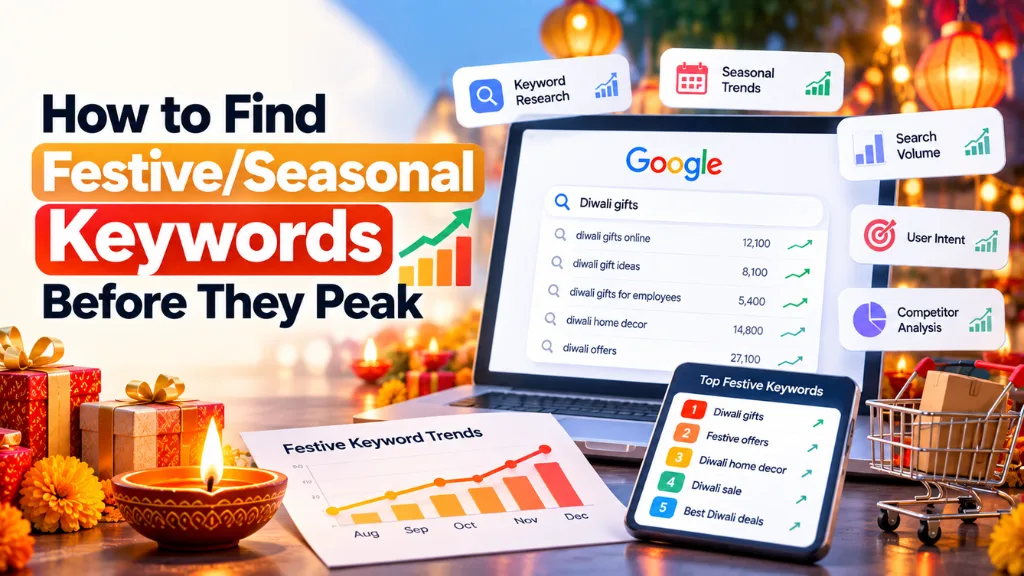

By the time a festival shows up on your content calendar, its keywords are usually already peaking. Google’s India team notes that search interest in “Diwali sales” began climbing as early as August in 2023, and that 82% of surveyed Indian shoppers plan festive purchases in advance. Demand starts months before the celebration, and so should your preparation.
In this article20 sections
This guide shows a repeatable seasonal keyword research process: mine your own data, chart keyword seasonality in Google Trends, work out when interest starts rising, and turn that into a publishing schedule. The short version: find the date each keyword starts climbing, count backwards for production and indexing time, and publish before that date, not before the festival.
What Is Seasonal Keyword Research?#
Seasonal keyword research is the process of identifying search terms whose demand rises and falls at predictable times, such as festivals, holidays or weather changes, and working out when interest starts climbing so content is published, indexed and improved before the peak arrives.
It differs from trend spotting. Seasonal demand is predictable and repeats. Trending demand is a sudden, often short-lived spike.
| Type | Pattern | Example | Best response |
| Seasonal | Repeats yearly around an occasion | “Dhanteras gift ideas” | Plan and publish early, refresh annually |
| Trending | Sudden spike, fades fast | A viral news topic | React quickly, only if relevant |
| Evergreen | Steady all year | “How to write a resume” | Build once, maintain |
Why Festive Search Demand Starts Earlier Than You Think#
Festive search demand in India is spread across a long window, not a single day. Trade commentary describes Q4 as a nine-week run from Navratri through Dussehra, Karwa Chauth and Diwali to Bhai Dooj and New Year, with several distinct shopping occasions inside it.
Timing has also shifted. Marketplace sales open before the festivals: Flipkart has announced Big Billion Days from 9 October, while Diwali falls on 8 November 2026. Most 2026 festivals also land later than in 2025 because of an extra lunar month. That makes calendar-date comparisons with last year unreliable, a problem the process below solves.
The Seasonal Keyword Research Process#
Step 1: Start With Your Own Search Console Data#
Google’s guidance says the Search Console Performance report is a good place to find starting ideas, since it shows queries you already earn clicks for. Set the range to the last 16 months, which is the longest the report offers, and look for queries that rose and fell around last year’s festivals. If you need a longer history, Google points to the Search Analytics API and bulk data exports for storing data yourself.
Step 2: Build an Occasion-Based Seed List#
Combine each occasion with your products or services and the intent behind them. For a home decor store, examples might be “diwali decoration ideas,” “dhanteras brass items” and “diya sets online.” Add intent modifiers such as gift, under a budget, how to, near me or same-day delivery. These are illustrative; your own queries should lead.
Search Savvy’s free blog title generator can help turn the strongest seed terms into working titles once you have validated them.
Step 3: Chart Keyword Seasonality in Google Trends#
Google Trends seasonal search analysis starts on the Explore page. Set the country to India, choose a five-year range and enter your seed terms. Keep these rules in mind:
- Values are relative. Google normalizes each point against total searches for the region and time, then scales from 0 to 100, so a 100 for a niche term and a 100 for a huge term are not equal in volume.
- Compare inside one chart. Numbers from separate charts cannot be mixed.
- Low-volume terms can show zero. Google’s training material notes that terms searched by very few people appear as 0, so very specific long-tail phrases may vanish.
- Try topics, not just terms. Google says topics aggregate languages, misspellings and variations, useful for festivals spelled several ways.
Google also added Gemini-powered related-term suggestions to Explore in January 2026, according to PPC Land, which can help widen a seed list.
Step 4: Find the “Start of Rise” Date for Each Keyword#
This is the step most guides skip. For each keyword, note when interest first climbs meaningfully in each of the past three years, and express it relative to the festival, such as “six weeks before Diwali,” not as a calendar date. Festival dates move, so aligning by festival keeps years comparable.
Then work backwards:
| Component | Example allowance |
| Interest starts rising | 6 weeks before festival |
| Research and writing | 1 week |
| Crawling, indexing and edits | 1 to 2 weeks (Google says new pages can take several days to be crawled) |
| Publish-by target | About 8 to 9 weeks before festival |
These numbers are placeholders; your data will set the real ones. As a rule of thumb, Semrush suggests publishing a Mother’s Day gift guide about a month early, to catch interest at the start of the annual trend line.
With Diwali about seven weeks away, existing pages that already earn festive impressions deserve a refresh before any brand-new article.
Step 5: Add Volume From Keyword Planner and Search Console#
Trends shows timing, not volume. Google Ads’ Keyword Planner reports average monthly searches and, as Google notes, can show how popular keywords are at different times of year. Its API documentation describes monthly volumes for the past twelve months. Use it alongside your own impressions to size each opportunity.
Step 6: Check Fit and Search Intent#
Google’s Search Central advice is blunt: “you shouldn’t write about something just because it’s trending.” Check that the keyword suits your business and your first-hand knowledge, then read the current results to see what format ranks: guides, category pages or video. Consider regional and language variants, since Trends supports city-level geography and festival names and customs vary by state.
Where Do Trending Keywords in India Fit?#
Trending keywords in India are best treated as a reactive layer on top of your seasonal plan. Google’s Trending Now page shows topics rising over recent hours and days, which suits news-style content, but a spike says little about lasting demand. Use it to spot new festive angles, such as a suddenly popular gift category, then validate against a five-year Trends chart before investing.
Build a Seasonal Content Calendar From the Data#
A seasonal content calendar records, for each keyword or theme, the festival date, the start-of-rise date, the publish-by date and a refresh date. Search Savvy’s SEO glossary defines terms like search intent and evergreen content if you are aligning a team.
| Occasion | 2026 date | Example keyword themes | Action |
| Marketplace festive sales | From 8 to 9 Oct (reported) | “diwali sale,” offers | Sale page live and indexed |
| Navratri and Dussehra | 11 to 19 Oct; 20 Oct | Festive wear, puja items | Refresh now |
| Karwa Chauth | 29 Oct | Gifts, mehndi, jewellery | Publish or refresh now |
| Dhanteras and Diwali | 6 Nov; 8 Nov | Gold, silver, decor, gifting | Update stock and offers |
| Bhai Dooj | 10 to 11 Nov | Gift ideas for siblings | Prepare gifting pages |
| Christmas and New Year | 25 Dec; 1 Jan | Party, cake, travel | Draft in October |
Dates vary by source and region, so verify them. Keep one permanent URL per event and update it yearly; Google’s deals-page guidance advises reusing the same URL each year. For teams planning social output too, a content calendar and creative production service can coordinate posts with your search plan, and content strategy helps connect festive pages to your wider topic coverage.
Common Mistakes to Avoid#
- Comparing separate Trends charts. Only terms in the same chart share a scale.
- Using calendar dates. Festival dates move, so align by festival.
- Publishing at the peak. By then, rivals have had weeks of indexing.
- Chasing every spike. Relevance and expertise beat raw popularity.
- Creating new URLs every year. Reusing URLs preserves accumulated links.
- Treating Trends as volume. Pair it with Keyword Planner and Search Console.
Frequently Asked Questions#
How Early Should I Publish Festive Content?#
Before the keyword’s start-of-rise date, which your own data reveals. For Diwali-related searches, Google’s India team saw interest climbing from August in 2023, so waiting until October puts you behind. Refreshing existing pages is faster than launching new ones.
Is Google Trends the Same as Search Volume?#
No. Trends shows relative interest on a 0 to 100 scale, based on a sample, not actual search counts. Use it for timing and comparison, then check Keyword Planner or Search Console for magnitude.
Which Free Tools Work for Seasonal Keyword Research?#
Google Trends, Search Console and Keyword Planner cover most needs. Trends reveals timing, Search Console shows your own queries and impressions, and Keyword Planner adds monthly search estimates. A free Google Ads account is enough to access Keyword Planner.
How Far Back Should I Look?#
Use three to five festival cycles where possible. Trends offers multi-year ranges, while Search Console keeps 16 months unless you export data. Be cautious with unusual years, and align each year by festival date.
How Do I Find Trending Keywords in India?#
Open Google Trends, set the location to India, and use Trending Now for recent spikes or Explore for rising related queries. Then check whether the term fits your business and whether demand looks lasting.
Do Seasonal Keywords Still Matter With AI Overviews and AI Mode?#
Yes. Google says core SEO practices still apply to its generative AI features, and pages must be indexed and eligible to appear. Publishing early gives content time to be crawled, indexed and improved before demand peaks.
The Bottom Line#
Seasonal keyword research is less about finding festive terms than finding the moment interest begins to climb. Mine your Search Console history, chart each term in Trends, align years by festival, and set publish-by dates from the start-of-rise point. Your next step is to pick five festive keywords today, note when each began rising last year, and check whether the pages targeting them are live. If you would like help building the list, Search Savvy’s keyword research services are a good starting point, and online stores can also look at e-commerce SEO services.