On-Page SEO vs Off-Page SEO vs Technical SEO: What’s the Difference?

Here is the confusion most beginners run into within their first week of learning SEO: three terms – on-page, off-page, and technical – get used interchangeably, and nobody stops to explain where one ends and the next begins.
In this article12 sections
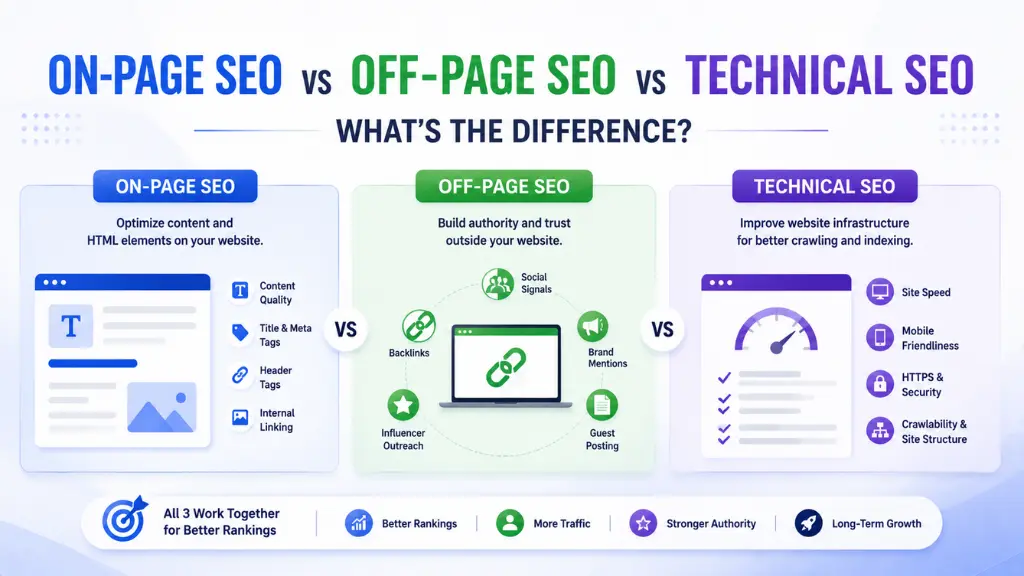
On-Page SEO vs Off-Page SEO vs Technical SEO is not actually a competition between three rival strategies. It is three different layers of the same website, each responsible for a different part of whether you rank.
Many businesses struggle with SEO because they focus heavily on one of these three areas while ignoring the others – publishing large volumes of content without fixing technical issues, or chasing backlinks while pointing them at pages that are not actually optimised. When these elements are not aligned, results stall regardless of how much effort goes in.
On-Page SEO vs Off-Page SEO vs Technical SEO matters even more in 2026, now that Google’s AI-powered results and AI Overviews increasingly dominate search results pages, including in India’s competitive, mobile-first search environment.
At Search Savvy, we build every SEO strategy around all three layers working together, because a brilliant blog post on a broken website, or a fast website with thin content, both fail in exactly the same way: they don’t rank. This guide breaks down each layer clearly, with current 2026 context and a practical starting point for where to focus first.
What Is On-Page SEO?#
On-Page SEO refers to everything you optimise directly within your own web pages – content, structure, and HTML elements that are entirely under your control.
On-Page SEO includes keyword placement, meta titles and descriptions, header structure, internal linking, image alt text, and overall content quality and depth. Unlike off-page SEO, on-page SEO does not depend on any other website or external party.
People Also Ask: What does on-page SEO include? Short Answer: On-page SEO includes content quality, keyword optimisation, meta tags, header structure (H1, H2, H3), internal linking, URL structure, and image alt text – every element that lives directly on a webpage and is fully within the site owner’s control.
What Is Off-Page SEO?#
Off-Page SEO covers everything that happens outside your own website to build its authority and reputation in Google’s eyes.
Off-Page SEO is built primarily through backlinks from other domains, but it also includes brand mentions, social signals, online reviews, and digital PR. Backlinks remain one of Google’s strongest ranking factors, and a page with strong on-page and technical SEO, supported by authoritative backlinks, will nearly always outperform an equivalent page with no external authority.
Off-Page SEO is earned, not configured. You cannot set it up from a CMS dashboard the way you can a meta description; it is built through content genuinely worth linking to, partnerships, and real reputation within an industry.
People Also Ask: Is off-page SEO just link building? Short Answer: No. Off-page SEO includes link building as its core component, but it also covers brand mentions without links, online reviews, social media engagement, and digital PR – all signals that exist outside your website but still influence how Google judges your credibility.
What Is Technical SEO?#
Technical SEO refers to the backend, infrastructure-level elements of a website that determine whether search engines can find, crawl, interpret, and index content at all.
Technical SEO includes site speed, mobile-friendliness, HTTPS security, crawlability, XML sitemaps, robots.txt configuration, structured data, and canonical tags to prevent duplicate content issues. No matter how brilliant your content is, if Googlebot cannot access your pages, none of your on-page or off-page work matters.
Technical SEO is genuinely foundational rather than optional in 2026, particularly in India, where over 70% of internet users browse on mobile devices and network speeds vary significantly between cities and rural areas.
People Also Ask: Why is technical SEO considered the foundation of SEO? Short Answer: Technical SEO is considered the foundation because content and backlinks cannot help a page that search engines cannot crawl or index in the first place. A technically broken site can make excellent content invisible to Google entirely, regardless of how well it is written.
How Does On-Page SEO vs Off-Page SEO vs Technical SEO Work Together?#
On-Page SEO vs Off-Page SEO vs Technical SEO works best understood as three legs of the same table rather than three competing options. If one leg is weak, the whole structure becomes wobbly, no matter how strong the other two are.
On-Page SEO vs Off-Page SEO vs Technical SEO breaks down in practice in two very common ways. A site can have strong keyword targeting, well-structured headers, and a compelling meta description, but if it loads in six seconds, has a robots.txt file accidentally blocking the blog directory, or suffers from duplicate pages eating crawl budget, Google may never properly index the excellent content at all.
The reverse is equally true. A technically flawless, lightning-fast website with thin, unhelpful content will still struggle to rank, because Google’s algorithms are sophisticated enough to distinguish between pages that are merely crawlable and pages that are genuinely valuable to the person reading them.
| SEO Type | What It Covers | Who Controls It | Example Tasks |
| On-Page SEO | Content & structure on the page | Fully within your control | Keywords, meta tags, headers, internal links |
| Off-Page SEO | Authority signals outside the site | Partly earned, partly influenced | Backlinks, brand mentions, reviews, digital PR |
| Technical SEO | Backend infrastructure | Fully within your control | Site speed, HTTPS, crawlability, schema markup |
Why Is Understanding On-Page SEO vs Off-Page SEO vs Technical SEO Important in 2026?#
On-Page SEO vs Off-Page SEO vs Technical SEO matters more in 2026 because search results pages now blend traditional rankings with AI Overviews, and getting cited in either requires all three layers functioning correctly.
On-Page SEO vs Off-Page SEO vs Technical SEO is also relevant to a simple question every site owner can ask themselves: can search engines and large language models easily access and understand the content on my site? If the honest answer is no, technical issues are very likely the first place to look, since they sit upstream of everything else.
On-Page SEO vs Off-Page SEO vs Technical SEO together also determine topical authority, which Google increasingly rewards. Sites that deeply and consistently cover a subject – well-structured on-page content, supported by genuine backlinks, sitting on a fast and crawlable technical foundation – consistently outrank scattered, shallow competitors.
- Faster, mobile-first technical foundations directly support AI Overview eligibility
- Genuine, earned backlinks carry more weight than ever as Google de-emphasises low-quality links
- Structured data on technically sound pages improves AI and voice search discoverability
- On-page content depth remains the strongest single ranking factor, but only once technical issues are resolved
How Do You Prioritise On-Page SEO vs Off-Page SEO vs Technical SEO?#
On-Page SEO vs Off-Page SEO vs Technical SEO does not need to be tackled all at once, but the order matters more than most beginners expect.
Step 1: Start With a Technical SEO Audit#
On-Page SEO vs Off-Page SEO vs Technical SEO should always begin with technical SEO, because content and backlinks cannot fix crawl errors, slow speed, or blocked pages. Use Google Search Console’s Index Coverage report to check which pages are indexed, excluded, or throwing errors – the “Excluded” tab often reveals crawling issues silently killing visibility.
Step 2: Strengthen On-Page SEO#
On-Page SEO vs Off-Page SEO vs Technical SEO continues with on-page improvements once the technical foundation is solid. Focus on matching search intent, structuring content with clear question-based headers, and ensuring every page has a genuine reason to exist rather than overlapping with another page on the same topic.
Step 3: Build Off-Page Authority#
On-Page SEO vs Off-Page SEO vs Technical SEO finishes with off-page work, because backlinks pointing to a slow or thin page rarely deliver meaningful results. Earn links through content worth citing, digital PR, and genuine industry partnerships rather than mass outreach for low-quality placements.
People Also Ask: Which should I fix first: technical, on-page, or off-page SEO? Short Answer: Technical SEO should generally be fixed first, since it determines whether search engines can access your content at all. On-page SEO should follow to ensure that accessible content is genuinely useful, and off-page SEO works best once both are solid, since links pointing to a weak or broken page deliver limited value.
How Should Indian Businesses Approach On-Page SEO vs Off-Page SEO vs Technical SEO?#
On-Page SEO vs Off-Page SEO vs Technical SEO requires a particular emphasis on technical fundamentals for Indian businesses, given how heavily mobile-first the market is and how much network speed varies across tier-1, tier-2, and tier-3 cities.
On-Page SEO vs Off-Page SEO vs Technical SEO also benefits Indian businesses through localised on-page content – city-specific landing pages, India-relevant examples, and INR pricing – paired with off-page signals like Google Business Profile reviews, which carry significant weight for local search visibility.
According to Search Savvy’s insights from auditing Indian small-business and D2C websites, the single most common gap is technical: businesses invest heavily in content and backlinks while ignoring site speed and mobile usability, which quietly caps how much of that investment ever gets rewarded.
Conclusion: Treat All Three as One Strategy#
On-Page SEO vs Off-Page SEO vs Technical SEO is, in the end, a false choice rather than a genuine decision between competing approaches. Technical SEO creates the foundation, on-page SEO builds relevance and clarity, and off-page SEO supplies the authority that tells Google your site deserves to be trusted.
At Search Savvy, we recommend auditing all three layers together rather than optimising one in isolation, since rankings improve fastest – and hold steadiest through algorithm updates – when all three reinforce each other.
FAQ: On-Page SEO vs Off-Page SEO vs Technical SEO – Your Questions Answered#
Q1: What is the main difference between on-page SEO and off-page SEO? On-page SEO covers elements you control directly on your website, such as content and meta tags. Off-page SEO covers external signals like backlinks and brand mentions that you must earn from other websites rather than configure yourself.
Q2: Is technical SEO part of on-page SEO? They are related but distinct. On-page SEO focuses on content and visible structure, while technical SEO focuses on backend infrastructure like crawlability, site speed, and indexing. Many guides treat technical SEO as a separate, foundational third pillar rather than a subset of on-page SEO.
Q3: Which type of SEO gives the fastest results? Technical SEO fixes, such as resolving crawl errors or fixing a blocked robots.txt file, often produce the fastest visible improvement, since they can unlock indexing for content that was previously invisible to Google entirely.
Q4: Can a website rank well with only one type of SEO done correctly? Rarely, and not sustainably. A technically perfect site with thin content will struggle to satisfy search intent, while excellent content on a slow or poorly indexed site may never be seen by Google or users at all. All three layers need to work together for lasting results.
Q5: How often should each type of SEO be reviewed? Technical SEO should be monitored regularly and reviewed in depth at least once per quarter. On-page SEO should evolve based on performance data and search behaviour, while off-page SEO should be tracked continuously to ensure new backlinks are positive and relevant rather than harmful.
Q6: Does off-page SEO still matter with AI Overviews and AI search becoming more common? Yes. Genuine backlinks and brand mentions remain strong trust signals that help establish the credibility AI systems look for when selecting which sources to cite, making off-page SEO just as relevant in an AI-driven search landscape as it was before.
Not sure whether your website’s biggest gap is content, technical health, or authority? Visit Search Savvy for a complete SEO audit that evaluates all three layers and shows you exactly where to focus first.