How Does Google Search Algorithm Work in 2026?

Here is the question every website owner eventually asks: why did my rankings change overnight, with no warning and no obvious mistake on my end? The honest answer is that the Google search algorithm never stops moving.
In this article14 sections
The Google search algorithm is not one formula. It is a collection of interconnected systems that crawl, index, and rank billions of pages every day, and in 2026 those systems lean more heavily on AI than at any point before.
Google has confirmed making thousands of changes to Search in a single year, with most of them small and unnoticeable, alongside three to four sweeping core updates that can meaningfully shift rankings overnight. Understanding how the Google search algorithm works is no longer optional background knowledge for SEOs – it is the difference between reacting in panic after every update and building a site that holds steady through them.
The Google search algorithm in 2026 is also the gateway to AI Overviews, ChatGPT, and Perplexity, since many of these tools draw on the same underlying web index and trust signals Google has spent two decades refining.
At Search Savvy, we track every meaningful shift in the Google search algorithm so our clients never have to guess why a page moved. This guide breaks down exactly how the algorithm works today, what changed in 2026, and how to build a site that performs regardless of the next update.
What Is the Google Search Algorithm?#
The Google search algorithm is the system of ranking factors, signals, and machine learning models Google uses to decide which pages appear, and in what order, for any given search query.
It is not a single piece of code. It is a layered process: Google must first crawl a page, then index it, then retrieve it as a candidate for a query, and only then rank it against competing pages. A page that fails at any earlier stage never reaches the ranking stage at all, no matter how well optimised it is.
A 2024 leak of more than 2,500 pages of internal Google API documentation gave SEOs an unprecedented look at this process, revealing over 14,000 individual attributes tracked across more than 2,500 modules – confirming what experienced SEOs had long suspected: ranking is the product of hundreds of signals working together, not one or two tricks.
People Also Ask: Is the Google search algorithm one single formula? Short Answer: No. The Google search algorithm is a combination of multiple systems – crawling, indexing, retrieval, and ranking – that work together. Google makes thousands of small changes a year and a handful of major core updates, meaning the “algorithm” is really an evolving network of interacting systems rather than one fixed formula.
How Does the Google Search Algorithm Work Step by Step?#
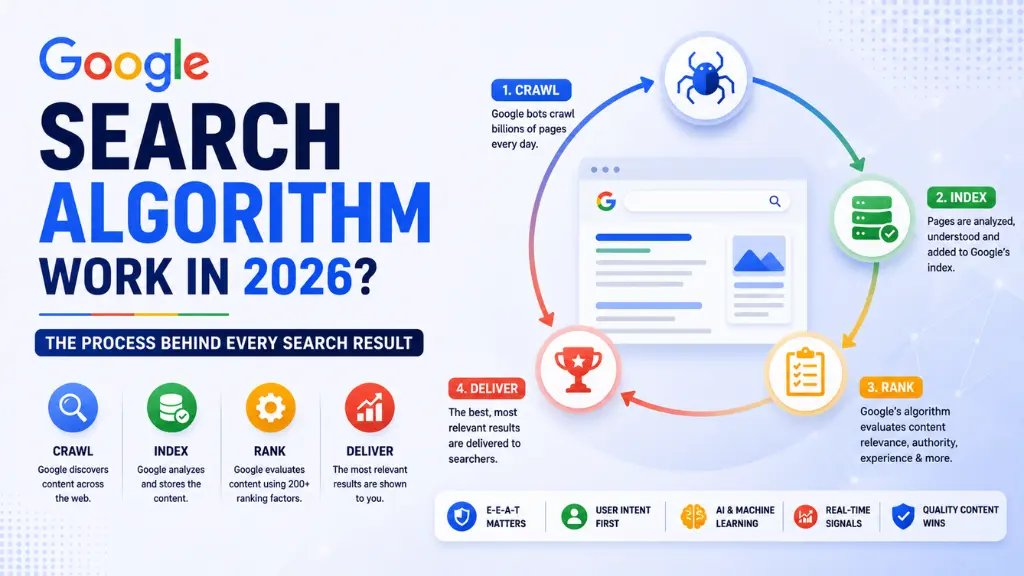
The Google search algorithm works through four distinct stages, and a page must pass through all of them before it can rank.
Step 1: Crawling#
The Google search algorithm starts with crawling, where automated bots called Googlebot follow links across the web to discover new and updated pages. Pages with no internal or external links pointing to them – orphan pages – are often missed entirely during this stage.
Step 2: Indexing#
The Google search algorithm next decides whether a crawled page deserves a place in Google’s index, the massive database of pages eligible to appear in search results. Thin, duplicate, or low-value content is frequently crawled but never indexed.
Step 3: Retrieval#
The Google search algorithm then narrows its full index down to a smaller set of candidate pages that are topically relevant to a specific search query, using natural language processing to understand intent rather than just matching exact keywords.
Step 4: Ranking#
The Google search algorithm finally evaluates every candidate page using ranking systems that weigh content relevance, backlink authority, user engagement data, technical performance, and trust signals to decide the final order of results.
One of the most significant ranking systems revealed in the 2024 leak was NavBoost, which uses Chrome clickstream data – including “goodClicks,” “badClicks,” and “lastLongestClicks” – to judge how satisfied users actually are with a result, not just whether they clicked it.
People Also Ask: What is NavBoost in the Google search algorithm? Short Answer: NavBoost is a Google ranking system that uses Chrome click data to assess how users interact with search results, including click quality and how long users stay before returning to the results page. It is one of the clearest pieces of evidence that real user satisfaction, not just keywords or links, drives modern rankings.
Why Is Understanding the Google Search Algorithm Important in 2026?#
The Google search algorithm matters more in 2026 because search itself has shifted from a list of blue links to AI-generated summaries, answer boxes, and conversational results. If your content is never selected by the algorithm’s earlier stages, it cannot appear in an AI Overview either.
The Google search algorithm is now also the primary signal AI tools like ChatGPT and Perplexity rely on indirectly, since these systems often draw from the same trusted, well-indexed sources that already rank well in Google.
The Google search algorithm in 2026 places far more weight on Experience, Expertise, Authoritativeness, and Trustworthiness (E-E-A-T) than in previous years. Google’s January 2026 core update specifically targeted “human-first, AI-enhanced” content, rewarding genuine expertise and authentic engagement while penalising AI-generated content published without meaningful human oversight.
- Faster detection of thin or AI-generated spam content
- Greater weight on first-hand experience and original research
- Continued emphasis on Core Web Vitals, including Interaction to Next Paint (INP)
- Increased reliance on entity and author verification for trust scoring
- Tighter integration between traditional rankings and AI Overview eligibility
What Ranking Factors Matter Most in the Google Search Algorithm Today?#
The Google search algorithm weighs hundreds of signals, but a smaller group of factors carries disproportionate weight in 2026.
| Ranking Factor | Why It Matters in 2026 |
| Content quality & depth | Remains the #1 factor; thin or AI-spam content loses rankings fast |
| Search intent match | Google’s NLP models judge whether a page truly satisfies the query, not just matches keywords |
| E-E-A-T signals | First-hand experience, credentials, and transparent authorship are now core ranking inputs |
| User engagement (NavBoost) | Click quality and post-click behaviour feed directly into rankings |
| Core Web Vitals & INP | Page speed and interaction responsiveness, especially on mobile |
| Backlink quality | Editorial links from reputable, topically relevant sources outweigh volume |
| Topical authority | Sites that deeply cover an entire subject area outrank shallow, scattered content |
| Technical SEO | Crawlability, internal linking, and structured data determine eligibility before ranking even begins |
The Google search algorithm rewards topical authority specifically because it signals depth rather than a single lucky page. Google now rewards websites that comprehensively cover an entire topic area through interconnected content, not isolated articles competing for one keyword.
People Also Ask: What is the most important Google ranking factor in 2026? Short Answer: Content quality and intent satisfaction remain the single most important factors. Google’s algorithm evaluates whether a page fully answers a user’s query in one visit; pages that fail this test underperform regardless of backlinks, speed, or other technical optimisation.
How Do Google Core Updates Fit Into the Algorithm?#
The Google search algorithm receives small adjustments almost daily, but core updates are the larger, scheduled re-evaluations that can meaningfully shift rankings across the entire web. Based on recent patterns, expect roughly three to four core updates per year, alongside additional, narrower spam updates in between.
The Google search algorithm does not “punish” sites during a core update. Google re-evaluates quality, relevance, and trust across the entire search landscape, and pages move up or down as competitors better – or worse – satisfy those refreshed standards.
The Google search algorithm’s first major core update of 2026 began rolling out on March 27, reinforcing the same human-first, E-E-A-T-driven direction set by January’s update. Recovery after a core update should start with content quality and intent match, not minor technical tweaks, since Google re-evaluates relevance first.
You can confirm whether a traffic change lines up with a known update using the Google Search Status Dashboard before assuming a technical error is to blame.
How Does the Google Search Algorithm Affect AI Overviews?#
The Google search algorithm now feeds directly into AI Overviews, the AI-generated summaries that appear above traditional search results for many queries. Pages must still pass the same crawling, indexing, and ranking stages before they can be cited in an AI Overview.
The Google search algorithm favours topically deep, clearly structured content for AI Overview citations, since these summaries are generated by pulling reliable, well-organised information from already-trusted pages. Schema markup, clear headings, and direct factual answers all improve a page’s odds of being selected.
According to Search Savvy’s insights from tracking AI Overview appearances across client sites in 2026, pages that already rank in the top five organic positions are overwhelmingly more likely to be cited, which means traditional Google search algorithm optimisation and AI visibility are no longer separate strategies – they are the same strategy.
How Should Indian Businesses Adapt to the Google Search Algorithm in 2026?#
The Google search algorithm treats mobile experience as foundational rather than optional, which matters significantly for Indian businesses given how much search traffic in India happens on mobile devices. A slow or clunky mobile site can quietly suppress rankings even with strong content.
The Google search algorithm’s emphasis on E-E-A-T also rewards Indian brands that clearly establish local credibility – accurate business information, genuine customer reviews, and verifiable expertise – particularly for local and Google Business Profile-driven searches.
At Search Savvy, we recommend Indian businesses pair technical fundamentals – mobile speed, HTTPS, and structured data – with genuinely authoritative content that demonstrates real, first-hand expertise, since this combination is exactly what the 2026 algorithm is built to reward.
How Can You Future-Proof Your Site Against Google Search Algorithm Changes?#
The Google search algorithm rewards consistency over chasing every individual update. Future-proofing means reducing volatility, not reacting to each ranking fluctuation as it happens.
- Build genuine topical authority instead of scattered, one-off blog posts
- Strengthen E-E-A-T with real author bios, credentials, and original insights
- Keep Core Web Vitals healthy, especially Interaction to Next Paint on mobile
- Use structured data so Google and AI tools can parse your content accurately
- Avoid AI-generated content without human oversight, since detection has improved sharply
- Prioritise intent satisfaction so users do not need to return to Google for a better answer
The Google search algorithm consistently rewards sites that work with its long-term goals – better answers, trusted sources, and genuine intent satisfaction – rather than sites trying to outsmart any single update.
Conclusion: Build for the Algorithm’s Direction, Not Its Details#
The Google search algorithm will keep changing, often without warning, and chasing every individual update is a losing strategy. What works consistently is building genuine expertise, technical reliability, and content that actually satisfies the people reading it.
Search Savvy helps brands align with exactly this direction – strong E-E-A-T, clean technical foundations, and content built for both human readers and AI Overviews – so rankings stay stable through whatever the algorithm does next.
FAQ: Google Search Algorithm – Your Questions Answered#
Q1: How often does Google update its search algorithm? Google makes minor changes almost daily and has confirmed thousands of changes in a single year. Larger core updates, which can meaningfully shift rankings, roll out roughly three to four times per year, with additional narrower spam updates in between.
Q2: Does the Google search algorithm punish websites during a core update? No. Core updates do not punish individual sites. Google re-evaluates quality, relevance, and trust across the entire search landscape, and rankings shift as pages are re-compared against improved standards – not as a penalty for any specific action.
Q3: How does the Google search algorithm decide what appears in AI Overviews? Pages must first pass the algorithm’s normal crawling, indexing, and ranking stages. Content that already ranks well organically, is clearly structured, and demonstrates topical depth is significantly more likely to be cited in an AI Overview.
Q4: What is E-E-A-T and why does it matter to the Google search algorithm? E-E-A-T stands for Experience, Expertise, Authoritativeness, and Trustworthiness. In 2026, these are treated as core ranking inputs rather than general quality guidelines, with first-hand experience and transparent authorship carrying real ranking weight.
Q5: Can AI-generated content still rank in the Google search algorithm? Yes, but only when it includes meaningful human oversight, original insight, and genuine expertise. Google’s detection systems can identify content created purely by AI without human contribution, and such content is increasingly penalised.
Q6: How can I tell if a ranking drop is from a Google algorithm update? Check the date of your traffic change against the Google Search Status Dashboard or Google Search Central’s official update announcements. If the dates align with a confirmed core update, the drop is likely a re-ranking, not a technical error or penalty.
Confused about why your rankings shifted after the last Google update – or unsure whether your content is built to survive the next one? Visit Search Savvy for an SEO audit that checks your site against exactly what the 2026 algorithm rewards.