What Is Hreflang Tag and How to Use It for Multilingual SEO?
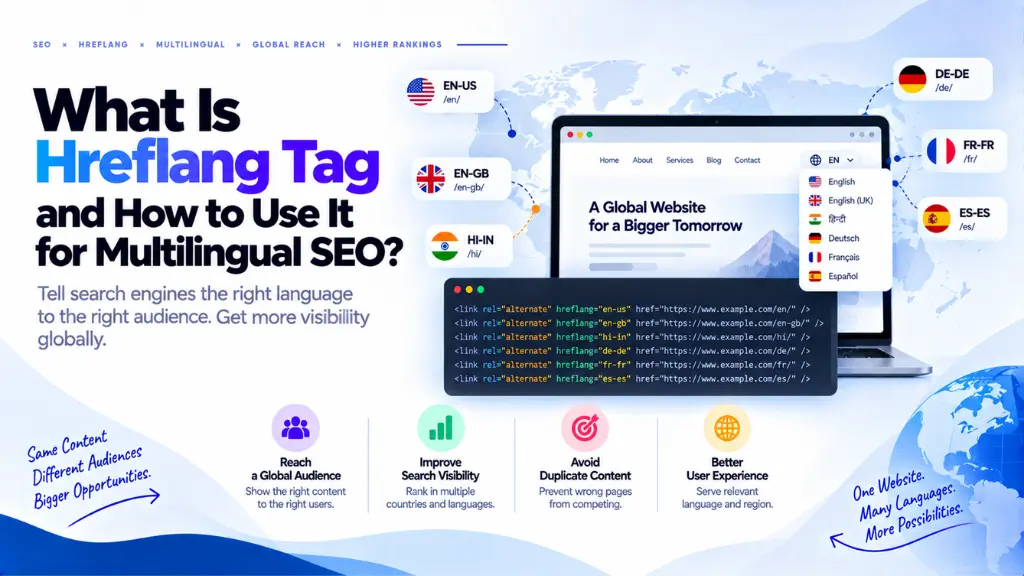

A hreflang tag is an HTML attribute that tells search engines which language and regional version of a page to serve to which visitor – the mechanism that stops Google from showing your English page to a Spanish-speaking visitor, or your UK pricing to someone searching from the US. Multilingual SEO depends on getting this signal right, and the data on how often it goes wrong is stark: studies across international sites have found that roughly 75% of hreflang implementations contain errors, and a single broken tag in a language cluster can cause Google to disregard the entire cluster.
In this article11 sections
This article covers what a hreflang tag actually does, the specific code format and mistakes that cause most of these failures, and a practical process for implementing and validating multilingual SEO signals correctly the first time.
What Is a Hreflang Tag?#
Formally known as rel=”alternate” hreflang, a hreflang tag is a link attribute that signals the relationship between different language or regional versions of the same content. Without it, Google has no reliable way to know that your /en/ and /de/ pages are translated versions of each other rather than duplicate or unrelated content – and it may show the wrong version to the wrong audience, flag your multilingual pages as duplicate content, or serve inconsistent versions to the same query over time.
The tag can be implemented three ways: in the HTML <head> as a <link> element, in the HTTP header (useful for non-HTML files like PDFs), or within an XML sitemap. All three achieve the same result; the important requirement is picking one method and using it consistently rather than mixing approaches inconsistently across a site.
Why Hreflang Matters for Multilingual SEO#
The direct symptom of missing or broken hreflang is straightforward to spot: if your English page appears in Google Germany for German-language queries, hreflang is either absent or misconfigured. You can verify this by searching your target queries at google.de using a VPN set to Germany, or by checking Search Console’s International Targeting report to see whether the correct page version is being identified for each hreflang value.
The stakes go beyond a single misplaced page. Multilingual sites without properly implemented hreflang often experience genuine ranking instability, with search engines rotating unpredictably between language versions for the same query because there’s no clear signal establishing which version belongs where. One estimate puts the resulting traffic cost at 20% to 40% of a site’s potential foreign-language traffic lost to hreflang misconfiguration alone – a scale of loss significant enough that fixing a broken implementation is often described as the single highest-leverage technical SEO fix available on a multilingual site.
There’s also a newer dimension worth understanding in 2026: as AI assistants and answer engines increasingly serve responses in a user’s native language, correctly implemented hreflang clusters help signal that a site is comprehensive and authoritative across languages, which factors into whether AI-generated answers cite it consistently in each language rather than defaulting to whichever version happens to be indexed most prominently.
Hreflang Code Format and Common Code Mistakes#
Hreflang values follow the format language or language-REGION, using ISO 639-1 language codes and ISO 3166-1 country codes. A tag targeting French speakers in Canada, for instance, uses fr-CA; a tag targeting all French speakers regardless of country simply uses fr.
| Correct Format | Common Mistake | Why It Fails |
| en-GB (uppercase country code) | en-uk (lowercase, non-standard) | Doesn’t match the required ISO 3166-1 format, so Google may not recognize it |
| zh-Hans (script code for Simplified Chinese) | zh-CN (country code used incorrectly as a script indicator) | Conflates country targeting with script/language variant, causing ambiguity |
| Reciprocal tags on every page in the cluster | A tag on page A pointing to page B, with no return tag on page B | Google requires symmetric, two-way “return tags” – a one-directional link is treated as invalid |
Getting these codes right matters because a single invalid code doesn’t just fail quietly for that one page – it can cause Google to disregard the validity of the entire hreflang cluster the page belongs to, undermining the implementation for every language version in that group.
The Three Non-Negotiable Requirements#
Across virtually every documented hreflang failure, the root cause traces back to one of three requirements being missed:
- Self-referencing tags. Every page in a hreflang cluster must include a hreflang tag pointing to itself, in addition to tags pointing to every other language version.
- Reciprocal (return) tags. If page A references page B, page B must reference page A back. This symmetric relationship is the single most commonly failed validation rule in international SEO, and Google will not honor a one-way reference.
- Valid, correctly formatted language and region codes. Even a single incorrectly cased or malformed code – as covered above – can invalidate the tag for that page and destabilize the surrounding cluster.
Keeping a spreadsheet tracking every language and region code used across the site, and auditing it whenever a new market or language version is added, is a simple habit that catches most of these errors before they reach production.
X-Default: The Fallback Everyone Forgets#
The x-default value specifies which page version to serve a visitor whose language or region doesn’t match any of the specific hreflang tags defined – for example, a visitor from a country your site hasn’t built a dedicated version for. Omitting x-default doesn’t break the tags that do exist, but it leaves a gap where Google has to guess which version best serves an unmatched visitor, rather than following an explicit fallback instruction.
Hreflang vs. Canonical Tags: How They Work Together#
Canonical tags and hreflang tags serve different purposes and, when combined incorrectly, actively undermine each other. The most common mistake is pointing every language version’s canonical tag at a single “master” page – typically the English version. This tells Google that the German, French, and Spanish pages are all duplicates of the English page, effectively instructing Google to ignore the very language versions the hreflang tags were meant to promote.
The correct approach is a self-referencing canonical on every page in the cluster: the German page canonicalizes to itself, the French page canonicalizes to itself, and so on, with hreflang tags handling the cross-language relationships separately. Without this self-referencing canonical in place, Google can become confused about which version of a page is the “master,” even when the hreflang tags themselves are configured correctly – the two systems need to work in agreement, not in conflict.
Choosing a URL Structure: ccTLD vs. Subdirectory vs. Subdomain#
The URL structure underlying a multilingual site carries its own SEO consequences, largely independent of hreflang itself.
| Structure | Example | Geotargeting Signal | SEO Authority |
| ccTLD | example.de | Strongest – country-code domains send the clearest signal | Requires building separate link authority per domain |
| Subdirectory | example.com/de/ | Strong, and the default recommendation for most businesses | Consolidates all link equity under a single domain |
| Subdomain | de.example.com | Moderate | Splits authority similarly to a ccTLD, without the strongest geotargeting benefit |
For most businesses entering new markets, subdirectories are the recommended structure specifically because they consolidate SEO authority under one domain while still supporting full hreflang implementation, rather than requiring a new site’s worth of authority to be built for each market from scratch.
How to Implement and Validate Hreflang#
- Choose one implementation method – HTML tags, HTTP headers, or an XML sitemap – and apply it consistently across the entire site rather than mixing methods.
- Build every tag as self-referencing and reciprocal, ensuring each page in a cluster links to every other version, including itself.
- Add an x-default tag to specify a fallback for visitors whose language or region doesn’t match a specific version.
- Keep canonical tags self-referencing, never pointing multiple language versions at a single master page.
- Validate with a hreflang checking tool after deployment, checking alternate URLs, HTTP status codes, indexability, language codes, and return tags – and repeat this validation whenever a new language or region is added.
- Monitor Search Console’s International Targeting report and expect a processing delay: Google typically takes two to four weeks to fully process hreflang changes on a large site, since it must crawl every page in a cluster to verify the return links.
Search Savvy’s advanced hreflang generator helps produce correctly formatted, reciprocal tags without manually tracking every language-region pairing by hand, reducing the risk of the code-level mistakes that cause most implementation failures. For sites managing a full international SEO strategy beyond the tags themselves, Search Savvy’s international and multilingual SEO services build hreflang implementation into the broader market-entry and content strategy, rather than treating it as an isolated technical checkbox.
Common Mistakes in Hreflang Implementation#
- Missing return tags. The single most-failed validation rule in international SEO – every reference must be reciprocated by the page it points to.
- Using incorrect or malformed language and region codes. Lowercase country codes, confused script versus country codes, and other formatting errors can invalidate an entire cluster.
- Pointing all canonical tags at one master version. This directly tells Google to disregard the non-master language versions, undermining the hreflang implementation entirely.
- Omitting x-default. This leaves visitors who don’t match any specific hreflang value without an explicit fallback instruction.
- Expecting instant results. Hreflang changes take two to four weeks to fully process on larger sites; judging an implementation’s success too early risks premature and inaccurate conclusions.
The Bottom Line#
Multilingual SEO depends on hreflang tags being self-referencing, reciprocal, and correctly coded – three requirements that sound simple but account for the vast majority of the roughly 75% error rate found across international sites. Getting canonical tags to agree with hreflang rather than conflict with it, choosing subdirectories for most standard international expansions, and validating the implementation after every change closes the gap between a technically present hreflang setup and one that actually works.
The practical next step is running your current hreflang implementation through a validation tool today, checking specifically for missing return tags and canonical conflicts before assuming the setup is working correctly. Search Savvy’s technical SEO services and free hreflang generator tool help fix exactly the errors that cause most multilingual SEO underperformance, so the right language version reaches the right audience consistently.
Frequently Asked Questions#
What is a hreflang tag used for? It’s an HTML attribute that tells search engines which language and regional version of a page to serve to a specific visitor, preventing the wrong language version from appearing in search results and avoiding duplicate content issues across translated pages.
Why do so many hreflang implementations contain errors? Studies across international sites have found error rates around 75%, most commonly missing return (reciprocal) tags, incorrectly formatted language or region codes, and canonical tags pointing at a single master version instead of being self-referencing.
What is a hreflang return tag, and why does it matter? A return tag means that if page A references page B in its hreflang tags, page B must reference page A back. This reciprocal relationship is required by Google, and it’s the single most commonly failed rule in hreflang implementation.
Should I use a ccTLD, a subdirectory, or a subdomain for international pages? Subdirectories are the default recommendation for most businesses, since they consolidate SEO authority under a single domain while still supporting full hreflang implementation. ccTLDs send the strongest geotargeting signal but require building separate link authority for each domain.
How long does it take for hreflang changes to take effect? Typically two to four weeks for Google to fully process changes on a larger site, since hreflang signals are processed at the URL level and Google must crawl every page in a cluster to verify the return links. Resubmitting sitemaps in Search Console can help speed this along.
Can hreflang and canonical tags conflict with each other? Yes, and this is one of the most common implementation mistakes. Pointing every language version’s canonical tag at a single master page tells Google to treat the other versions as duplicates, effectively canceling out the hreflang tags. Each version should have its own self-referencing canonical tag.