
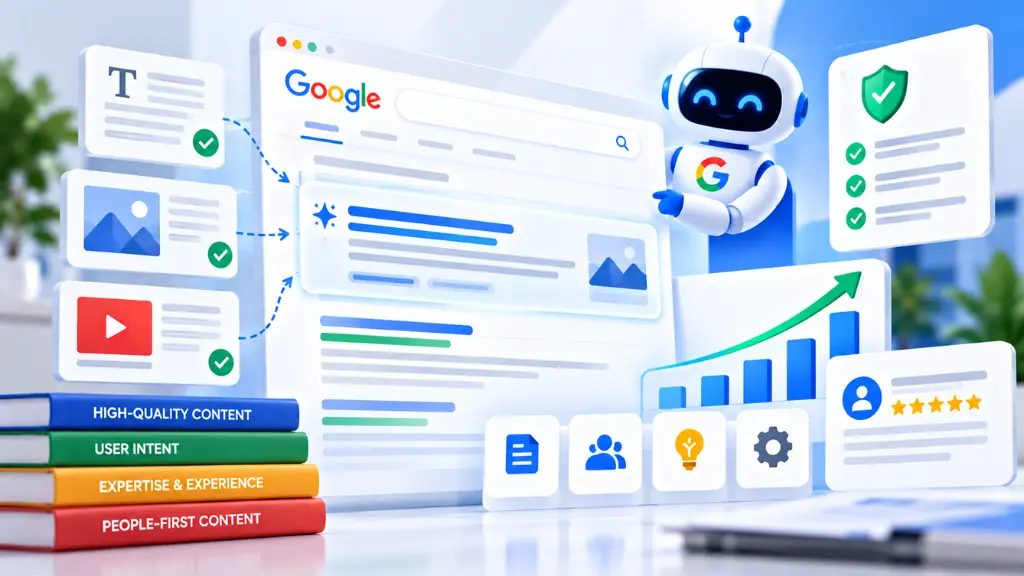

The helpful content system is no longer a separate classifier. Google folded it into its core ranking systems in March 2024, and since then multiple core systems assess how helpful content is, continuously. There is no standalone “helpful content update” to wait for or recover from. Changes in how Google judges helpfulness now arrive through broad core updates, including those in March 2025 and March and May 2026.
A note on timing: some guides describe this change as happening in 2025. It did not. Google announced the integration alongside the March 2024 core update. This article covers what that means in 2026, what Google actually says helpful content is, and how to audit your site without chasing myths.
What Was the Helpful Content System?
Short answer: The helpful content system was a ranking system launched in August 2022 that used a classifier to identify content created primarily for search engines instead of people, and applied a site-wide signal that could suppress rankings across a site.
It ran as its own system, with confirmed updates in August 2022, December 2022, and September 2023. A site with a lot of content judged unhelpful could see rankings suppressed across the whole site, and recovery depended on that system re-evaluating the site, which could take months. That is why the system was often described as site-wide and punitive.
What Changed in March 2024?
Short answer: On March 5, 2024, Google announced a combined core and spam update and said the helpful content system had been incorporated into its core ranking systems. The standalone classifier was retired, and several core systems now evaluate helpfulness.
According to Amsive’s summary, Google described the March 2024 update as involving changes to multiple core systems and an evolution in how it identifies the helpfulness of content. Google also added an FAQ explaining that its core systems would show more helpful results using a variety of signals and approaches, without relying on a single signal or system. The core update finished rolling out on April 19, 2024.
Two consequences follow:
- No separate hit to recover from. Helpfulness is now part of the overall calculation across core systems, not a standalone penalty-like layer.
- Recovery follows core updates. Instead of waiting for a dedicated helpfulness update, sites see changes when core systems are updated.
How Does the Helpful Content System Work Now?
Short answer: Google says it uses a variety of signals and systems within its core ranking systems to prioritize helpful, reliable, people-first content. It has not published the exact signals, weights, or whether judgments are mainly page-level or site-level.
Practitioners disagree on the details. Some analysts argue helpfulness now feeds site-level quality evaluations; others argue it is assessed primarily at the page level. Both are interpretations, since Google has not published the mechanics. The safest approach is to improve both the pages and the overall site.
| Question | What is known | What is not known |
| Is there still a helpful content classifier? | Google says the standalone system was incorporated into core ranking systems | How individual systems weigh signals |
| Are there still helpful content updates? | No standalone updates since the integration | Whether Google may change this again |
| Is it page-level or site-level? | Google has not specified | Practitioners disagree |
| Can you “recover” quickly? | Gains from improvements can take time to show | Exact timelines |
Which Core Updates Have Followed the Integration?
Confirmed broad core updates since the integration, based on Search Engine Roundtable’s list and the Search Status Dashboard coverage, include the following. This is a partial list.
| Update | Rollout dates |
| March 2024 core update | March 5 to April 19, 2024 |
| March 2025 core update | March 13 to March 27, 2025 |
| March 2026 core update | March 27 to April 8, 2026 |
| May 2026 core update | May 21 to June 2, 2026 |
For the March 2026 update, Google called it a regular update designed to better surface relevant, satisfying content from all types of sites, and it did not issue new guidance. The pattern is consistent: core updates reassess content quality broadly, and Google keeps pointing site owners to its existing helpful content guidance. Search Savvy’s Google algorithm update tracker is a way to line up your traffic changes with confirmed rollout dates.
What Does Google Say Is People-First Content?
Short answer: People-first content is created to help the people who read it, not mainly to attract search traffic. Google’s guidance asks whether content offers original information, a complete treatment of the topic, insight beyond the obvious, and a trustworthy source.
Google’s page on creating helpful, reliable, people-first content offers self-assessment questions. Condensed, they ask:
- Does the content provide original information, reporting, research, or analysis?
- Does it cover the topic completely or comprehensively?
- Does it go beyond the obvious and offer insightful analysis?
- Is it substantially different from other pages in results, rather than a rewrite?
- Would a reader feel they have learned enough to achieve their goal?
- Does the title describe the content accurately, without exaggeration?
Google also frames content around “Who, How, and Why”: who created it, how it was created, and why it exists. Content created mainly to attract search visits is the pattern the original system targeted, and that principle did not change with the integration.
How Does E-E-A-T Alignment Fit In?
Short answer: E-E-A-T, meaning Experience, Expertise, Authoritativeness, and Trust, is a framework Google uses to evaluate quality. Google has described it as a way to assess content, not a single ranking factor, with Trust as the most important part.
The Search Quality Rater Guidelines explain that trust is the central member of the E-E-A-T family and that untrustworthy pages have low E-E-A-T regardless of other qualities. Raters do not set rankings. Their ratings help Google evaluate its systems. The practical value for site owners is as a checklist of what trustworthy content looks like:
| E-E-A-T element | What it looks like on a page |
| Experience | First-hand use, testing, photos, results from real work |
| Expertise | Accurate, specific, and well-explained content; credentials where they matter |
| Authoritativeness | Recognized as a go-to source on the topic |
| Trust | Accurate facts, transparent sources, clear authorship, honest purpose, safe site |
Do not treat an author bio as a quick fix. A bio supports credibility only when the content itself shows real knowledge.
What Content Quality Signals Should You Focus On?
Google does not publish its signals, but its guidance and the rater guidelines point to qualities worth building:
- Originality and added value. Unique data, examples, analysis, or experience.
- Depth appropriate to the intent. Enough detail for the reader to act.
- Accuracy and sourcing, especially on health, finance, and safety topics.
- Clear purpose and transparency about who is responsible for the content.
- Good page experience. Content that loads well, reads clearly, and is not buried under ads.
- Honest titles and headings.
Content that works against these includes pages produced at scale with little oversight. Google’s spam policies treat scaled content abuse as a violation, and its guidance on generative AI says AI can help with research and structure, but publishing many pages without adding value may violate those policies. Search Savvy’s content strategy and topical authority services describe the planning side of building original, connected coverage.
How Do You Audit Your Site for Helpfulness?
- List your top pages by traffic and business value from Search Console and analytics.
- Score each against Google’s questions above. Mark pages that mainly repeat what other results say.
- Check authorship and sourcing, including dates and cited references.
- Review page experience: speed, mobile layout, intrusive ads, and navigation.
- Identify thin or overlapping pages that could be improved or consolidated.
- Prioritize by impact, starting with pages that matter commercially.
- Improve in batches and track results over months.
A structured website audit can help with the technical and content review if you want an outside perspective.
What Should You Do After a Core Update Drop?
- Wait for the rollout to finish, then compare pre- and post-update windows in Search Console.
- Separate causes. Check whether a spam update, technical problem, or seasonality overlaps.
- Identify which pages and queries lost visibility and what now ranks.
- Improve genuinely, rather than making cosmetic edits.
- Expect time. Gains from improvements can take months to show, and recovery is not guaranteed.
- Avoid mass deletion without analysis, since removing useful content can hurt.
If a drop looks like a deeper ranking loss, search engine recovery services cover diagnosis and recovery planning.
Common Misunderstandings About the Helpful Content System
- “The HCU is still a separate penalty.” Google says it was integrated in 2024.
- “Adding an author bio fixes it.” Bios help only alongside real expertise.
- “AI content is automatically penalized.” Google focuses on quality and value, not the production method.
- “Pruning pages always helps.” Remove or merge only after analysis.
- “Recovery happens on a set date.” Timing follows core updates and your improvements.
- “E-E-A-T is a score you can optimize.” It is a framework for judging quality.
Frequently Asked Questions
Is the helpful content system still active?
Its principles are active, but as part of Google’s core ranking systems, not as a standalone classifier. Google integrated it in March 2024.
When was the helpful content system integrated into core?
Google announced the integration on March 5, 2024, alongside the March 2024 core and spam updates.
Is there still a helpful content update?
No standalone helpful content updates have occurred since the integration. Changes now arrive through core updates.
How do I recover from a helpful content hit?
Improve the quality, originality, and usefulness of your content and site, then wait for the next core update to reassess. There is no separate recovery process.
Is AI-generated content penalized?
Google says the focus is on quality and value, not how content is produced. Publishing large volumes of low-value pages can violate its spam policies, however you create them.
Is E-E-A-T a ranking factor?
Google has described it as a framework used to evaluate quality, not a single ranking factor. Treat it as a guide to building trustworthy content.
The Practical Takeaway
Stop looking for a helpful content switch. Helpfulness is now part of how Google’s core systems judge every page, so the work is ongoing: original substance, honest purpose, clear authorship, and good experience.
If you want help sorting out which of your pages meet that standard, Search Savvy can review your content and site against Google’s own people-first questions.