What Is a Digital Marketing Funnel and How to Build One?

A prospect discovers a brand on Instagram, ignores it, sees a retargeting ad three weeks later, asks ChatGPT for a comparison, reads two reviews, then messages the business directly to ask a final question before buying. That path isn’t a straight line – but it still passes through the same broad phases a digital marketing funnel has always described: awareness, consideration, and decision. The funnel as a strict, linear pipeline is a simplification real buyer behaviour has never fully matched, and 2026’s more nonlinear journeys make that gap more visible than ever. It remains genuinely useful anyway, as long as it’s built and used correctly.
In this article15 sections
This guide covers what a digital marketing funnel actually is, the stages that make it up, why treating it as a strict linear path causes real strategic mistakes, and a practical, step-by-step process for building one that reflects how your specific customers actually decide.
What Is a Digital Marketing Funnel?#
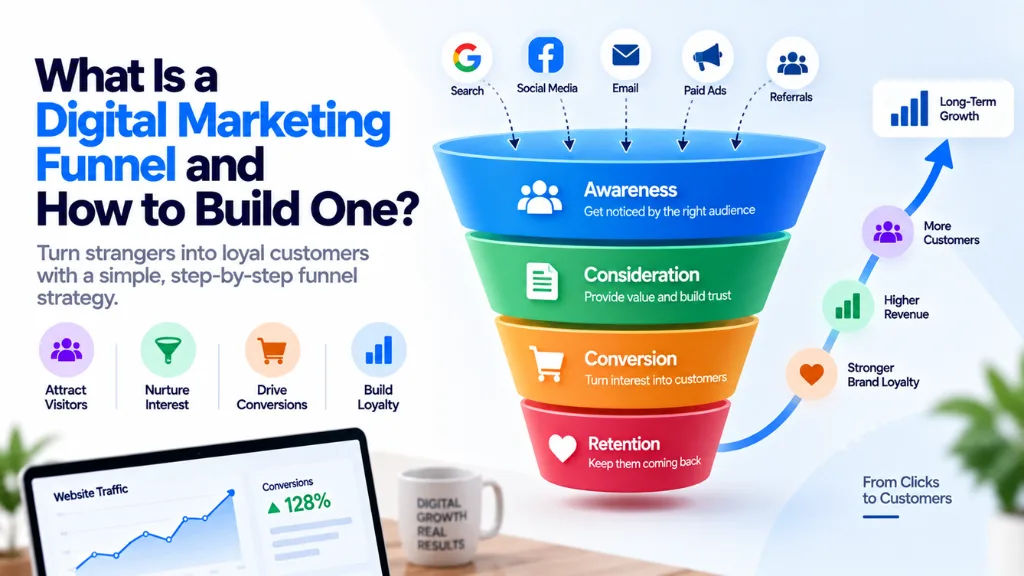
A digital marketing funnel is a model that maps the customer journey from someone’s first encounter with a brand through to purchase and, ideally, repeat business and referral. It’s called a funnel because a large number of people enter at the top with only casual awareness, and progressively fewer continue through each stage as they move toward an actual purchase decision.
The concept traces back further than digital marketing itself – the underlying model originates with AIDA (Awareness, Interest, Desire, Action), developed by Elias St. Elmo Lewis in 1898, more than a century before the internet existed. Every modern funnel framework used in digital marketing today, from TOFU/MOFU/BOFU to HubSpot’s flywheel, is either a descendant of or a direct response to that original structure.
The Core Stages: TOFU, MOFU, and BOFU, Plus the Loop After#
The most common shorthand splits the funnel into three working stages, commonly abbreviated TOFU, MOFU, and BOFU, with a fourth stage – retention and advocacy – that many funnel diagrams leave out despite its ongoing value.
| Stage | Buyer’s Mental State | Primary Goal | Typical Content | Primary Metrics |
| TOFU (Top of Funnel) | Has a problem but may not know your brand, or a specific solution, exists yet | Build broad awareness and educate, not sell | Blog articles, social content, SEO-driven pages, short-form video | Reach, impressions, CPM, traffic |
| MOFU (Middle of Funnel) | Knows the brand exists and is actively evaluating options | Build credibility and begin qualifying genuine interest | Comparison guides, webinars, email nurture sequences, case studies | CTR, cost per lead (CPL), engagement rate, landing page conversion rate |
| BOFU (Bottom of Funnel) | Close to a decision, wants final reassurance | Convert evaluation into an actual purchase | Product demos, free trials, testimonials, pricing pages, direct outreach | Conversion rate, CPA, ROAS, CAC |
| Retention & Advocacy (the loop) | Already a customer | Retain, satisfy, and turn customers into referral sources | Onboarding content, loyalty programs, review requests, customer success touchpoints | Retention rate, LTV, referral rate, LTV:CAC ratio |
Each stage represents a genuinely different mental state, which is why using the same content and message at every stage tends to underperform – someone who’s never heard of a brand needs a fundamentally different message than someone comparing it directly against two competitors.
Marketing Funnel vs. Sales Funnel#
These two terms are often used interchangeably, but they describe overlapping, not identical, scopes. A marketing funnel covers the full customer journey from initial awareness through purchase; a sales funnel typically refers specifically to the later stages, where a sales team actively works to convert a qualified prospect into a closed deal. In most organisations, marketing owns TOFU and early MOFU, while sales takes over from late MOFU through BOFU – though exactly where that handoff happens varies significantly by industry and how self-serve or sales-assisted the purchase process is.
Why the Funnel Is a Simplification: The Messy Middle#
The classic funnel assumes a steady, one-directional progression – awareness leads to consideration, which leads to a decision. Google’s own research into buyer behaviour, referred to as the “messy middle,” documented that real purchase journeys are nonlinear: buyers cycle repeatedly between exploration and evaluation before deciding, encountering dozens of touchpoints across many channels rather than moving through them once in sequence.
This matters practically in two ways. First, a prospect can re-enter the funnel at any stage – someone who already knows a brand well from a previous purchase might jump straight to a comparison-stage query, skipping the awareness content entirely. Second, a meaningful share of what actually influences a decision happens outside anything a funnel diagram can track – a recommendation in a private group chat, a review read on a third-party site, a question asked inside an AI chat tool – none of which show up as a clean, attributable step in a linear model.
HubSpot’s response to this reality was the flywheel model, which replaces the funnel’s dead end at purchase with a continuous loop: existing customers become the primary engine for new growth, through referrals, reviews, and organic advocacy, rather than treating acquisition as a one-way pipeline that ends the moment someone converts. A brand with a genuinely strong flywheel can spend less on cold top-of-funnel acquisition, since word-of-mouth and reviews fill part of that gap on their own.
None of this makes the funnel model obsolete – as a planning tool, it still forces a deliberate match between content, channel, and audience readiness, which a purely reactive, unstructured approach doesn’t provide. The correction worth internalising is simply that the funnel describes a set of buyer mindsets to design content around, not a literal, fixed sequence every prospect walks through in order.
How to Build a Digital Marketing Funnel: Step by Step#
Step 1: Define the Stages That Actually Fit Your Business#
Not every business needs a full five-stage model. A low-cost consumer product with a short, impulse-driven purchase cycle might move from awareness to purchase within the same session, making an elaborate MOFU nurture sequence unnecessary. A considered B2B purchase, by contrast, often genuinely benefits from a distinct middle stage with its own dedicated content, since that decision realistically takes weeks or months and involves multiple stakeholders.
Step 2: Map Content Types to Each Stage#
Content built for the wrong stage is a common cause of funnel underperformance. Awareness-stage content should educate around a problem, not pitch a specific product; middle-stage content should help someone genuinely evaluate options, including honest comparisons; bottom-stage content should remove final friction – pricing clarity, proof through testimonials or case studies, and a low-friction way to take the next step.
Step 3: Choose the Right Channel for Each Stage#
Different channels naturally suit different stages. Organic search and social content tend to perform well for top-of-funnel discovery, since they reach people who aren’t yet actively searching for a brand by name. Email nurture sequences and retargeting ads suit the middle stage, where the goal is staying present through an evaluation period. Direct outreach, demos, and highly targeted paid campaigns tend to convert better at the bottom, where intent is already established and the remaining question is which specific option to choose.
Step 4: Set Stage-Specific Metrics#
Measuring every stage against the same metric – typically direct conversions – misreads what most stages are actually meant to accomplish. Top-of-funnel content succeeding on reach and cost-efficient impressions is doing its job even if it generates few immediate conversions; judging it by conversion rate alone will consistently make awareness content look like a failure it isn’t.
Step 5: Build the Connective Tissue Between Stages#
A funnel with well-designed content at every stage still leaks prospects if nothing actively moves people from one stage to the next. This is where lead capture (email sign-ups, gated content), CRM-based nurture sequences, and retargeting campaigns matter – the mechanisms that keep a prospect who engaged with top-of-funnel content from simply disappearing rather than progressing toward a decision.
Step 6: Don’t Stop the Funnel at Purchase#
A funnel that treats conversion as the finish line misses the flywheel’s core insight: existing, satisfied customers are frequently the most cost-effective source of new business available, through referrals, reviews, and repeat purchases. Building retention-stage content – onboarding sequences, loyalty programs, and deliberate review requests – into the funnel from the start, rather than as an afterthought, compounds growth in a way pure top-of-funnel acquisition spend doesn’t.
Step 7: Instrument Tracking Across the Whole Journey#
A funnel is only as useful as the data confirming whether it’s actually working. Track which content and channels drive movement between each stage, not just final conversions – since, as with content marketing more broadly, a channel that never gets last-click credit for a sale can still be doing essential work earlier in the journey that a purely conversion-focused view would miss entirely.
Common Mistakes in Funnel Design#
- Chronically underfunding the middle. Top-of-funnel content gets the traffic budget and bottom-of-funnel gets conversion-optimisation attention, while the middle stage – arguably where evaluation actually happens – is often the most neglected part of the funnel.
- Designing the funnel around the sales process instead of how customers actually decide. A funnel structured to match internal sales stages rather than genuine buyer behaviour tends to lose people at exactly the points where it stops matching their real questions.
- Treating the funnel as strictly linear. Assuming every prospect moves neatly from top to bottom in order ignores how often people re-enter mid-journey, skip stages entirely, or bounce between evaluation and further research repeatedly before deciding.
- Stopping the funnel at the sale. Ignoring retention and advocacy discards one of the most cost-efficient growth levers available, particularly in markets where word-of-mouth and reviews carry real influence over new purchase decisions.
- Measuring every stage by the same metric. Judging awareness content by direct conversion rate, or bottom-of-funnel content purely by reach, misreads what each stage is actually meant to accomplish.
Frequently Asked Questions#
Is the traditional marketing funnel outdated in 2026? Not entirely, but it needs to be used as a planning framework rather than a literal, fixed sequence. Google’s own research into nonlinear buyer behaviour and HubSpot’s flywheel model both reflect a broader industry recognition that real customer journeys loop and re-enter rather than progressing in a straight line – the funnel’s stages remain useful for organising content and strategy even so.
What’s the difference between a marketing funnel and a sales funnel? A marketing funnel spans the full journey from initial awareness through purchase, while a sales funnel typically refers specifically to the later stages where a sales team works to close a qualified prospect. Marketing generally owns the top and early-middle stages, with sales taking over as intent solidifies, though the exact handoff point varies by business.
Do small businesses need a full multi-stage marketing funnel? Not necessarily a full, elaborate version. A business with a short, low-consideration purchase cycle may only need a simplified awareness-to-conversion path, while a business selling a higher-consideration product or service typically benefits from a more developed middle stage with dedicated nurture content.
What is the flywheel model, and how is it different from a funnel? The flywheel model, popularised by HubSpot, treats existing customers as an active engine for new growth – through referrals, reviews, and advocacy – rather than treating purchase as the funnel’s final, dead-end stage. It doesn’t replace the funnel’s stages so much as add a continuous loop back into the top of the journey.
Why is the middle of the funnel often the weakest part of a marketing strategy? It tends to be underfunded relative to the other stages – top-of-funnel gets traffic investment and bottom-of-funnel gets conversion-rate optimisation attention, leaving the evaluation stage, where prospects are actively comparing options, without the dedicated content and nurture investment it typically needs.
How do I know which metrics matter at each funnel stage? Match the metric to what that stage is actually meant to accomplish: reach and cost-efficient impressions for awareness, engagement and lead generation for consideration, and conversion rate or cost per acquisition for the decision stage. Applying a single conversion-focused metric across every stage misreads what earlier-stage content is actually doing.
The Bottom Line#
A digital marketing funnel is still a genuinely useful way to organise content, channels, and metrics around how a prospect actually thinks at different points in their decision – as long as it’s treated as a planning scaffold rather than a literal, one-directional path every customer follows in order. Build content deliberately for each stage’s real mental state, connect the stages with active nurture and retargeting rather than assuming people progress on their own, and extend the funnel past the sale into retention and advocacy, where much of the most cost-efficient growth actually comes from. Search Savvy’s content marketing services and content strategy and topical authority services help build the awareness and consideration stages of a funnel with genuine substance, performance marketing services support the bottom-of-funnel conversion work, and the marketing automation glossary is a useful reference for the nurture and automation terminology covered throughout this guide.