
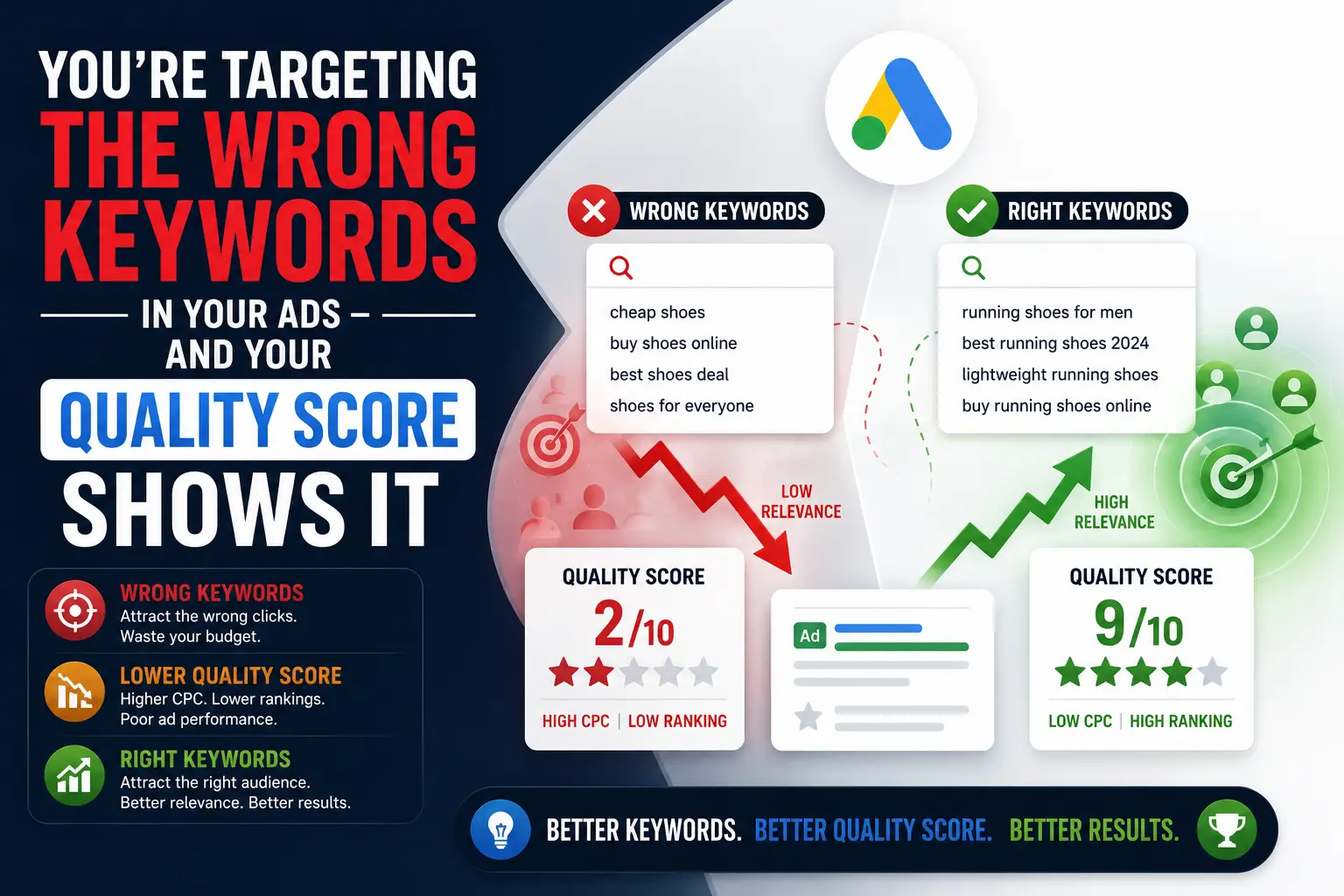

You are spending real money on Google Ads every single day. The campaigns are live. The budget is running. The keywords are in place. And your Cost Per Click is quietly, consistently higher than it should be – sometimes significantly higher than your competitors are paying for the exact same position.
The culprit is usually not your bid. It is not your targeting radius. It is not even your ad copy – at least, not primarily.
It is your keywords. And the Quality Score sitting next to them is telling you so.
Google Ads Quality Score improvement is one of the highest-leverage optimisation moves available in paid search – because a low Quality Score does not just reflect a problem. It creates one. It forces you to pay more per click, pushes your ads into lower positions, and signals to Google that your campaigns are misaligned with what searchers actually need. The problem compounds with every rupee of wasted spend.
At Search Savvy, we audit Google Ads accounts regularly – and the most consistently expensive mistake we find is advertisers targeting the wrong keywords for the wrong reasons, housed in loosely structured ad groups that make alignment between keyword, ad, and landing page nearly impossible. This article explains exactly how Quality Score works in 2026, why keyword choice is the root cause of most low scores, and what to do to fix it.
What Is Google Ads Quality Score and Why Does It Control Your CPC?
Google Ads Quality Score improvement starts with understanding that Quality Score is not just a diagnostic number – it is a direct multiplier on every rupee you spend.
Quality Score is a 1-to-10 rating Google assigns to each keyword in your account. It measures the quality and relevance of your keywords, ads, and landing pages. And it directly determines two things that affect your budget every day: how much you pay per click and where your ads appear in the auction.
The financial impact is stark. A keyword at Quality Score 1–3 can cost up to 400% more per click than the Quality Score 5 baseline. A keyword at QS 10 unlocks up to a 50% CPC discount. The arithmetic is immediate and brutal: fixing a keyword from QS 3 to QS 6 moves it from paying +67% above baseline to paying -17% – that is an 84-percentage-point CPC improvement on that keyword alone.
Quality Score is calculated from three components: expected click-through rate (CTR), ad relevance, and landing page experience. Research from Adalysis estimates their approximate weights:
| Component | Estimated Weight | What It Measures |
| Expected CTR | ~39% | How likely your ad is to be clicked for this keyword |
| Landing Page Experience | ~39% | How relevant and useful your landing page is after the click |
| Ad Relevance | ~22% | How closely your ad copy matches the keyword’s intent |
A keyword with “Above Average” ratings across all three components will typically score 7 or higher. Quality Score 7 or above is generally considered good. Below 5, you are paying a progressively steeper surcharge for the same ad position your competitor is earning at a significant discount.
People Also Ask: What is a good Google Ads Quality Score in 2026? Short Answer: A Quality Score of 7 or above is generally considered good. Keywords scoring 7 to 10 typically have “Above Average” ratings on at least two of the three components – expected CTR, ad relevance, and landing page experience. Quality Score 5 is the neutral baseline. Below 5, you are paying a CPC premium. Above 7, you receive a CPC discount that compounds across every click in the campaign.
How Does Wrong Keyword Targeting Destroy Your Quality Score?
Google Ads Quality Score improvement is impossible when your keyword strategy is built around the wrong signals. And in most underperforming accounts, keyword choice is the root cause – not the ad copy, not the bid strategy.
Wrong keyword targeting manifests in three specific ways that each attack a different Quality Score component.
1. Broad, Mixed Ad Groups Kill Ad Relevance
Google Ads Quality Score improvement is fundamentally about alignment – and alignment is impossible in a loosely structured ad group. Instead of broad, mixed ad groups, the highest-performing accounts break campaigns into tightly focused clusters where each keyword, ad, and landing page speaks the same language. This alone often improves ad relevance and CTR within weeks.
The most common structural mistake is placing keywords with different intent types into the same ad group. A B2B software company might group “project management software,” “project management tool free,” “project management app for teams,” and “what is project management” into a single ad group. These keywords represent four completely different user goals – a purchase intent, a free-tool seeker, a team buyer, and an information researcher. A single ad cannot satisfy all four intents. The result: below-average ad relevance on most terms, lower CTR, and a Quality Score that cannot break 5.
An ad group with 50 loosely related keywords needs generic copy. An ad group with 5–8 tightly themed keywords supports highly specific, high-CTR headlines written directly for that intent. The fix is structural: reorganise your ad groups so every keyword within a group shares the same search intent, and write ad copy specifically for that intent.
Professional Google Ads accounts are organised around tightly themed ad groups where keywords share a common intent and relevance cluster. This structure ensures that your Quality Score remains high because your keyword, ad copy, and landing page are all tightly aligned.
2. Wrong Match Types Generate Irrelevant Queries
Google Ads Quality Score improvement requires controlling which searches actually trigger your ads – not just which keywords you have added to your campaign.
Your keyword list is what you tell Google to target. Your Search Terms report shows what Google actually matched. The gap between them is where Quality Score problems and budget waste hide.
Broad match in 2026 is smarter and more dangerous in equal measure. Without sufficient conversion data to guide Smart Bidding, broad match keywords expand to queries far outside your intended targeting – generating clicks from users who have no realistic intent to buy, suppressing your CTR, and sending traffic to landing pages that do not match what they were searching for. Each of these damages a different Quality Score component simultaneously.
Exact match delivers the highest precision and lowest wasted spend. Phrase match balances reach and relevance and is the right default starting point for most campaigns. Broad match is more capable than ever in 2026, but only when paired with Smart Bidding and sufficient conversion data.
3. No Negative Keywords Means Your Ads Are Showing for the Wrong Searches
Google Ads Quality Score improvement is impossible without an aggressive negative keyword strategy. Negative keywords are one of the most effective ways to eliminate wasted spend by blocking irrelevant clicks from people who are unlikely to convert.
When your ads show for queries that are clearly misaligned – competitor brand searches, informational queries when you are targeting transactional intent, free-seeking searches when your product has no free tier – users click, find nothing relevant, and leave. Every one of those clicks reduces your CTR signal and damages your landing page experience score. The Quality Score drops. Your CPC rises. Your budget depletes faster on low-intent traffic.
Most well-managed accounts have at least 50–100 account-level negatives as a baseline, plus additional campaign-level and ad group-level negatives tailored to each campaign’s intent. E-commerce accounts often need 200 or more negatives across all levels.
People Also Ask: Why is my Google Ads Quality Score low even with good ad copy? Short Answer: Good ad copy cannot compensate for structural keyword problems. Low Quality Score despite strong creative almost always traces to one of three causes: keywords with different intent types grouped together (killing ad relevance), broad match keywords generating irrelevant queries (suppressing expected CTR), or a landing page that does not match the keyword’s specific intent (lowering landing page experience score). Fix the structure before rewriting the copy.
How Does Landing Page Experience Affect Quality Score?
Google Ads Quality Score improvement requires fixing what happens after the click – because landing page experience carries approximately 39% of the Quality Score weighting, equal to expected CTR.
Google evaluates your landing page for how well it addresses users’ search queries, tracking content clarity, page load speed, and mobile friendliness. The best way to improve your landing page experience score is to pick the most relevant page on your site for a particular ad group.
The most common landing page mistake in underperforming accounts is sending all ad traffic to the homepage. A homepage is designed to serve every possible visitor. A person who searched “SEO agency for e-commerce brands in Mumbai” and clicks your ad arrives with a very specific need. If they land on a homepage introducing your agency broadly across all services, the mismatch is immediate – and so is the exit.
If you want to show ads for the keyword “gold necklaces,” you want to send people to the category page with gold necklaces, not to your homepage which features all kinds of jewellery. If your page does not reflect what users were expecting, they will leave your site and go back to the search results.
The three landing page experience requirements that Quality Score evaluates:
- Content relevance – The page content must directly address the keyword intent. The primary keyword and related terms should appear in the headline, H1, and opening paragraph.
- Page load speed – When your page loads quickly across devices and contains content that users find useful, you can achieve an above-average landing page experience score. Pages failing Core Web Vitals thresholds receive below-average landing page experience ratings.
- Mobile experience – Google evaluates your landing page’s mobile rendering specifically. Unresponsive design, oversized images, and tap targets that are too close together all contribute to below-average mobile landing page scores.
If landing page experience is consistently poor across tightly themed keywords, that is usually not noise – that is friction. And friction in the landing page experience component is what drives the largest Quality Score improvements when fixed, precisely because it shares equal weighting with expected CTR.
People Also Ask: How does landing page experience affect Google Ads Quality Score? Short Answer: Landing page experience accounts for approximately 39% of Quality Score weighting – equal to expected CTR and higher than ad relevance. Google evaluates content relevance, page speed, mobile experience, and navigability. Sending ad traffic to a generic homepage instead of a specific, intent-matched landing page is the most common cause of below-average landing page experience scores, and fixing it often produces the largest single improvement in Quality Score.
What Is the Step-by-Step Google Ads Quality Score Improvement Framework?
Google Ads Quality Score improvement follows a specific sequence. Fixing the wrong component first produces limited results. Here is the correct order of operations:
Step 1 – Audit your current Quality Scores at keyword level.
Open Google Ads and navigate to Keywords. Add the Quality Score, Expected CTR, Ad Relevance, and Landing Page Experience columns to your view. Sort by Quality Score ascending to identify your most expensive problems first. Export the data and group keywords by their below-average components – this tells you which of the three problems is most prevalent in your account.
Step 2 – Restructure your ad groups around shared intent.
A practical keyword architecture for a new campaign: start with 3–5 core keyword themes based on your most valuable service or product categories. Within each theme, identify 5–10 keyword variants spanning phrase and exact match. Create separate ad groups for each theme, with dedicated ad copy and landing page alignment.
Each ad group should have a clear intent label. “Service X – informational” and “Service X – transactional” are different ad groups with different ad copy and different landing pages – even though both include the same service name.
Step 3 – Build a comprehensive negative keyword list immediately.
Build your negative keyword list in parallel with any match type strategy – it is not optional, it is structural. Review your Search Terms report every week to understand which queries are actually triggering your ads.
Add negatives at three levels: account level (queries that are never relevant to any campaign), campaign level (queries relevant to other campaigns but not this one), and ad group level (queries that belong in a different ad group within the same campaign). Daily, remove queries spending money that convert zero times.
Step 4 – Align every ad to its ad group’s specific intent.
After restructuring, rewrite your responsive search ads. Every headline and description should directly reflect the keyword intent of its specific ad group. Include the primary keyword in at least one headline. Match the CTA to the landing page’s primary conversion action.
Try grouping your keywords into themes to increase relevance. If your expected CTR has a status of “Below average” or “Average,” edit your ad text to make your offer more compelling to your target audience and ensure the details in your ad match the intent of your keywords.
Step 5 – Create or update landing pages for each ad group theme.
Every tightly themed ad group needs a landing page that reflects its specific intent. The page headline should match the ad’s primary value proposition. The body content should address the keyword’s specific user need. The CTA should ask for the next logical action for a user at that specific stage of consideration.
If users click but do not stay, Quality Score drops. Improve page speed, content clarity, and message match to ensure the experience after the click matches the promise made in the ad.
Step 6 – Monitor Search Terms weekly and maintain aggressively.
Google Ads Quality Score improvement is not a one-time fix – it is a weekly discipline. Search Terms Report mining: daily, remove queries spending money that convert zero times. Quality Score is recalculated continuously. The accounts that maintain high Quality Scores are the ones that treat the Search Terms report as a standing weekly agenda item, not an occasional audit.
According to Search Savvy’s insights from managing Google Ads accounts across multiple industries in India and internationally, the accounts that improve Quality Score fastest share one structural characteristic: they do not try to fix ad copy before fixing keyword structure. Ad copy improvements on a misstructured account produce marginal gains. Structural fixes – new ad groups, match type corrections, negative keyword lists – produce the step-changes in Quality Score that translate into CPC reductions visible within two to four weeks.
People Also Ask: How long does it take to improve Google Ads Quality Score after making changes? Short Answer: Quality Score is recalculated continuously based on accumulated performance data. Structural changes – tighter ad group themes, negative keyword additions, landing page updates – typically begin improving component scores within 1–2 weeks as the new data accumulates. Full Quality Score improvements are usually visible within 2–4 weeks of implementing structural fixes. Landing page experience updates can show improvement faster if the page changes are significant.
Why Does Quality Score Still Matter in 2026 When Smart Bidding Exists?
Google Ads Quality Score improvement is sometimes dismissed as outdated in the era of automated bidding and Advantage+ style automation. This is a costly misunderstanding.
Quality Score works best when you treat it as something that helps you understand how the system views expected CTR, ad relevance, and landing page experience. It may be pointing to real friction in the auction.
Smart Bidding optimises your bids given the Quality Score your keywords have. It does not override Quality Score. A keyword with QS 3 that Smart Bidding is optimising will always cost more and achieve lower positions than the same keyword at QS 7 – because the Ad Rank formula multiplies your bid by Quality Score, and Smart Bidding cannot compensate for a low multiplier with a higher bid indefinitely.
It is about tightening message match, refining search term coverage, improving landing page clarity, and strengthening alignment between intent and experience. These are human strategic decisions that automation cannot make on your behalf – because they require understanding what your customer actually needs at each stage of their journey and building the account architecture that reflects it.
At Search Savvy, we treat Quality Score as a diagnostic lens – the fastest way to identify which keyword, ad, and landing page relationships are creating friction in the auction. When a component is below average, it is a signal that something in the keyword-ad-landing page chain is misaligned. Finding that misalignment and fixing it is the highest-ROI optimisation available in a paid search account – before increasing budget, before testing new bid strategies, and before investing in new creative.
People Also Ask: Does Smart Bidding make Quality Score irrelevant in 2026? Short Answer: No. Smart Bidding optimises within the constraints of your Quality Score – it does not override it. A keyword at Quality Score 1–3 can cost up to 400% more per click than the Quality Score 5 baseline, regardless of how well Smart Bidding is configured. Quality Score is a multiplier in the Ad Rank formula, and Smart Bidding cannot compensate for a fundamentally low multiplier. Structural keyword quality must be addressed before bidding strategy can perform at its potential.
FAQ: Google Ads Quality Score Improvement – Your Questions Answered
Q1: What is the fastest single action to improve Quality Score? Restructuring loosely themed ad groups into tightly focused intent clusters is consistently the fastest structural fix. Instead of broad, mixed ad groups, breaking campaigns into tightly focused clusters where each keyword, ad, and landing page speaks the same language often improves ad relevance and CTR within weeks – without changing bids, budgets, or landing pages. After restructuring, update the ad copy to reflect each ad group’s specific intent. These two changes address ad relevance and expected CTR simultaneously.
Q2: Should I pause low Quality Score keywords or fix them? It depends on the keyword’s commercial value. High-intent keywords with low Quality Score should be fixed, not paused – because the traffic intent is valuable and the problem is structural rather than fundamental. Pause keywords that have historically generated no conversions despite sufficient impressions, or keywords that are clearly irrelevant to your offering. For commercially valuable keywords at QS 3–5, invest in structural fixes: tighter ad group theme, intent-specific ad copy, and a dedicated landing page. The CPC reduction from moving a keyword from QS 3 to QS 7 justifies the optimisation investment on high-volume terms.
Q3: How many keywords should each ad group contain in 2026? Aim for 5 to 15 tightly themed keywords per ad group, with a named theme that makes the grouping logic explicit. This is the Single Theme Ad Group (STAG) approach that has largely superseded Single Keyword Ad Groups (SKAGs) at scale. Five to fifteen keywords that share the same search intent give Google’s algorithms sufficient data per ad group to learn effectively, while remaining specific enough to support highly relevant, high-CTR ad copy written directly for that intent.
Q4: How do negative keywords affect Quality Score? Negative keywords improve Quality Score indirectly but powerfully. By preventing your ads from showing for irrelevant or low-intent queries, negatives protect your expected CTR signal from being diluted by impressions on searches that are unlikely to click. They also prevent irrelevant traffic from landing on pages that do not match their intent – protecting your landing page experience score. Adding to negative keywords stops wasted spend, especially with broad or phrase matches. Well-managed accounts review their Search Terms report weekly and add negatives continuously.
Q5: Can I check Quality Score in Google Ads and see what is driving it below average? Yes. In Google Ads, navigate to Keywords and add the Quality Score columns: Quality Score, Landing Page Exp., Ad Relevance, and Exp. CTR. Each component shows “Above average,” “Average,” or “Below average” – identifying exactly which element is pulling your score down. Look through your high-performing keywords and use Quality Score to identify which ones may do even better with changes to your ads and landing pages. Use low Quality Scores and component status to find weaker trends for ad relevance, clickthrough rate, and landing page experience that might exist across your account. This diagnostic view is the fastest way to identify which structural fix will have the largest impact.
Q6: Is it worth building separate landing pages for each ad group? For high-spend, high-intent ad groups, yes – and the ROI is measurable. An advertiser struggling with a £40 CPC can drop to £22 after fixing landing page experience and tightening ad group themes. Dedicated, intent-matched landing pages improve landing page experience scores, which carry approximately 39% of Quality Score weighting. They also improve conversion rates – the same alignment that Google rewards with lower CPCs also reduces the friction that prevents visitors from converting. At Search Savvy, dedicated landing pages for top-priority ad groups are a standard recommendation in every paid search audit, particularly for campaigns in competitive Indian verticals where CPC premiums from low Quality Scores compound significantly over monthly budgets.
Paying more per click than you should be – or watching budget disappear without conversions to show for it? Visit Search Savvy for a Google Ads Quality Score audit and a clear, keyword-level fix plan that reduces your CPC and improves your position without increasing your budget.