
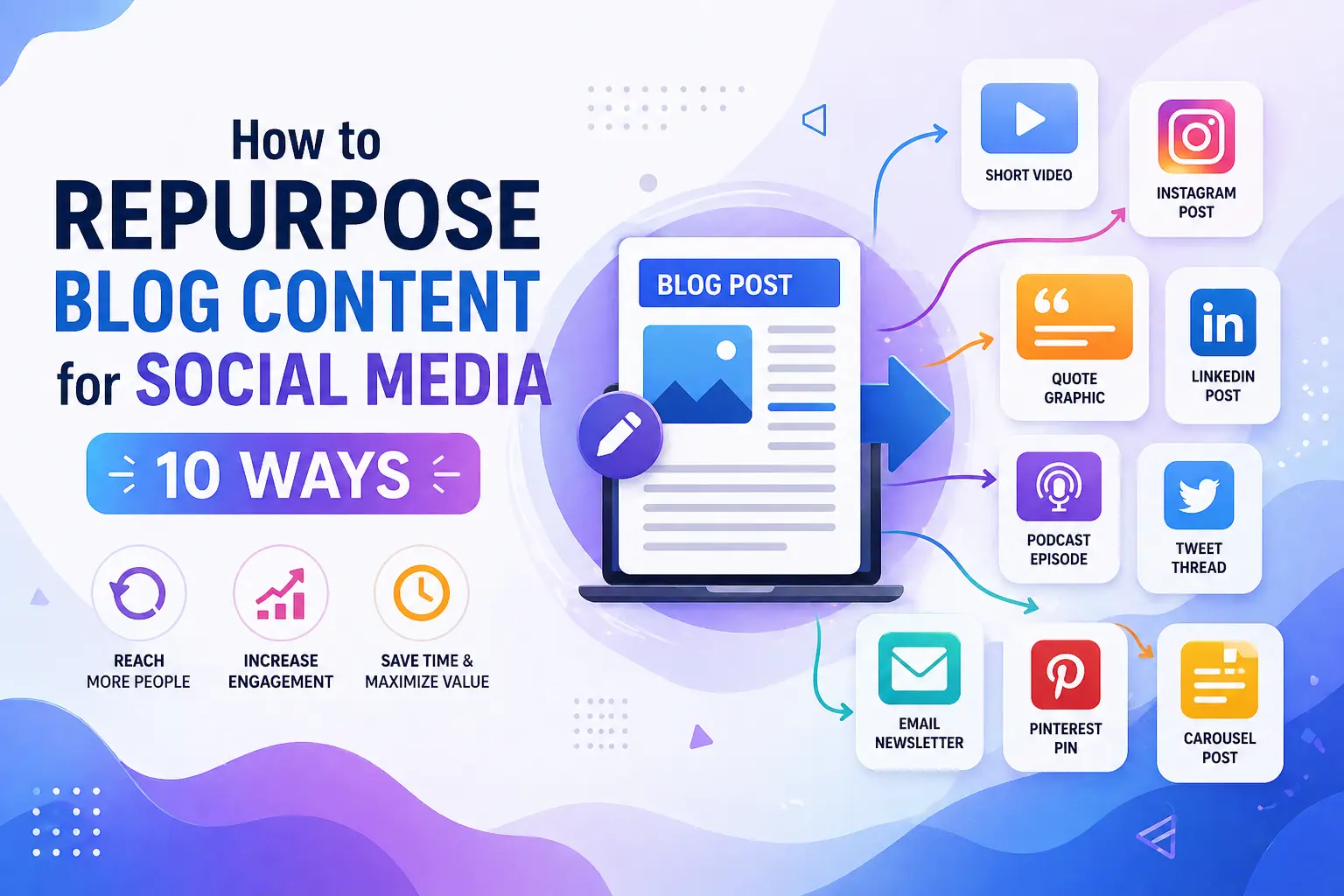

Repurpose blog content – three words that represent one of the highest-leverage, lowest-effort strategies in modern content marketing. According to the SEMrush Content Repurposing Study 2026, 94% of marketers who repurpose content say it increases their ROI, while businesses that systematically repurpose content see 300% greater reach and 40% higher content output without proportionally more production time. Yet the majority of businesses still publish a blog post, share it once on social media, and leave it to die quietly in their archives. At Search Savvy, we treat every well-researched blog post as a content asset – not a one-time event. One 1,500-word post should power weeks of social media presence across multiple platforms, reaching audiences who will never visit your blog but are active on Instagram, LinkedIn, or YouTube every single day.
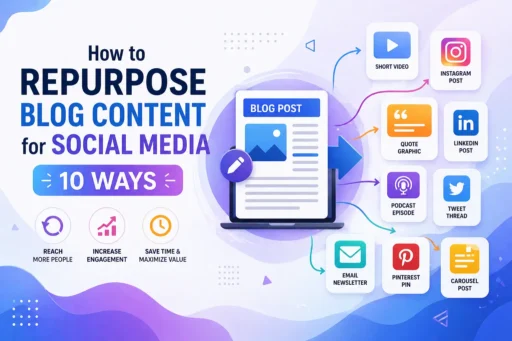
This guide covers 10 proven, platform-specific ways to repurpose blog content for social media in 2026 – with practical guidance on adapting each format for maximum engagement, reach, and ROI.
Why Should You Repurpose Blog Content for Social Media in 2026?
Repurpose blog content because the average person now uses 6.8 different social media networks per month and spends over 14 billion hours on social platforms daily. Your blog post, however excellent, reaches only the fraction of your audience that finds it through search or email. Social media reaches everyone else – but only if your content speaks each platform’s native language.
The data makes the case compellingly:
- 94% of marketers who repurpose content report higher ROI (SEMrush, 2026)
- Businesses that repurpose content see double the engagement rates compared to those relying solely on original content (HubSpot)
- Repurposing content increases results by 75% without a proportional increase in investment (Curata)
- Businesses that repurpose see a 30% increase in organic traffic compared to those that don’t
- 21% of marketers say short-form videos deliver the highest ROI of any content type (HubSpot 2026)
Repurpose blog content and you immediately multiply the number of audience entry points to your expertise – without starting from scratch. Every repurposed piece drives discovery, builds authority, and supports your SEO by generating social signals and brand mentions that AI search engines in 2026 actively use as credibility indicators.
What Is the Best System for Repurposing Blog Content?
Repurpose blog content most effectively using a three-stage framework: Create the Asset → Extract the Components → Adapt and Distribute.
Stage 1: Choose a cornerstone post. Not every blog post is worth repurposing equally. Prioritise posts that are evergreen (not time-sensitive), high-performing (strong traffic or engagement), or strategically important (covering your core services or expertise areas). A 2,000-word blog post contains at least 10–12 individual insights, statistics, frameworks, or examples – each of which can become a standalone piece of social content.
Stage 2: Atomise the content. Go through your post and extract every discrete, valuable idea: key statistics, step-by-step processes, before/after comparisons, bold claims, expert quotes, and actionable tips. Each “content atom” is a potential social post.
Stage 3: Adapt for each platform. The critical rule: adapt, never copy-paste. Platform cultures are distinct. A LinkedIn post pasted to Instagram without adaptation looks out of place and performs poorly. Format, tone, length, and call-to-action must all be recalibrated for each destination.
10 Ways to Repurpose Blog Content for Social Media
Way 1: Transform Your Post Into Short-Form Video (Reels, TikTok, Shorts)
Repurpose blog content into short-form video and you tap into the highest-ROI content format in 2026. Over 85% of internet users consume video content monthly, and businesses that repurpose blog posts into videos see a 50% increase in engagement. Short-form videos under 60 seconds are the most shared content type on social media across Instagram Reels, TikTok, and YouTube Shorts.
How to do it:
- Pick one key insight, tip, or statistic from your blog post – not the entire article
- Write a punchy 30–60 second script that opens with a hook, delivers the value, and closes with a CTA
- Record using your phone (authenticity beats production quality for short-form video in 2026)
- Add on-screen text, captions, and your branding
- Link the full blog post in your bio or in a pinned comment
One blog post can generate 3–5 short-form videos this way – each focusing on a single insight.
Way 2: Design LinkedIn Carousel Posts
Repurpose blog content into LinkedIn carousels and you reach the platform where 80% of all B2B social media leads originate (LinkedIn Marketing Solutions, 2026). Carousel posts – multi-slide, swipeable formats – consistently outperform single-image posts on LinkedIn in both reach and engagement, and they’re one of the most effective formats for sharing structured, educational blog content.
How to do it:
- Take your blog’s main steps, tips, or framework and assign one point per slide
- Slide 1: Bold hook (the problem or promise)
- Slides 2–9: One insight, tip, or step per slide – short text, clean design
- Final slide: Summary + CTA with your website link and branding
Tools like Canva make carousel design fast and professional without a graphic designer.
Way 3: Create Instagram and Facebook Infographics
Repurpose blog content that is rich in statistics, steps, or comparisons into infographics – and give it new life on Instagram and Facebook. 51% of marketers who regularly use infographics say they yield high ROI, and infographic content earns 3x more social media engagement than standard blog posts.
How to do it:
- Identify the most data-rich or visually logical section of your blog (statistics lists, comparison tables, numbered frameworks)
- Use Canva or Adobe Express to convert it into a vertical infographic (1080 × 1920px for Instagram Stories, 800 × 2000px for feed posts)
- Add your brand colours, logo, and website URL
- Post with a caption that summarises the key takeaway and invites followers to save the post for later
Way 4: Write LinkedIn Text Posts From Key Insights
Repurpose blog content by extracting your single most compelling statistic, counterintuitive insight, or actionable tip and turning it into a standalone LinkedIn text post. LinkedIn’s algorithm in 2026 actively amplifies well-structured text posts – particularly those that generate comments in the first 60 minutes.
High-performing LinkedIn text post structure:
- Line 1: Bold hook (a surprising stat, a question, or a bold claim from your post)
- Lines 2–5: Expand on the insight in 3–5 short, punchy sentences
- Lines 6–9: 3–5 bullet points with supporting data or examples
- Final line: Soft CTA (“What’s been your experience with this? Drop a comment.”)
At Search Savvy, we recommend batching 3–5 LinkedIn text posts from every major blog post in a single sitting – turning a two-hour blog post into a month of LinkedIn content with an additional 30 minutes of extraction work.
Way 5: Convert Your Post Into a Twitter/X Thread
Repurpose blog content into a numbered Twitter/X thread and you access one of the platform’s consistently highest-engagement formats. Threads are particularly effective for step-by-step how-to content, numbered lists, and analytical breakdowns – formats that are common in well-structured blog posts.
Thread structure for maximum engagement:
- Tweet 1: Hook – “I analysed [X]. Here’s what I found: (thread 🧵)”
- Tweets 2–9: One step, insight, or tip per tweet (max 280 chars each)
- Final tweet: Summarise + link to the full blog post
A 10-point blog post becomes a 10-tweet thread. Add visuals, data highlights, or short video clips to individual tweets for additional reach.
Way 6: Turn Statistics Into Quote Graphics for Instagram and Pinterest
Repurpose blog content by pulling out your three most striking statistics or expert quotes and designing standalone quote graphics. These formats are highly shareable on Instagram, Pinterest, and Facebook – and they build brand authority signals that AI search engines in 2026 increasingly use to assess credibility.
How to do it:
- Extract statistics formatted as bold, attributable statements: “94% of marketers say content repurposing increases ROI – SEMrush 2026”
- Design clean, on-brand graphics using Canva or Adobe Express
- Pin your best-performing quote graphics to Pinterest boards categorised by topic
- Share on Instagram with a caption expanding on why that statistic matters to your audience
Way 7: Extract Email Newsletter Sections
Repurpose blog content into your email newsletter – your highest-converting owned channel. Email newsletters powered by existing blog content deliver 3x more engagement than social posts alone (Litmus / Campaign Monitor, 2026), with no algorithm risk. Your newsletter audience has already opted in; they’re your most qualified reader.
How to do it:
- Write a 150–200 word newsletter introduction that presents the blog post’s core insight or most surprising finding
- Include 3–5 bullet-point takeaways from the post
- Add a clear CTA: “Read the full guide → [link]”
- Use tools like Mailchimp or Brevo to schedule and track open rates
Way 8: Record a Podcast Episode or Audio Summary
Repurpose blog content into an audio format and tap into an audience of over 500 million active podcast listeners worldwide in 2026. Podcast production costs have dropped 60% since 2024 due to AI editing tools, making audio repurposing more accessible than ever – and listener engagement has increased 45% as a result of improved content quality.
How to do it:
- Read your blog post aloud with conversational additions – personal anecdotes, expanded examples, reactions to the data
- Edit using Descript or Adobe Podcast (both use AI to remove filler words and improve audio quality automatically)
- Publish on Spotify for Podcasters and Apple Podcasts
- Share the episode link on social media with an audiogram clip (a waveform-animated short audio snippet) for Instagram and LinkedIn
Way 9: Build a YouTube Long-Form Video
Repurpose blog content into a YouTube video and combine the long-term compounding traffic of YouTube SEO with the reach of the world’s second-largest search engine. YouTube is particularly effective for how-to, tutorial, and explainer content – the exact formats that well-structured blog posts naturally support.
How to do it:
- Use your blog post as your video script structure: each H2 becomes a section of the video
- Record a screen-share walkthrough (ideal for tutorials), a talking-head video (ideal for opinion pieces), or a combination
- Optimise your YouTube title with your primary keyword, add a keyword-rich description, and include timestamps matching each H2 section
- Link the full blog post in the video description and pin a comment with the link
YouTube videos are also a source of additional repurposable content – pull 3–5 short clips from your long-form video for Reels, Shorts, and TikTok.
Way 10: Create Pinterest How-To Boards and Step-by-Step Pins
Repurpose blog content into Pinterest pins and you access a platform with uniquely long content longevity – Pinterest content can drive traffic for months or years after posting, unlike the 24–48 hour lifespan of most social media posts. Pinterest is especially effective for how-to, tutorial, recipe, design, and educational content – all common blog formats.
How to do it:
- Extract each numbered step or section from your blog post and design a vertical pin for each one (1000 × 1500px)
- Create a “Step 1 of 6” pin series – each pin links back to the full blog post
- Organise pins into themed boards by topic (e.g., “SEO Tips,” “Content Strategy,” “Local SEO”)
- Use keyword-rich descriptions for each pin – Pinterest functions as a visual search engine and its SEO rules mirror standard keyword optimisation
People Also Ask: Content Repurposing Questions
How many social media posts can you get from one blog post?
A 2,000-word blog post can generate 10–30 platform-native social media posts using the content atom method. A single post can typically produce: 3–5 short-form videos, 1 LinkedIn carousel, 1–2 infographics, 5–8 LinkedIn text posts or Twitter/X tweets, 1 email newsletter section, 1 podcast episode, and 5–10 quote graphics. The actual number depends on the richness of the source content.
Is repurposing content bad for SEO?
No – repurposing blog content for social media is not duplicate content and does not harm SEO. Google’s duplicate content concerns apply to indexable web pages with the same or very similar text. Social media posts are not indexed in the same way, and the brand mentions, social signals, and backlinks that repurposed content can generate are positive SEO signals. Always link back to the original blog post from your social repurposing to strengthen its authority.
What is the best platform to repurpose blog content for in 2026?
The best platform depends on your audience. LinkedIn is essential for B2B businesses (80% of B2B social leads). Instagram Reels and TikTok deliver the highest reach and engagement growth for consumer brands. YouTube provides the longest content longevity and best SEO compounding. Pinterest suits visual niches and how-to content with exceptional long-term traffic. Search Savvy recommends starting with the one or two platforms where your target audience is most active, mastering repurposing there, then expanding.
Frequently Asked Questions (FAQ)
Q1: How often should I repurpose a blog post into social content? There’s no upper limit – but a practical starting point is extracting 5–7 social assets from each new blog post, distributed across 2–4 weeks. Spreading repurposed content out prevents your social feed from feeling repetitive. Evergreen posts can be repurposed on a 90-day rotation cycle – resharing your best content every quarter with fresh framing reaches new followers who weren’t there the first time.
Q2: What tools make content repurposing faster in 2026? The most effective repurposing toolkit in 2026 includes: Canva for graphics and carousels, Descript for video and audio editing, Adobe Express for quote graphics and infographics, Mailchimp or Brevo for email, and a social media scheduling tool like Buffer or Heropost to batch and automate distribution. AI writing tools like Claude or ChatGPT can dramatically speed up caption writing and format adaptation.
Q3: Should I always link back to the original blog post in social repurposing? Yes – where platform features allow. Always include a link to the original blog post in LinkedIn posts, Twitter/X threads, email newsletters, YouTube descriptions, and Pinterest pins. For platforms where links don’t work in captions (Instagram feed posts, TikTok), direct followers to the link in your bio or use a link-in-bio tool like Linktree. Driving traffic back to the original post builds its authority signals and supports its Google rankings.
Q4: How do I know which blog posts are worth repurposing first? Prioritise posts by three criteria: (1) Performance – posts already driving traffic or engagement have proven their resonance; repurposing them amplifies a proven asset. (2) Evergreen value – posts covering fundamental topics that don’t expire (how-to guides, strategy frameworks, tool comparisons) have long repurposing shelf lives. (3) Strategic importance – posts about your core services or target keywords deserve the widest possible distribution. Check Google Search Console for your top-impression and top-click posts – these are your highest-priority repurposing candidates.
Q5: Is it effective to repurpose older blog posts, or only new ones? Older, evergreen blog posts are often the best candidates for repurposing – particularly if they were published before you had a systematic distribution strategy. Updating a high-performing older blog post with fresh 2026 data and repurposing it across social media simultaneously delivers two wins: refreshed search rankings and a new social media content cycle from proven material. Research shows that updating old blog posts can boost traffic by 146%.
Q6: How do I avoid making repurposed content feel repetitive? Vary the angle with each repurposed piece. The same blog post insight can be reframed as a “mistake to avoid,” a “how-to step,” a “surprising statistic,” a “personal experience story,” or a “question to your audience” – each frame feels fresh even though the underlying information is the same. Adapt tone and format for each platform. Use the 85-15 content rule: 85% value (education, inspiration, entertainment), 15% promotion. Spreading repurposed content over 3–4 weeks also prevents oversaturation.
Final Thoughts
Repurpose blog content and you transform your content operation from a single-channel, single-impression asset into a multi-platform, multi-format content engine. The math is compelling: one well-researched blog post, systematically atomised and adapted, can power 20–30 pieces of social content – reaching audiences across LinkedIn, Instagram, YouTube, TikTok, Pinterest, and email that would never encounter the original post.
In 2026, content repurposing is not a shortcut. It’s the intelligent alternative to the exhausting cycle of creating from scratch for every platform. With 94% of marketers reporting higher ROI from repurposing, the only question is not whether to do it – it’s why you haven’t built the system yet.
Search Savvy helps businesses build content strategies that make every blog post work as hard as possible – from initial keyword research and writing to systematic repurposing across the social media channels your audience actually uses.