Content Clusters and Pillar Pages: The Ultimate Guide

Content Clusters and Pillar Pages have become the defining content architecture of modern SEO – and in 2026, they’re no longer a competitive advantage. They’re the baseline expectation. Google’s algorithms have fundamentally shifted from rewarding individual keyword-optimised pages to favouring websites that demonstrate comprehensive, interconnected topical authority. Sites that implement content clusters correctly see an average 40% increase in organic traffic compared to non-clustered content strategies, while businesses with clear topic cluster architecture generate 34% more organic traffic growth than those still using traditional blog structures. At Search Savvy, content cluster strategy is the first architecture decision we make for every new content engagement – because without it, even great individual posts consistently underperform their potential.
In this article19 sections
This ultimate guide explains exactly what content clusters and pillar pages are, how they work, why they matter more than ever in 2026, and the step-by-step process to build yours from scratch.
What Are Content Clusters and Pillar Pages?#
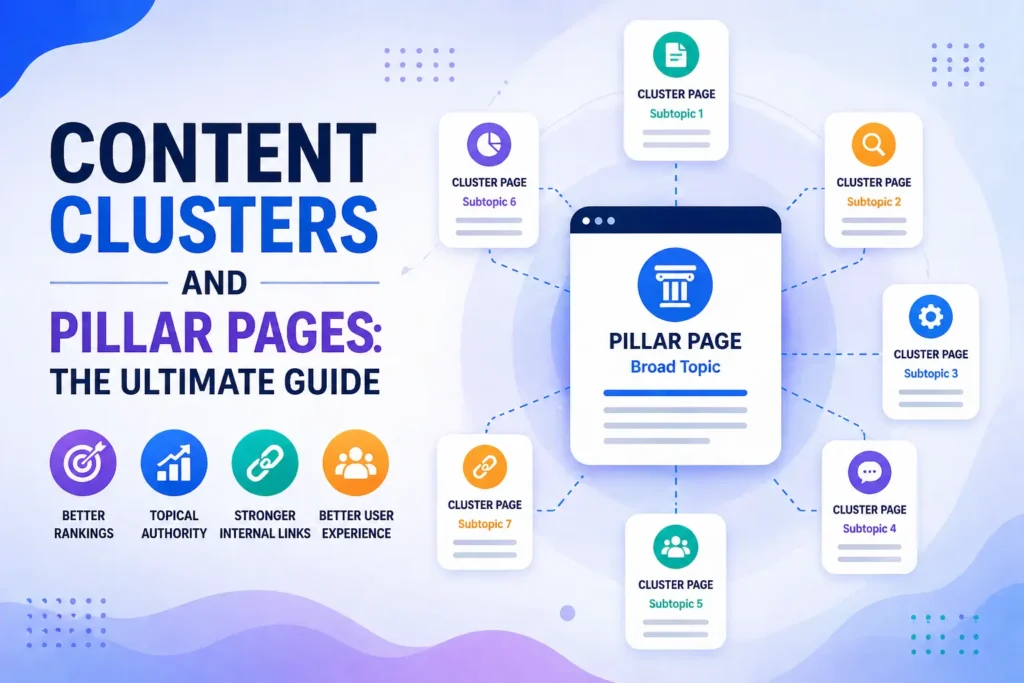
Content Clusters and Pillar Pages are a structured content architecture model built around three core components:
1. The Pillar Page The pillar page is your comprehensive, authoritative hub on a broad topic. It covers the subject at a high level, answers the most fundamental questions, links out to every cluster page, and serves as the canonical authority on that subject for both users and search engines. Pillar pages typically require 3,000–5,000 words to cover a broad topic comprehensively. Thin pillar pages – those under 2,000 words – consistently undermine the entire cluster’s authority signal.
2. Cluster Pages (Supporting Content) Cluster pages are individual, in-depth articles that each explore one specific sub-topic or “micro-intent” related to the pillar’s broad theme. Each cluster page goes deeper than the pillar on its specific angle, targets a distinct long-tail keyword, and always links back to the pillar page. Successful content cluster models typically require 10–15 cluster pages per pillar to build meaningful topical authority signals.
3. Internal Links Internal links are the connective tissue that transforms a collection of related articles into a functioning content cluster. Every cluster page links back to the pillar using anchor text containing the pillar’s target keyword. The pillar page links to every cluster page. Where relevant, cluster pages link to each other. This bidirectional linking architecture creates what SEO professionals call a “semantic web” – a structure that Google’s algorithm can recognise as evidence of genuine, comprehensive expertise.
A visual example:
PILLAR PAGE: “The Complete Guide to Local SEO”
↕ Internal links
├── Cluster: Google Business Profile Optimisation
├── Cluster: NAP Consistency for Local SEO
├── Cluster: Local SEO Checklist
├── Cluster: How to Get More Google Reviews
├── Cluster: Local Keyword Research Guide
└── Cluster: Local Link Building Strategies
Each cluster page links back to the pillar. The pillar links to every cluster. Together, they signal to Google that your site owns the “Local SEO” topic space.
Why Do Content Clusters and Pillar Pages Matter in 2026?#
Content Clusters and Pillar Pages matter more in 2026 than at any previous point in SEO history – and the reason is Google’s fundamental shift in how it evaluates authority.
For years, SEO was treated as a collection of isolated keyword battles. Publish a page optimised for a keyword, build some backlinks, wait for rankings. That approach produced diminishing returns as Google’s Helpful Content system grew more sophisticated at evaluating the depth and coherence of a site’s topical knowledge.
In 2026, Google’s algorithm assesses topical authority: does this website demonstrate genuine, comprehensive expertise across an entire subject area? The answer is determined not by any single page, but by the interconnected network of pages covering that topic – how many, how deeply, and how coherently they link to each other.
Why isolated pages fail in 2026:
- Keyword cannibalization – multiple pages competing for similar terms weaken each other
- Lack of depth – Google recognises that standalone pages don’t signal genuine expertise
- No authority signal – without topical connectivity, there’s no evidence of comprehensive subject matter knowledge
- Isolated link equity – backlinks to one page strengthen only that page, not your overall topical authority
Why content clusters succeed:
- A site with 20 interconnected articles on email marketing will consistently outrank a site with one 5,000-word guide on the same topic – even if the single article is technically superior
- Cluster performance compounds over 6–12 months: authority accumulates as Google indexes more cluster pages and as internal links distribute equity through the structure
- Sites sustaining cluster publishing for 12+ months see 40% higher organic traffic than comparable single-page strategies
Content Clusters and Pillar Pages also align with how AI search engines evaluate content in 2026. Google AI Overviews, ChatGPT, and Perplexity all prefer sources that demonstrate comprehensive coverage of a topic – not one-off pages on isolated keywords. A well-structured cluster makes your site a more reliable citation source across an entire topic area.
How Do Content Clusters and Pillar Pages Work?#
Content Clusters and Pillar Pages work by leveraging three mechanisms simultaneously:
1. Topical Authority Signalling#
Google’s algorithm evaluates your site’s coverage breadth and depth for each topic. When it crawls your site and finds a pillar page linking to 12 cluster pages – each covering a distinct sub-topic, each linking back to the pillar – it recognises a coherent topical knowledge base. This signals that your site is a genuine authority on the subject, not a keyword-stuffed document farm.
The key insight: Google evaluates what a site covers holistically, not page by page. A cluster is scored as a unit.
2. Internal Link Equity Distribution#
Content Clusters and Pillar Pages create a controlled network for distributing PageRank across your content. The pillar page – typically the most authoritative page in the cluster due to backlinks – passes link equity to every cluster page through its outbound internal links. Each cluster page reinforces the pillar by linking back to it with keyword-rich anchor text.
A controlled A/B test by SearchPilot demonstrated that expanding internal linking achieved a 5% uplift in organic traffic for linked destination pages. Across a full content cluster, this effect compounds.
3. Keyword Cannibalization Prevention#
Content Clusters and Pillar Pages solve one of the most common and most damaging SEO problems: keyword cannibalization, where multiple pages on your site compete for the same query. The cluster model assigns a clear “winner” for each query – one page, one intent. The pillar wins broad queries; cluster pages win specific long-tail queries. Google knows exactly which page to rank for which search.
How Do You Choose Topics for Content Clusters and Pillar Pages?#
Content Clusters and Pillar Pages require careful topic selection – and the best pillar topics share three characteristics:
1. Broad enough for a pillar page A pillar topic must be broad enough to generate 10–15 distinct sub-topics that each merit their own in-depth article. “Local SEO” is a strong pillar topic. “How to add photos to your Google Business Profile” is too narrow – it belongs as a cluster page.
2. Aligned with your core business expertise Pillar topics should directly reflect your business’s areas of expertise and your customers’ primary pain points. Google’s March 2026 Core Update amplified E-E-A-T signals, rewarding first-hand experience content and penalising sites that published outside their genuine authority zone. HubSpot’s cautionary tale bears repeating: publishing pillar content outside your core expertise contributed to an 80% organic traffic decline when Google recalibrated their E-E-A-T signals.
3. Commercially connected The best pillar topics connect to your service offerings. An SEO agency’s pillar pages might cover “Local SEO,” “Technical SEO,” “Content Strategy,” and “Link Building” – each directly supporting a core service with measurable business value.
Topic selection process:
- List your 4–6 core business topics or service areas
- Use Ahrefs Keywords Explorer or Semrush Keyword Magic Tool to identify head terms with 1,000–10,000+ monthly searches per topic
- Validate that each topic generates at least 10 distinct sub-topics (potential cluster pages) by searching the head term and reviewing People Also Ask, related searches, and competitor content
- Prioritise topics where competitors have thin cluster coverage – the opportunity to be the most comprehensive resource in an underserved topic cluster is the highest-ROI starting point
How Do You Build a Pillar Page That Ranks?#
Content Clusters and Pillar Pages start with building a pillar page worthy of the authority it’s supposed to represent. A pillar page that ranks in 2026 requires:
Comprehensive Topic Coverage (3,000–5,000 words)#
Your pillar page must answer the primary question the topic poses at a high level, then introduce every major subtopic – without going so deep on any one angle that you overlap with your cluster pages. Think of the pillar as your “city centre map”: it shows what’s available and where to go, with links to the detailed pages.
Pillar page structure:
- Introduction: what the topic is and why it matters (with a direct answer in the first 100 words)
- 6–8 H2 sections, each covering a major sub-topic at overview level
- Internal links from each H2 section to the relevant cluster page
- FAQ section with FAQPage schema markup
- Conclusion with a summary and CTA
Question-Based Heading Structure#
Every H2 and H3 in your pillar page should be phrased as a question. This serves three SEO functions simultaneously: it mirrors People Also Ask query formats, supports voice search optimisation, and signals to AI engines that your page directly answers specific questions – increasing citation probability in AI Overviews.
Article Schema with dateModified#
Add BlogPosting or Article schema with a dateModified field that reflects when the page was last updated. AI engines strongly prefer sources updated within the past 90 days. Treat your pillar pages as living documents – refresh statistics, add new sub-topics, and update the schema timestamp at least quarterly.
According to Search Savvy’s content architecture framework, pillar pages should be reviewed and refreshed every 90 days minimum – and every time a new cluster page is published, it should be linked from the pillar immediately. Stale pillar pages and newly orphaned cluster pages are the two most common reasons content clusters underperform.
How Do You Build Cluster Pages That Support Your Pillar?#
Content Clusters and Pillar Pages require cluster content that is genuinely more specific and more useful than the overview coverage in the pillar. Each cluster page should:
- Target one specific long-tail keyword (3–5 words) related to the pillar’s head term
- Cover a single, distinct sub-topic in depth (typically 1,500–2,500 words)
- Answer the question raised by its heading completely, without requiring the reader to visit the pillar
- Include a contextual link back to the pillar using anchor text containing the pillar’s target keyword
- Link to 2–3 related cluster pages (where the connection is natural and genuinely helpful)
Micro-intent targeting is critical. Instead of one general cluster page on “Google Business Profile photos,” create distinct cluster pages for:
- “How many photos should I upload to my Google Business Profile?”
- “What types of photos should a restaurant upload to Google Business Profile?”
- “How do Google Business Profile photos affect local rankings?”
Each micro-intent becomes its own cluster page. Optimising for micro-intents can increase click-through rates by up to 33% (Moz) because Google and AI engines prioritise content tailored to ultra-specific queries.
How Do You Measure Content Cluster Performance?#
Content Clusters and Pillar Pages are measured differently from individual blog posts. The key metrics:
- Organic impressions for the cluster (the sum of all pages’ impressions in Google Search Console)
- Average position improvements across the cluster’s target keywords over time
- Internal link click-through rates – are readers navigating from cluster pages to the pillar and vice versa?
- AI citation rate – how often do queries in your topic area trigger AI Overviews or GPT responses citing your pillar or cluster pages?
- Traffic to the cluster as a unit – track in Google Analytics 4 using a content group filter for all cluster URLs
Expect cluster performance to compound. Month 1–3 typically shows minimal movement. Month 4–6 shows measurable ranking improvements as Google indexes the full cluster. Months 7–12 produce the most significant traffic increases as topical authority fully consolidates.
People Also Ask: Content Clusters and Pillar Pages#
What is the difference between a pillar page and a landing page?#
A pillar page is a comprehensive, educational resource covering a broad topic and linking to cluster content – designed for organic search visibility and topical authority building. A landing page is a focused, conversion-oriented page designed for a specific campaign, paid traffic, or one single call to action. They serve fundamentally different purposes and should not be confused in your content architecture planning.
How long should a pillar page be in 2026?#
Pillar pages require 3,000–5,000 words to cover a broad topic comprehensively enough to signal genuine authority. Pages shorter than 2,000 words consistently undermine the cluster’s authority signal. However, length must serve depth – a 3,000-word pillar covering every angle of a topic outperforms a 6,000-word pillar padded with repetitive content.
Can you start building a content cluster without a pillar page?#
Yes – and many SEO experts actually recommend creating cluster pages first. Publishing cluster content before the pillar means your internal linking strategy is fully prepared when you launch the pillar, making it immediately effective as the cluster’s central hub from day one of publication.
Frequently Asked Questions (FAQ)#
Q1: How many cluster pages do I need per pillar page? A successful content cluster model typically requires 10–15 cluster pages per pillar. Fewer than 8 cluster pages rarely generates enough topical authority signal to produce meaningful ranking improvements. More than 20 cluster pages per pillar can be highly effective for competitive topics where comprehensive sub-topic coverage is necessary to outcompete established sites.
Q2: Should I build multiple content clusters simultaneously? At Search Savvy, we recommend building one content cluster at a time – completing the pillar and at least 8 cluster pages before starting a second cluster. Spreading effort across multiple half-built clusters produces weaker authority signals than completing one cluster comprehensively. Quality and completeness within each cluster consistently outperforms volume across many incomplete ones.
Q3: How do content clusters affect AI search visibility? Content clusters significantly improve AI search visibility. AI engines like Google AI Overviews, ChatGPT, and Perplexity prefer sources that demonstrate comprehensive coverage of a topic – exactly what a well-built content cluster provides. When your pillar page and cluster pages collectively represent the most complete resource on a topic, AI systems have more material to extract and cite across a wider range of user queries within that topic area.
Q4: What tools help build and manage content clusters? Use Ahrefs or Semrush for topic research, keyword mapping, and competitive gap analysis. Use Screaming Frog to audit your internal linking structure and identify orphaned cluster pages. Use Google Search Console to track impressions and ranking performance across the cluster. Use a spreadsheet to map your pillar and cluster URLs, target keywords, and internal link connections – keeping the architecture visible and manageable.
Q5: Can I retrofit existing content into a content cluster model? Yes – and this is one of the highest-ROI applications of the content cluster strategy. Conduct a content audit to identify existing posts that cluster naturally around a broad topic. Designate the most comprehensive existing post as the pillar (updating and expanding it to full pillar depth if needed). Identify which existing posts become cluster pages. Add the required internal links between them. Then identify and publish the cluster pages that are missing. This retrofitting approach typically produces measurable ranking improvements within 4–8 weeks.
Q6: How do I prevent my cluster pages from cannibalising each other? Prevent internal cannibalization by ensuring each cluster page targets a genuinely distinct keyword and addresses a clearly different micro-intent. If two cluster pages are getting impressions for the same queries in Search Console, consolidate them into one stronger page and 301 redirect the weaker URL to the surviving one. The rule: one micro-intent = one cluster page. Overlap is the most common cause of cluster content underperforming.
Final Thoughts#
Content Clusters and Pillar Pages are not a content marketing trend – they’re a structural response to how Google actually evaluates authority in 2026. The algorithm has moved decisively from rewarding individual keyword battles to rewarding comprehensive, interconnected topical coverage. The sites that understand and execute this architecture consistently outperform those that don’t – regardless of their budget, domain age, or link profile.
The investment is real: building a complete content cluster takes time, planning, and consistent execution. But so does the reward. A well-maintained cluster compounds in authority over months and years, delivering sustained organic traffic growth that isolated blog posts simply cannot replicate.
Search Savvy helps businesses design, build, and maintain content cluster architectures that earn topical authority, drive organic traffic, and get cited by AI search engines across the full scope of a topic – not just one keyword at a time.