Your Blog Is Getting Traffic from the Wrong People – and Costing You Leads
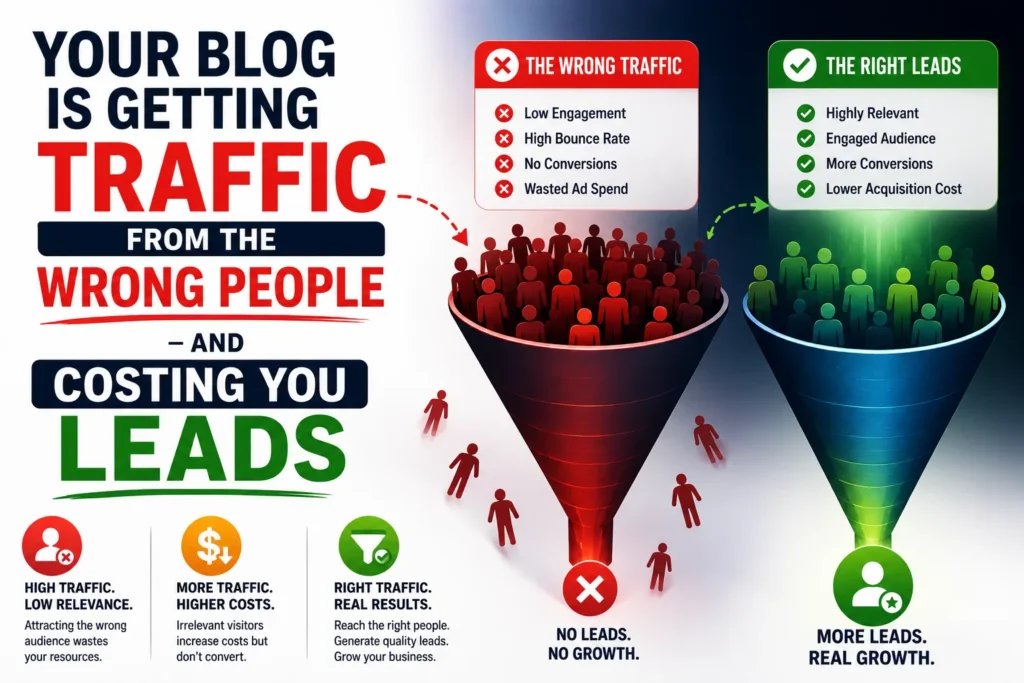

Your blog analytics look impressive. Thousands of sessions a month. Healthy time-on-page. A growing list of keywords you rank for. The SEO report says everything is working.
In this article11 sections
But your leads are not coming in. The enquiry form stays quiet. The sales team has nothing in the pipeline from organic. And somewhere between all that traffic and your revenue targets, something is silently breaking.
Content intent mismatch SEO is the diagnosis that most agencies and content teams never make – because it does not show up in a rankings report. Your traffic numbers look healthy. Your keyword positions look strong. But you are ranking for the right words with the wrong meaning, attracting the right volume with the wrong people, and spending your content budget on an audience that was never going to buy.
At Search Savvy, this is one of the most common – and most costly – problems we uncover in content audits. Businesses with blogs generating tens of thousands of monthly visitors but blog-to-lead conversion rates below 0.3% – when the B2B benchmark is 1–2%. This article explains exactly what content intent mismatch is, why it is happening to your blog in 2026, and how to fix it before another quarter of traffic passes without pipeline.
What Is Content Intent Mismatch SEO – and Why Does It Cost You Leads?#
Content intent mismatch SEO occurs when the people arriving on your blog through search have a fundamentally different goal from what your business needs them to have in order to become a lead.
Search intent is the reason behind a search query – not the words, the goal. Every search sits in one of four categories: informational (learning something), navigational (finding a specific site), commercial (comparing options before a decision), or transactional (ready to act now). Each category requires a completely different content format, a completely different CTA, and a completely different conversion pathway.
A blog post that ranks beautifully for an informational query is sitting at the top of the funnel. The person reading it is in learning mode. They are curious. They are not ready to buy. If your only CTA is “Book a Call” or “Get a Quote,” you are asking someone in a research mindset to make a purchase decision. Most of them will not. And every month you attract thousands more of them, your lead conversion rate stays flat while your traffic bill climbs.
Many digital marketing blogs fail because they assume intent instead of validating it. They rank for high-volume terms but serve the wrong type of content. AI search systems are particularly sensitive to this mismatch – they assess whether a page genuinely satisfies the implied intent of the query. If it does not, the page is less likely to appear in AI-generated answers and less likely to convert when clicked.
People Also Ask: What is content intent mismatch in SEO? Short Answer: Content intent mismatch occurs when the content on a page does not match what the searcher was actually trying to accomplish. A page ranking for a research-stage query but containing only bottom-of-funnel sales content – or ranking for a commercial query but only providing educational information – fails to convert traffic into leads. In 2026, Google and AI search systems both penalise intent mismatches through lower rankings, higher bounce rates, and reduced AI Overview citation eligibility.
How Does Content Intent Mismatch Happen in the First Place?#
Content intent mismatch SEO is almost always the result of a content strategy built around traffic volume instead of buyer intent.
Your SEO strategy may have drifted toward informational and navigational queries while transactional and commercial-investigation intent terms have been deprioritised – producing high traffic and low intent. This drift is invisible in a rankings report. The keywords you rank for look relevant. The traffic looks engaged. But the audience is researchers, students, competitors, and curious readers – not buyers.
Here is how it typically unfolds for a service business:
A content team is briefed to “build organic traffic.” They do keyword research and find that broad, informational terms around their industry have the highest search volume. They write guides, explainers, listicles, and how-to articles for those terms. Rankings improve. Traffic grows. Leadership sees the numbers and calls it a win.
Six months later, the sales team notes that organic leads have not meaningfully increased. The content team points to the traffic. The sales team points to the pipeline. And nobody has mapped the two together.
People Also Ask: Why is my blog getting traffic but not generating leads? Short Answer: The most common cause is content intent mismatch – your blog is ranking for informational queries, attracting people in learning mode, not buying mode. A good blog-to-lead conversion rate for B2B is 1–2%. Rates below 0.3% indicate poor audience-content alignment or a CTA that does not match the visitor’s intent stage. Fixing the problem requires mapping every piece of content to a funnel stage and realigning your keyword strategy toward commercial and transactional intent.
What Are the Warning Signs That Your Blog Has an Intent Mismatch Problem?#
Content intent mismatch SEO leaves a very clear set of diagnostic signals in your analytics – once you know what to look for.
These are the patterns that should immediately trigger an intent audit:
High traffic, flat or declining lead volume. This is the defining symptom. Traffic going up while leads go down is a signal – it tells you that your SEO programme has grown in a direction that does not align with your commercial objectives. If monthly sessions are increasing but MQLs are not, you are attracting more of the wrong audience, not fewer.
Blog-to-lead conversion rate below 0.3%. A good blog-to-lead conversion rate is 1–2% for B2B and 0.3–0.8% for e-commerce. Rates below 0.3% suggest either poor audience-content alignment or inadequate CTAs. Run this number for your top 10 organic blog pages. If most sit below the floor benchmark, intent mismatch is almost certainly the cause.
High impressions, low CTR for commercial terms in Search Console. In Google Search Console, identify pages well-positioned but with low CTR – this signals a promise or format misalignment. Pages with impressions for “comparison” queries whilst the content remains “definition” indicate an angle mismatch. These are pages Google is showing for commercial intent queries, but your content is not satisfying that intent – so users do not click, or click and immediately leave.
Your audience does not match your ICP. Check the demographic and firmographic data in your analytics against your Ideal Customer Profile. The traffic may be real and engaged – but it simply is not people who would ever buy what you sell. Industry-level misalignment is especially common in B2B, where a blog targeting broad industry terms attracts readers at companies far outside the target segment.
No conversion pathway from your top content pages. Map every page in your organic funnel and identify the conversion action available on that page. If there is not one – or if it is a weak, generic newsletter signup that bears no relationship to why someone landed there – you have a conversion architecture gap. Every page should have a next step relevant to the content and the intent behind the search that brought the visitor there.
How Do You Fix Content Intent Mismatch SEO Across Your Blog?#
Content intent mismatch SEO is entirely fixable – but it requires a structured audit and a clear intent mapping framework before any new content is commissioned.
Step 1: Build an Intent Map of Your Existing Content#
Content intent mismatch SEO starts with a complete inventory. Export all your blog pages from Google Search Console and Google Analytics 4. For each page, record:
- Primary keyword it ranks for
- Search intent of that keyword (informational / commercial / transactional / navigational)
- Current monthly organic sessions
- Conversion rate (leads or goal completions per organic session)
- CTA currently on the page
Pages with high traffic but no commercial intent keyword and zero conversion action are your top-priority intent mismatch cases. Run a quarterly content gap audit mapping 50–100 keywords to funnel stages, tagging intent. This is the map that reveals where your traffic and your pipeline have disconnected.
Step 2: Classify Every Page by Funnel Stage#
Content intent mismatch SEO requires aligning each page with one explicit funnel stage role:
- Top-of-funnel (TOFU) – Awareness: Informational guides, glossary posts, “what is X” content. These pages should generate awareness and capture soft leads – content downloads, newsletter signups, topic interest. They should never be the primary lead generation asset.
- Middle-of-funnel (MOFU) – Consideration: Comparison articles, “X vs Y” posts, “best of” roundups, case studies. These attract commercial intent traffic from visitors actively evaluating their options. These pages should have direct service or demo CTAs.
- Bottom-of-funnel (BOFU) – Decision: Pricing pages, service pages, testimonials, specific use-case landing pages. These attract transactional intent visitors who are ready to act. These pages should be optimised exclusively for conversion – not for breadth.
Content works best when each format has one explicit funnel-stage role. Teams that create content because a topic is trending, then decide afterward what business job it should do, reverse strategy and production. The fix is defining the funnel stage before writing begins, not after publishing.
Step 3: Rewrite, Restructure, or Redirect#
Content intent mismatch SEO gives you three tools for each mismatched page:
- Rewrite – The intent is right, but the format or depth is wrong. A commercial intent keyword answered with an informational article needs to be restructured with comparison tables, specific outcomes, and a direct CTA.
- Restructure – The core content is solid but it is buried or poorly organised for the user’s goal. Move the answer and the CTA above the fold. Add a summary box. Reduce preamble.
- Redirect – The page is targeting an intent that a different existing page already serves better. Consolidate the content, 301-redirect the weaker URL, and concentrate authority on the stronger page.
The fastest way to identify intent: search your target keyword and look at what is already ranking. If competitors ranking above you are running comparison pages and yours is a product page – or vice versa – you have a format mismatch. Mirror the format that the SERP confirms users want.
Step 4: Match Every CTA to the Visitor’s Mindset#
Content intent mismatch SEO is not only a keyword problem – it is a CTA problem. An informational blog post about “how SEO works” does not convert well with a “Book a Free Consultation” button, because the reader has not reached the point in their journey where that ask makes sense.
Align your CTAs to funnel stage:
- TOFU content CTAs: “Download the free guide,” “Subscribe to our newsletter,” “Read the next article in this series”
- MOFU content CTAs: “See how we helped [industry] businesses,” “Compare our services,” “Read a case study”
- BOFU content CTAs: “Book a free audit,” “Get a custom quote,” “Talk to our team today”
People Also Ask: How do I know which funnel stage my blog content should target? Short Answer: Search your target keyword and analyse the top 3–5 ranking pages. The format Google consistently ranks – informational guides, comparison articles, product pages, or service pages – tells you the intent Google has confirmed users want satisfied. If the SERP shows primarily comparison content and yours is educational, that is your intent mismatch. Match the format, depth, and CTA of the content type that already satisfies that query.
Why Is This Problem Getting Worse in 2026?#
Content intent mismatch SEO is compounding in severity because the search landscape has split in a way that punishes misaligned content on two fronts simultaneously.
First, Google’s AI Overviews are absorbing informational traffic. Organic CTR on informational queries has declined by up to 61% in some studies, as AI Overviews answer the question before the user clicks. If your blog is built primarily on informational content, you are losing traffic to AI summaries while also failing to convert the traffic that does arrive.
Second, Google’s ranking algorithms in 2026 are increasingly sensitive to user behaviour signals. When intent is wrong, dwell time drops, bounce rates climb, and conversion rates flatline. Pages that consistently satisfy user intent do the opposite – they hold rankings, attract the right traffic, and convert. A blog page that receives high bounce rates because the content mismatches what the searcher needed is sending a signal to Google that this page is not the right answer for that query. Over time, rankings erode – taking the traffic with them.
The businesses growing organic leads in 2026 are the ones that started with commercial and transactional keywords first. New content marketers make the mistake of targeting high-volume informational keywords first. Start with bottom-of-funnel commercial keywords – “best SEO agency in Delhi,” “[product] review,” “X vs Y” – these have lower volume but 5–10x higher conversion rates and faster ROI.
According to Search Savvy’s insights from running content audits across B2B and service businesses, the highest-ROI content switch most businesses can make is not to publish more – it is to shift 30–40% of their content investment from high-volume informational topics toward mid-funnel commercial content. The traffic numbers go down slightly. The lead numbers go up significantly.
How Should You Measure Content Intent Alignment Going Forward?#
Content intent mismatch SEO is an ongoing discipline, not a one-time audit. The measurement framework that prevents drift is built on three principles:
Measure lead quality, not just lead volume. Create a shared dashboard that shows organic sessions alongside organic-attributed leads and MQL rate. Make this the document that SEO, content, and demand generation teams all review together. Shared metrics create shared accountability and surface misalignment before it becomes a crisis.
Tag every piece of content by funnel stage and intent before publishing. Map your content types to appropriate KPIs based on where they sit in the customer journey. Top-of-funnel posts should track reach and engagement rate; bottom-of-funnel case studies should measure lead quality and conversion rates. Measuring everything with the same metric produces misleading conclusions.
Audit quarterly, not annually. Run a quarterly content gap audit mapping keywords to funnel stages. A page with good traffic but weak progression – few internal clicks, few micro-conversions – often signals an angle or CTA mismatch that is correctable before it damages rankings or pipeline.
At Search Savvy, we build intent-mapped content audits into every SEO engagement from the first month. The businesses that close the gap between traffic and leads fastest are the ones that start treating content performance as a commercial metric – not a marketing vanity metric.
People Also Ask: What is a good blog-to-lead conversion rate in 2026? Short Answer: The benchmark is 1–2% for B2B and 0.3–0.8% for e-commerce. Rates below 0.3% indicate poor audience-content alignment or inadequate CTAs. Above 2% indicates highly targeted content reaching the right intent stage audience. To reach these benchmarks, every blog page needs a funnel-stage aligned CTA, intent-matched content format, and a clear next-step pathway that moves the visitor closer to a conversion – not just deeper into informational content.
FAQ: Content Intent Mismatch SEO – Your Questions Answered#
Q1: Can I fix content intent mismatch by just adding better CTAs to existing blog posts? Improved CTAs help, but they are a surface fix for a structural problem. Adding a “Book a Call” button to a page ranking for an early-stage informational query will not dramatically improve conversion rates – because the visitor’s mindset does not match the ask. The real fix requires restructuring the content to address the next logical step in the visitor’s journey. For informational pages, that might mean adding a content download aligned to the topic, or adding a comparison section that naturally bridges toward commercial intent. CTAs should match the intent stage, not override it.
Q2: Should I delete or redirect my low-converting informational blog posts? Not immediately – and not without checking their link equity and brand value first. Low-converting informational content can still serve a valuable role if it attracts the right audience at the awareness stage and has a clear pathway to MOFU content. The decision framework is: does this page have organic traffic? Does it link to any commercial content? Does it attract your ICP, even if they are not ready to convert yet? If yes, restructure and add an intent-aligned next step. If the page has no traffic, no links, and attracts a completely misaligned audience, redirect or consolidate it.
Q3: How does content intent mismatch affect my Google rankings, not just my conversion rate? Both are connected. When visitors arrive on a page that does not satisfy their intent, they leave quickly – increasing your bounce rate and reducing session depth signals. Google’s systems use these engagement signals to evaluate whether your page is the right answer for that query. Pages that consistently satisfy user intent hold rankings and attract the right traffic; mismatched pages see ranking erosion over time. In 2026, with AI Overviews reducing informational click volume, a ranking that does not convert is essentially worthless – fixing intent alignment protects both rankings and pipeline simultaneously.
Q4: What tools can I use to audit content intent alignment across my blog? Use Google Search Console to identify pages with high impressions but low CTR – these signal a title-to-intent mismatch where your page appears for the query but users do not click because the title does not match their expectation. Use Google Analytics 4 to measure engagement rate, session duration, and goal completions by page. Use Ahrefs or Semrush to check the SERP for your target keywords and compare the format Google ranks versus your current page format. Hotjar or Microsoft Clarity session recordings reveal exactly where users lose interest on pages – often the first indication that intent is not being satisfied.
Q5: How long does it take to see results after fixing content intent alignment? Quick structural wins – updating titles to better match intent signals, adding intent-aligned CTAs, restructuring opening paragraphs – can improve CTR and engagement metrics within 4–6 weeks of implementation. Rankings adjustments for pages that have been receiving negative engagement signals typically take 6–12 weeks to stabilise as Google recrawls and reassesses user behaviour. Conversion rate improvements from MOFU and BOFU content fixes are often visible within the same content quarter, particularly when the fix involves adding comparison tables, case study references, or specific next-step pathways that were previously absent.
Q6: Is informational content worth creating at all if it does not directly generate leads? Yes – when it is intentionally created as awareness content with a clear pathway to commercial content, not as an orphan asset. Top-of-funnel informational content builds brand recognition, supports topical authority that strengthens all your rankings, and attracts early-stage researchers who may convert later. The problem is not informational content – it is informational content with no next step, no internal linking to commercial pages, and no measurement framework that distinguishes its role from conversion-stage content. Use TOFU content to grow the audience and build trust; use MOFU and BOFU content to convert it.
Getting thousands of blog visitors every month but barely any leads? Visit Search Savvy for a content intent audit that maps exactly where your traffic and your pipeline have disconnected – and a clear fix to bring them back together.