You’re Publishing Every Week But Google Still Ignores You. Here’s Why
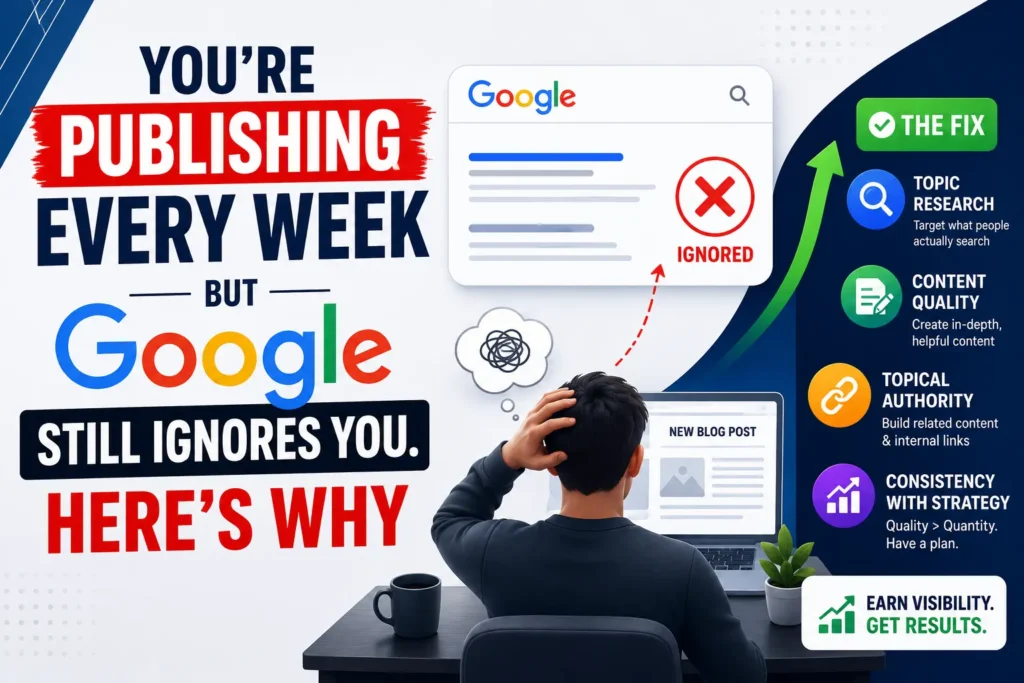

You are consistent. You are disciplined. Every Monday morning, a fresh blog post goes live. Your content calendar is colour-coded, your word counts are solid, and your team has not missed a deadline in months.
In this article8 sections
And yet Google treats your website like it does not exist.
No rankings. No meaningful organic traffic. No movement – despite the effort, the time, and the budget being poured into content every single week.
If this sounds familiar, you are not alone. This is one of the most common – and most misunderstood – SEO problems in 2026. And at Search Savvy, we see it constantly: businesses confusing publishing activity with content strategy for SEO. They are not the same thing. They have never been the same thing. And in 2026, the gap between them is wider than ever.
This article explains exactly why frequent publishing fails to move rankings, what Google actually rewards, and how to build a content strategy for SEO that compounds in value over time rather than disappearing into the void.
Why Is Publishing More Content Not Improving My Rankings in 2026?#
A strong content strategy for SEO begins with understanding what Google’s algorithm is actually evaluating – and “how often you publish” is not on that list.
Google’s ranking system in 2026 is a complex, AI-driven framework built on a deeper understanding of user intent, topical authority, and genuine expertise. Publishing volume is visible to you in your content calendar. It is effectively invisible to Google’s ranking signals.
The core problem is clear: publishing random posts without understanding search intent, planning topic clusters, or building a clear SEO content plan rarely leads to rankings. More content does not mean more authority. More content without structure means more pages competing against each other – and none of them winning.
Here is what Google does evaluate:
- Topical depth – How comprehensively does your site cover a subject area?
- Search intent alignment – Does each page answer exactly what the searcher is trying to accomplish?
- Content structure – Are your pages interconnected in a way that signals expertise?
- E-E-A-T signals – Does your content demonstrate real experience, expertise, authority, and trust?
- Content freshness – Are your existing pages up to date, or are they quietly decaying?
Publishing one new article per week while your existing pages become outdated is the SEO equivalent of filling a leaking bucket.
People Also Ask: Why is my content not ranking on Google despite publishing regularly? Short Answer: Frequent publishing without a structured content strategy for SEO rarely drives rankings. Google rewards topical depth, search intent alignment, and interconnected content architecture – not publishing frequency. If your content lacks these, volume makes no difference.
What Is a Content Strategy for SEO – and Why Does It Matter in 2026?#
A content strategy for SEO is the plan that determines what you publish, why you publish it, and how each piece connects to support your overall ranking goals and business objectives.
It is not a blog schedule. It is not a keyword list. It is not a brief handed to a freelancer every Thursday.
In 2026, Google’s algorithm has two primary audiences it considers when evaluating any page: the human user, and the AI that may summarise your content in an AI Overview or LLM response. Your content must be structured to serve both – engaging and authoritative for human readers, and clearly structured and citable for AI systems.
A content strategy for SEO that works in 2026 answers three questions before a single word is written:
- What is the user’s intent behind this query? Informational, navigational, commercial, or transactional – each intent requires a different content format and different ranking signals.
- How does this page fit into a broader content cluster? An isolated blog post carries a fraction of the authority of a post embedded in a structured topic hub.
- What existing page might this new content compete with? Publishing a new article on a topic you have already covered splits ranking signals and often means both pages perform worse.
People Also Ask: What is the difference between a content calendar and a content strategy for SEO? Short Answer: A content calendar is a schedule. A content strategy for SEO is a system. The strategy determines which topics to cover, how pages connect to each other, what search intent each page serves, and how the entire content architecture builds topical authority over time.
How Does Topical Authority Work – and Why Does It Beat Volume Every Time?#
A content strategy for SEO built on topical authority is the single most proven path to durable rankings in 2026.
Topical authority is Google’s assessment of how deeply and comprehensively your website covers a specific subject area. It is built not through individual articles but through interconnected networks of content – pillar pages supported by related cluster articles, all linked together in a coherent structure.
The data is unambiguous. A site with 20 interconnected articles on a specific topic consistently outranks a site with one comprehensive guide on the same topic, even if the single article is technically superior. And sites that sustain cluster publishing for 12 months or more see 40% higher organic traffic than comparable single-page strategies.
The architecture that drives this is called the pillar-cluster model:
- Pillar page – A comprehensive, 3,000–5,000-word resource covering a broad topic at a strategic level. It links to every cluster page and serves as the canonical authority on the subject.
- Cluster pages – Supporting articles that dive deep into specific subtopics, each linking back to the pillar. Each cluster page answers a narrower question the pillar cannot fully address.
- Internal linking – The connective tissue that tells Google’s crawlers which topic you specialise in, which pages support that expertise, and how content relates across your site.
Publishing random posts across different topics – no matter how frequently – builds nothing. It is the publishing equivalent of digging twenty shallow holes and wondering why you have not struck water.
People Also Ask: How many articles do I need to build topical authority? Short Answer: Research suggests building at least 25–30 high-quality, interlinked articles within a single content cluster before expanding to new topic areas. Depth within one niche consistently outperforms breadth across multiple unrelated topics.
What Is Keyword Cannibalization and Is It Silently Killing Your Rankings?#
A content strategy for SEO cannot succeed if your own pages are competing against each other – and this is exactly what keyword cannibalization causes.
Keyword cannibalization happens when multiple pages on your site target the same keyword and intent, causing them to compete and dilute your rankings. Google’s systems are forced to choose between multiple imperfect options rather than surfacing one definitive answer – and often, the result is that none of your pages rank well for the target term.
This is one of the most common – and most overlooked – reasons why consistent publishers see flat results. Every new article published on a topic that already has coverage on your site potentially splits the authority that should be concentrating on one strong URL.
The fix is structured intent mapping. Before any new content is commissioned:
- Maintain a keyword map: one primary keyword, one target URL, one intent type (informational, commercial, transactional, navigational) per row
- Check whether the new topic overlaps with any existing page in intent – not just in keyword
- If overlap exists, update and expand the existing page rather than publishing a new one
According to Search Savvy’s insights from auditing content programmes across dozens of businesses, keyword cannibalization is almost always discovered in content libraries that prioritised publishing speed over strategic planning. The solution is never to publish more – it is to publish correctly.
How Does Search Intent Alignment Affect Content Rankings?#
A content strategy for SEO must treat search intent as the foundational variable – not keywords, not word count, not publication frequency.
Search intent is what the user is actually trying to accomplish when they type a query. Volume-first keyword research is a 2019 strategy. In 2026, chasing high-volume keywords without matching intent produces traffic that converts to nothing – or no traffic at all. The most successful content programmes have shifted to an intent-first approach: identify what the user is trying to do, then build the content format that best answers that need.
The four intent categories that should govern your content planning:
- Informational – The user wants to learn something. Best served by guides, explainers, tutorials, and FAQ-led content.
- Navigational – The user wants to find a specific brand or page. Best served by optimised brand and product pages.
- Commercial – The user is comparing options before a decision. Best served by comparison pages, reviews, and “best of” roundups.
- Transactional – The user is ready to act. Best served by clear service pages, landing pages, and product pages with direct CTAs.
Publishing an informational blog post when the top-ranking pages are all comparison guides means your content will underperform – not because it is poorly written, but because the format does not match what Google knows searchers want for that query.
People Also Ask: Does search intent matter more than content quality in 2026? Short Answer: Both matter, but misaligned intent can disqualify a page regardless of quality. Google’s systems evaluate intent alignment as a prerequisite before assessing content depth. A well-written page in the wrong format for a query will consistently underperform a weaker page in the correct format.
Why Does Content Refreshing Matter as Much as New Content?#
A content strategy for SEO built only on new content creation is leaving significant ranking potential on the table.
Top-ranking articles in 2026 average 14 monthly content changes versus only 5 for lower-ranked articles. The pages that hold the top positions are not just the most comprehensive – they are the most consistently updated.
Google’s AI-powered systems prefer content that is current, accurate, and structured to serve real users right now. A 2022 blog post with outdated statistics, broken links, or superseded information is a liability in your content library, not an asset.
The content refresh hierarchy – what to do with underperforming pages:
- Update and expand – For pages ranking positions 4–30 on relevant terms. Refresh data, add new sections, improve internal linking.
- Restructure – For pages where intent has shifted or format does not match the SERP. Rewrite to match what is currently ranking.
- Merge and consolidate – For cannibalisation conflicts where two pages compete for the same intent. Combine into one authoritative page and 301-redirect the weaker URL.
- Delete or redirect – For pages with zero traffic, no backlinks, and no realistic path to value. Removing thin content strengthens the overall quality signal of your domain.
At Search Savvy, we recommend every content team conduct a quarterly audit – reviewing each page’s performance, checking for intent shifts, updating statistics, and strengthening internal linking before commissioning a single new article. In most cases, the highest-ROI content activity is improving what already exists, not adding to the pile.
How Do You Build a Content Strategy for SEO That Actually Works in 2026?#
A content strategy for SEO that produces compounding results in 2026 follows a clear sequence. Here is the framework Search Savvy uses with clients:
Step 1: Audit before you create. Catalogue every existing page. Identify which are performing, which are cannibalising each other, which need refreshing, and which should be removed.
Step 2: Choose one topic cluster to own. Pick one core subject area, map every important subtopic within it, and build 25–30 interconnected articles in that cluster before expanding. Depth before breadth – always.
Step 3: Map intent before writing. Assign every planned page a primary keyword, a clear intent type, and a position in the cluster architecture. No page gets written without a defined role.
Step 4: Build pillar pages first. Your pillar page is the anchor of the cluster. Publish it at 3,000–5,000 words before building out the cluster articles that support it.
Step 5: Refresh before you publish new. Before adding any new content to your library, check whether an existing page covers the same intent. Update and expand first. Publish new only when there is a genuine gap.
Step 6: Track the right metrics. Use Google Search Console to monitor impressions, clicks, and average position. Use Semrush or Ahrefs to track topical coverage and identify content gaps. Measure what is moving – and what still is not.
FAQ: Content Strategy for SEO – Your Questions Answered#
Q1: How long does it take for a content strategy for SEO to show results? Content clusters and topical authority build gradually. Most sites see initial ranking movement within 3–4 months of implementing a structured cluster strategy. Significant organic traffic growth – particularly the compounding effect – typically becomes visible at the 6–12 month mark. Consistent execution is the variable that separates the sites that see 40% traffic growth from those that plateau.
Q2: Should I stop publishing new content and focus only on refreshing old content? Not entirely – both matter. But for most sites that have been publishing for over a year, the refresh-to-new ratio should shift significantly toward refreshing. A good rule of thumb: for every three new pieces of content, plan one substantial refresh of an underperforming existing page. As your library matures, that ratio often shifts further toward refreshing.
Q3: Does content length still matter for SEO in 2026? Length matters only when it serves the searcher’s intent. A 500-word page that perfectly answers an informational query can outrank a 3,000-word guide that buries the answer in filler. That said, pillar pages genuinely require 3,000–5,000 words to cover a broad topic comprehensively. Let the query’s intent and the competitive SERP guide your target length – not an arbitrary word count target.
Q4: What is the fastest way to identify keyword cannibalization in my content library? Open Google Search Console and use the Performance report to identify keywords where multiple URLs appear in the data with similar rankings. A site search in Google (site:yourdomain.com “target keyword”) can also reveal competing pages quickly. For a systematic audit, run a keyword cannibalization report in Semrush or Ahrefs, which flags overlapping keyword-to-URL mapping across your entire site.
Q5: Can AI-generated content work within a content strategy for SEO? AI-generated content can rank if it is genuinely useful, original in perspective, and edited with real human expertise. The issue in 2026 is not the tool – it is the output quality. Neutral, generic content that anyone could generate blends in with the thousands of similar pages Google is increasingly filtering out. Use AI to accelerate research, structuring, and drafting – but add real opinions, original data, and human editorial judgment to every piece before it publishes.
Q6: How do I know which topics to build my content cluster around? Start with your core business offering and work outward. Map every question a potential customer might have at each stage of their journey – awareness, consideration, and decision. Then validate demand using keyword research tools to confirm search volume exists. Prioritise topics where your site has a realistic chance to compete based on your current domain authority, and where the commercial value of ranking is highest for your business.