
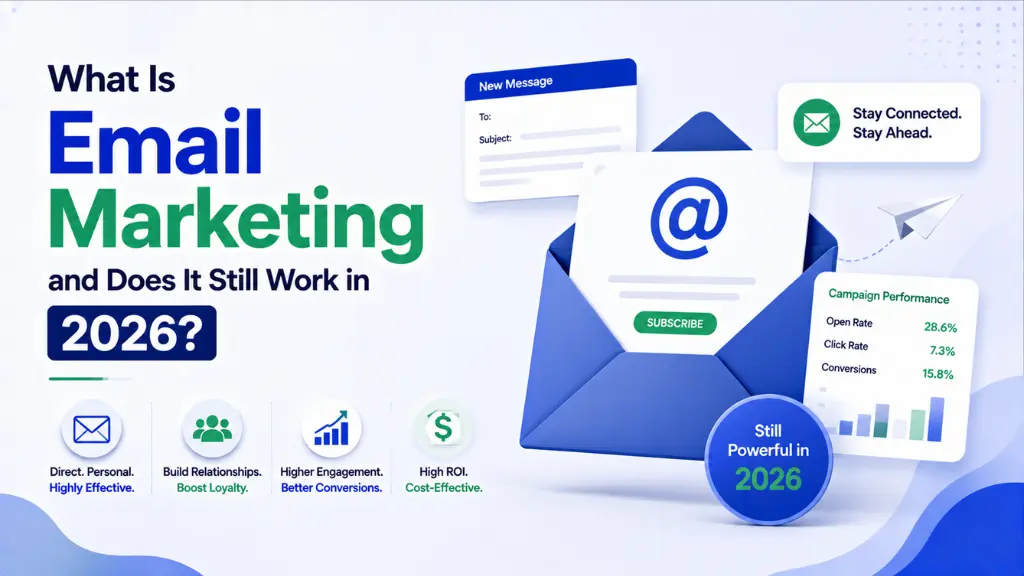

Every few years, someone confidently declares email dead – first it was social media that would replace it, then messaging apps, now AI chat assistants. Yet email marketing keeps quietly outperforming nearly every other digital channel by a wide, well-documented margin.
Email marketing delivers an average return of $36 to $42 for every $1 spent in 2026, outperforming paid search at roughly $2, social advertising at roughly $2.80, and display ads at roughly $1.35, according to DigitalApplied’s 2026 email marketing statistics report. No other digital channel currently offers comparable returns at this scale, and the gap is widening, not narrowing, as AI personalisation continues improving results further.
At Search Savvy, email marketing remains one of the most consistently underrated channels in client strategy conversations, precisely because it lacks the novelty of newer platforms. This guide breaks down exactly what email marketing is, whether it genuinely still works in 2026, and what the current data shows about doing it well.
What Is Email Marketing, Exactly?
Email marketing is the practice of sending targeted, permission-based messages to a list of subscribers – customers, leads, or prospects who have explicitly opted in – with the goal of building relationships, driving engagement, and generating revenue over time.
Unlike social media, email marketing operates on an owned audience, meaning your list is not subject to algorithm changes, platform policy shifts, or sudden reach reductions the way organic social content is. Email is immune to algorithm shifts and remains the most reliable way to engage users who have already opted in and already trust your brand, according to WSI World’s 2026 email marketing analysis. More than 4.8 billion people are expected to use email worldwide in 2026, with that number projected to exceed 4.9 billion by 2028, according to XtendedView’s 2026 email marketing statistics report.
People Also Ask: What makes email marketing different from social media marketing? Short Answer: Email marketing relies on an owned, permission-based audience list, making it immune to the algorithm changes and reach fluctuations that affect social media. Subscribers have explicitly opted in, which typically means higher intent and trust compared to a general social media audience.
Does Email Marketing Still Actually Work in 2026?
Email marketing works better in 2026 than most alternative channels, based on nearly every available ROI benchmark – the “email is dead” narrative simply does not match the current data.
59% of marketers name email their most effective channel for revenue, ahead of social media at 14% and paid search at 12%, according to Floworks’ 2026 email marketing analysis, citing HubSpot’s 2026 State of Marketing report. Among businesses that actively measure ROI, 60% report earning more than $10 for every $1 invested in email marketing, and more than 10% of organisations report returns approaching 40:1, according to XtendedView’s 2026 report.
Email marketing also continues earning strong forward investment confidence from businesses themselves, not just backward-looking performance data. 79% of businesses plan to maintain or increase their investment in email marketing during 2026, per the same XtendedView analysis – a genuinely strong signal that the channel’s practitioners see continued value, not diminishing returns.
People Also Ask: Is email marketing still profitable for small businesses in 2026? Short Answer: Yes, consistently. Even without large budgets, small businesses using basic automation tools regularly report returns well above $10 for every $1 spent, since email’s cost efficiency does not require the scale that some other digital channels do to be worthwhile.
How Has AI Changed Email Marketing Performance in 2026?
Email marketing has been reshaped substantially by AI in 2026, and the performance gap between teams using AI-driven personalisation and those still running generic batch campaigns is widening quickly.
AI-powered email programs generate 41% more revenue than manually managed campaigns, according to Salesforce benchmarks cited in DigitalApplied’s 2026 AI personalisation guide, and teams implementing a full AI stack see 3.2 times higher revenue per recipient compared to non-AI programs. AI-generated subject lines specifically outperform human-written ones by roughly 26% in open rate, per the same source.
The personalisation effect extends well beyond subject lines. Hyper-personalised emails can achieve transaction rates up to 9 times higher than traditional batch-and-blast campaigns, and behaviour-triggered messages show an 11.4 times uplift over standard sends, according to Sci-Tech Today’s 2026 hyper-personalisation ROI report. For retail and e-commerce specifically, personalised email ROI climbs to $45–$68 for every $1 spent, considerably higher than the broader channel average.
People Also Ask: Does AI personalisation in email actually improve revenue, not just open rates? Short Answer: Yes, substantially. AI-powered email programs generate roughly 41% more revenue than manually managed campaigns, and hyper-personalised, behaviour-triggered emails can achieve transaction rates up to 9 to 11 times higher than standard batch campaigns.
Why Do Automated and Behaviour-Triggered Emails Outperform Standard Campaigns?
Email marketing performance data consistently shows a large, well-documented gap between automated, behaviour-triggered messages and traditional one-off batch campaigns sent to an entire list at once.
Automated emails generate 22 times more revenue per message than standard campaigns, and automated workflows achieve nearly 19 times higher conversion rates than regular, non-triggered emails, according to XtendedView’s 2026 performance statistics report. Shopping cart abandonment emails sent one hour after a user leaves your site convert at roughly 6.33%, making prompt, well-timed automation genuinely one of the highest-leverage tactics available in the entire channel, per PGM Solutions’ 2026 statistics report.
Lifecycle and retention-focused campaigns also consistently outperform acquisition-focused sends. Lifecycle campaigns and retention emails generally produce stronger long-term ROI than one-time acquisition campaigns, since they target existing customers who already carry higher purchase intent, according to the same XtendedView analysis.
People Also Ask: What is a behaviour-triggered email, and why does it perform so much better? Short Answer: A behaviour-triggered email is automatically sent based on a specific subscriber action – abandoning a cart, browsing a product, or completing a purchase – rather than sent to an entire list on a fixed schedule. These messages perform dramatically better because they arrive at genuinely relevant, high-intent moments.
What Metrics Actually Matter for Email Marketing in 2026?
Email marketing measurement has shifted in 2026, since Apple’s Mail Privacy Protection has made open rate a less reliable indicator of genuine engagement than it once was.
Open rate is now considered a directional metric rather than a precise one, since Apple’s Mail Privacy Protection artificially inflates it – click-through rate, click-to-open rate, and revenue-per-email are now the metrics that matter most, according to Floworks’ 2026 analysis. Click-through rate specifically cannot be artificially inflated by privacy features the way open rate can, since it requires a genuine, deliberate user action.
Reasonable current benchmarks to measure against:
- Open rate – 20–30% is typical for most marketing emails, though treat this as directional given Apple MPP’s inflating effect
- Click-through rate – 3–5% is common industry-wide, though this varies meaningfully by industry and list quality
- Personalised subject lines – lift open rates by roughly 26% compared to generic subject lines, according to Floworks’ 2026 data
- Send-time optimisation – individually calculated per subscriber, delivers a 15–25% open rate improvement, according to DigitalApplied’s 2026 AI personalisation guide
People Also Ask: Why is open rate no longer a fully reliable email marketing metric? Short Answer: Apple’s Mail Privacy Protection automatically pre-loads email content for a large share of Apple Mail users, artificially inflating open rate regardless of whether a person actually engaged. Click-through rate and revenue-per-email are now considered more trustworthy performance indicators.
How Should Businesses Actually Approach Email Marketing in 2026?
Email marketing succeeds in 2026 through a combination of genuine personalisation, deliberate automation, and consistent list quality – not through simply sending more emails or chasing open rate as the primary success metric.
According to Search Savvy’s insights from managing email programs for clients, the businesses seeing the strongest results are the ones treating automation and segmentation as foundational, not optional add-ons implemented only after basic campaigns are already running.
A practical framework for 2026 email marketing:
- Build segmented flows around key behavioural triggers – cart abandonment, browse abandonment, post-purchase follow-up, and win-back sequences for inactive subscribers
- Use AI tools for subject line generation and send-time optimisation, given the documented lift both provide over manual, one-size-fits-all approaches
- Prioritise click-through rate and revenue-per-email over open rate as your primary success metrics, given Apple MPP’s distorting effect on open data
- Invest disproportionately in lifecycle and retention campaigns, since they consistently outperform one-time acquisition-focused sends
- Keep list quality high through regular list cleaning, since sustained deliverability depends more on engaged subscribers than raw list size
- Test personalisation depth incrementally – moving from basic name personalisation toward genuine behaviour-based content – rather than attempting full hyper-personalisation all at once
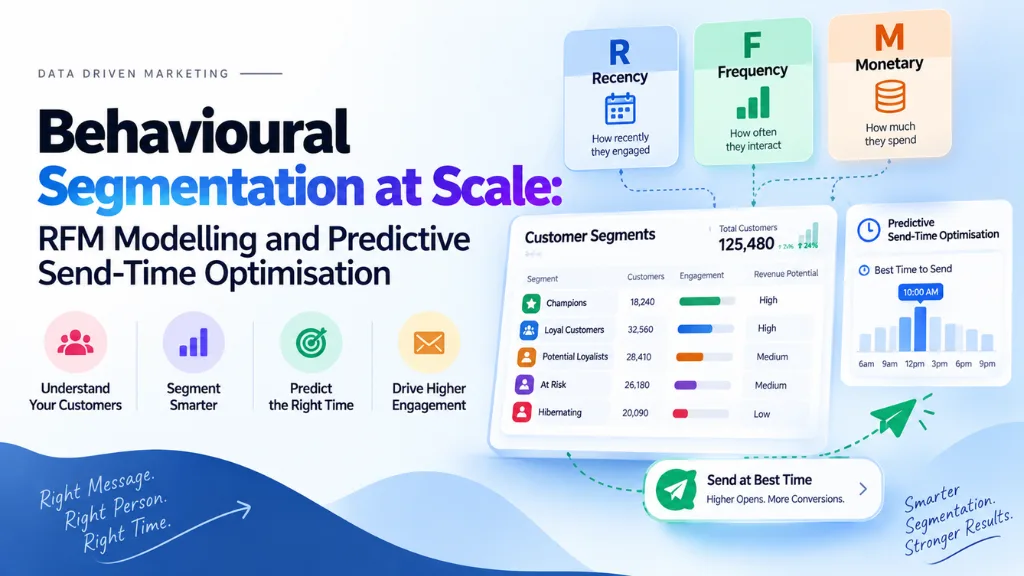
At Search Savvy, we recommend starting with cart or browse abandonment automation for any business not yet using behaviour-triggered emails – it is consistently one of the fastest, highest-return implementations available in the entire channel.
FAQ: Email Marketing in 2026
Q1: Is email marketing still worth investing in given how many channels exist in 2026? A: Yes. Email consistently delivers the highest ROI of any major digital marketing channel, at roughly $36–$42 per $1 spent, considerably ahead of paid search, social advertising, and display advertising.
Q2: Does a small email list still generate meaningful results? A: Yes, provided the list is genuinely engaged rather than large but inactive. A smaller, well-segmented list of subscribers who actively open and click consistently outperforms a large, disengaged list on nearly every meaningful metric.
Q3: How much does AI actually improve email marketing results? A: Significantly. AI-powered email programs generate roughly 41% more revenue than manually managed campaigns, and businesses using a full AI stack see over three times higher revenue per recipient compared to non-AI programs.
Q4: What is the single highest-return email automation to set up first? A: Cart or browse abandonment automation is widely considered the fastest, highest-return starting point, given documented conversion rates around 6.33% for well-timed cart abandonment emails sent within an hour of a visitor leaving.
Q5: Should businesses still track open rate at all in 2026? A: It still provides some directional value, but should not be treated as a precise engagement measure due to Apple Mail Privacy Protection’s inflating effect. Click-through rate and revenue-per-email are now considered more trustworthy indicators of genuine performance.
Q6: Is email marketing at risk of becoming obsolete due to AI chat assistants? A: Unlikely in the near term. Global email adoption is projected to continue growing through 2028, and email’s owned-audience model gives it a structural advantage over channels dependent on a third-party platform’s algorithm or policy decisions.
Want help building an email marketing program that actually performs in 2026? Visit Search Savvy to speak with an expert who can build segmented, automated flows tailored to your audience.