Social Media Marketing Strategy: A Complete Guide for 2026

Posting consistently is no longer the bar for success on social media – it barely qualifies as a starting point. With 5.66 billion active social media users worldwide spreading their attention across an average of 6.75 different platforms each month, a strategy without clear platform priorities and measurable goals gets lost in the noise almost immediately.
In this article8 sections
Social media marketing strategy delivers a genuinely strong average return when built correctly – $5.20 in revenue for every $1 spent, according to SQ Magazine’s 2026 social media marketing statistics report. That return is not automatic, though. It depends heavily on platform selection, format choices, and how deliberately AI tools get integrated into the workflow in 2026.
At Search Savvy, building and refining social media marketing strategy for clients across industries is core to what we do, because the platforms, formats, and audience behaviours shift meaningfully year over year. This guide breaks down exactly what a social media marketing strategy should look like in 2026, backed by current data.
Why Does Social Media Marketing Strategy Need to Change in 2026?#
Social media marketing strategy needs regular rebuilding, not just refreshing, because platform algorithms, audience behaviour, and content format preferences have all shifted meaningfully since last year’s playbook was written.
Organic reach for business pages has declined across major networks, as platform algorithms continue prioritising paid content and creator-driven engagement, according to Falkon SMS’s 2026 statistics report. This makes a documented, adaptive strategy more important than ever – businesses relying on organic posting alone, without a clear paid and content strategy layered in, are increasingly working against the platforms rather than with them.
Social media marketing strategy also has to account for genuinely explosive short-form video growth. Short-form video now accounts for 43% of all social media content consumed, and delivers the highest ROI among video formats at 41%, according to Sprout Social’s 2026 statistics report. Any strategy still treating video as a secondary format rather than a central pillar is already behind where the audience and the algorithms both sit in 2026.
People Also Ask: What is the average ROI for social media marketing in 2026? Short Answer: The average return is $5.20 for every $1 spent, according to 2026 industry data. Actual results vary significantly by platform, format, and industry, with video-based and platform-optimised campaigns consistently outperforming generic, unoptimised approaches.
Which Platforms Should Anchor a Social Media Marketing Strategy in 2026?#
Social media marketing strategy in 2026 should be built around a small number of well-chosen platforms, rather than spreading effort thin across every network simultaneously.
Instagram remains the most widely used platform among marketers at 70%, and is also the most frequently cited platform for ROI, according to HubSpot’s 2026 State of Marketing Report. Facebook follows closely at 69.6% marketer adoption, with 43% of marketers ranking it among their highest-ROI channels – largely because it remains the top platform for both product discovery and social customer service, per Sprout Social’s 2026 data.
Platform choice should also reflect your specific business model, since B2B and B2C results diverge sharply. Instagram is the top platform for ROI among B2C brands, with 78% of marketers reporting positive returns, while LinkedIn produces the highest B2B conversion rates, with lead-generation ads averaging a 6.1% conversion rate, according to NewMedia’s 2026 statistics report. Facebook ads convert at an average of 9.2%, making the platform the strongest choice specifically for direct-response campaigns.
- Instagram – strongest overall marketer adoption and ROI, particularly for B2C brands
- Facebook – top platform for product discovery, customer service, and direct-response ads
- LinkedIn – highest B2B conversion rates; strongest for lead generation specifically
- TikTok – drives 28% higher engagement-to-conversion rates than Instagram Reels
People Also Ask: Which social media platform delivers the best ROI for a B2B business? Short Answer: LinkedIn consistently produces the highest B2B conversion rates, with lead-generation ads averaging around 6.1% conversion. Instagram and Facebook tend to perform better for B2C-focused businesses specifically.
How Should Video Content Fit Into a Social Media Marketing Strategy?#
Social media marketing strategy in 2026 cannot treat video as optional – it has become the single most reliably profitable content category across nearly every platform and industry.
91% of businesses now actively leverage video in their marketing, and 82% of marketers report that video delivers a positive return on investment, according to AutoFaceless’s 2026 social media ROI report. Video-based campaigns generate 34% higher conversion rates than static ads across all platforms, and posts with images generate 2.3 times more engagement than text-only posts, per NewMedia’s 2026 analysis and Falkon SMS’s 2026 data.
Short-form video specifically continues to outperform every other format tracked. Instagram Reels deliver 35% higher engagement than standard video posts, and TikTok drives notably higher engagement-to-conversion rates than Reels specifically, according to Falkon SMS’s 2026 report. Video ads overall deliver roughly 48% higher engagement rates than static image ads, per SQ Magazine’s 2026 data.
People Also Ask: Is short-form video worth prioritising over long-form video in 2026? Short Answer: Generally, yes, for most social platforms. Short-form video delivers the highest ROI among video formats and now accounts for 43% of all social content consumed, making it the more efficient investment for most brands’ primary social strategy.
How Is AI Changing Social Media Marketing Strategy in 2026?#
Social media marketing strategy has become deeply intertwined with AI tools in 2026, changing both how content gets produced and how campaigns get optimised in real time.
71% of social media marketers have embedded AI tools into their strategies, and generative AI lets 83% of marketers produce significantly more content, saving over an hour per day for 86% of users, according to SQ Magazine’s 2026 report. Nearly 48% of branded social media content is now expected to be AI-generated on average, and AI-optimised campaigns are reporting up to 40% higher efficiency compared to earlier benchmarks.
AI adoption extends well beyond content creation into strategic decision-making too. Roughly 62% of social marketers use social listening tools powered by AI to monitor sentiment, trends, and competitors, and 69.2% of social teams use chatbots or conversational AI tools for customer interaction, per the same source. AI-driven personalisation in influencer campaigns specifically can boost conversion rates by up to 20% and improve overall efficiency by up to 30%.
People Also Ask: How many marketers actually use AI tools in their social media strategy? Short Answer: Roughly 71% of social media marketers now use AI tools as part of their strategy, according to 2026 data, spanning content creation, social listening, chatbots, and campaign optimisation – making AI integration close to the industry standard rather than a fringe tactic.
Why Does Influencer Marketing Still Matter in a Social Media Marketing Strategy?#
Social media marketing strategy in 2026 continues to rely heavily on influencer partnerships, which consistently outperform traditional digital advertising on both engagement and cost efficiency.
94% of organisations say influencer marketing outperforms traditional digital advertising, often delivering two to three times the return, according to Sprout Social’s 2026 statistics report. Human-generated content remains the top priority for users navigating an increasingly automated web in 2026 – a genuine advantage for influencer content over purely brand-produced material, which audiences can increasingly detect and discount.
Nano-influencers specifically offer a strong efficiency advantage that many brands underuse. Creators with smaller, more engaged followings often deliver stronger engagement rates relative to cost than larger accounts, making them a particularly efficient channel for brands with more modest budgets, according to broader 2026 influencer marketing analysis. Combined with AI-driven personalisation, influencer campaigns can achieve conversion rate improvements of up to 20%.
People Also Ask: Does influencer marketing still outperform traditional advertising in 2026? Short Answer: Yes, significantly. 94% of organisations report that influencer marketing outperforms traditional digital advertising, often delivering two to three times the return – making it a core, not supplementary, part of most effective 2026 social strategies.
How Does Social Commerce Fit Into a Social Media Marketing Strategy?#
Social media marketing strategy increasingly needs to account for direct in-platform purchasing, since social commerce has grown into a genuinely massive, fast-growing revenue channel in its own right.
The global social commerce market reached approximately $2.11 trillion in 2026, growing at a 29.12% compound annual growth rate, with U.S. social commerce sales surpassing $100 billion for the first time, according to AutoFaceless’s 2026 report. 26% of marketers now plan to sell products directly on social platforms, per AMW’s 2026 statistics, and shoppable content delivers 1.7 times more conversions than non-shoppable branded posts, according to NewMedia’s 2026 data.
Live shopping specifically has emerged as a standout format within this trend. Live shopping events on platforms like TikTok and Instagram achieve conversion rates as high as 30%, compared to the 2–3% average for traditional e-commerce, per the same AutoFaceless report – a genuinely dramatic performance gap worth testing for brands with the right product category and audience.
People Also Ask: Is social commerce worth investing in for a small or mid-sized business? Short Answer: Often, yes, particularly for visually compelling or impulse-driven products. Shoppable content delivers meaningfully higher conversion rates than standard branded posts, and the format requires relatively modest setup effort compared to the return it can generate.
How Should You Actually Build a Social Media Marketing Strategy in 2026?#
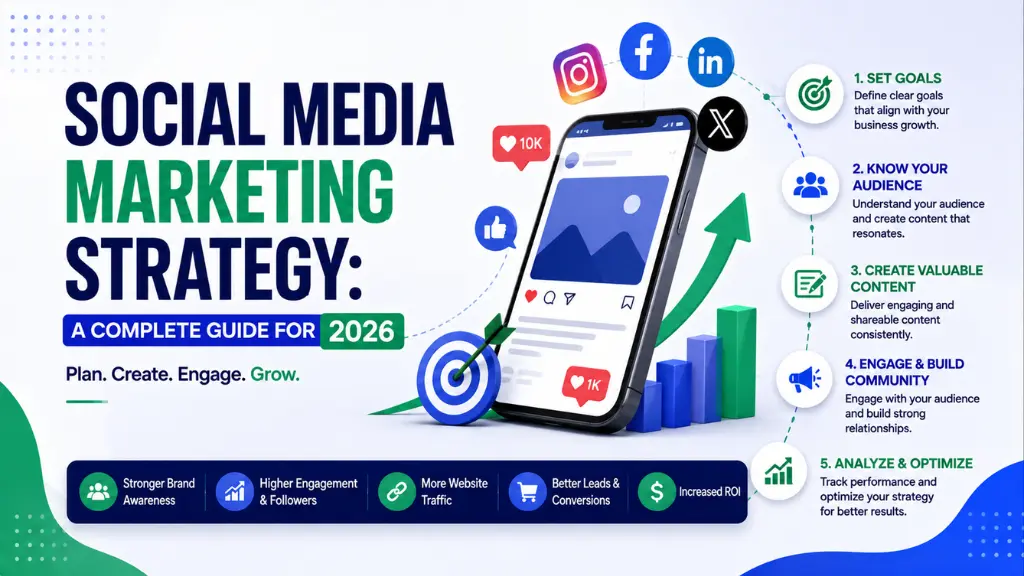
Social media marketing strategy should be built as a documented, prioritised framework, rather than a loose collection of tactics assembled reactively as trends emerge.
According to Search Savvy’s insights from building strategy across client industries, the businesses seeing the strongest results consistently start with platform prioritisation before committing to content formats or budget allocation.
A practical strategy-building framework for 2026:
- Choose two to three primary platforms based on where your specific audience and business model – B2B or B2C – see the strongest documented ROI
- Make short-form video your primary content pillar, supported by static posts and stories for supplementary reach
- Integrate AI tools deliberately for content production speed, social listening, and campaign optimisation, while keeping human oversight for brand voice and strategy
- Evaluate influencer partnerships, particularly nano and micro-influencers, as a cost-efficient complement to owned content
- Test shoppable and social commerce features where your product category and audience fit, given the strong documented conversion lift
- Set clear, platform-specific KPIs and review performance monthly, adjusting budget and format mix based on actual data rather than assumptions
At Search Savvy, we recommend revisiting platform priorities and format mix at least twice a year – the pace of change in 2026’s social landscape means a strategy that worked well six months ago may already need meaningful adjustment.
FAQ: Social Media Marketing Strategy for 2026#
Q1: How many social media platforms should a business actively use? A: Most 2026 guidance recommends focusing deeply on two to three primary platforms rather than spreading effort across many. Depth of engagement and consistency on fewer platforms generally outperforms shallow presence across a wide range of networks.
Q2: Is organic social media reach still worth pursuing in 2026? A: It remains valuable, but organic reach for business pages has declined across major networks as algorithms increasingly favour paid and creator-driven content. A combined organic and paid approach now performs meaningfully better than organic content alone.
Q3: How much should a business budget for social media advertising in 2026? A: There is no universal figure, but 80% of marketers plan to increase their social media budgets in 2026, reflecting broader confidence in the channel’s ROI. Budget should scale with documented platform-specific performance rather than an arbitrary percentage.
Q4: Does AI-generated content perform as well as human-created social content? A: It depends on execution. AI can significantly speed up production and support optimisation, but human-generated and human-reviewed content remains the top priority for audiences navigating an increasingly automated feed, making pure AI automation without human oversight a risk.
Q5: Should small businesses invest in influencer marketing or focus on owned content first? A: Both have a role, but nano and micro-influencers offer a cost-efficient entry point for smaller budgets, often delivering stronger engagement relative to cost than larger influencer partnerships or purely owned content built from scratch.
Q6: What is the biggest mistake businesses make with their social media marketing strategy? A: Treating video as a secondary format rather than a central pillar. Given video’s consistently higher engagement and conversion rates across nearly every platform in 2026, deprioritising it puts a strategy at a significant disadvantage from the outset.
Want help building a social media marketing strategy tailored to your business and audience? Visit Search Savvy to speak with an expert who can identify the right platforms, formats, and budget allocation for your goals.