

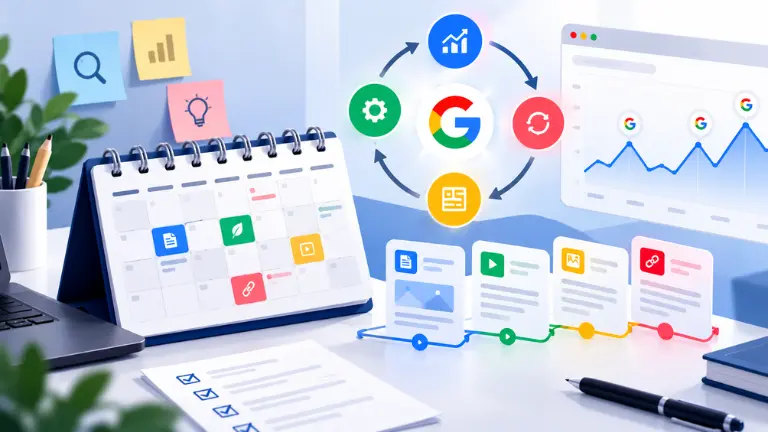

An SEO content calendar built around Google algorithm cycles is a publishing plan with scheduled review windows, flexible capacity, and a refresh rhythm, so that ranking changes become checkpoints instead of emergencies. The catch is that Google announces core updates when they begin, not before. You cannot predict the date, so you plan for the pattern.
The pattern in 2026 has been busy. Google’s Search Status Dashboard lists a December 2025 core update, a March 2026 core update, a May 2026 core update, and spam updates in March, June, August, and September. This guide shows how to turn that rhythm into a practical calendar, with a template, a post-update review routine, and rules for seasonal planning and cadence.
What Is an SEO Content Calendar Built Around Algorithm Cycles?
An SEO content calendar is a schedule of planned topics, formats, owners, publish dates, and refresh dates tied to search demand. Building it around algorithm cycles adds three things: reserved capacity for fixes, fixed review checkpoints after major updates, and a change log that separates your edits from Google’s.
It does not mean pausing publishing when an update starts, and it does not mean guessing dates. Google’s own documentation says that most sites do not need to worry about core updates and may not even notice one. The goal is to stay organized so you can read the results calmly when one does affect you.
How Often Does Google Update Search, and What Does That Mean for Timing?
Google ships confirmed core updates a few times a year and spam updates more irregularly, with rollouts that last from hours to a few weeks. For algorithm update timing, the useful lesson is duration and spacing, not prediction.
Recent confirmed updates from the dashboard:
| Update | Start | Approximate duration |
| December 2025 core update | 11 Dec 2025 | 18 days |
| February 2026 Discover update | 5 Feb 2026 | About 22 days |
| March 2026 spam update | 24 Mar 2026 | Under 20 hours |
| March 2026 core update | 27 Mar 2026 | About 12 days |
| May 2026 core update | 21 May 2026 | About 12 days |
| June 2026 spam update | 24 Jun 2026 | About 2 days |
| August 2026 spam update | 18 Aug 2026 | About 2.5 days |
| September 2026 spam update | 24 Sep 2026 | About 13.5 days |
Two planning conclusions follow. First, the March spam and core updates started three days apart, so overlapping windows happen and cleanly attributing a change can be hard. Second, the six weeks between the March and May core updates show that gaps vary. Check the Search Status Dashboard for anything newer than the entries above, since this table reflects what was listed when this article was written.
How Do You Plan Content Around Algorithm Update Timing?
Plan in quarterly blocks with built-in flexibility, and treat every update as a measurement event. Reserve roughly one slot in four for refreshes and fixes, keep a running log of Google’s announcements, and avoid stacking big site changes on top of an active rollout.
Here is a workable approach:
- Plan in 12-week blocks. Fill about 75% of capacity with new content and hold the rest for refreshes, consolidation, and reactive work.
- Keep a cycle log. Record each update’s name, start, end, and your own site changes next to it. Search Savvy’s Google algorithm update tracker is one place to cross-check dates.
- Avoid compounding changes. Do not migrate, redesign, or restructure URLs during a rollout window if you can help it, so you can read the results.
- Annotate everything. Mark launches and updates on your analytics and Search Console charts.
- Schedule the review. When an update completes, book the analysis for one week later.
What should you do before, during, and after a core update?
| Phase | Do | Avoid |
| Before | Keep publishing, log changes, track a baseline | Big structural changes in a known rollout window |
| During | Note volatility, keep working, annotate | Judging results from daily ranking swings |
| After (week 1) | Wait, keep the log current | Rushed rewrites |
| After (week 2+) | Compare the week after completion with the week before the rollout began, per search type | Blaming a single page before checking site-wide patterns |
Google’s guidance supports this sequence. It recommends confirming the update has finished, waiting at least a full week, then comparing that week with the week before the update started rolling out. It also says improvements may take months to show, and that smaller, unannounced core updates run continuously, so progress can appear between major ones.
What Content Publishing Cadence Works Best?
The best content publishing cadence is the one your team can sustain without lowering quality. Google’s core update guidance centers on helpful, reliable content rather than posting frequency, so a consistent rhythm of well-made pieces beats bursts of thin pages.
Practical guidance:
- Set cadence by capacity. Four excellent articles a month is better than twelve rushed ones.
- Mix content tiers. For example, a pillar guide each quarter, supporting articles monthly, and refreshes of older posts on a schedule. Treat the ratio as a starting point to adjust.
- Protect originality. Google’s spam policies target scaled content that adds little value, and its guidance on generative AI says to fact-check and focus on accuracy, quality, and relevance. Fast, unedited output is a risk, not a shortcut.
- Batch production, stagger publishing. Writing in batches saves effort, while spacing releases keeps your review data cleaner.
Search Savvy’s content strategy and topical authority services describe the planning side of grouping articles into clusters, which also helps you decide what to publish next.
How Do You Plan Seasonal Content?
For seasonal content planning, start well before the peak, because pages need time to be crawled, indexed, and found. Use Google Trends and last year’s Search Console data to see when interest begins rising, then publish early enough to be ready when it does.
A seasonal planning routine:
- Pull last year’s data. Find when impressions started climbing for each seasonal topic.
- Work backward. Publish new seasonal pages weeks or months ahead of that rise, depending on your category and how quickly your site gets crawled.
- Reuse the same URL each year. Update the page instead of creating a new one, so authority accumulates.
- Refresh before the season. Update facts, prices, dates, and examples, then show the updated date honestly.
- Plan the aftermath. Keep the page live after the peak, or redirect it deliberately if it is no longer useful.
Matching topics to real demand is the foundation here. Search Savvy’s keyword research services page covers how demand patterns feed a calendar.
What Does Update-Proof Content Look Like?
No content is fully update-proof, but some content is far more resilient. It is helpful to the reader, accurate, clearly attributed, and maintained. Google describes core updates as designed to deliver helpful and reliable results, which is why quality fundamentals are the safest long-term plan.
Traits of resilient content:
- First-hand experience: original examples, data, screenshots, or testing.
- Clear authorship: named authors with relevant credentials, especially for advice topics.
- Accuracy and sourcing: claims you can back up, with dates.
- Complete answers: the main question and the obvious follow-ups.
- Maintenance: scheduled reviews, so facts do not go stale.
- Honest purpose: content made for readers, not only to capture search traffic.
For deeper pages like pillar guides, a broader content marketing plan helps keep distribution and updates consistent.
An Editorial Calendar Template You Can Copy
Use one tab for the calendar and one for the cycle log.
Tab 1: Content calendar
| Column | Example |
| Publish date | 12 Nov |
| Topic and primary keyword | Seasonal gift guide |
| Search intent | Commercial investigation |
| Content type | Pillar guide |
| Owner and editor | Writer, editor |
| Refresh date | 12 Aug next year |
| Status | Drafting |
| Primary metric | Clicks, conversions |
Tab 2: Algorithm cycle log
| Column | Example |
| Update name | May 2026 core update |
| Start and end dates | 21 May to 2 Jun |
| Review date | 9 Jun |
| Site changes during window | None |
| Findings and actions | Refresh three declining guides |
Common Mistakes When Planning Around Algorithm Updates
- Trying to predict updates. Google gives no advance notice, so plan for flexibility instead.
- Pausing all publishing. A rollout is a reason to measure carefully, not to stop.
- Analyzing mid-rollout. Results shift several times before they settle.
- Changing everything after a drop. Isolate causes before rewriting the whole site.
- Chasing frequency over quality. More posts do not fix thin pages.
- Skipping the log. Without it, you cannot separate your changes from Google’s.
- Ignoring technical health. Crawling and indexing problems can look like algorithm trouble. A periodic website audit catches them early.
Frequently Asked Questions
How do you plan content around Google core updates?
Plan quarterly with spare capacity, keep a log of updates and site changes, and review results one week after each rollout completes. Do not try to time publishing to predicted dates.
Should you stop publishing during a core update?
No. Keep publishing, but avoid large structural changes during the rollout so you can interpret results. Save analysis for after the update finishes.
How long should you wait before analyzing a core update?
Google recommends waiting at least a full week after the update completes, then comparing that week with the week before the rollout began.
How often should you publish new SEO content?
As often as you can maintain quality. A steady, sustainable cadence matters more than a high number, and refreshing existing pages counts as part of your schedule.
How far ahead should you publish seasonal content?
Look at last year’s data to see when interest began rising, then publish ahead of that point. The right lead time depends on your niche and how quickly your site is crawled.
What should you do if rankings drop after an update?
Confirm the update has finished, wait a week, and compare performance by search type. Look for site-wide patterns before editing individual pages. If you need a second opinion, a search engine recovery review can help.
Bottom Line
You cannot schedule around Google’s updates, but you can schedule for them. Build a calendar with spare capacity, a cycle log, and a review one week after each rollout, then fill the rest with helpful, well-maintained content planned around real demand.
This week, add two tabs to your editorial calendar: one for content and one for the update log. If you would like help turning that into a repeatable system, Search Savvy’s update tracker and service pages are a practical place to continue.