How to Optimize for ChatGPT and AI Search Engines in 2026

ChatGPT and AI search engines have fundamentally changed the rules of online visibility – and most businesses haven’t caught up yet. Traditional SEO gets your pages onto Google’s blue links. But in 2026, an entirely new layer of discovery has emerged: AI-generated answers on ChatGPT, Google AI Overviews, Perplexity, Gemini, and Microsoft Copilot. These platforms don’t send users to a list of results. They synthesise a direct answer – and either cite your brand as a source, or leave you completely invisible. At Search Savvy, we’re helping businesses adapt to this shift before their competitors do. The brands that invest in AI search optimisation now are building a compounding advantage that will define their market position for years to come.
In this article17 sections
This guide explains exactly what AI search optimisation is, why it matters more than ever in 2026, and the specific strategies that get your content cited – not just ranked.
Why Are ChatGPT and AI Search Engines Changing SEO in 2026?#
ChatGPT and AI search engines are no longer a niche experiment – they are the primary way a fast-growing segment of users discovers brands, compares products, and makes purchase decisions. The numbers in 2026 make this impossible to ignore:
- ChatGPT now reaches over 800–900 million weekly active users
- Google AI Overviews reach more than 2 billion monthly users and appear in at least 1 in 4 search results – significantly higher for comparison and high-intent queries
- Perplexity processes hundreds of millions of queries every month
- According to a Search Engine Land study, as of January 2026, 37% of consumers start searches with AI – not traditional search engines
- Gartner projects that organic search traffic to commercial websites will decline 25% in 2026 as users shift discovery to AI-powered answer engines
Here is what makes this shift particularly urgent: ranking on page one of Google does not guarantee you will appear in AI answers. Research from Foundation Inc. shows that only about 10% of AI Mode citations match Google’s organic results. The overlap between traditional search rankings and AI citations is shrinking rapidly – meaning SEO alone is no longer sufficient.
What Is Generative Engine Optimisation (GEO)?#
ChatGPT and AI search engines require a new optimisation framework called Generative Engine Optimisation (GEO) – also referred to as Answer Engine Optimisation (AEO), Large Language Model Optimisation (LLMO), or AI SEO. The terminology varies, but the goal is the same: get your content cited by AI when it generates an answer.
Traditional SEO optimises for clicks from a ranked list of links. GEO optimises for being cited within the AI’s generated answer itself – which is where the user’s attention now sits.
The key difference is in how AI engines process queries. When someone asks ChatGPT a question, the model doesn’t search for that exact phrase. Instead, it fans out the query – breaking it into 15–20 smaller sub-queries and searching for each one separately. A prompt like “best digital marketing agency for e-commerce in India” might generate sub-queries like “top digital marketing agencies India 2026,” “e-commerce SEO services India,” and “best agency for online stores.” Your content needs to rank for those shorter component queries – not just the broad, complex question.
How Do ChatGPT and AI Search Engines Decide What to Cite?#
ChatGPT and AI search engines evaluate source credibility through a set of signals that overlap with – but extend beyond – traditional SEO:
1. Technical Accessibility AI bots (like GPTBot, Google-Extended, PerplexityBot) must be able to crawl your pages. Many sites are unknowingly blocking AI crawlers through robots.txt rules, CDN configurations, or JavaScript rendering issues. Check your robots.txt file to confirm you are not accidentally blocking AI-specific user agents.
2. Content Freshness AI engines show a documented recency bias. According to an Ahrefs study, AI platforms prefer sources that are on average 26% fresher than traditional search results. Research also shows that 50% of content cited in AI responses is less than 13 weeks old. A guide published in 2024 with no updates will consistently lose ground to a 2026 article on the same topic. Add a visible “Last Updated” timestamp, include a dateModified field in your Article JSON-LD schema, and refresh cornerstone content at least quarterly.
3. E-E-A-T and Entity Signals AI engines are trained to assess Experience, Expertise, Authoritativeness, and Trustworthiness. Pages that clearly identify their author, link to author credentials, and include verifiable data and original insights rank more consistently in AI answers. A Princeton/IIT Delhi research paper that formally introduced GEO found that AI engines strongly favour earned media – authoritative third-party sources – over brand-owned content alone.
4. Multi-Platform Presence ChatGPT and AI search engines pull citations from across the web – including Reddit, YouTube, Wikipedia, G2, LinkedIn, and industry publications – not just your own website. Brands that are discussed, mentioned, and reviewed across multiple authoritative platforms are far more likely to be cited than brands that only publish on their own domain.
How Do You Optimise Content for ChatGPT and AI Search Engines?#
ChatGPT and AI search engines reward content that is extractable, structured, and self-contained. Here are the specific strategies that drive AI citation in 2026:
Write Direct-Answer Content Blocks#
ChatGPT and AI search engines extract answers by pulling short, self-contained passages that directly address a specific question. The ideal format:
- State the main answer in the first sentence – never bury it in paragraph three
- Keep direct-answer blocks to 40–60 words – concise enough to be extracted cleanly
- Use clear H2 and H3 question headings – “What is X?” and “How does Y work?” signal to AI that this section answers a specific query
- Each section should stand alone – an AI should be able to quote a single paragraph from your article without losing any meaning
Use Structured Data (Schema Markup)#
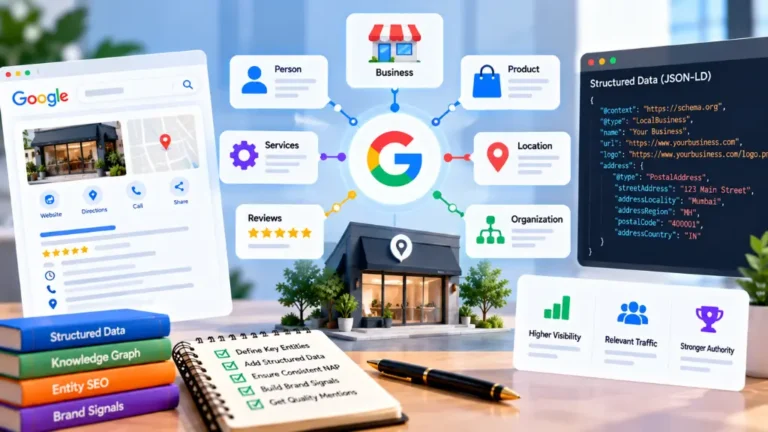
ChatGPT and AI search engines use structured data to instantly understand your content’s purpose, authorship, and context. In 2026, the highest-impact schema types for AI citation are:
- FAQ Schema – directly maps questions to answers; ideal for AI Overviews and ChatGPT extraction
- Article / BlogPosting Schema – defines who wrote the content, when it was published, and when it was last updated
- HowTo Schema – captures step-by-step processes in AI results
- Product and Review Schema – essential for e-commerce brands to appear in AI recommendation responses
Add datePublished and dateModified to your Article JSON-LD on every page. This single technical step directly signals recency to AI retrieval systems.
Build Topical Authority Through Content Clusters#
ChatGPT and AI search engines assess how comprehensively a source covers a topic, not just whether it contains a keyword. A site with 30 deeply interlinked articles covering every dimension of “technical SEO” will be cited far more reliably than a site with one comprehensive guide and nothing else.
Build content clusters around your core topics:
- Create a pillar page covering the topic broadly
- Support it with cluster articles addressing specific sub-questions
- Interlink them extensively so AI crawlers can map your topical authority
- Address the fan-out sub-queries – the shorter component questions AI systems generate from complex prompts
Earn Third-Party Citations and Brand Mentions#
ChatGPT and AI search engines are heavily influenced by what third-party sources say about your brand. According to Search Engine Journal, AI engines actively scan “best of” listicles and roundup articles – and the brands featured in those articles are the ones that get cited in AI responses.
- Identify which listicles and roundup articles AI engines are already citing for your category (run your target queries in ChatGPT and Perplexity to find them)
- Build a PR and outreach strategy aimed at getting included in those publications
- Encourage genuine reviews on platforms like G2, Trustpilot, and Google – AI engines use review platforms as credibility signals
- Publish original research or proprietary data – AI engines cite unique data because it can’t be found elsewhere
Optimise for Voice and Conversational Queries#
ChatGPT and AI search engines are primarily used through conversational, question-based prompts – not keyword searches. Your content needs to mirror the natural language of how people ask questions to AI:
- Use “who, what, when, where, why, how” headings throughout your content
- Write in plain, conversational language – avoid jargon-heavy sentences that don’t scan well when synthesised by an AI
- Include People Also Ask–style sections and FAQ blocks – these are among the most frequently extracted elements by AI systems
How Do You Track Your Visibility on ChatGPT and AI Search Engines?#
ChatGPT and AI search engines require entirely different metrics from traditional SEO. In 2026, tracking your AI presence means monitoring:
- AI Citation Share – how often your brand appears in AI-generated answers across platforms
- Share of Voice – your mentions versus competitors across ChatGPT, Perplexity, and Google AI
- Referral Traffic from AI – monitor traffic sources in Google Analytics 4 for referrals from chatgpt.com and perplexity.ai
- Sentiment Accuracy – is the AI describing your brand the way you want it to?
According to Search Savvy’s AI visibility framework, the first step in building any GEO strategy is auditing your current AI presence. Run your 10–15 most important customer queries in ChatGPT, Perplexity, and Google AI Overviews. Note whether your brand is cited, which competitors appear instead, and which specific article formats and sources get referenced. That audit tells you exactly what to build next.
Tools for tracking AI visibility include Semrush’s AI Visibility tracking, Ahrefs AI mentions, and dedicated GEO platforms like Geoptie and LLMrefs.
People Also Ask: ChatGPT and AI Search Questions#
Does ranking on Google still matter if I want to appear in ChatGPT?#
Yes – but it’s not sufficient on its own. Strong organic Google rankings remain a prerequisite for Google Gemini and AI Overview citations. ChatGPT’s retrieval pipeline also uses web search to fetch real-time sources. However, the overlap between top Google rankings and AI citations is less than 40% – meaning you also need to actively optimise content structure, freshness, and third-party mentions to appear in AI answers.
How often does ChatGPT update the sources it cites?#
ChatGPT’s cited sources are highly volatile. Research shows that between 40% and 60% of cited sources change from month to month. This means GEO is not a one-time optimisation – it requires the same ongoing discipline as traditional SEO, with regular content updates, fresh data, and continuous monitoring of your AI citation share.
Can small websites appear in ChatGPT and AI search answers?#
Yes. A smaller website with highly specific, authoritative, well-structured content on a niche topic can appear in AI answers – even if it doesn’t rank on Google’s first page. AI engines evaluate content quality, freshness, and topical authority – not just domain authority. This is one of the biggest opportunities GEO presents for newer or smaller brands.
Quick-Reference: GEO vs SEO in 2026#
| Traditional SEO | Generative Engine Optimisation (GEO) | |
| Goal | Rank in blue-link results | Be cited in AI-generated answers |
| Primary signal | Keywords + backlinks | Content extractability + entity authority |
| Success metric | Position 1–10 in SERPs | AI citation share + share of voice |
| Content format | Long-form keyword-optimised | Direct-answer blocks + question headings |
| Platform | Google, Bing | ChatGPT, Perplexity, Gemini, AI Overviews |
| Replaces SEO? | – | No – GEO is additive, not a replacement |
Frequently Asked Questions (FAQ)#
Q1: What is Generative Engine Optimisation (GEO)?
GEO is the practice of structuring your content so that AI-powered search platforms – including ChatGPT, Google AI Overviews, Perplexity, and Gemini – cite your brand in their generated answers. It differs from traditional SEO in that you’re optimising to be part of the answer, not just to appear in a ranked list of links.
Q2: How do I make sure ChatGPT can crawl my website?
Check your robots.txt file to confirm you’re not blocking AI-specific crawlers like GPTBot (ChatGPT), Google-Extended (Google AI), or PerplexityBot. Also verify that your key pages are not blocked by CDN firewall rules, JavaScript rendering issues, or login-gated access. AI bots must be able to fully access and read your pages to cite them.
Q3: Does adding FAQ Schema help with AI search visibility?
Yes – significantly. FAQ schema directly maps questions to answers in a machine-readable format, making it one of the easiest elements for AI engines to extract and cite. Combined with clearly structured H2/H3 question headings and short direct-answer paragraphs, FAQ schema is one of the highest-impact technical additions for AI search visibility in 2026.
Q4: How is Perplexity different from ChatGPT for SEO purposes?
Both platforms use real-time web search to ground their answers, but they retrieve content through different pipelines. Perplexity indexes the web more directly and shows inline citations prominently. ChatGPT’s search feature synthesises answers from web results with citations. For both, the same fundamentals apply: crawlable pages, fresh content, clear structure, and strong third-party mentions across authoritative sources.
Q5: How long does it take to appear in ChatGPT and AI search answers?
There is no fixed timeline, but brands that follow structured GEO practices – fresh content, direct-answer formatting, schema markup, and third-party citation building – have seen AI citation rates climb from near-zero to double-digit percentages within 60 days, according to GenOptima’s tracking data. Consistent effort compounds over time, similar to traditional SEO.
Q6: Should I stop investing in traditional SEO and focus only on GEO?
No. Search Savvy strongly recommends treating GEO as an additive layer on top of existing SEO – not a replacement. Strong organic rankings remain a prerequisite for several AI platforms, particularly Google AI Overviews and Gemini. SEO and GEO are complementary: a strong SEO foundation makes your content more discoverable to the web crawlers that AI systems rely on, while GEO-specific optimisations maximise how often and how favourably AI systems cite that content.
Final Thoughts#
ChatGPT and AI search engines are not a future trend to prepare for – they are the present reality reshaping how brands are discovered, evaluated, and chosen. With 37% of consumers now starting searches with AI, and Google AI Overviews appearing in one out of every four searches, visibility in AI-generated answers has become just as important as ranking on page one.
The brands that will win this decade are the ones building their GEO strategy now: writing extractable content, earning third-party citations, publishing with schema markup, and tracking their AI citation share across platforms. The overlap between Google rankings and AI citations continues to shrink – which means waiting for SEO alone to deliver AI visibility is a strategy that will cost you ground every month.
Search Savvy is at the forefront of this shift – helping businesses build AI-ready content strategies that earn citations on ChatGPT, Perplexity, Google AI Overviews, and beyond, while maintaining a strong traditional SEO foundation.