ChatGPT Doesn’t Mention Your Brand. Here’s the Fix That Actually Works
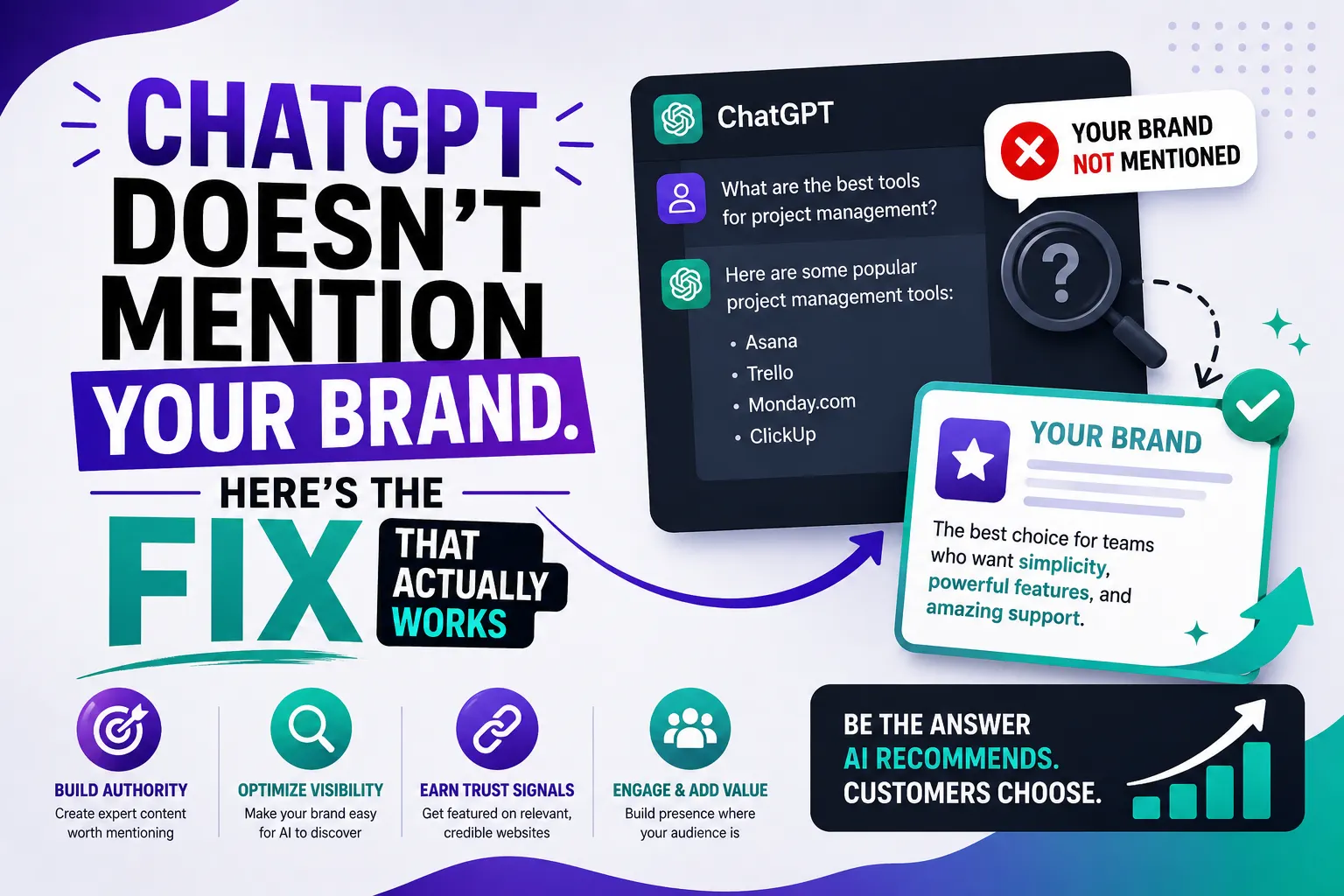

You have done the work. Your website ranks on Google. Your content is polished. Your backlinks are solid. Yet when a potential customer opens ChatGPT and types a question directly in your niche – it is your competitor’s name in the answer. Not yours.
In this article14 sections
This scenario is playing out millions of times every single day in 2026. ChatGPT now serves over 800 million weekly active users. Perplexity handles roughly 780 million monthly queries. Google’s AI Overviews appear on the majority of commercial searches. And according to a 2026 study analysing 80 million citations, approximately 67% of information discovery now happens via LLM interfaces – not traditional search results.
If your brand is invisible in those answers, you are invisible to more than half your potential audience.
At Search Savvy, we have seen this problem firsthand across client after client. The root cause is almost always the same: brands are optimising for Google’s ranking algorithm while completely ignoring a newer, more urgent discipline – GEO, generative engine optimisation.
This article explains what GEO generative engine optimisation is, why it matters more than almost any other strategy in 2026, and – most importantly – exactly how to get your brand appearing in AI-generated answers starting now.
What Is GEO Generative Engine Optimisation – and How Is It Different from SEO?#
GEO generative engine optimisation is the practice of structuring your content and brand presence so that AI platforms like ChatGPT, Perplexity, Google AI Overviews, and Gemini cite, recommend, or mention you in their responses.
The term was formalised in academic research in 2024 by researchers at Princeton, Georgia Tech, and IIT Delhi, and entered mainstream marketing vocabulary in 2025. By early 2026, most enterprise marketing teams already have a GEO initiative – but most SMB teams have not started yet, which represents a significant first-mover opportunity.
Here is the critical distinction that most marketers miss:
| Traditional SEO | GEO Generative Engine Optimisation | |
| Goal | Rank a web page in search results | Get cited inside AI-generated answers |
| Success metric | Rankings + clicks | Citation frequency + AI mention share |
| User behaviour | User sees your link and clicks | User sees your brand in the answer itself |
| Core signal | Authority + keywords | Structural clarity + entity recognition |
SEO drives clicks. GEO establishes authority – if ChatGPT cites your research, users may not immediately visit your site, but they associate your brand with expertise. That brand association, built repeatedly at scale, is the new competitive moat in AI-driven search.
People Also Ask: What does GEO stand for in digital marketing? Short Answer: GEO stands for Generative Engine Optimisation. It is the practice of optimising your content and brand so AI tools like ChatGPT, Perplexity, and Google AI Overviews cite and recommend your brand in their generated responses.
Why Is GEO Generative Engine Optimisation So Important in 2026?#
GEO generative engine optimisation has become non-negotiable because the search behaviour of your audience has fundamentally changed. People are no longer scrolling ten blue links – they are asking AI a question and trusting the answer they receive.
Traditional search engine volume is predicted to drop 25% by 2026 and 50% by 2028, replaced by traffic from generative engines like ChatGPT. That trajectory is already visible in analytics dashboards. Traffic from AI bots – ChatGPT-User, PerplexityBot, Claude-Web – is measurable and growing. Brands that appear in those AI answers win attention that never touches a search results page.
The competitive implication is stark. The framing from leading marketers has shifted in 2026: “I care less about Google rankings and more about whether AI tools like ChatGPT or Perplexity mention the brands I work with”.
At Search Savvy, we recommend treating GEO as a parallel strategy to SEO – not a replacement, but an essential complement. In 2026, an effective visibility strategy requires both: SEO for organic traffic volume, GEO for high-intent AI-referred discovery and brand authority.
People Also Ask: Is GEO replacing SEO in 2026? Short Answer: No – GEO and traditional SEO are complementary. Strong domain authority, backlinks, and technical SEO all contribute to GEO performance. But GEO requires additional optimisation specifically for how AI systems discover, evaluate, and cite content. Both are essential.
How Does GEO Generative Engine Optimisation Actually Work?#
GEO generative engine optimisation works by aligning your content and brand presence with the way AI language models ingest, evaluate, and cite information when generating answers.
Most AI platforms like ChatGPT use a process called RAG – Retrieval-Augmented Generation. This means the model retrieves relevant content from trusted sources at query time and synthesises it into an answer. Whether your brand appears in that answer depends on three things:
1. Relevance and Authority#
GEO generative engine optimisation begins with ensuring your content directly and definitively answers the question being asked. AI models also require multi-source confirmation – if your site says one thing and review platforms say another, AI treats your brand as ambiguous and often omits you as a result.
2. Entity Recognition#
GEO generative engine optimisation depends heavily on how clearly AI models understand who you are. AI systems build an internal model of your brand – its name, category, products, and key attributes. Brands with a consistent, well-confirmed entity model get cited more reliably. Inconsistent naming, vague category positioning, or missing structured data weaken this signal.
3. Structured Presentation#
GEO generative engine optimisation requires that your content be presented in formats AI can easily extract. Answer-first formatting, FAQ schema, and clean HTML make content significantly easier for LLMs to parse. JavaScript-heavy pages reduce citation probability regardless of content quality.
People Also Ask: How does ChatGPT decide which brands to mention? Short Answer: ChatGPT cites brands based on content relevance, multi-source confirmation, entity recognition clarity, and structural formatting. It favours content from third-party publications, review platforms, and community sources as much as – or more than – brand websites themselves.
What Are the Most Effective GEO Strategies to Get Your Brand Into AI Answers?#
GEO generative engine optimisation is not a single tactic – it is a layered strategy. Here are the most proven approaches for 2026, ranked by impact:
Build Content in AI-Friendly Formats#
GEO generative engine optimisation starts with structure. AI models favour specific content formats over unstructured prose:
- Comparison tables with consistent columns, pricing rows, and “best for” labels
- Numbered lists with step-by-step instructions and clear action verbs
- FAQ sections with specific questions and direct two-to-three sentence answers
- Pros and cons breakdowns that present honest trade-offs rather than marketing copy
Traditional keyword-stuffed content fails because semantic search identifies concepts, not keyword density. A page that explains your topic thoroughly with supporting examples and clear structure will always outperform a page that repeats a phrase dozens of times.
Implement Schema Markup – Especially FAQPage and Organisation Schema#
GEO generative engine optimisation has a strong technical layer. Structured data acts as a translation layer between your content and AI systems, providing explicit signals about what your content represents rather than forcing AI to guess through natural language processing.
For ChatGPT specifically: it values FAQPage and Article schema for conversational answers, and Organisation schema to correctly attribute information to specific brands. Use JSON-LD format for all schema implementation – it is the format preferred by Google and supported by all major AI systems.
Add comprehensive Organisation schema to your homepage. Include your official name, logo, founding date, social profiles, and sameAs links to Wikipedia, Wikidata, Crunchbase, and LinkedIn. Google’s Knowledge Graph feeds into AI model training data – brands with Knowledge Graph entries get cited more because AI models have richer entity data to reference.
Earn Third-Party Coverage on Sources AI Engines Already Trust#
GEO generative engine optimisation cannot rely on your own website alone. The highest-cited sources in any category are comparison articles, review sites, and community platforms – not corporate homepages.
Earned media placements in Tier 1 publications are cited by AI engines 82–89% of the time. Being featured on industry roundups, appearing in credible review platforms, and earning coverage in respected trade publications dramatically increases the probability of AI citation.
This is why digital PR is now one of the highest-ROI activities in a GEO generative engine optimisation strategy.
Maintain Brand Consistency Across Every Platform#
GEO generative engine optimisation requires that your brand identity be consistent everywhere AI might encounter it. The most effective strategies focus on clarity – clear product descriptions and consistent messaging – and consistency, meaning your brand name, descriptors, and key facts appear the same way across your site and third-party sources.
This means auditing your presence on:
- Your own website (homepage, About page, product descriptions)
- Google Business Profile
- Wikipedia and Wikidata
- Crunchbase, LinkedIn, and industry directories
- Review platforms (Google Reviews, Trustpilot, G2)
Update Your Content With Fresh Data Consistently#
GEO generative engine optimisation is an ongoing process, not a one-time setup. AI models prioritise recent, accurate sources. Updating statistics, percentages, and data points with the most current available information and refreshing source links often restores citation frequency within two to three weeks.
Set a quarterly content refresh schedule for your highest-traffic and most strategically important pages.
People Also Ask: Does having good SEO automatically help with GEO? Short Answer: Partially. Well-structured content that ranks on Google is often ingested by AI models too. But SEO alone is not sufficient – ChatGPT frequently cites listicles, review platforms, and community discussions that rank poorly on Google. You need both strategies running in parallel.
How Do You Track GEO Generative Engine Optimisation Performance?#
GEO generative engine optimisation requires a new measurement framework alongside your traditional SEO metrics. You cannot measure AI visibility with Google Analytics alone.
Key metrics to track in 2026:
- AI citation frequency – How often does your brand appear when relevant prompts are run in ChatGPT, Perplexity, or Gemini?
- AI mention share – What percentage of AI responses in your category mention your brand vs. competitors?
- Source attribution – Which third-party pages are driving AI citations for your brand?
- Sentiment in AI responses – When AI mentions your brand, is the context positive, neutral, or negative?
You need both traditional SEO metrics and AI visibility metrics to understand your full organic search presence in 2026. Tools worth exploring include Semrush’s Enterprise AIO, SE Ranking, and Gauge for monitoring brand mentions and citation patterns across AI platforms.
Also check your Google Search Console for AI bot traffic patterns and review your GA4 data for sessions driven by known AI user agents (ChatGPT-User, PerplexityBot, Claude-Web).
According to Search Savvy’s insights, the brands winning in AI search right now are those that treat visibility monitoring as a weekly discipline – not a one-off audit.
FAQ: GEO Generative Engine Optimisation – Your Questions Answered#
Q1: What is GEO generative engine optimisation in simple terms? GEO (Generative Engine Optimisation) is the process of optimising your content, brand presence, and technical setup so that AI tools like ChatGPT, Perplexity, and Google AI Overviews mention or recommend your brand in their generated answers. Think of it as SEO – but for AI-generated responses rather than ranked blue links.
Q2: How long does it take to see results from GEO? Initial improvements in AI citation frequency can appear within two to four weeks, particularly after implementing schema markup, updating data points, and earning third-party coverage. Building sustained AI visibility – where your brand is consistently cited across multiple platforms – typically takes three to six months of strategic effort.
Q3: Do I need to block AI crawlers from accessing my website? No – and blocking them is almost always counterproductive. Blocking bots like GPTBot, ClaudeBot, or PerplexityBot removes your content from citation consideration entirely. Only block pages you do not want AI models to learn from, such as admin areas or duplicate content. Everything else should remain accessible.
Q4: Is GEO only relevant for large enterprise brands? Not at all. In fact, smaller brands have a first-mover advantage in many niche categories where enterprise competitors have not yet implemented GEO strategies. The core principles – structured content, entity clarity, consistent brand presence, and earned third-party coverage – are achievable at any budget level.
Q5: Can I do GEO without changing my entire content strategy? Yes. Start with high-impact, low-effort changes: add FAQPage schema to existing pages, add an Organisation schema block to your homepage, audit your brand consistency across key platforms, and run weekly prompt tests in ChatGPT to track your current visibility. These steps alone can produce measurable improvement before you rebuild any content from scratch.
Q6: What is the difference between AEO (Answer Engine Optimisation) and GEO? AEO was the earlier term used to describe optimising content for voice assistants and featured snippets. GEO is the evolved, broader discipline covering optimisation specifically for generative AI systems – ChatGPT, Perplexity, Google AI Overviews, and Gemini. GEO builds on AEO principles but addresses a fundamentally different technology with different citation mechanics and content evaluation criteria.