GEO vs SEO: What’s the Difference and Which Matters More?
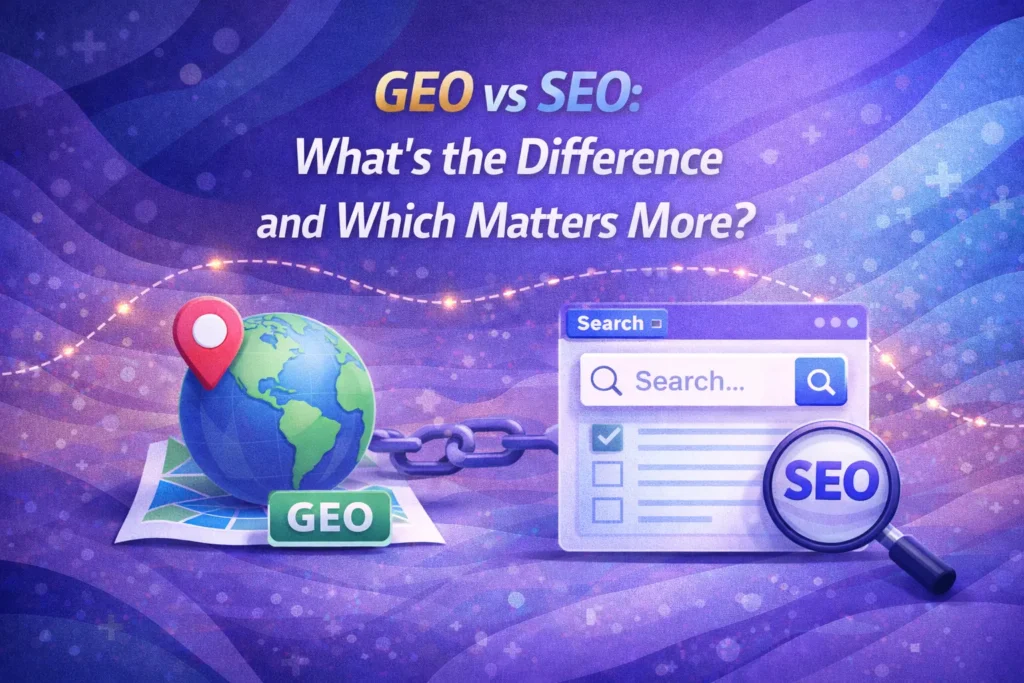

GEO vs SEO is the defining conversation in digital marketing in 2026 – and the answer isn’t what most people expect. For over two decades, Search Engine Optimisation (SEO) has been the undisputed foundation of online visibility. But a new discipline has entered the picture: Generative Engine Optimisation (GEO), built specifically for the AI-powered search platforms – ChatGPT, Google AI Overviews, Perplexity, Gemini, and Copilot – that are now reshaping how people discover brands and find information. At Search Savvy, we’ve been studying this shift closely, and the data is unambiguous: the brands that will dominate search visibility through the rest of this decade are the ones mastering both channels simultaneously.
In this article18 sections
This guide breaks down exactly what GEO and SEO are, how they differ in practice, which one matters more for your business right now, and – crucially – why the real answer is “you need both.”
What Is SEO – and How Does It Work in 2026?#
GEO vs SEO starts with a clear understanding of what traditional SEO is. Search Engine Optimisation is the practice of improving your website’s content, technical structure, and authority so it ranks higher in traditional search engine results pages (SERPs) – primarily on Google, which holds approximately 90% of the global search market.
SEO in 2026 still operates on its core pillars:
- Content quality – original, helpful, E-E-A-T-aligned content that satisfies user intent
- Backlinks – authoritative inbound links from trusted websites that signal credibility to Google
- Technical health – fast loading, mobile-friendly, crawlable, clean site architecture
- Keywords – matching the language your audience uses when searching for your topics
- User experience signals – Core Web Vitals, engagement, and low bounce rates
SEO earns your page a position in a ranked list of results. When someone searches Google, they see up to 10 blue links per page, each leading to a different website. The goal of SEO is to be as high on that list as possible – ideally in the top 3 positions, where the overwhelming majority of clicks go.
What Is GEO – and How Is It Different?#
GEO vs SEO diverges fundamentally at the output level. Generative Engine Optimisation (GEO) is the practice of structuring and positioning your content so that AI-powered search platforms select it as a cited source when generating their answers. Where SEO earns a URL a position in a ranked list, GEO earns your brand a citation inside a single AI-generated answer.
The platforms that GEO targets in 2026 include:
- Google AI Overviews – AI-generated summaries appearing at the top of Google results, now present in over 25% of all queries
- ChatGPT with Browse – OpenAI’s AI assistant, now handling 2.8 billion monthly active users with web retrieval
- Perplexity AI – processing 780 million+ monthly queries with inline source citations
- Google Gemini – Google’s standalone AI assistant with 2 billion monthly visits
- Microsoft Copilot – AI search integrated into Bing and Microsoft’s productivity suite
Here’s what makes GEO fundamentally different from SEO: when a user asks an AI a question, the platform doesn’t display 10 links. It synthesises a single, coherent answer – and cites only 1 to 3 sources in that response. The stakes are binary. You’re either cited, or you’re invisible.
How Are GEO and SEO Different in Practice?#
GEO vs SEO plays out across every dimension of how you create, structure, and distribute content. Here’s a precise breakdown:
How Success Is Measured#
In SEO, success is measured in rankings (position 1–10), organic click-through rate (CTR), and traffic from search results pages. You track your keyword positions in tools like Google Search Console, Ahrefs, or Semrush.
In GEO, success is measured by AI Citation Share – how often your brand appears in AI-generated answers across ChatGPT, Perplexity, Google AI Overviews, and Gemini. New metrics include share of voice in AI responses, referral traffic from chatgpt.com and perplexity.ai in Google Analytics 4, brand mention sentiment, and the specific prompts that trigger your citation.
How Content Is Optimised#
SEO content is structured around keyword clusters, search intent matching, meta tags, heading hierarchy, and word count. You’re optimising for a crawler that reads your page, assesses relevance, and assigns a ranking position.
GEO content is structured around extractability and answer-completeness. AI engines don’t rank pages – they extract the clearest, most self-contained passage that directly answers a sub-query. The ideal GEO content block is 40–60 words, leads with the direct answer in the first sentence, and stands alone as a complete thought even when quoted out of context.
How Authority Is Built#
In SEO, authority is primarily built through backlinks – inbound links from high-domain-authority websites pass PageRank and signal credibility to Google’s algorithm.
In GEO, authority is built through entity prominence and brand mentions – even unlinked mentions across trusted platforms carry significant weight. AI engines scan Reddit, LinkedIn, G2, Trustpilot, Wikipedia, YouTube, and industry publications to determine which brands are genuinely recognised as authoritative. A brand mentioned consistently across multiple trusted third-party sources is far more likely to be cited than one with excellent backlinks but limited external coverage.
How Schema and Structure Are Used#
SEO uses schema markup to earn rich results in the SERP – star ratings, FAQs, HowTo steps, and breadcrumbs that enhance your listing’s appearance in Google results.
GEO uses the same schema – but for a different purpose. FAQ Schema, Article Schema, and HowTo Schema are the AI’s “nutrition label” for your content, allowing it to instantly classify what a page is about, who wrote it, and when it was last updated. The dateModified field in Article JSON-LD is particularly critical – AI engines show a strong recency bias, preferring sources updated within the last 90 days.
GEO vs SEO at a Glance: The Key Differences Table#
| Dimension | SEO | GEO |
| Target platforms | Google, Bing | ChatGPT, Perplexity, AI Overviews, Gemini |
| Goal | Rank in a list of 10 links | Be cited in a single AI-generated answer |
| Slots available | 10 per page | 1–3 per AI response |
| Primary authority signal | Backlinks + domain authority | Brand mentions + entity prominence |
| Content format | Keyword-optimised, long-form | Direct-answer blocks, question headings |
| Key schema | Rich results, breadcrumbs | FAQ, Article, HowTo with dateModified |
| Success metric | Ranking position, organic traffic | AI citation share, share of voice |
| Content freshness | Important | Critical – 50% of AI citations are under 13 weeks old |
| Replaces the other? | – | No – both are complementary |
Which Matters More – GEO or SEO?#
GEO vs SEO is not an either/or decision – but understanding their relative urgency matters for allocating your resources in 2026. Here is the honest answer:
SEO remains the foundation. A Writesonic analysis of over 1 million AI Overviews found that 40.58% of AI citations come directly from Google’s top 10 search results. Strong organic rankings are a prerequisite for several AI platforms – particularly Google AI Overviews and Gemini. If you don’t rank well in traditional search, AI engines are less likely to find and cite your content in the first place.
GEO is the growth layer. Traditional search volume is projected to decline by 25% in 2026 as users shift to AI-powered answer engines (Gartner). According to Search Engine Journal, the overlap between Google’s top search results and AI citations has dropped from 70% to below 20% in just two years. This gap is growing – meaning SEO alone will reach a shrinking share of your potential audience over time.
According to Search Savvy’s digital strategy framework, the right question in 2026 is not “GEO or SEO?” – it is “how do I build a content strategy that earns visibility in both?” The brands that treat GEO as an additive layer on top of solid SEO are the ones capturing the widest possible audience across all discovery channels.
Where Should You Focus First?#
If your SEO foundation is weak – technical issues, thin content, no backlinks – fix that first. It will benefit both channels simultaneously.
If your SEO is already solid and you’re still not appearing in AI answers, your GEO-specific gaps likely include: content that isn’t formatted for extractability, missing or outdated schema markup, limited third-party brand mentions, and content freshness issues.
What Do GEO and SEO Have in Common?#
GEO vs SEO is often framed as a conflict, but the two disciplines share the same bedrock principles:
- E-E-A-T matters for both. Experience, Expertise, Authoritativeness, and Trustworthiness are evaluated by both Google’s ranking algorithm and AI engine citation systems. Named authors with credentials, transparent sourcing, and original insights build credibility for both channels simultaneously.
- User intent is still central. Whether you’re targeting a Google ranking or an AI citation, you must answer the exact question the user is asking – clearly, completely, and accurately.
- Technical accessibility applies to both. Googlebot and AI crawlers (GPTBot, PerplexityBot, Google-Extended) all need to be able to crawl and render your pages. A site with crawl errors or blocked bot access loses visibility in both channels.
- Thin content fails everywhere. Generic, low-value content doesn’t rank in Google and doesn’t get cited by AI. Original research, unique data, expert commentary, and first-hand experience are rewarded by both systems.
People Also Ask: GEO vs SEO Questions#
Is GEO replacing SEO in 2026?#
No. GEO is evolving alongside SEO, not replacing it. Strong SEO foundations – quality content, technical health, and backlinks – remain prerequisites for several AI platforms. GEO adds a new optimisation layer on top of SEO, addressing how AI engines evaluate, extract, and cite content. Both strategies are necessary to capture visibility across the full spectrum of how people now search for information.
Can a page rank on Google and still not appear in AI answers?#
Yes – and this is increasingly common. Research shows that less than 40% of ChatGPT’s cited sources overlap with Google’s top results. A page can rank position one on Google but never be cited by ChatGPT if it lacks the structural elements AI engines prioritise: direct-answer formatting, clear question headings, fresh content, schema markup, and multi-platform brand presence.
Do backlinks still matter for GEO?#
Backlinks remain the primary authority signal for traditional SEO. For GEO, unlinked brand mentions across trusted platforms (Reddit, G2, LinkedIn, Wikipedia, industry publications) carry significant weight – sometimes more than formal backlinks. A comprehensive authority strategy in 2026 builds both backlinks and brand mention coverage across the open web.
How to Build a Combined GEO + SEO Strategy in 2026#
GEO vs SEO thinking dissolves when you build a unified content strategy that serves both channels. At Search Savvy, here is the framework we recommend:
Step 1: Audit Your AI Presence Run your 10–15 most important customer queries in ChatGPT, Perplexity, and Google AI Overviews. Identify whether your brand is cited, which competitors appear instead, and what content format those cited sources use.
Step 2: Fix Your SEO Foundation Use Google Search Console to identify crawl errors, indexing issues, and underperforming pages. Ensure your site is technically sound – fast, mobile-friendly, and fully crawlable by both Googlebot and AI-specific bots.
Step 3: Reformat Key Content for Extractability Identify your highest-traffic pages and restructure them with direct-answer paragraphs (40–60 words), question-based H2/H3 headings, and FAQ sections. Add or update Article/FAQ/HowTo schema markup with a current dateModified timestamp.
Step 4: Build Topical Authority Clusters Publish comprehensive content clusters – a pillar page plus supporting articles – that cover your core topics from every angle. This satisfies both Google’s topical authority scoring and AI engines’ preference for sources with deep, consistent coverage.
Step 5: Earn Multi-Platform Brand Coverage Pursue editorial mentions in industry publications, seek inclusion in “best of” roundup articles, encourage genuine reviews on G2 and Trustpilot, and engage in platforms like Reddit and LinkedIn where AI engines actively mine brand signals.
Step 6: Track AI Citation Metrics Weekly Monitor referral traffic from AI platforms in Google Analytics 4 and use dedicated GEO tracking tools like Semrush or Ahrefs to follow your brand’s share of voice in AI-generated answers.
Frequently Asked Questions (FAQ) About GEO Vs SEO#
Q1: What is the simplest way to explain GEO vs SEO?
SEO optimises your website to rank in a list of 10 links on Google. GEO optimises your content to be cited inside a single AI-generated answer on platforms like ChatGPT, Perplexity, and Google AI Overviews. SEO drives traffic through clicks. GEO drives visibility through citations and brand mentions – sometimes without any click at all.
Q2: Does good SEO automatically help with GEO?
Partially. Strong SEO is a prerequisite for GEO on platforms like Google AI Overviews, which pulls heavily from existing top-ranked pages. However, good SEO alone is insufficient for platforms like ChatGPT, Perplexity, and Gemini – which use their own crawling and retrieval systems. GEO requires additional optimisation: extractable content format, schema markup, content freshness, and multi-platform brand presence.
Q3: How quickly can GEO strategies show results?
GEO results vary by platform. Brands that implement structured direct-answer content, fresh schema markup, and third-party citation building have reported their AI citation rates climbing from near-zero to measurable double-digit percentages within 60 days. Like SEO, GEO compounds over time – the longer you build topical authority and brand mentions, the more consistently AI engines cite you.
Q4: Should small businesses invest in GEO in 2026?
Yes – and GEO may actually present a larger opportunity for small businesses than traditional SEO. AI engines evaluate content quality, freshness, and answer-completeness – not just domain authority. A smaller website with highly specific, well-structured content on a niche topic can appear in AI answers even without the link profile that would be needed to compete for Google’s top rankings.
Q5: What is the biggest mistake brands make with GEO vs SEO?
The biggest mistake is treating GEO and SEO as separate, competing strategies with separate budgets and separate teams. The most effective approach is an integrated content strategy that earns traditional rankings and AI citations from the same content, by building topical authority, using clear extractable formatting, maintaining content freshness, and earning coverage across multiple platforms simultaneously.
Q6: How does Search Savvy approach GEO and SEO for clients?
Search Savvy builds integrated GEO + SEO strategies that start with a strong technical SEO foundation – crawlability, Core Web Vitals, content structure – and layer GEO-specific optimisations on top: direct-answer content blocks, schema markup with freshness signals, AI bot accessibility audits, and multi-platform brand mention campaigns. We track both traditional SEO metrics and AI citation share to give clients a complete picture of their search visibility across all discovery channels.
Final Thoughts#
GEO vs SEO is not a competition – it’s a progression. SEO built the foundation that makes your content discoverable on the open web. GEO extends that foundation to ensure your content is not just discoverable but citable by the AI systems that an increasingly large share of your audience now relies on to find answers.
In 2026, with 37% of consumers starting searches with AI, Google AI Overviews appearing in one in four searches, and ChatGPT handling nearly 3 billion monthly active users, optimising for both channels is no longer a strategic advantage. It’s the baseline expectation.
The brands that invest now in building content that serves both search engines and AI engines will compound their visibility advantages month after month – while those that wait will find themselves competing for an ever-shrinking share of traditional search traffic.
Search Savvy helps businesses build exactly this kind of integrated strategy – one that earns rankings, earns citations, and earns trust across every channel where your audience is searching.