Growth Loops vs Funnels: Designing Self-Reinforcing Acquisition Systems
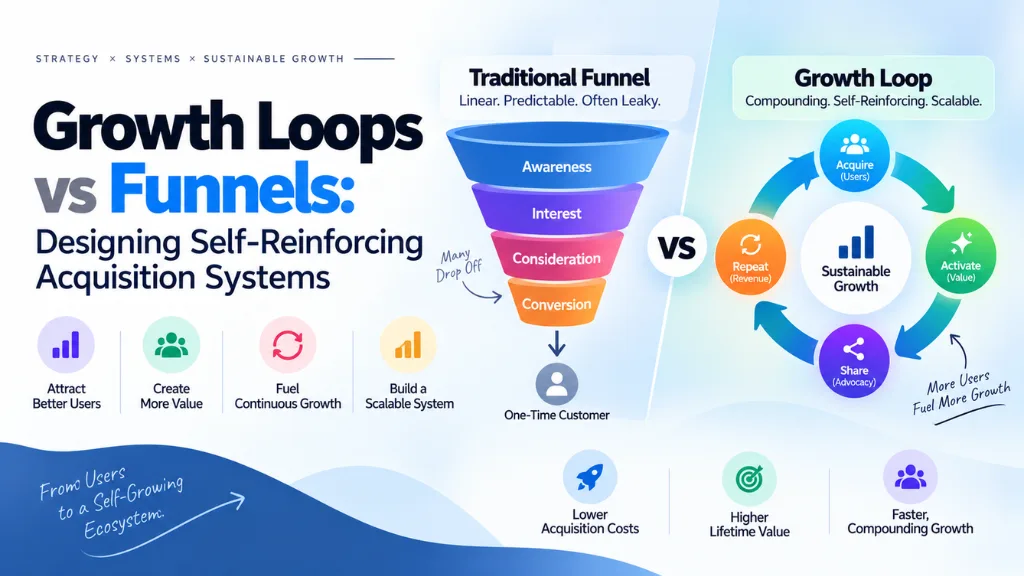

If your acquisition numbers only move when you spend more on ads or publish more content, you’re running a funnel – and funnels stop the moment you stop feeding them. A growth loop works differently: the output of one cycle becomes the input for the next, so the system keeps generating new users without a constant fresh injection of budget or effort. Understanding growth loops vs funnels isn’t an academic exercise. It changes how you allocate budget, what you measure, and which parts of your product or marketing you invest in first.
In this article13 sections
This article breaks down what separates a funnel from a loop, when each model actually applies, and how to design a loop that compounds instead of decaying. You’ll also see the most common mistakes teams make when they try to force a loop where one doesn’t naturally exist.
What Is a Growth Funnel?#
A growth funnel is a linear model that maps the stages a prospect moves through on the way to becoming a customer – typically awareness, consideration, conversion, and retention. The most widely used version is the AARRR framework (Acquisition, Activation, Retention, Referral, Revenue), which breaks the customer journey into measurable stages so teams can find where people drop off.
Funnels are diagnostic by design. A funnel treats growth as a series of stages – awareness, consideration, conversion – where traffic is poured in, each stage is optimized, and drop-off is measured and addressed. That structure is genuinely useful: it tells you exactly where a campaign, landing page, or onboarding flow is leaking prospects.
The limitation shows up at scale. Because a funnel is linear, every new user requires a fresh input at the top – stop the ad spend or the content output, and the funnel dries up. A funnel doesn’t get easier to fill over time; it gets harder, because the cheapest, most receptive audience segments are usually acquired first.
What Is a Growth Loop?#
A growth loop is a self-reinforcing system where the output of one user’s action becomes the input that drives the next cycle of growth, rather than the process simply resetting after a conversion. Unlike a traditional funnel, which moves users linearly from awareness to conversion and then resets, a loop is circular – each completed cycle generates the conditions for the next one.
The term was popularized within the growth and product strategy community largely through the work of Reforge founder Brian Balfour, alongside growth strategists including Andrew Chen. Companies that scaled through loops did so because their products were architecturally designed to generate their own demand – users who found value created conditions, through sharing, referrals, or content creation, that brought in new users, who then created more value, completing the loop.
Balfour has described the underlying mechanism plainly: “Self-reinforcing systems create compounding returns.” That compounding is the entire point – a loop that runs twice as long doesn’t just add growth, it multiplies it, because each cycle feeds the next.
Growth Loops vs Funnels: The Core Difference#
| Growth Funnel | Growth Loop | |
| Shape | Linear – top to bottom | Circular – output feeds back as input |
| Growth pattern | Requires continuous fresh input | Compounds without new external input |
| What it measures | Conversion rate per stage | Cycle time and reinvestment rate |
| Best for | Diagnosing where prospects drop off | Building growth that isn’t repurchased every cycle |
| Failure mode | Dries up when spend or content stops | Stalls if the reinvestment step breaks |
| Example | Paid ad campaign → landing page → signup | User invites a colleague → colleague signs up → colleague invites another |
The two models also require different metrics: funnels are measured stage by stage, while loops are measured on cycle time and reinvestment – how fast and how often the result feeds the next cycle.
Are Growth Loops Better Than Funnels?#
Neither model is universally “better” – they answer different questions. Funnels help a business understand conversion efficiency; loops help a business build compounding growth. One is diagnostic, the other is architectural. A SaaS company still needs funnel-level clarity on where trial signups abandon onboarding, even if its long-term growth engine is a referral loop.
Why Funnels Break Down at Scale#
Funnels don’t fail because the model is wrong – they fail because they treat every growth cycle as a one-time transaction. Once you exhaust the cheapest acquisition channels, customer acquisition cost climbs, and the business has to keep spending more to hold flat growth. This is the pattern behind rising CAC in mature paid-acquisition businesses: funnel-based companies typically face rising acquisition costs as they scale, because the earliest cohorts are usually the cheapest and easiest to acquire.
This doesn’t mean funnels should be abandoned. It means they should be treated as a diagnostic layer inside a larger system, not the entire growth strategy.
How Growth Loops Compound Over Time#
The mechanics of a loop are best understood through a real example. Uber’s rider growth wasn’t accidental – every new rider attracted more drivers, and every new driver attracted more riders, which is a growth loop in action. Neither side of the marketplace grew independently; each side’s growth became the fuel for the other side’s growth.
Andrew Chen, who led rider growth at Uber before becoming a general partner at Andreessen Horowitz, has pointed out that network effects generally strengthen the more a product is experienced alongside other users at the same time and place – which is exactly why marketplace and social products are some of the clearest examples of loop-driven growth. AI products have shown the same pattern more recently: Balfour has noted that the primary driver behind ChatGPT’s rapid early growth was word of mouth, as people shared their conversations on social platforms, which then drew mainstream media attention – a content-and-sharing loop rather than a paid funnel.
Types of Growth Loops#
Most companies run more than one loop simultaneously rather than relying on a single mechanism. There are four commonly recognized loop types – viral/referral, content/SEO, paid acquisition, and sales-assisted – each with its own trigger, mechanism, and failure mode, and most companies run two or three loops at once.
| Loop Type | Trigger | Typical Example |
| Viral / Referral | Existing user invites another | Uber’s driver-rider loop |
| Content / SEO | Published content attracts organic search traffic | A blog post that ranks and drives new signups who create more content |
| Paid Acquisition | Ad spend converts users who generate revenue that funds more ads | Reinvesting a share of new-customer revenue into the next campaign |
| Sales-Assisted | Customer success stories or referrals feed the next sales cycle | A case study that sales uses to close the next deal in the same segment |
The paid-acquisition loop only compounds if new-customer revenue is deliberately reinvested into the next round of spend – most teams running performance marketing services treat that reinvestment ratio as the metric that matters, not just raw conversion rate.
Search and AI answer engines are increasingly part of the content/SEO loop. Content built around topical authority – rather than isolated keyword targeting – tends to compound because each well-linked article increases the likelihood that both search engines and AI systems like AI Overviews, ChatGPT, and Perplexity surface and cite the next one. That’s why the groundwork for a content loop usually starts with keyword research that maps out a whole topic cluster rather than a single target term, and Search Savvy treats content strategy and topical authority as a growth infrastructure decision rather than a one-off publishing task.
Growth Loops vs Funnels: Which Should You Use?#
Do You Need Both a Funnel and a Loop?#
Yes – most sustainable businesses run both, because they solve different problems. Use the funnel to see friction per stage, and use loops to build growth you don’t have to buy all over again. A funnel without a loop means growth caps out at your acquisition budget. A loop without a funnel means you can’t diagnose why a specific stage – say, activation – is underperforming. This is especially true for subscription businesses; Search Savvy’s work on SEO for SaaS companies usually starts by mapping the funnel stage where trial users stall before layering in a referral or product-led loop.
In practice, this looks like:
- Use funnel metrics (conversion rate by stage, time-to-activation, drop-off points) to fix what’s broken right now.
- Use loop metrics (cycle time, reinvestment rate, loop coefficient) to understand whether the system compounds without new spend.
- Treat the funnel as the entry point into a loop, not a replacement for one.
How to Design a Growth Loop for Your Business#
- Identify the existing behavior that already creates value for another user – a share, review, referral, or piece of content a satisfied customer is already inclined to create.
- Reduce friction on that specific action. A share that takes five steps won’t compound; one that takes one step will.
- Confirm the new user reaches value quickly. A loop collapses if new entrants churn before completing their own cycle.
- Measure cycle time and reinvestment rate, not just conversion rate – how long one cycle’s output takes to generate the next input, and what share of it is actually reinvested.
- Project the loop forward several cycles on paper before building it, working backward to spot where it will bottleneck first.
- Pair the loop with funnel-level tracking so you can still see where individual users drop off inside an otherwise-working loop.
Common Mistakes#
- Assuming every business has a natural loop. Not every product creates conditions for one user’s action to generate another. Forcing a referral program onto a product nobody talks about rarely produces a real loop.
- Measuring loops with funnel metrics. Conversion rate alone won’t show whether a loop compounds – cycle time and reinvestment rate will.
- Ignoring retention while chasing loop mechanics. New users who don’t stick around aren’t compounding growth; they’re just a slower-decaying funnel.
- Treating funnels as obsolete. Funnels remain essential for diagnosing friction inside a specific stage, even inside a loop-driven business.
- Building a loop without a reinvestment mechanism. If a cycle’s output isn’t actively fed back into acquiring the next user, the cycle is decorative, not a loop.
- Underestimating the content loop’s dependency on internal linking. A single high-ranking article rarely sustains a loop; a cluster of interlinked, authoritative content around one topic does.
Search Savvy’s own approach reflects this pairing: funnel-level audits identify where a client’s traffic is leaking, while the content and AI-search work is designed to compound over time rather than reset with every campaign.
Frequently Asked Questions#
What is the main difference between a growth loop and a funnel? A funnel is linear – traffic enters at the top and a percentage converts at the bottom, requiring continuous new input. A growth loop is circular – the output of one cycle becomes the input for the next, so the system can keep generating new users without proportional new spend.
Can a small business build a growth loop, or is it only for large tech companies? Loops apply at any scale, but they require an existing behavior worth amplifying. A local service business with strong referrals, or a content site with genuinely useful resources people share, already has the raw material for a loop – it just needs the friction reduced.
Do growth loops replace the need for paid advertising? No. Paid acquisition can itself be a loop input if a share of revenue from new customers is reinvested into the next campaign. Loops reduce dependence on ever-increasing ad spend, but they don’t eliminate paid channels entirely.
How do you measure whether a growth loop is actually working? Track cycle time (how long one cycle takes to produce the next) and reinvestment rate (what share of output feeds back into acquiring the next user), rather than relying solely on funnel-style conversion rates.
Is content marketing a growth loop or a funnel? It can be either, depending on design. Content that’s published once and drives a single wave of traffic behaves like a funnel. Content built around topical authority – where each article strengthens the site’s relevance and drives internal traffic to related pages – behaves like a compounding loop.
Should AI search optimization be part of a growth loop strategy? Increasingly, yes. As AI answer engines like AI Overviews, ChatGPT, and Perplexity synthesize and cite content, well-structured, entity-rich content that gets cited repeatedly can create a discovery loop distinct from traditional organic search. This is why AI search optimization for AEO and GEO is becoming part of loop design rather than a separate discipline.
Bottom Line#
Funnels and loops aren’t rival philosophies – they’re different instruments for different jobs. A funnel tells you where a specific stage is leaking prospects right now. A loop tells you whether your growth system can keep generating new users without paying for every single one of them. The businesses that scale efficiently generally use funnel diagnostics to fix friction and loop design to build the compounding engine underneath it. If you’re mapping out where your acquisition strategy currently sits on that spectrum, a structured content strategy and topical authority plan is usually the fastest way to convert a one-time funnel into a self-reinforcing loop.