SEO vs PPC: Which Should You Invest In First?

Small businesses collectively spend seven times more on PPC than SEO, despite organic search delivering 5.8 times more leads per dollar spent, according to Verlua’s 2026 SEO vs PPC analysis, citing First Page Sage’s 2026 Cost Per Lead Report. That mismatch is not a mystery – PPC feels urgent and SEO feels slow – but it does mean a lot of marketing budgets are pointed in a direction the actual math does not fully support.
In this article8 sections
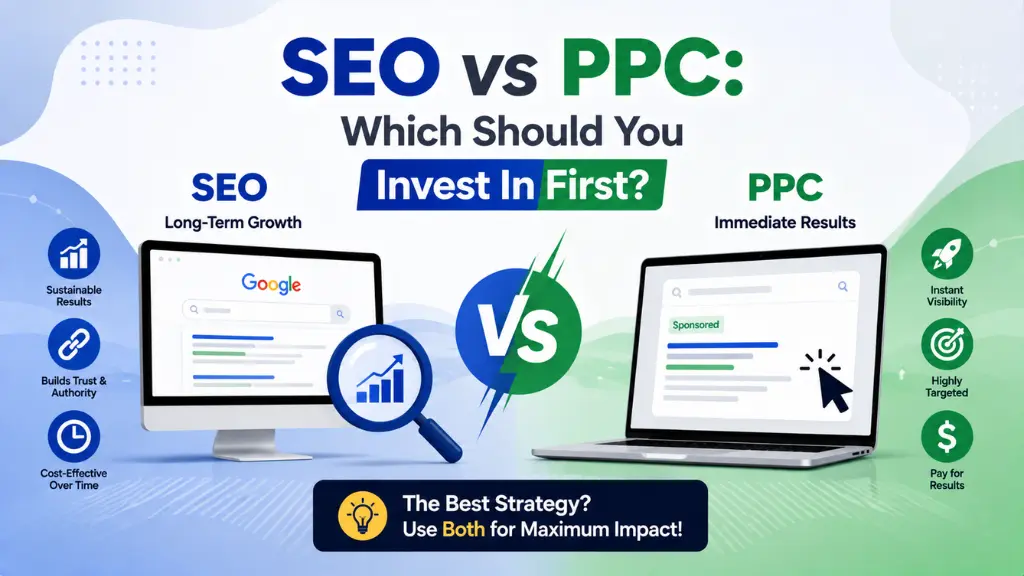
SEO vs PPC is one of the most common questions we get from business owners deciding where to put their first serious marketing dollar. The honest answer depends heavily on timeline: PPC delivers results within hours of launch but stops generating traffic the moment your budget runs out, while SEO takes months to build but drives 53% of all website traffic globally, according to Slaterock Automation’s 2026 comparison guide.
At Search Savvy, this exact decision comes up with nearly every new client conversation, and the right answer genuinely varies by business situation. This guide breaks down the current 2026 data on cost, conversion rates, and timelines so you can make that call with real numbers, not just agency opinion.
How Does SEO vs PPC Actually Differ in How They Work?#
SEO vs PPC operate on fundamentally different mechanics – one earns visibility through organic ranking signals accumulated over time, the other buys visibility instantly through an ongoing auction that stops the moment spending stops.
Pay-per-click advertising puts your business at the top of search results immediately, and you pay every time someone clicks – the moment you stop paying, you stop appearing, according to Codivox’s 2026 comparison guide. SEO, by contrast, takes months to build but creates a compounding asset – traffic that continues arriving without proportional ongoing cost once rankings are established.
SEO vs PPC also differ sharply in how users actually behave toward each result type. The top organic result gets roughly six to ten times more clicks than the top paid result for the same keyword, since users increasingly skip ads and scroll to organic listings, especially for informational and research-stage queries, according to the same Codivox analysis.
People Also Ask: Do people actually click on paid ads, or do they skip straight to organic results? Short Answer: Increasingly, they skip ads. The top organic result receives roughly six to ten times more clicks than the top paid ad for the same search term, particularly for informational and research-stage queries where users trust unpaid results more.
What Does the Cost and ROI Data Actually Show for SEO vs PPC?#
SEO vs PPC cost comparisons consistently favour organic search once enough time has passed, though the upfront investment pattern looks very different between the two channels.
Organic search generates leads at roughly $31 per conversion, compared to $198 across paid channels, according to Verlua’s 2026 report, citing First Page Sage’s 2026 Cost Per Lead Report. SEO costs approximately $31 per lead and compounds over time, delivering roughly 748% ROI over three years, per the same source – a dramatically different trajectory than PPC’s flat, linear cost structure.
Conversion rates also consistently favour organic traffic. SEO converts at an average rate of 2.4%, nearly double PPC’s 1.3%, according to Sagapixel’s 2026 research, cited in Slaterock Automation’s analysis – largely because organic searchers have typically done more research before clicking and arrive with higher inherent trust in unpaid results. Local SEO specifically can generate average returns of up to 700% within six to twelve months, with organic leads closing at roughly 14.6%, compared to around 1.7% for outbound marketing, according to SEOProfy’s 2026 benchmarks cited by StepNgroow.
People Also Ask: Which converts better, SEO traffic or PPC traffic? Short Answer: SEO traffic converts at roughly 2.4% on average, nearly double PPC’s 1.3% conversion rate. This gap exists largely because organic searchers have typically done more research and arrive trusting unpaid results more than they trust paid advertisements.
How Long Does It Actually Take Each Channel to Deliver Results?#
SEO vs PPC timelines could not be more different – this is genuinely the single factor that should weigh heaviest in deciding which channel to fund first for most businesses.
PPC delivers results within hours of launch, making it the clear choice for businesses needing leads within 30 to 60 days, according to Blogrator’s 2026 data-driven comparison. SEO, by contrast, typically takes three to six months to gain initial traction, with more competitive industries requiring six to twelve months, according to Dabre Marketing’s 2026 breakdown.
Full ROI realisation for SEO – the point where cost per organic lead drops below your paid alternative – typically takes twelve to eighteen months of consistent investment, according to Futuristic Marketing Services’ 2026 analysis. This “crossover point” varies based on your starting domain authority, target keyword competitiveness, content quality and frequency, and the pace of your link building efforts.
- Days 1–30 – PPC delivers immediate traffic; SEO shows minimal visible movement yet
- Months 1–4 – PPC remains the primary lead source; SEO foundational work continues
- Months 3–6 – SEO begins showing measurable early traction for most businesses
- Months 6–12 – SEO cost-per-lead starts approaching, then often beating, PPC cost-per-lead
- Months 12–18 – the crossover point, where SEO’s cost efficiency typically overtakes PPC’s
People Also Ask: When does SEO typically become cheaper per lead than PPC? Short Answer: Usually between twelve and eighteen months of consistent investment, though this varies by industry competitiveness and starting domain authority. This is often called the “crossover point,” after which SEO’s cost per lead continues dropping while PPC costs stay flat.
Which Businesses Should Prioritise PPC First?#
SEO vs PPC decisions should tilt firmly toward PPC first when a business genuinely cannot afford to wait months for organic traction, regardless of how much better SEO’s long-term economics look on paper.
PPC wins clearly if you need leads within 30–60 days, since Google Ads can deliver qualified traffic immediately while you build your SEO foundation in parallel, according to Blogrator’s 2026 guide. This makes PPC the right starting point for genuinely time-sensitive situations, not a permanent strategic choice.
Situations where PPC deserves priority:
- New businesses with zero existing traffic or domain authority needing leads immediately
- Time-sensitive promotions or seasonal offers where SEO’s timeline simply does not fit
- Highly competitive keywords where organic ranking would take considerably longer than the business can wait
- Testing new markets or offers where fast feedback matters more than long-term cost efficiency
People Also Ask: Is PPC ever the better long-term choice over SEO? Short Answer: Rarely, for most businesses. PPC’s cost stays flat or increases over time since you pay per click indefinitely, while SEO’s cost per lead decreases as rankings compound. PPC’s advantage is speed, not long-term cost efficiency.
Which Businesses Should Prioritise SEO First?#
SEO vs PPC decisions should lean toward SEO first when a business has a genuine budget runway and a longer-term growth horizon, since the compounding economics strongly favour organic investment over an extended period.
If your monthly marketing budget is under $2,000, SEO typically delivers better long-term ROI, according to Verlua’s 2026 analysis. SEO is also the stronger choice for long-term brand building and authority, content-driven business models like blogs or media sites, and businesses with a limited long-term budget but the ability to invest time upfront, according to Improvado’s 2026 SEO vs PPC guide.
Situations where SEO deserves priority:
- Limited ongoing budget where PPC’s per-click costs would be unsustainable at meaningful volume
- Content-driven business models already producing material that can be optimised for organic search
- Long sales cycles where building authority and trust over time matters more than immediate leads
- A genuine 6+ month runway before the business needs organic traffic to meaningfully contribute to revenue
People Also Ask: Is SEO worth it for a business with a very tight marketing budget? Short Answer: Often, yes – SEO tends to deliver stronger long-term ROI specifically for businesses with monthly marketing budgets under roughly $2,000, since PPC’s per-click costs scale directly with traffic volume in a way SEO’s do not.
Should Most Businesses Just Run Both SEO and PPC Together?#
SEO vs PPC framed as an either-or choice misses what the data actually recommends for most established businesses – running both channels together, in the right ratio, consistently outperforms committing exclusively to either one alone.
The best small businesses do both: PPC for immediate survival, SEO for sustainable growth, according to Blogrator’s 2026 analysis. Over a 24-month period, SEO typically delivers two to three times better ROI than PPC alone – but this requires enough runway to survive the ramp-up period, which is exactly the gap PPC can fill in the meantime, per Codivox’s 2026 guide.
According to Search Savvy’s insights from managing combined SEO and PPC strategies for clients, the businesses seeing the strongest results treat the two channels as complementary from day one, rather than sequential – PPC covers the gap while SEO investment compounds quietly in the background, until organic traffic can carry more of the load.
People Also Ask: Is it a waste of budget to run SEO and PPC at the same time? Short Answer: No, generally the opposite. Combined SEO and PPC strategies typically deliver the strongest long-term ROI, even though initial combined costs are higher. PPC fills the immediate lead gap while SEO builds toward its stronger long-term cost efficiency.
How Should You Actually Decide Where to Start?#
SEO vs PPC decisions come down to three practical questions worth answering honestly before committing budget to either channel.
According to Search Savvy’s insights from these conversations with clients, most indecision comes from treating this as a philosophical choice rather than a practical budget-and-timeline calculation.
A simple decision framework:
- What is your timeline? If you need leads within 30–60 days, start with PPC while building SEO in parallel
- What is your budget? Under roughly $2,000/month favours SEO’s long-term efficiency; larger budgets can sustain both channels simultaneously
- What is your business model? Content-driven and long-sales-cycle businesses lean SEO; time-sensitive offers and new markets lean PPC
- Can you commit to 6–12 months minimum for SEO? If not, PPC alone may be the more realistic near-term choice
- Once either channel is generating consistent, profitable results, layer in the second channel rather than staying single-channel indefinitely
At Search Savvy, we recommend most established businesses eventually run both – the question is rarely “SEO or PPC” for the long term, but rather which one earns the first dollar of your budget while the other builds toward its own payoff.
FAQ: SEO vs PPC#
Q1: Which is cheaper overall, SEO or PPC? A: SEO is generally cheaper per lead over time, at roughly $31 per lead compared to $198 across paid channels, according to 2026 data. However, SEO requires more upfront time investment before that cost advantage materialises.
Q2: Can a business switch from PPC to SEO later, or should the choice be permanent? A: The choice does not need to be permanent. Many businesses start with PPC for immediate leads, build SEO in parallel, and gradually shift budget toward SEO as organic rankings mature and cost per lead drops below PPC.
Q3: Does stopping PPC mean losing all traffic immediately? A: Yes, essentially. PPC traffic stops almost immediately once ad spend stops, since paid visibility is rented, not owned. SEO traffic, once established, continues generating visits without ongoing per-click cost.
Q4: How much should a small business budget for SEO or PPC to see real results? A: For PPC, enough to sustain meaningful click volume for your specific industry’s cost-per-click range – often starting around $500–$1,000/month. For SEO, consistent monthly investment over at least six months is generally needed to see meaningful traction.
Q5: Does AI search change whether SEO or PPC is the better first investment? A: It reinforces SEO’s long-term value further. Businesses investing in content built for traditional SEO increasingly get cited by AI search tools like ChatGPT, Perplexity, and Google AI Overviews too, extending organic content’s reach beyond just traditional search rankings.
Q6: What is the biggest mistake businesses make when choosing between SEO and PPC? A: Splitting a limited budget too thin across both before either has enough investment to be effective. Committing meaningfully to one channel first, based on timeline and budget, generally outperforms a diluted effort spread across both simultaneously.
Not sure whether SEO, PPC, or a combined strategy makes sense for your budget and timeline? Visit Search Savvy to speak with an expert who can build a plan matched to where your business actually is right now.