Automated Content Auditing: Building Pipelines to Identify Cannibalisation at Scale
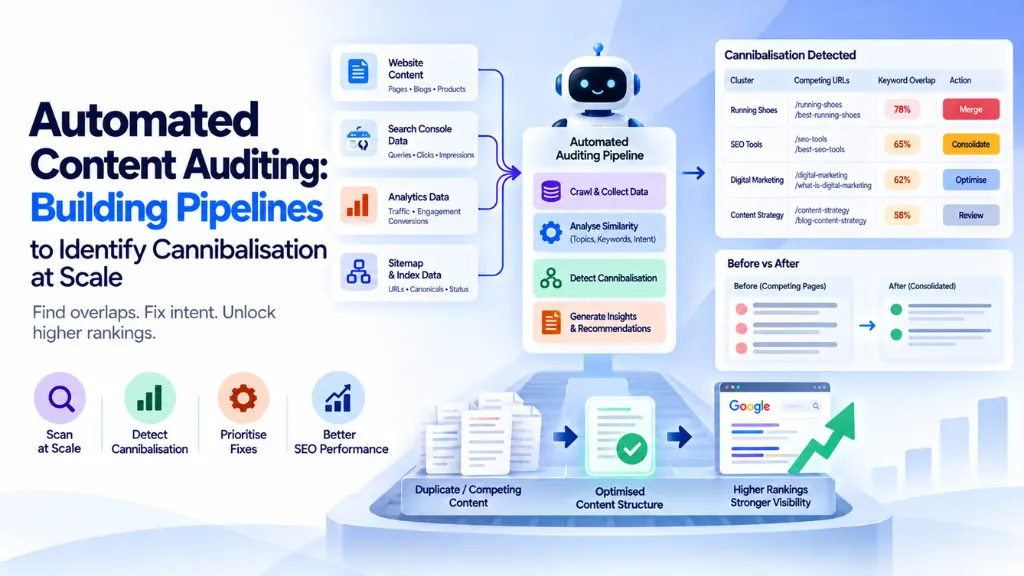

Checking whether two blog posts compete for the same keyword is a five-minute task. Checking whether any two of five thousand pages compete with each other is not a task a human should be doing manually at all. Automated content auditing is the practice of building a repeatable, data-driven pipeline that detects content cannibalisation across an entire site continuously, rather than relying on someone noticing a ranking dip and investigating after the damage is already visible.
In this article10 sections
This guide covers what content cannibalisation actually is, why it’s become a bigger stake in 2026 than it used to be, and how to architect a pipeline – combining Search Console data with content-level similarity detection – that catches conflicts at scale before they quietly cost a site traffic, rankings, and AI citation visibility.
What Is Content Cannibalisation, and Why Manual Audits Don’t Scale#
Content cannibalisation occurs when two or more pages on the same domain target the same search query and intent closely enough that they compete against each other in search results, splitting ranking signals, clicks, and link equity that a single, consolidated page could otherwise capture.
Two signals reliably indicate active cannibalisation:
- Multiple URLs receiving meaningful impressions for the same query in Search Console – a direct, structured signal that Google itself sees more than one candidate page as relevant.
- Rank instability – a query where the ranking URL alternates between two or more pages week over week. This volatility is often the clearest indicator available, since it shows Google itself is undecided about which page deserves the position, rather than confidently favouring one.
On a site with a few dozen pages, spotting this manually – searching a target keyword, checking which of your own pages show up, comparing titles – is entirely workable. On a site with thousands of pages and tens of thousands of tracked queries, the number of query-page combinations to check makes manual review practically impossible, which is exactly the gap automated auditing is built to close.
Why Cannibalisation Matters More in 2026: The AI Citation Angle#
Cannibalisation has always been framed as a ranking-dilution problem, and that’s still true. But it’s also become a citation problem. AI answer engines increasingly use query fan-out – decomposing a single question into several related sub-queries, retrieving results for each, and generally selecting roughly one URL per sub-query to cite in the final answer. When that retrieval process encounters a domain with several near-identical pages competing for the same topic, it tends to treat them as a cluster and represent the group with a single URL – and in some cases, the apparent duplication itself reads as a lack of confident authority on the topic, pushing the system to cite a competitor’s single, clear resource instead of any of your pages.
This changes the cost calculation for leaving cannibalisation unresolved. It’s no longer just about which of your own pages ranks a few positions higher – it’s about whether any of your pages gets chosen at all when an AI system is deciding what to cite on a topic where your domain has fragmented its own authority across several competing URLs.
The Two Detection Layers an Automated Pipeline Needs#
A pipeline built on a single detection method will miss real conflicts. Two complementary layers cover the cases each one misses individually.
Layer 1: Query-level overlap, detected through the Search Console API. This is the most direct, structured signal available – pulling query, page, clicks, impressions, and position data on a recurring schedule, then grouping by query to flag any query where two or more of your own URLs receive meaningful impressions. This layer is cheap to run and catches the clearest, most literal form of cannibalisation, but it only catches conflicts for queries you’re already tracking and ranking for at some level.
Layer 2: Content-level semantic similarity, detected through embeddings. Converting each page’s content into a vector embedding and calculating pairwise similarity (commonly using cosine similarity) surfaces pages that are substantively near-duplicates even when they don’t yet share obvious keyword overlap in Search Console data – new pages that haven’t accumulated ranking history yet, or pages targeting slightly different phrasing that nonetheless serve the same underlying intent. A commonly cited rule of thumb treats similarity scores above roughly 0.9 as a strong signal of likely cannibalisation, though this threshold should be tuned against your own content rather than treated as a universal cutoff, since what counts as meaningful overlap varies by content type and site.
Neither layer alone is sufficient. Query-level detection catches active, measurable conflicts but misses emerging ones; content-level similarity catches emerging conflicts but generates false positives for content that’s legitimately similar by design – a pillar page and its supporting cluster articles, for instance, which are intentionally related rather than cannibalising each other.
Building the Pipeline: Architecture Step by Step#
- Pull Search Console performance data on a recurring schedule – query, page, clicks, impressions, and average position – using the Search Console API rather than the UI, since the UI’s export limits make this impractical at scale.
- Group by query and flag multi-URL conflicts. Any query where two or more of your own pages receive impressions within the same period is a candidate conflict, worth ranking by combined impression volume so higher-traffic conflicts surface first.
- Track position volatility over time, not just a single snapshot. Store historical position data per query-page pair and flag cases where the ranking URL has changed between two or more of your own pages across recent weeks – this is a stronger and more specific signal than impression overlap alone.
- Extract and embed page content for your full content library, generating a vector embedding per page using a consistent embedding model, and calculate pairwise similarity across the corpus to surface content-level overlaps independent of current ranking data.
- Cross-reference the two layers. A query-level conflict backed by high content similarity is a near-certain, high-priority case; a content-level similarity flag with no corresponding query overlap may be an emerging conflict worth monitoring rather than acting on immediately.
- Score severity by combining traffic value (impressions and clicks at stake), position volatility, and similarity score into a single priority ranking, so the output surfaces the conflicts worth fixing first rather than an undifferentiated list.
- Classify a recommended remediation path per conflict – merge-and-redirect, differentiate by intent, canonicalise, or archive – based on rules informed by the underlying cause (see the remediation table below), rather than defaulting to the same fix for every case.
- Alert on new conflicts each cycle, rather than only producing a static report, so emerging cannibalisation gets caught while it’s still small rather than resurfacing as a full audit finding months later.
Detection Signals at a Glance#
| Signal | What It Catches | Data Source |
| Multiple URLs with impressions for one query | Active, measurable ranking conflicts | Search Console API |
| Position volatility across weeks | Google’s own uncertainty about which page should rank | Historical Search Console position data |
| High content similarity score | Near-duplicate content, including pages without established ranking history yet | Page content embeddings + cosine similarity |
| Overlapping title tags and meta descriptions | A common surface-level indicator, useful for quick manual triage | Site crawl data |
Choosing the Right Remediation Path#
Not every flagged conflict should be resolved the same way, and the two most confused tools in this process – canonical tags and 301 redirects – do genuinely different jobs.
| Remediation | What It Does | Best For |
| Merge and 301 redirect | Combines the strongest content from both pages into one, permanently redirects the weaker URL, and transfers link equity and crawl attention to the survivor | Pages that are genuinely duplicative with no legitimate reason to keep both live |
| Differentiate by intent | Rewrites titles, metas, and content angle so each page serves a distinct stage or audience – informational vs. commercial, beginner vs. advanced | Pages that are similar on the surface but could legitimately serve different searcher needs |
| Canonicalise | Keeps both URLs live and accessible, but tells search engines which one should be treated as the authoritative version for indexing and ranking | Cases where both pages need to remain reachable for users, such as filtered or parameter-driven variants |
| Archive | Removes the weaker page entirely when it adds no unique value and has no meaningful traffic or link equity worth preserving | Genuinely redundant, low-value pages with nothing worth consolidating |
A distinction worth stating plainly: a canonical tag is not a substitute for a redirect. A canonical tells Google which version to prioritise while leaving both pages crawlable and live; a 301 redirect actually removes the weaker page from circulation and passes its signals directly to the survivor. Using a canonical tag when a redirect is the appropriate fix doesn’t consolidate crawl budget or fully resolve the underlying competition – it just asks Google to make the same decision it was already struggling to make consistently.
Common Pitfalls in Automated Consolidation#
- Picking the wrong survivor page. The URL kept after a merge should be chosen based on existing backlink profile, traffic history, and ranking stability – not simply whichever page happens to be newer or better designed.
- Redirecting without updating internal links. A 301 redirect that’s still being routed through dozens or hundreds of internal links pointing at the old URL creates unnecessary redirect hops, weakening the direct link equity transfer the redirect was meant to provide.
- Creating a “Franken-page.” Pasting two articles together without a clear editorial rewrite produces a longer but less coherent page, which can perform worse than either original page did separately.
- Flagging intentional topic-cluster overlap as cannibalisation. A pillar page and its genuinely distinct supporting articles are meant to be topically related; an automated pipeline needs a way to distinguish deliberate cluster architecture from unintentional duplication, typically by checking whether internal linking and site structure indicate a cluster relationship rather than treating high similarity alone as conclusive.
- Treating every conflict as needing consolidation. If two pages both rank reasonably well and genuinely serve different search intents despite keyword overlap, forcing a merge can destroy value that differentiation would have preserved instead.
How Often Should the Pipeline Run?#
For sites with large, actively growing content libraries, a continuous or weekly automated detection cycle catches emerging conflicts while they’re still small and easy to resolve, layered with a deeper quarterly manual review to catch subtler content-level overlaps the automated thresholds might miss and to validate that previous fixes are holding. Smaller sites with a slower publishing cadence can generally manage with a quarterly automated run and a lighter-touch check after any significant content push.
Frequently Asked Questions#
What’s the difference between content cannibalisation and a legitimate topic cluster? A topic cluster deliberately links a broad pillar page to several narrower, genuinely distinct supporting articles that each cover a different angle of the same subject. Cannibalisation occurs when two or more pages target the same query and intent so closely that they compete rather than complement each other – the distinguishing factor is whether the pages serve genuinely different purposes or are effectively duplicates.
Can I detect cannibalisation without using embeddings or a coding-based pipeline? Yes, at smaller scale. Filtering Search Console by query to check for multiple ranking URLs, and manually reviewing pages with very similar titles and meta descriptions, catches much of the same signal without a technical pipeline – it simply doesn’t scale to sites with large content libraries the way an automated, embeddings-based approach does.
Should I always merge cannibalising pages, or is differentiation sometimes better? Differentiation is often the better path when both pages already rank reasonably well and genuinely serve different search intents – informational versus commercial, for example. Merging is the stronger choice when the pages are effectively duplicative with no legitimate reason for both to exist separately.
Does content cannibalisation affect visibility in AI-generated search answers? Yes. AI systems using query fan-out tend to select roughly one URL per sub-query when constructing an answer, and a domain with multiple near-identical pages competing for the same topic risks having none of them chosen, or the duplication itself signalling reduced confidence in the domain’s authority on that subject.
Is a canonical tag enough to fix cannibalisation, or do I need a redirect? It depends on whether both pages need to remain accessible. A canonical tag tells search engines which version to prioritise while leaving both pages live, which is appropriate for legitimate variants. A 301 redirect actually removes the weaker page from circulation and transfers its signals directly, which is the stronger fix when the pages are genuinely duplicative and one no longer needs to exist independently.
How do I know if a flagged similarity is a real conflict or a false positive? Cross-referencing content-level similarity flags against actual Search Console query overlap and position volatility data is the most reliable filter – a high similarity score paired with genuine ranking competition is a strong signal, while high similarity alone, especially between a pillar page and its intentionally related supporting content, often isn’t.
The Bottom Line#
Automated content auditing turns cannibalisation detection from a reactive, manual process into a continuous, data-driven pipeline – combining Search Console’s query-level performance data with content-level similarity scoring catches both the obvious ranking conflicts and the subtler, emerging overlaps that manual review alone would miss at scale. Getting the remediation choice right matters as much as the detection: merging and redirecting genuinely duplicative pages, differentiating pages with real intent differences, and reserving canonical tags for cases where both versions need to stay live. Search Savvy’s content strategy and topical authority services and technical SEO services teams build this kind of detection and consolidation process directly into large-scale content programs, and AI search optimization (AEO/GEO) services address the citation-visibility stakes that make resolving cannibalisation more urgent in 2026 than it used to be.