

Landing page design conversion rate is the metric that separates brands growing efficiently from brands burning budget on traffic that never converts. The global average landing page conversion rate across all industries is 10.76%, but the median dedicated landing page converts at just 4.02% – nearly double the 2.35% median for general website pages, but nowhere near the 11.45%+ that top-quartile performers consistently achieve. That gap between the middle and the top is almost entirely explained by design decisions, not traffic quality or offer strength.
Most agencies focus on the design elements that are easiest to show in a portfolio: hero image aesthetics, colour palette, brand consistency, and typography. These things matter. But the decisions that most reliably move the conversion rate needle are structural and strategic – and they are the ones most commonly skipped in a typical agency engagement.
At Search Savvy, we review landing pages as part of paid media and technical SEO work constantly – and the same structural errors appear on pages that cost ₹2 lakh to build and pages that cost ₹20 lakh. Beautiful pages that convert at 2% while straightforward, structurally-correct pages convert at 8%. This post covers the conversion principles that drive the difference, backed by the most current 2026 benchmark data available.
What Is Landing Page Design Conversion Rate and How Is It Measured?
Landing page design conversion rate is the percentage of visitors who complete the desired action on a landing page – a form submission, a purchase, a phone call, a trial signup, or any other defined conversion event. It is calculated as: (conversions ÷ unique visitors) × 100.
The measurement context matters enormously. A landing page conversion rate of 5% is excellent for a high-ticket B2B service. It is mediocre for a food brand. A 3.8% median is typical for SaaS landing pages, while restaurant and food pages average 39.93% at the top of the industry benchmark range. Financial services pages should target 8.4% or higher. Retail averages as low as 0.70%.
The 2026 benchmark landscape:
- Global average across 18 industries: 10.76%
- Median dedicated landing page: 4.02%
- Top 25% of landing pages: 11.45% or higher
- Top 10%: also exceeds 11.45%, with top performers in optimal conditions reaching 15–20% (particularly with warm email traffic or highly-targeted paid campaigns)
- Gap between the average website (2.35%) and a properly designed dedicated landing page (4.02%+): nearly double
Every percentage point of landing page conversion is typically worth 30–70% more pipeline than the same investment in additional traffic. This is the reason landing page optimisation has an asymmetric ROI: a 1% absolute improvement from 3% to 4% conversion represents a 50% revenue lift on identical traffic spend – with no additional acquisition cost.
Why Do Most Landing Pages Fail to Convert in 2026?
Landing page design conversion rate underperformance in 2026 almost always traces to the same set of structural failures – not to bad design aesthetics. The five most common and most costly:
Failure 1: Navigation That Gives Visitors a Way Out
Landing page design conversion rate is reduced by 10–15% simply by having a navigation menu on the page – one of the most consistently replicated findings in conversion research. Unbounce’s analysis confirms this benchmark year after year, including 2026.
The logic is direct: a navigation menu is an invitation to leave the conversion path. Every link in the header is a decision point where the visitor can choose to explore your blog, your about page, or your careers section instead of completing the action you spent money to get them there for. A landing page is a funnel, not a brochure. The most important structural decision is also the simplest: remove the navigation menu entirely.
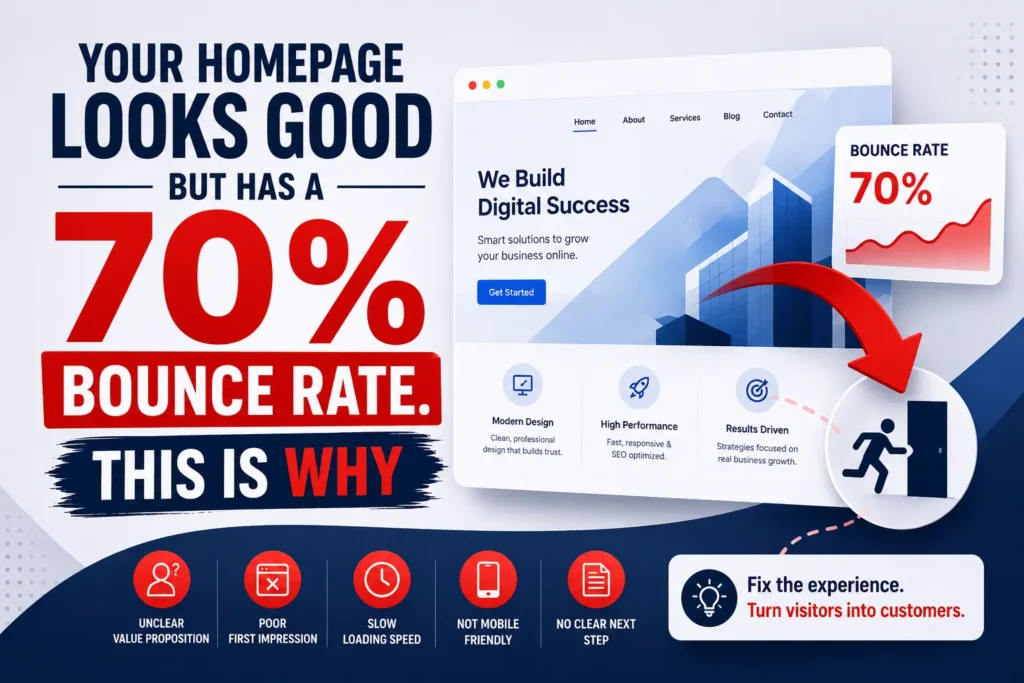
Most agencies do not do this – because landing pages are often built on top of standard website templates where the navigation is part of the global header and removing it requires custom development effort. The result is a conversion-optimised headline on a page with seven navigation links inviting the visitor to leave.
Failure 2: Multiple CTAs Competing for the Same Click
Landing page design conversion rate suffers severely from CTA confusion. Single CTA landing pages convert at 13.5% compared to 10.5% for pages with multiple CTAs – a 29% improvement from eliminating the paradox of choice.
Most landing pages have three to five distinct calls to action: “Start Free Trial,” “Watch Demo,” “Read Case Studies,” “Contact Sales,” and “Download PDF.” Each additional CTA does not add to your conversion options – it splits the visitor’s attention and reduces the probability of any one action being completed.
A well-designed landing page has one CTA, repeated in multiple places: in the hero, after the social proof section, and at the bottom. The CTA is always the same action. The destination is always the same URL.
Failure 3: Forms With Too Many Fields
Landing page design conversion rate drops predictably with every additional form field. The data from 2026 is specific and consistent:
- 3-field forms convert at 10.1%; 9-field forms drop to 3.6% (Unbounce 2026 Conversion Benchmark Report)
- 5 or fewer fields: 120% better conversion than longer forms
- Phone number fields drop conversion by 5% when required, 2% when optional
- Password fields on signup forms drop conversion by 14%
- CAPTCHA challenges drop conversion by 3.2%
- 81% of users abandon forms after starting, with 67% never returning
The most common agency response to a poor-converting form is redesign – changing the layout, adjusting the button colour, or rewording field labels. The correct response is field reduction. If your form has more than 5 fields, your first CRO action is to ask: which fields can be removed or deferred to the email follow-up sequence?
Failure 4: Page Speed That Fails the 2-Second Threshold
Landing page design conversion rate is directly tied to load speed at a 7% conversion loss for every additional second of load time. King Content Agency’s 2026 analysis confirms the critical threshold: pages that load under 2 seconds consistently outperform slower pages across every industry.
This is the highest-ROI conversion optimisation available – it requires no copywriting changes, no design rebuild, no new creative. It is a technical fix that produces measurable revenue impact from the same traffic.
The most common speed failures on landing pages:
- Unoptimised hero images (a 4MB hero image on a page designed to load in 2 seconds is not achievable)
- Render-blocking third-party scripts (chatbots, heatmap tools, A/B testing libraries all add load time)
- No image lazy loading for below-the-fold content
- Shared hosting that cannot deliver pages in under 500ms TTFB
Failure 5: Mobile Experience Designed as a Scaled-Down Desktop
Landing page design conversion rate has a persistent mobile gap: desktop averages 4.8–5.06% while mobile averages 2.49–2.9% – a 40–51% gap that represents significant revenue loss given that 83% of traffic comes from mobile. However, Involve.me’s 2026 analysis shows that actively mobile-optimised pages (optimised mobile forms, proper tap targets, and mobile-specific load speed) convert at 11.7% versus 10.7% for desktop-optimised pages – mobile can actually outperform desktop when properly designed.
Most landing pages are not properly mobile-optimised. They are responsive – they reflow to fit a mobile screen – but they are not designed for the mobile experience. The form is too small to tap accurately. The CTA button is in the middle of the screen rather than in the thumb zone. The hero takes 4 seconds to load on a mobile data connection.
What Does a High-Converting Landing Page Actually Contain?
Landing page design conversion rate is built on a specific content architecture – an ordered sequence of elements that matches how a motivated visitor naturally processes information and makes decisions. This is the structure that the top-converting pages consistently follow, regardless of industry:
Element 1: A Clarity-First Hero Section
The hero section must answer three questions within the first 3 seconds: What is this? Who is it for? What happens if I take action? Not in that order necessarily, but all three – clearly, with no ambiguity.
Headlines that try to be clever, mysterious, or brand-voice-forward at the expense of clarity consistently underperform. “We Transform Your Business Through Digital Innovation” answers none of the three questions. “Get Your First Month of SEO Reports Free – For Indian D2C Brands” answers all three.
Clarity principles:
- Sentence length: 15–20 words maximum
- Reading level: 8th-grade equivalent
- Active voice throughout
- No jargon in the hero – save technical specificity for lower sections
Element 2: The Value Proposition Beneath the Fold
The hero captures attention. The value proposition section, just below the fold, converts consideration into intent. This section answers: Why this, why now, and why from you specifically?
The most common failure here is a list of features. Features describe what your product does. Value propositions describe what changes in the visitor’s life or business if they convert. “Automated reporting” is a feature. “Spend 3 fewer hours per week on client reporting” is a value proposition.
Element 3: Social Proof That Is Actually Verifiable
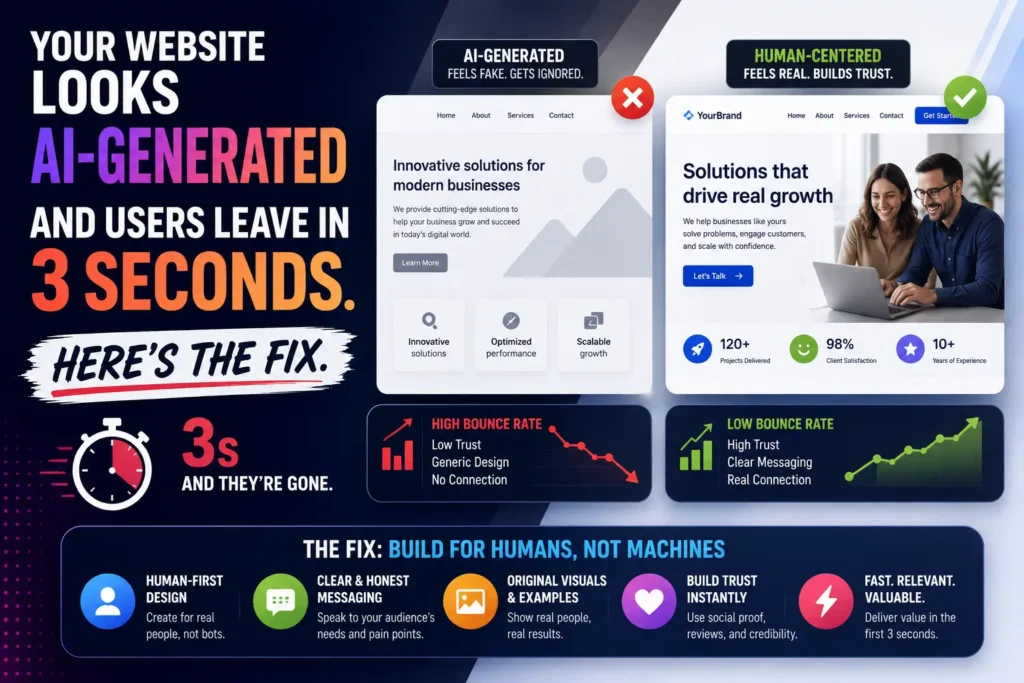
Landing page design conversion rate improves with social proof – testimonials appear in 36% of the top-performing landing pages – but generic testimonials that look fabricated provide almost no trust value in 2026.
The 2026 standard for high-converting social proof:
- Full name, company, role, and photo on every testimonial
- Specific outcome data: not “they helped us grow” but “we went from 2% to 8% conversion in 60 days”
- Third-party review platform links (Google Reviews, Clutch, G2) that can be independently verified
- Logos of recognisable clients – even a row of company logos provides a strong visual authority signal
Element 4: A Risk Reversal Element
Landing page design conversion rate increases when you explicitly address the primary reason visitors do not convert: fear of a bad outcome. The risk reversal element reduces this fear with a concrete guarantee.
The most effective risk reversal formats:
- Money-back guarantee with a specific time period
- Free trial with no credit card required
- “Cancel any time, no questions asked”
- Results guarantee: “If you don’t see X outcome in Y days, we’ll Z”
Any one of these signals that your confidence in the product is high enough to bear the risk – which transfers confidence to the visitor.
Element 5: A Single, Specific CTA That Describes the Next Step
The CTA button copy is one of the highest-tested variables in conversion optimisation – and the data consistently shows the same pattern: specific, action-describing copy outperforms generic verbs.
- “Submit” → lowest converting category
- “Click Here” → near-equivalent underperformer
- “Start My Free Trial” → clear, specific, first-person
- “Get My Free Audit” → valuable, specific, possessive
- “Show Me My Dashboard” → outcome-focused, first-person
Personalised CTAs convert 42% more users than generic alternatives. The highest-converting CTA copy is written in the first person (the visitor’s perspective, not the brand’s) and describes the next specific action that happens after the click.
What Does A/B Testing Actually Change on Landing Pages?
Landing page design conversion rate improvement through A/B testing is real and significant – but the testing hierarchy matters. Not all variables are equal in their conversion impact.
Priority order for A/B testing by impact-to-effort ratio (2026 data):
- Page speed under 2 seconds – single highest-ROI fix, zero design changes required; compress images, minimise scripts, upgrade hosting
- Navigation removal – single-decision structural change; 10–15% conversion lift on most pages
- Form field reduction – specific, data-backed impact per field removed; three-field vs. nine-field difference is 10.1% vs. 3.6%
- CTA copy – specifically, first-person vs. second-person and action-specific vs. generic
- Hero headline – clarity framing vs. clever framing; longest-standing winner in most A/B test libraries
- Social proof format – specific outcomes vs. generic praise; video vs. text testimonials
What not to test first:
- Button colour (almost never produces statistically significant conversion differences when traffic volumes are normal)
- Font choices
- Image aesthetics
- Background colours
These are the variables most agencies propose in A/B testing plans because they are easy to implement and measure. They are also the variables with the lowest historical impact on conversion rates.
At Search Savvy, the testing sequence we run for conversion optimisation follows the impact priority order – not the aesthetic priority order. The former produces measurable revenue impact within the testing window. The latter produces beautiful reports with inconclusive results.
How Does Landing Page Design Affect Google Ads Quality Score and Cost?
Landing page design conversion rate is not only a revenue metric – it directly affects your advertising costs. Google Ads Quality Score, which determines your cost-per-click and ad position, uses landing page experience as one of three equal components (alongside expected click-through rate and ad relevance).
A landing page that loads slowly, has high bounce rates, and poor mobile optimisation receives a low landing page experience score – which increases your effective CPC and reduces your ad position, even when your bid is competitive. The result: you pay more per click for worse placement because your landing page is penalising your Quality Score.
Conversely, a landing page with fast load times, clear message match with the ad, and a low bounce rate earns a high landing page experience score – which reduces your effective CPC and improves your ad position.
The landing page is not just a post-click experience. It is a determinant of your pre-click advertising economics. Improving a landing page’s conversion rate and quality signals simultaneously reduces CPA and improves ad performance – a double dividend that most campaign audits treat as separate workstreams when they are the same intervention.
FAQ: Landing Page Design Conversion Rate in 2026
Q1: What is a good landing page conversion rate in 2026? The global average landing page conversion rate across 18 industries is 10.76%, with a median of 4.02% for dedicated landing pages. The top 25% of landing pages convert at 11.45% or higher. However, “good” is highly industry-dependent: 3.8% is typical for SaaS, 8.4%+ is the target for financial services, and restaurant/food pages can average nearly 40%. The most useful benchmark is your own industry vertical’s median – and the goal is top-quartile performance (11.45%+) rather than average.
Q2: What is the single most impactful landing page design change for conversion? Removing the navigation menu. Unbounce’s research confirms that landing pages with navigation menus convert at 10–15% lower rates than equivalent pages without navigation. This is the single highest-impact, lowest-design-effort conversion improvement available – and most businesses never make it because their landing pages are built on website templates where the navigation is part of the global header. After navigation removal, form field reduction (to 5 or fewer) is the next highest-impact structural change.
Q3: How many form fields should a landing page have in 2026? 5 or fewer for maximum conversion. Three-field forms convert at 10.1% while nine-field forms drop to 3.6% – a 64% conversion penalty from adding six fields. Each additional field beyond 5 represents a 20–30% conversion penalty. For lead generation pages, capture name and email only. Qualify leads in your email follow-up sequence, not on the landing page. Phone number fields reduce conversion by 5% when required. CAPTCHA reduces conversion by 3.2%.
Q4: Why do mobile landing pages convert so much worse than desktop? The 40–51% desktop-to-mobile conversion gap in most markets stems from both behavioural and technical factors. Behaviourally, mobile users often research on-the-go with lower immediate purchase intent. Technically, most landing pages are responsive but not mobile-optimised – forms are too small to complete comfortably, tap targets are too small for accurate thumb navigation, and images are not compressed for mobile connections. Actively mobile-optimised pages (proper tap targets, mobile-specific form design, load speed under 2 seconds on 4G) can actually achieve higher conversion rates than desktop – Involve.me’s 2026 data shows 11.7% for actively mobile-optimised pages vs. 10.7% for desktop-only optimised pages.
Q5: Does page speed affect landing page conversion rate? Yes – significantly and directly. Every additional second of load time costs 7% in conversions. Pages that load under 2 seconds consistently outperform slower pages across all industries in 2026. This is the highest-ROI conversion optimisation available because it requires no copywriting or design changes – only technical fixes: image compression, script minimisation, and fast hosting. Page speed also affects Google Ads Quality Score, making it a lever that simultaneously improves conversion rate and reduces CPC.
Q6: What is the difference between a landing page and a website homepage for conversion? A homepage serves multiple audiences and multiple purposes – it is a brochure. A landing page serves one specific visitor segment with one specific conversion goal – it is a funnel. Dedicated landing pages convert at a median of 4.02% compared to 2.35% for general website pages – nearly double. The structural differences that drive this gap: landing pages remove navigation, eliminate competing CTAs, match the page’s message precisely to the ad or campaign that brought the visitor, and remove every element that does not directly serve the conversion decision.
The Bottom Line
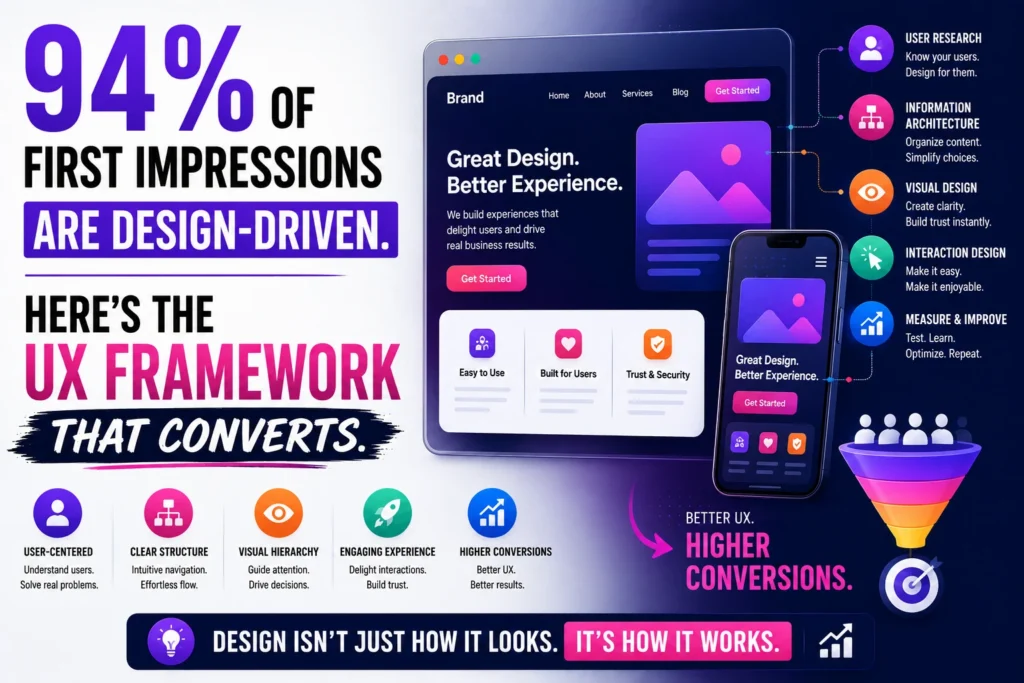
Landing page design conversion rate is not a design problem. It is a structural and strategic problem – and the gap between a 4% converting page and an 11%+ converting page is almost entirely explained by structural decisions that aesthetics-first agency processes consistently skip.
Remove the navigation. Reduce the form fields. Pick one CTA and repeat it. Load in under 2 seconds. Design the mobile experience as a primary, not a responsive fallback. Address the visitor’s fear of a bad outcome explicitly. Write the headline for clarity, not cleverness.
None of these changes require a complete redesign. Most can be implemented on an existing page in under a week. And each one produces a measurable, quantifiable revenue impact from the traffic you are already paying to send to the page.
According to Search Savvy’s paid media and conversion optimisation practice, the highest-ROI intervention we make on client campaigns is almost never in the ads – it is in the landing page they lead to. A campaign reaching the right audience with the wrong landing page structure is a campaign converting at 30% of its potential. Fixing the page before increasing the budget is the correct sequence, every time.
If you want a landing page conversion audit that benchmarks your pages against 2026 industry top-quartile performance and identifies the highest-impact structural changes, get in touch with the Search Savvy team.