

Google Marketing Live 2026 dropped 42 new product launches for lead generation advertisers on May 20, 2026. Forty-two. In a single event.
Most of those headlines have already been covered. But there is one update that is generating far less attention than it deserves – particularly for B2B marketers, service businesses, and any advertiser running Demand Gen campaigns with a lead generation objective: the expansion of Demand Gen into Google’s Commerce Media Suite.
Demand Gen Commerce Media Suite integration is not a cosmetic product refresh. It is a structural shift in what signals your Demand Gen campaigns can access, what audiences they can reach, and how your bidding system learns from conversion data. And when paired with the other April–May 2026 Demand Gen updates – view-through conversion optimisation, Google Maps inventory, AI-assisted campaign creation, and creator partnership boosting – it fundamentally changes what Demand Gen can do for businesses whose primary goal is not e-commerce but qualified lead generation.
At Search Savvy, we track every meaningful Google Ads update and translate it into actionable strategy for our clients – and the April–May 2026 Demand Gen updates are the most significant capability expansion this campaign type has received since its launch. This article covers exactly what changed, what it means for lead gen specifically, and how to use it before your competitors even know it exists.
What Is the Demand Gen Commerce Media Suite – and What Changed in April 2026?
Demand Gen Commerce Media Suite is Google’s expansion of its commerce data infrastructure to support Demand Gen campaign inventory – announced in April 2026 and listed as a “New for 2026” launch on Google’s Accelerate hub.
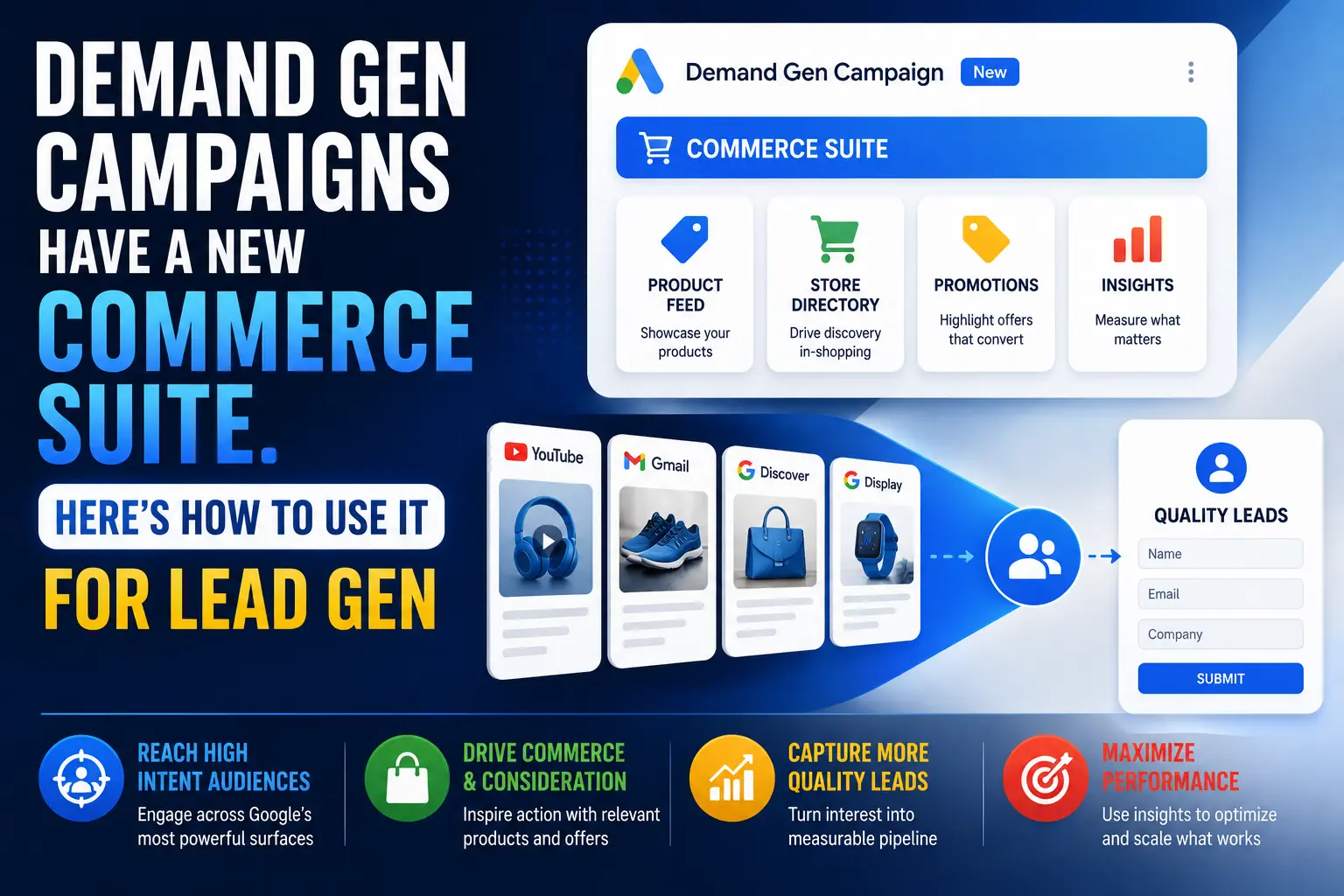
Before this update, Commerce Media Suite activations sat largely inside Display & Video 360 and retailer-adjacent placements. The addition of Demand Gen routes retailer audience data into Google’s discovery surfaces – YouTube, Discover, and Gmail – under a single campaign workflow inside standard Google Ads.
Commerce Media Suite is Google’s product for connecting retailer first-party data with brand ad buys. Retailers make their first-party audience and catalog data available through Commerce Media Suite. Brands and advertisers can then activate those audiences through Demand Gen campaigns across Google’s properties. Google AI then optimises campaign delivery to drive conversions throughout the customer journey, while reporting connects ad exposure with purchase outcomes.
The practical mechanics work as follows:
- A retailer (your retail partner, marketplace, or an affiliated commerce partner) shares their first-party customer audience data and product catalog data into Commerce Media Suite
- Your Demand Gen campaign accesses this data as audience signals, enabling targeting that is built from verified commerce intent – people who have actually purchased or browsed relevant product categories on that retailer’s platform
- Your ads run across YouTube, Discover, and Gmail with audience matching powered by first-party commerce data rather than cookie-based or contextual signals alone
- Performance data flows back through the shared framework, connecting your ad exposure to actual downstream purchase outcomes
The Google Blog official description confirmed: “With this update, you can use retailers’ first-party catalog and conversion data to reach high-intent shoppers across YouTube, Discover and Gmail.”
People Also Ask: What is the Demand Gen Commerce Media Suite in Google Ads? Short Answer: Demand Gen Commerce Media Suite is a Google Ads feature launched in April 2026 that lets brands activate retailers’ first-party audience and catalog data through Demand Gen campaigns across YouTube, Discover, and Gmail. It was previously only available in Display & Video 360. The update allows Demand Gen campaigns to use verified commerce intent data – from real shopper behaviour on retailer platforms – as targeting signals, improving both audience relevance and conversion measurement.
Why Does the Demand Gen Commerce Media Suite Matter for Lead Generation?
Demand Gen Commerce Media Suite was designed as a commerce and retail media tool – but its lead generation applications are significant and underappreciated. Understanding why requires understanding what makes Demand Gen different from other campaign types.
Demand Gen is a key driver of new customer acquisition, leading to an 18% higher share of conversions from new customers compared to the paid media average. That new customer acquisition advantage is what makes Demand Gen particularly valuable for lead gen: it is specifically engineered to reach people who have not previously interacted with your brand, across the highest-quality visual discovery surfaces Google operates.
The Commerce Media Suite integration enhances this new customer acquisition capability in three ways that matter specifically for lead gen:
Higher-intent audience signals. Cookie deprecation has made third-party audience signals less reliable and less precise over the last two years. Retailer first-party data represents verified purchase and browsing intent – the highest-quality signal available. For a B2B SaaS company, for example, being able to reach people whose retail behaviour indicates ownership of small or medium-sized businesses (business supply purchases, professional services, business software) is significantly more precise than contextual or interest-based targeting.
Cross-channel conversion intelligence. Commerce Media Suite reporting connects ad exposure to actual downstream purchase behaviour. For lead gen advertisers, this means more complete attribution – the ability to see not just whether someone filled in a form, but what happened to that lead downstream, when commerce data is part of the measurement framework.
Scale with precision. Demand Gen reaches users across YouTube, Discover, and Gmail simultaneously from a single campaign. Commerce Media Suite adds first-party retailer data as the audience layer, combining the scale of Google’s largest visual surfaces with the precision of verified commerce intent.
People Also Ask: Can Demand Gen Commerce Media Suite be used for B2B lead generation? Short Answer: Yes. While the Commerce Media Suite was designed primarily for retail media and e-commerce, the audience data and targeting precision it provides is directly applicable to B2B and service business lead generation. Retailer first-party data can identify professionals, small business owners, and decision-makers through purchase behaviour that correlates with business ownership and professional role – providing higher-quality audience targeting than broad interest or contextual signals. The 18% new customer acquisition advantage Demand Gen already has is amplified by Commerce Media Suite’s precision.
What Are All the New Demand Gen Features Launched at Google Marketing Live 2026?
Demand Gen Commerce Media Suite is the headline feature, but the May 20, 2026 announcement included a comprehensive suite of Demand Gen enhancements that together transform how this campaign type operates. Here is the complete picture:
View-Through Conversion Optimisation for YouTube
The second major April 2026 launch alongside Commerce Media Suite was view-through conversion (VTC) optimisation – the ability to enable Demand Gen campaigns to optimise toward YouTube view-through conversions, not just click-through conversions.
VTC optimisation drives more conversions in less time, aligning with capabilities that are already available in connected TV (CTV) and video action campaigns. The practical significance: many conversions influenced by YouTube ads happen after the view, not because of a direct click – the user sees your ad, continues their research through other channels, and converts days later. VTC optimisation allows Google’s AI to attribute and optimise toward these influenced conversions, rather than under-counting YouTube’s contribution to the conversion funnel.
For lead gen advertisers who have historically under-attributed YouTube because of its lower direct CTR relative to Search, this is a significant measurement and optimisation correction.
Google Maps Inventory for Demand Gen
Google announced Google Maps inventory for Demand Gen – connecting brands with people exploring local areas on Google Maps. For local service businesses, professional service firms, clinics, restaurants, and any brand with geographic targeting requirements, this extends Demand Gen’s reach into a new intent-rich surface.
A person using Google Maps to search for a plumber, an accountant, or a marketing agency in a specific city is displaying high-intent, location-qualified behaviour. Demand Gen ads appearing in this context are shown to users at a moment of active local exploration – fundamentally different from the passive discovery context of YouTube or Discover.
The critical caveat: for Maps inventory specifically, lead quality monitoring is non-negotiable. Maps traffic can include exploratory, low-intent browsing. Set up conversion tracking and monitor lead quality separately for Maps-attributed traffic before scaling budget into this placement.
AI-Assisted Campaign Creation
Demand Gen Commerce Media Suite campaigns can now be set up with AI assistance – combining settings from an existing Performance Max campaign with Demand Gen best practices before publishing. This reduces the setup friction that has historically made Demand Gen less accessible for smaller teams and lower-maturity advertisers.
For accounts already running Performance Max, the AI setup uses your existing conversion data, audience signals, and asset library as the starting framework – so a new Demand Gen campaign is not starting from scratch but building intelligently from your proven campaign architecture.
Creator Partnership Boosting
Advertisers can now boost authentic creator videos directly inside Demand Gen setup – a capability introduced with the YouTube creator partnership tools announced at Google Marketing Live. This combines the reach of Demand Gen’s multi-surface distribution with creator content authenticity, enabling brands to extend creator campaign reach beyond organic to the full YouTube, Discover, and Gmail inventory.
For B2B brands using YouTube creators for educational or thought leadership content, this creates a pathway to amplify high-performing creator partnerships through paid Demand Gen distribution without creating separate standalone campaigns.
Dynamic Product Videos from Google Merchant Center
Retailers can upload videos to Google Merchant Center for dynamic distribution across Demand Gen based on real-time user interest. This enables product-level video personalisation at scale – Demand Gen serving the most relevant product video to each user based on their demonstrated interest signals.
Campaign Type Attribution and Uplift Experiments
Two measurement improvements address the attribution gap that has historically limited confidence in Demand Gen’s contribution to lead generation. Campaign Type Attribution connects Demand Gen exposures to downstream conversion outcomes across campaign types. Uplift Experiments measure the incrementality of Demand Gen activity – answering the question “would these conversions have happened without the Demand Gen exposure?” – providing the empirical basis for budget justification.
People Also Ask: What new features did Demand Gen get at Google Marketing Live 2026? Short Answer: Google Marketing Live 2026 (May 20, 2026) added 10 significant Demand Gen updates: Commerce Media Suite integration (retailer first-party data for YouTube, Discover, Gmail targeting), view-through conversion optimisation for YouTube, Google Maps inventory, AI-assisted campaign creation, creator partnership boosting, multimodal video creation in Asset Studio, dynamic product videos from Merchant Center, expanded checkout links, Campaign Type Attribution, and Uplift Experiments. Together these represent the largest single-event Demand Gen capability expansion since the campaign type launched.
How Do You Set Up a Demand Gen Campaign Using Commerce Media Suite?
Demand Gen Commerce Media Suite setup requires a specific configuration sequence – particularly for lead gen advertisers who may not have an existing retail media relationship but want to leverage the available audience signals.
Step 1: Confirm Commerce Media Suite Access
Commerce Media Suite access for Demand Gen is rolling out through 2026. Verify access in your Google Ads account by checking the Audiences section for Commerce Media Suite audience options. If you manage client accounts in Google Ads Manager, check the Commerce Media Suite tab in your account settings.
For lead gen advertisers who are not retailers themselves, the data access pathway is through partnership with a retailer already enrolled in Commerce Media Suite, or through direct access to Google’s available commerce audience segments built from aggregate Commerce Media Suite signals.
Step 2: Set Campaign Objective and Conversion Goal
Demand Gen Commerce Media Suite campaigns for lead gen should be configured with a Leads objective and your primary conversion action – typically a form submission, phone call, or qualified lead event – as the optimisation goal. Ensure your conversion tracking is verified and recording accurately before launching. The Commerce Media Suite audience signals inform audience targeting; your conversion goal informs bidding optimisation. Both must be clean.
Step 3: Configure Commerce Media Suite Audience Signals
In your Demand Gen campaign’s Audience section, add available Commerce Media Suite audiences as audience signals (not targeting layers that restrict delivery). Audience signals guide Google’s AI toward relevant users – they do not limit reach. Adding Commerce Media Suite audiences as signals tells the bidding system to prioritise users matching that commerce intent profile while still exploring adjacent audiences that may convert.
Combine Commerce Media Suite signals with your first-party data: CRM customer lists, website visitors, lead form completers, and similar audience segments. The combination of retailer first-party commerce data with your own first-party audience creates the most precise signal set available.
Step 4: Enable View-Through Conversion Optimisation
For campaigns running YouTube inventory, enable VTC optimisation in your campaign settings. This allows the system to attribute and optimise toward conversions that happen after a YouTube view – not just after a click. For lead gen campaigns where YouTube is a significant placement, VTC optimisation typically reveals that YouTube’s actual contribution to the funnel is higher than click-based attribution showed.
Monitor VTC conversion data alongside click-through conversion data in your reporting. The combined view gives you a more complete picture of Demand Gen’s actual impact on your lead pipeline.
Step 5: Set Up Asset Groups by Creative Theme
Demand Gen Commerce Media Suite campaigns deliver across YouTube (in-feed, Shorts, skippable in-stream), Discover, and Gmail simultaneously. Create separate asset groups for different audience intentions and creative themes – not one generic asset group for all placements.
For lead gen, consider separate asset groups for:
- Awareness creative – Educational, problem-focused content for cold audiences. “Is this your challenge? Here’s what most businesses get wrong.”
- Consideration creative – Differentiation and proof-focused content. Case study highlights, client results, process explanations.
- Decision-stage creative – Offer-led content. Free audit, consultation, demo, or resource download with a direct CTA.
Google AI will serve the most relevant creative to each user – but your asset group structure determines which themes are available for that matching to occur.
Step 6: Configure Uplift Experiments
Set up an Uplift Experiment before your campaign launch if your budget justifies it. These experiments measure whether Demand Gen activity is driving incremental conversions – leads that would not have occurred without the campaign exposure. For lead gen advertisers reporting ROI to stakeholders, Uplift Experiment data provides the empirical evidence that Demand Gen budget is generating net new pipeline rather than attributing leads that would have converted through other channels.
According to Search Savvy’s insights from managing Demand Gen campaigns for clients across B2B, professional services, and lead-generation-focused e-commerce, the most common mistake in Demand Gen lead gen setup is treating it as a scaled-up Search campaign. Demand Gen operates in a discovery context – it reaches users before they are actively searching. The creative, the CTA, and the conversion expectation must reflect that earlier funnel position.
How Does View-Through Conversion Optimisation Change Demand Gen Reporting?
Demand Gen Commerce Media Suite’s companion feature – view-through conversion optimisation – changes how you should read your Demand Gen performance data and what metrics to use for campaign evaluation.
Traditional Demand Gen reporting counted conversions from users who clicked the ad. This systematically undercounted YouTube’s actual contribution, because YouTube is primarily a viewing surface – users watch, continue their research elsewhere, and convert later. The click-based model missed all of that influenced conversion activity.
With VTC optimisation enabled, your reporting now includes two conversion streams:
- Click-through conversions (CTC) – Conversions from users who clicked your ad directly
- View-through conversions (VTC) – Conversions from users who saw your YouTube ad but converted later through another channel
The combination gives a materially different picture of campaign effectiveness. For most lead gen advertisers enabling VTC optimisation for the first time, the total attributed conversion volume increases – revealing that Demand Gen’s contribution to the pipeline was always larger than click-based reporting showed.
The risk to manage: VTC attribution windows can be set from 1 to 30 days. Longer windows capture more influenced conversions but risk over-attributing conversions that were primarily driven by other channels. At Search Savvy, we recommend starting with a 7-day VTC attribution window for lead gen campaigns, then comparing 7-day and 30-day windows across 60 days of data to understand which window best reflects the actual influence dynamic in your specific funnel.
People Also Ask: What is view-through conversion optimisation in Demand Gen? Short Answer: View-through conversion (VTC) optimisation, launched for Demand Gen in April 2026, allows campaigns to optimise toward YouTube conversions that happen after a user views (rather than clicks) an ad. It addresses the systematic under-attribution of YouTube’s contribution in click-based reporting. With VTC enabled, the campaign bidding system learns from both click-through and view-through conversion signals – improving optimisation accuracy and revealing YouTube’s actual contribution to the lead generation funnel.
What Does the Demand Gen Commerce Media Suite Mean for Lead Gen Strategy in 2026?
Demand Gen Commerce Media Suite, combined with the full suite of May 2026 updates, represents a strategic repositioning of Demand Gen from a brand awareness-adjacent campaign type to a full-funnel lead generation tool with enterprise-grade audience data, measurement, and creative capabilities.
The businesses that will benefit most are those that move quickly – because the advantage of access to retailer first-party data, VTC optimisation, and Uplift Experiment measurement is most significant before these capabilities are standard practice in your competitive set.
At Search Savvy, we are already integrating the April–May 2026 Demand Gen updates into our standard campaign frameworks for lead gen clients. The BBVA case study from GML 2026 demonstrates what is possible when these capabilities are applied correctly: using Smart Bidding Exploration with AI Max alongside updated Demand Gen features, BBVA achieved a 155% surge in new high-quality leads while decreasing their cost per lead by 3%. That is the return profile that makes the investment in understanding and implementing these updates worthwhile.
The strategic priorities for any lead gen advertiser in the remainder of 2026:
- Audit your Demand Gen campaigns for Commerce Media Suite audience access and apply available signals immediately
- Enable VTC optimisation on all YouTube-heavy Demand Gen campaigns and establish a 60-day reporting baseline
- Set up Uplift Experiments before scaling Demand Gen budget to build the attribution evidence your stakeholders will ask for
- Test Google Maps inventory for local-intent lead gen with stringent lead quality monitoring before scaling
People Also Ask: Is Demand Gen better than Performance Max for lead generation in 2026? Short Answer: They serve different strategic roles and work best together. Performance Max is designed for conversion volume optimisation across all Google inventory. Demand Gen is specifically optimised for new customer acquisition at the top and middle of the funnel – with 18% higher new customer conversion share than the paid media average. For lead gen, Demand Gen builds pipeline by reaching audiences before they are actively searching. Performance Max converts high-intent audiences who are ready to act. The strongest lead gen strategy runs both in complementary configuration, with Demand Gen feeding top-of-funnel awareness and Performance Max capturing bottom-of-funnel intent.
FAQ: Demand Gen Commerce Media Suite – Your Questions Answered
Q1: Who can access Demand Gen Commerce Media Suite in 2026? Commerce Media Suite for Demand Gen was announced as part of Google Marketing Live 2026 and is rolling out through 2026. Access is available in standard Google Ads accounts. For the retailer first-party data component, access requires either being a retailer enrolled in Commerce Media Suite directly, or being a brand advertising through a retailer partner who has shared their data into the suite. Google is also making aggregate commerce audience segments available to advertisers without a direct retail partner relationship. Check your Google Ads account for Commerce Media Suite audience options in the Audience Manager, or contact your Google Ads representative for access confirmation.
Q2: Do I need a Google Merchant Center account to use Demand Gen Commerce Media Suite? Not necessarily, for the audience targeting component. The core audience signal functionality – reaching high-intent shoppers based on retailer first-party data – does not require your own Merchant Center account. However, the dynamic product video feature (which enables product-level video personalisation from your catalog) does require a Google Merchant Center account and a product feed. For lead gen advertisers without e-commerce product catalogs, the audience targeting and VTC optimisation features are accessible without Merchant Center.
Q3: How is Demand Gen different from Display advertising for lead generation? Demand Gen and Display are fundamentally different in audience intelligence, inventory quality, and creative capability. Display advertising uses contextual and audience interest signals from Google’s Display Network – which spans millions of websites of varying quality and relevance. Demand Gen accesses YouTube, Discover, and Gmail specifically – Google’s highest-quality, highest-engagement visual surfaces – with first-party Commerce Media Suite audience signals and AI-powered creative matching. Demand Gen also specifically optimises for new customer acquisition, with 18% higher new customer conversion share than average paid media. Display is a broader, lower-cost reach channel. Demand Gen is a more targeted, higher-intent discovery channel with stronger new customer acquisition data.
Q4: What creative formats work best in Demand Gen for lead generation in 2026? The highest-performing creative combination for lead gen Demand Gen in 2026 uses three format types across separate asset groups: short-form video (15–30 seconds) for Shorts and in-feed placements delivering a direct value proposition and soft CTA (download, learn more); longer explanatory video (60–90 seconds) for YouTube in-stream and Discover, demonstrating expertise or social proof with a specific lead magnet offer; and static image ads for Gmail and Discover placements where video may not render. As of GML 2026, creator-boosted video is also available inside Demand Gen – authentic creator content combined with Demand Gen distribution represents a high-trust, high-reach format combination with no equivalent in traditional display advertising.
Q5: How should I measure Demand Gen Commerce Media Suite campaign success for lead generation? Use a four-metric evaluation framework. First: lead volume by attribution type – track CTC and VTC conversions separately to understand YouTube’s full contribution. Second: cost per qualified lead – filter for leads that meet your ICP criteria, not just any form completion. Third: Uplift Experiment incrementality score – what percentage of conversions are genuinely incremental versus what would have occurred without the campaign? Fourth: new customer conversion share – Demand Gen should be generating leads from people who had not previously converted through other channels. These four metrics together provide a complete picture of Demand Gen’s lead gen contribution that click-based reporting alone cannot deliver.
Q6: Can small businesses and Indian SMBs use Demand Gen Commerce Media Suite? Yes – and the AI-assisted campaign creation feature introduced at GML 2026 specifically addresses the setup complexity barrier that previously made Demand Gen more accessible to enterprise advertisers. The AI setup uses settings from an existing Performance Max campaign (which most SMBs running Google Ads already have) to configure a Demand Gen campaign with best-practice settings, reducing the configuration time and expertise required to launch. For Indian SMBs in competitive service categories – healthcare, legal, education, financial services, real estate – Demand Gen’s new customer acquisition advantage and the Commerce Media Suite audience precision offer a meaningful differentiation from the crowded Search landscape, at a cost structure that is typically lower than equivalent Search CPC rates for high-competition keywords.
Running Google Ads but not yet using Demand Gen Commerce Media Suite’s new lead generation capabilities? Visit Search Savvy for a paid media audit covering all the GML 2026 updates – and a clear, account-level action plan to implement the features that will drive the most incremental lead volume for your business.