

Right now, someone is visiting your website on their phone. They tapped your link from Google, clicked through from an Instagram bio, or typed your domain directly from memory.
And they are waiting.
Three seconds pass. Then four. Then five. And then – they are gone. Back to Google. Straight into the arms of a faster competitor who took website speed optimisation seriously.
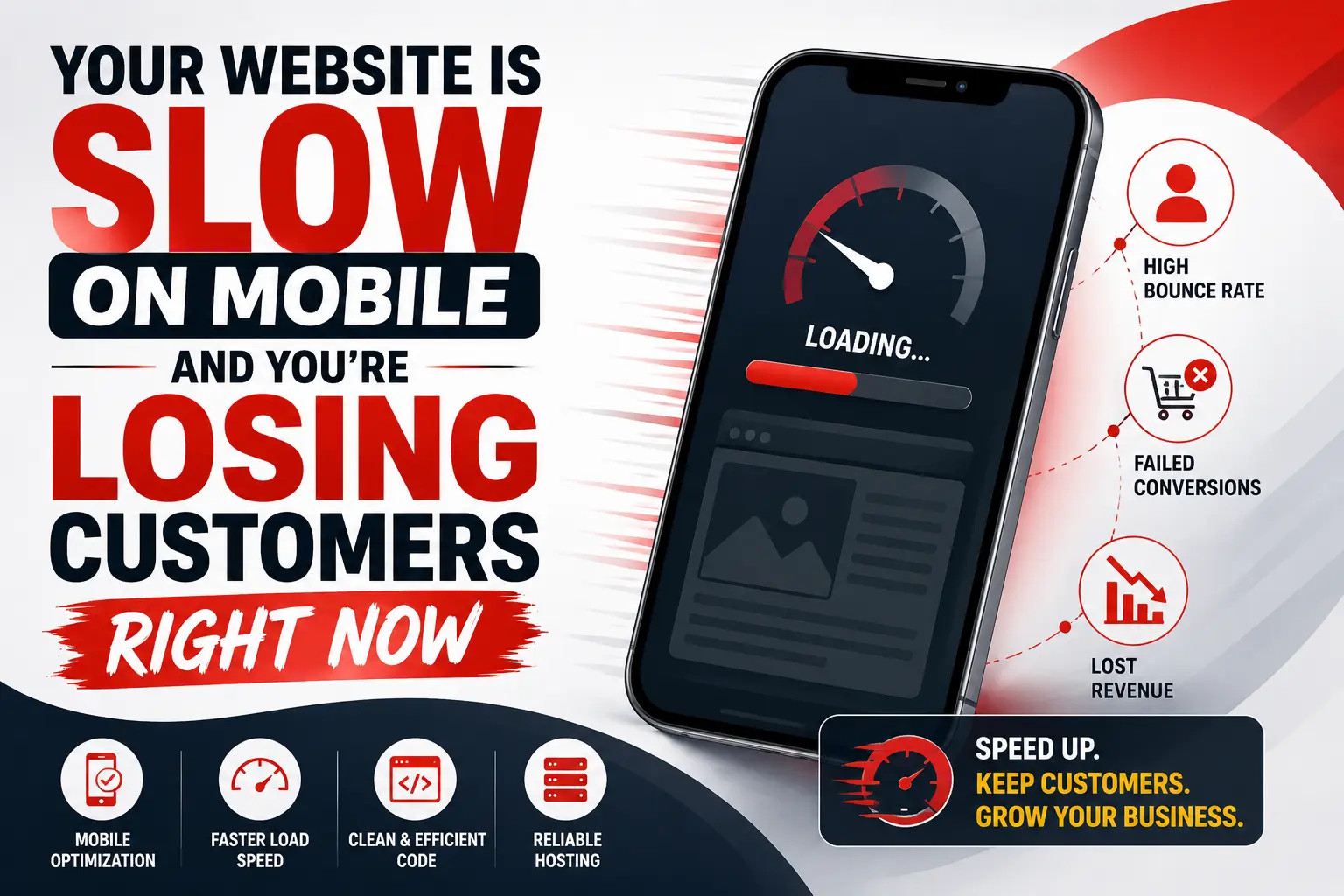
This is not a hypothetical scenario. It is happening to your business, likely dozens or hundreds of times every single day. 53% of mobile visitors abandon a page that takes longer than 3 seconds to load. And the brutal reality? The average website in 2026 still takes 8.6 seconds to load on mobile – nearly three times longer than the threshold at which more than half your visitors have already left.
At Search Savvy, we audit websites every week and the pattern is always the same: businesses investing heavily in SEO, paid ads, and content – yet haemorrhaging traffic and conversions because of a slow mobile experience they have never properly addressed.
This article explains exactly what mobile speed is costing you, why website speed optimisation matters more than ever in 2026, and the specific fixes that produce measurable results.
Why Is Website Speed Optimisation So Critical in 2026?
Website speed optimisation has moved from a technical nice-to-have to a direct business metric. The data in 2026 makes this impossible to ignore.
Every extra second a mobile page takes to load causes an average 12% decrease in conversion rates. That is not a marginal impact – it is a compounding one. A site loading in 5 seconds instead of 1 second does not lose 48% of its conversions. It loses them progressively and permanently, because those users leave, never return, and tell others.
Look at what the numbers say about what your customers actually expect:
- 64% of mobile users expect pages to load in under 4 seconds
- 85% of mobile users expect pages to load as fast or faster than desktop – which almost never happens
- 95% of users say they would return to a fast site – compared to only 62% for a slow one
- A 0.1-second improvement in mobile speed increases retail conversions by 8.4%
- Online businesses collectively lose approximately $2.6 billion in revenue annually due to slow load times
Website speed optimisation is not a developer problem. It is a revenue problem – and it sits squarely on the agenda of every business owner and marketing lead who cares about ROI.
People Also Ask: How much does a slow website actually cost my business? Short Answer: The cost is direct and measurable. A one-second delay reduces conversions by up to 7–12%, cuts page views by 11%, and drops customer satisfaction by 16%. For an e-commerce site generating ₹10 lakh per month, a 3-second mobile load time could be costing ₹1–2 lakh in lost revenue every single month.
How Does Mobile Website Speed Affect Google Rankings in 2026?
Website speed optimisation is not just a user experience issue – it is a core ranking signal that Google has officially confirmed and consistently strengthened over the last five years.
1. Traditional Mobile-First Indexing
Google now indexes the mobile version of every website first. If your mobile experience is slow, your rankings suffer – regardless of how fast your desktop site loads. Mobile speed directly determines where your pages appear in search results.
2. Core Web Vitals as Ranking Signals
Website speed optimisation in 2026 must address Google’s three Core Web Vitals – the specific, scored metrics that Google uses to evaluate your page experience in real-user conditions:
| Metric | What It Measures | Good Threshold |
| LCP (Largest Contentful Paint) | How fast the main content loads | Under 2.5 seconds |
| INP (Interaction to Next Paint) | How quickly the page responds to taps/clicks | Under 200ms |
| CLS (Cumulative Layout Shift) | How stable the layout is while loading | Under 0.1 |
INP replaced FID (First Input Delay) in March 2024 and is significantly stricter – it measures every interaction on a page, not just the first. Google doubled down on Core Web Vitals after the December 2025 core update, with tighter thresholds and more weight given to real-user experience. Currently, 47% of all websites still fail Google’s Core Web Vitals thresholds – meaning nearly half of the web is being penalised in rankings right now.
3. AI Overview Eligibility
Website speed optimisation now affects whether your pages are cited in Google’s AI Overviews. Google’s AI systems favour pages that are fast, stable, and structured – slow pages are less likely to be extracted and surfaced in generative answers, regardless of content quality.
People Also Ask: Do Core Web Vitals directly affect my Google rankings in 2026? Short Answer: Yes. Core Web Vitals – LCP, INP, and CLS – are confirmed Google ranking factors. Google scores your site at the 75th percentile of real user data, meaning your ranking reflects your slowest visitors, not your average ones. Sites meeting all three thresholds are 24% less likely to have users abandon the page before it loads.
What Are the Most Common Causes of a Slow Mobile Website?
Website speed optimisation starts with an honest diagnosis. These are the most frequent culprits behind slow mobile load times – and most of them are entirely fixable without a full rebuild.
Unoptimised Images
Website speed optimisation audits almost always find this first. Large, uncompressed images are the single biggest cause of slow LCP scores. Reducing image sizes and converting to modern formats like WebP dramatically cuts load time without any visible quality loss. A hero image that weighs 2MB should weigh 200KB. A product gallery that loads 12 full-resolution images on page load should lazy-load everything below the fold.
Render-Blocking JavaScript and CSS
Website speed optimisation requires that your browser can render the page without waiting for unnecessary scripts to load first. JavaScript files that are not deferred or asynchronous force the browser to stop rendering until each script has fully loaded – adding seconds to your perceived load time before a user sees anything.
Slow Server Response Time (TTFB)
Website speed optimisation is undermined by slow hosting. If your server response time (Time to First Byte) is above 800ms, your LCP will suffer regardless of how well everything else is optimised. Shared hosting on overloaded servers, no CDN, and unoptimised databases are the most common causes. For businesses serving Indian customers, hosting geographically closer to your audience or using a CDN with Indian edge nodes makes a measurable difference.
No Content Delivery Network (CDN)
Website speed optimisation for a global or national audience requires a CDN. Without one, every visitor’s browser fetches assets directly from your origin server, adding latency proportional to physical distance. A CDN caches static assets at edge locations closest to the user, reducing this load time dramatically.
Cumulative Layout Shift from Unsized Media
Website speed optimisation also covers visual stability. When images and video embeds do not have defined width and height dimensions in HTML, the browser cannot reserve space for them during loading – causing content to jump and shift as elements render. This directly worsens your CLS score and creates a frustrating experience that users associate with an untrustworthy, unfinished website.
People Also Ask: What is the fastest fix for improving mobile website speed? Short Answer: Image optimisation delivers the fastest, highest-impact improvement for most websites. Compressing all images, converting them to WebP format, and adding lazy loading to below-the-fold images can cut mobile load time by 1–3 seconds with no changes to design or code structure.
How Do You Test Your Mobile Website Speed Right Now?
Website speed optimisation cannot begin without a clear baseline measurement. Use these free, authoritative tools to assess your current performance:
- Google PageSpeed Insights – The most important tool. Runs both lab and field data tests against Google’s own benchmarks, scores your Core Web Vitals, and provides prioritised fix recommendations. Always test your actual mobile URL, not just the homepage.
- Google Search Console – The Core Web Vitals report shows real-user data across your entire site, flagging URLs that are failing LCP, INP, or CLS thresholds. This is your most actionable dataset because it reflects actual visitor experiences.
- GTmetrix – Detailed waterfall analysis showing exactly which resources are slowing your page down, with specific file-level recommendations.
- WebPageTest – Advanced testing with mobile simulation, real device testing, and filmstrip views that show exactly what a user sees during each second of loading.
According to Search Savvy’s insights, the most important starting point is always Google Search Console’s Core Web Vitals report – because it shows real user data, not simulated conditions. Many businesses score acceptably in lab tests but fail in field data because of real-world conditions: slower devices, congested networks, or browser extensions their test environment does not simulate.
What Are the Most Effective Website Speed Optimisation Fixes in 2026?
Website speed optimisation at its most impactful follows a clear priority order. Tackle these in sequence for the fastest return:
Fix 1 – Preload your LCP image. Add <link rel=”preload”> to the largest image that appears above the fold on mobile. This single change is consistently the highest-impact LCP improvement available and takes under an hour to implement.
Fix 2 – Serve images in WebP format. Convert all JPEG and PNG images to WebP, which delivers 25–35% smaller file sizes at equivalent visual quality. Most modern CMSs offer plugins that handle this automatically.
Fix 3 – Implement lazy loading for below-the-fold images. Add loading=”lazy” to all image tags that appear below the visible viewport on initial load. Browsers supported this natively from 2022 onward – no JavaScript library required.
Fix 4 – Defer non-critical JavaScript. Add the defer or async attribute to all JavaScript files that are not required for above-the-fold rendering. This allows the page to begin displaying content while scripts load in the background.
Fix 5 – Set explicit dimensions on all media elements. Add width and height attributes to every image and video embed on your pages. This eliminates the most common cause of poor CLS scores by allowing the browser to reserve the correct space before assets load.
Fix 6 – Upgrade your hosting or implement a CDN. If your TTFB is above 800ms, no amount of front-end optimisation will achieve a Good LCP score. Upgrade to managed hosting with faster server response, or implement a CDN like Cloudflare to cache assets at edge locations globally.
Fix 7 – Eliminate unused CSS and JavaScript. Every unused stylesheet and script file is load time your visitors pay for without receiving any benefit. Audit your pages with Google PageSpeed Insights and remove or defer all resources flagged as unused.
At Search Savvy, we recommend prioritising fixes in the order above – images first, JavaScript second, hosting third. In our experience, the first three fixes alone typically reduce mobile load time by 2–4 seconds on the average business website, which is often enough to move from a failing Core Web Vitals score to a passing one.
People Also Ask: How much can website speed optimisation improve my conversion rate? Short Answer: The impact is consistent and significant across industries. A 1-second improvement in mobile load time increases conversions by 5.9–7%. Pages loading in 1 second achieve conversion rates up to 40%, versus 22% for pages loading in 5 seconds. Improving Core Web Vitals scores also makes users 24% less likely to abandon the page before it finishes loading.
Why Is Mobile Speed More Important Than Desktop Speed in 2026?
Website speed optimisation efforts should always prioritise mobile over desktop – and the data makes this clear. 58% of all global internet traffic now comes from mobile devices. In India specifically, mobile internet usage is higher still, with the majority of searches, purchases, and browsing sessions happening on smartphones – often on 4G networks rather than fibre broadband.
The average mobile user in 2026 compares every website experience to the near-instant response of native mobile apps. Anything slower than 2–3 seconds does not just feel inconvenient – it feels broken. And a website that feels broken is a brand that feels untrustworthy.
Around 75% of mobile users say they have encountered a website that was too slow to load, ranking it above broken functionality, bad formatting, and error messages as their most frustrating mobile experience. Your mobile experience is your brand experience for the majority of people who encounter it.
And with Google’s mobile-first indexing fully in effect, the speed performance of your mobile site directly determines your search rankings across all devices – not just mobile searches.
FAQ: Website Speed Optimisation – Your Questions Answered
Q1: What is a good mobile page load time in 2026? Google’s recommended benchmark is under 3 seconds. However, to maximise conversions, the target is under 2 seconds – pages loading in 1–2 seconds achieve the highest average conversion rates of approximately 3–4%. For LCP specifically, Google’s threshold for a “Good” score is under 2.5 seconds. Start by testing your current score in Google PageSpeed Insights, then use that as your baseline to measure improvement.
Q2: Will fixing my website speed improve my Google rankings? Yes, directly and measurably. Core Web Vitals – LCP, INP, and CLS – are confirmed ranking factors. Sites passing all three thresholds perform better in both traditional rankings and AI Overview eligibility. After the December 2025 core update, Google further increased the weight given to real-user performance data, meaning speed improvements have a more immediate impact on rankings than ever before.
Q3: How do I know if my Core Web Vitals are failing? Open Google Search Console and navigate to Experience → Core Web Vitals. This report uses real-user Chrome data (CrUX) to show which URLs across your entire site are failing LCP, INP, or CLS thresholds. This is more reliable than lab tests because it reflects actual visitor conditions. You can also run individual URLs through Google PageSpeed Insights for a detailed score breakdown and specific fix recommendations.
Q4: Does website speed affect local SEO in India? Yes. Google’s local ranking algorithm includes page experience signals, which incorporate Core Web Vitals. For local businesses in India targeting mobile searches in cities like Ahmedabad, Mumbai, or Bengaluru, a fast mobile experience directly contributes to Map Pack visibility and organic local rankings. Given the prevalence of mobile browsing and mixed 4G/5G connectivity across India, mobile speed optimisation is particularly high-impact in the Indian market.
Q5: How long does it take to see results after improving website speed? Google re-crawls pages and updates CrUX field data continuously, but a meaningful dataset takes approximately 28 days to accumulate. Most sites see Core Web Vitals scores update in Search Console within 4–6 weeks of implementing fixes. Ranking improvements often follow within 6–8 weeks, though the timeline varies based on how significant the speed improvements are and the competitive landscape of your target keywords.
Q6: Can I improve my website speed without a developer? Yes – for many of the highest-impact fixes. On WordPress sites, plugins like WP Rocket, ShortPixel, or Smush handle image compression, lazy loading, and caching with minimal technical configuration. Implementing a free Cloudflare CDN layer requires no code changes. However, deferred JavaScript, host-level server optimisation, and eliminating render-blocking resources typically require developer involvement. The image and caching fixes alone are often enough to move from a failing to a passing Core Web Vitals score.
Is your mobile site costing you customers and rankings? Visit Search Savvy for a professional website speed audit and a clear, prioritised plan to fix what is slowing you down.