Google’s May 2026 Core Update Hit Your Rankings. Here’s What Actually Changed
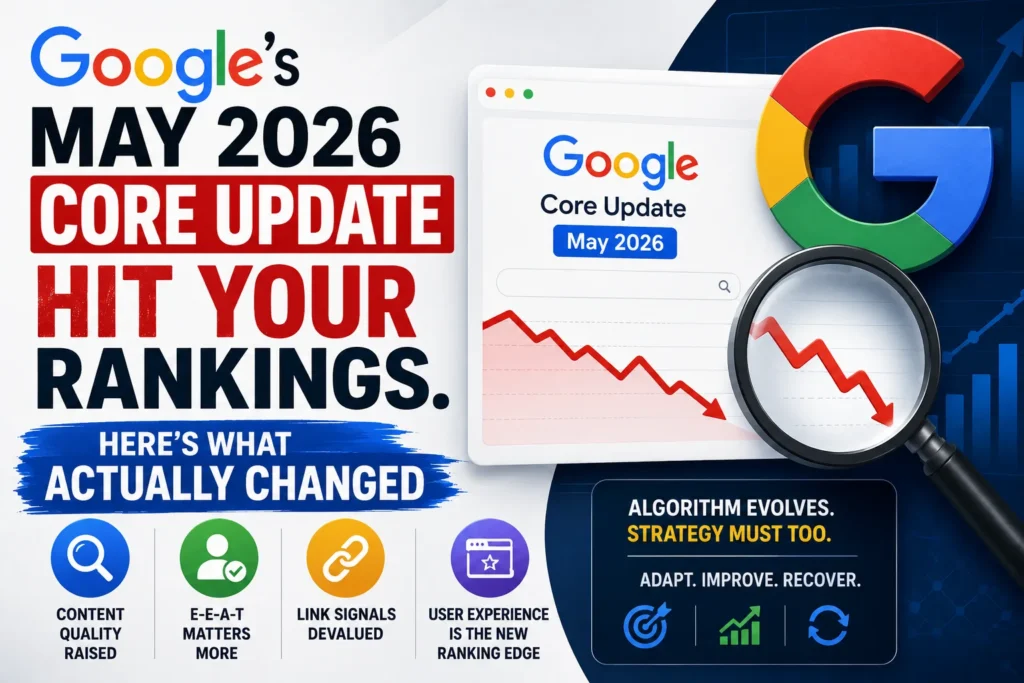

The May 2026 Core Update rollout began on May 21 – and if your rankings, impressions, or organic traffic have felt unstable since then, you are not imagining it. Google confirmed the update via its Search Status Dashboard with a deliberately brief official statement: “a regular update designed to better surface relevant, satisfying content for searchers from all types of sites.”
In this article11 sections
That sentence does a lot of work. It sounds routine. It is not.
At Search Savvy, we have been monitoring ranking signals and Search Console data across client sites since the moment the rollout began. What we’re seeing confirms a pattern that started with the March 2026 Core Update and has now accelerated: Google’s ranking systems are being deeply reshaped by Gemini-powered quality models, and the gap between sites with genuine authority and those without is growing significantly wider.
This post covers everything that is confirmed, what the data directionally suggests, how to accurately measure your impact, and – critically – what to do and what not to do while the rollout is still active.
What Is the May 2026 Core Update and When Does It Complete?#
The May 2026 Core Update rollout is a broad, system-wide recalibration of how Google evaluates content quality and relevance across its entire search index. It is not a penalty. Google has been explicit: core updates are not targeted spam actions. They don’t punish specific sites for specific violations. Instead, they shift the weighting of Google’s quality evaluation signals, meaning sites that previously ranked well can drop – not because they did something wrong, but because Google’s improved systems now rate other content as more relevant and trustworthy.
The rollout began on May 21, 2026, and Google states it may take up to two weeks to fully complete, placing the expected stabilisation point around June 4, 2026. Until that date, ranking positions are actively in flux. The first 3–4 days of a rollout typically produce the most volatile movements – and those early shifts are not reliable signals of where rankings will ultimately settle.
Key confirmed facts about this rollout:
- Launched: May 21, 2026 via Google Search Status Dashboard
- Scope: Global – affects all regions, all languages
- Duration: Up to two weeks (est. completion ~June 4)
- Affected surfaces: Standard organic rankings, Google Discover, featured snippets, and other search features
- Official description: A “regular update” – but the second core update in just six weeks, following the March 2026 update that completed on April 8
That six-week gap between core updates is highly unusual. Historically, Google has spaced core updates three to four months apart. The accelerated cadence signals that Google is actively and aggressively recalibrating its ranking systems – and the timing relative to Google I/O 2026 adds important context.
What Did Google Announce at I/O 2026 That Matters for Rankings?#
The May 2026 Core Update rollout launched just two days after Google I/O 2026 on May 19, where Google’s VP of Search, Liz Reid, published a post titled “A new era for AI Search” and announced the most significant Search architecture changes in years.
The major announcements relevant to organic rankings and content visibility:
- Gemini 3.5 integration – Google confirmed Gemini 3.5 Flash as the new standard AI model powering AI Mode in Search globally
- AI Overviews + AI Mode merger – follow-up questions from AI Overviews now flow directly into AI Mode, creating a more deeply AI-mediated search experience
- Redesigned AI-powered Search box – the entry point to search itself has been redesigned around AI-first interaction
- Agentic search capabilities – Google announced background information agents, booking agents, and generative UI within Search
- Personal Intelligence – expanded personalised search features
Google has not confirmed a direct causal link between the I/O announcements and the May 2026 Core Update rollout. But the context is critical: the ranking environment in which this update operates is one that is being fundamentally redesigned around AI-mediated content delivery. Ranking #1 in traditional organic results is no longer equivalent to capturing traffic from that query.
One data point illustrates this starkly: on queries where AI Overviews appear, position-one organic click-through rates have dropped from approximately 27% to as low as 11%, according to SISTRIX data from March 2026. Being cited inside the AI Overview is now worth more than holding position three in classic organic listings – because the AI summary reaches the user before they see the blue links at all.
What Has Actually Changed in Rankings Since May 21?#
The May 2026 Core Update rollout has produced early signals consistent with the pattern established during the March 2026 update. Based on community observations and industry monitoring, the directional picture looks like this:
Who Is Losing Visibility#
- Thin informational content – pages that summarise what is already widely available, without adding original insight, data, or first-hand perspective
- AI-generated content without meaningful human editing – Google has not confirmed this is a specific target, but the pattern of losses in this category is consistent across both 2026 updates
- Information aggregators – job portals, travel aggregation services, generic dictionaries, synonym databases, and comparison portals that compile information without contributing original content
- Ad-heavy pages – content bloated with advertising that degrades the user experience is being downgraded consistently
Who Is Holding or Gaining Visibility#
- Sites with strong topical authority – brands that have deeply covered a subject area across multiple, interlinked pieces of content
- Named expert voices – content with clearly identified, credentialed authors and verifiable E-E-A-T signals
- Original, first-hand content – pages that include proprietary data, case studies, unique perspectives, or experiences that cannot be replicated by an AI summarising other sources
- Institutional and brand-authoritative sources – established brands with strong entity recognition in Google’s knowledge graph are benefiting from higher citability in AI Overviews
The underlying principle, consistent with every major update since Google’s Helpful Content system became part of core ranking in March 2024, is the same: content that genuinely helps a specific person with a specific need outperforms content created primarily to rank.
Why Is the Cadence of 2026 Updates So Significant?#
The May 2026 Core Update rollout is the second confirmed broad core update in six weeks. That compressed timeline is not random. According to Search Savvy’s analysis of the 2026 update pattern, Google is running faster cycles because it is actively aligning its ranking infrastructure with the Gemini-powered AI search ecosystem announced at I/O.
The 2026 update timeline so far:
| Update | Start Date | End Date |
| March 2025 Core Update | March 13, 2025 | March 27, 2025 |
| June 2025 Core Update | June 30, 2025 | July 17, 2025 |
| December 2025 Core Update | December 11, 2025 | December 29, 2025 |
| March 2026 Core Update | March 27, 2026 | April 8, 2026 |
| May 2026 Core Update | May 21, 2026 | ~June 4, 2026 |
The six-week gap between the March and May 2026 updates is the shortest inter-update window in recent years. The message from Google’s behaviour – if not its official communications – is clear: the recalibration of Search is ongoing and accelerating.
How Should You Measure the Impact of the May 2026 Core Update on Your Site?#
The May 2026 Core Update rollout is still active as of publication. The single most important piece of advice we can give right now is this: do not make reactive SEO changes before the rollout completes.
Early ranking movements during a core update rollout are unstable. Making content changes, restructuring pages, or building emergency backlinks during an active rollout can create new problems while the original ones haven’t yet resolved.
Here is the correct measurement and response sequence:
While the rollout is active (now until ~June 4):
- Monitor daily but do not act
- Check the Google Search Status Dashboard for the official completion announcement
- Track impressions and ranking changes in Google Search Console, not just Analytics traffic – traffic drops can have causes unrelated to core updates (seasonal patterns, AI Overview cannibalisation, competitor activity)
After June 4 (once the rollout completes):
- Pull Search Console data and compare the period from May 21 onward against the equivalent period before the update
- Focus on pages that lost impressions and clicks on specific queries – this is the clearest signal of update-related ranking impact
- For pages that held rankings but lost traffic, investigate whether AI Overviews are now answering those queries above organic results – this is a separate issue from the core update, requiring a different response (AI visibility strategy, not content fixes)
- Benchmark your affected pages against the competitors who replaced you – what signals do they have that your pages lack?
What Should You Do If Your Rankings Dropped?#
If the May 2026 Core Update rollout has caused ranking losses, the path forward requires honest content evaluation – not quick technical fixes. Google has consistently stated that there is no specific action to “reverse” a core update impact. Recovery happens through genuine improvement, and the biggest changes are typically seen after the next core update.
At Search Savvy, the content evaluation framework we apply after core updates assesses pages against the following questions:
Content quality and depth:
- Does this page answer the query more completely than competing pages?
- Does it include first-hand experience, original data, or expert perspective that isn’t available elsewhere?
- Is there a named, credentialed author whose expertise is verifiable?
E-E-A-T signals:
- Does the site demonstrate topical authority through a deep content cluster on this subject?
- Are author credentials, business information, and editorial standards clearly communicated?
- Do external, independent sources – links, mentions, citations – validate this expertise?
User experience:
- Does the page deliver on the implied promise of its title and meta description?
- Is it free of excessive advertising or interstitial interruptions?
- Does it load efficiently and perform well on mobile?
AI visibility readiness:
- Is the content structured for AI extraction – clear definitions, concise answers, schema markup?
- Is the brand recognised as a trusted entity in Google’s Knowledge Graph?
If your honest answer to most of these questions is “no” or “not as well as my competitors,” the core update has surfaced a quality gap that existed before May 21. The fix is the same as it always is: build content that genuinely deserves to rank.
What Mistakes Should You Avoid During This Rollout?#
The May 2026 Core Update rollout period is when bad advice circulates fastest. Here is what not to do:
- Do not make panic-driven content changes before the rollout ends – you will be optimising against an unstable signal
- Do not confuse AI Overview CTR drops with ranking losses – a site can hold position one and still lose traffic if AI Overviews are answering queries before organic results
- Do not trust “winner and loser” lists published in the first week – domain-level analysis requires full SISTRIX or similar data, which won’t be available until after June 5
- Do not delete or significantly restructure pages that have lost rankings during the rollout – wait for stabilisation first
- Do not build emergency links – manipulative link activity during a core update period can trigger a separate spam review
FAQ: Google May 2026 Core Update#
Q1: When will the May 2026 Core Update rollout finish? Google states the rollout may take up to two weeks from the May 21 start date, placing estimated completion around June 4, 2026. The Google Search Status Dashboard will publish the official completion announcement. Do not draw final conclusions from ranking changes until at least one full week after the rollout ends.
Q2: Is the May 2026 Core Update a penalty? No. Core updates are not penalty systems and do not target specific sites for violations. They are broad recalibrations of how Google’s ranking systems evaluate content quality and relevance across the entire index. Sites that lose rankings have not necessarily done anything wrong – Google has simply shifted its evaluation weighting, and other content now scores higher against its quality criteria.
Q3: Why did Google release two core updates just six weeks apart in 2026? The unusually short gap between the March 2026 Core Update (completed April 8) and the May 2026 Core Update (launched May 21) reflects an accelerated recalibration cycle. The timing of the May update – two days after Google I/O 2026, where major Gemini-powered Search changes were announced – suggests Google is actively aligning its ranking infrastructure with its AI-first search direction, though Google has not formally confirmed a direct connection.
Q4: My traffic dropped but my rankings look similar. What’s happening? If rankings held but traffic declined, the most likely cause is AI Overview cannibalisation – Google is now answering your target queries with an AI-generated summary above the organic results, reducing click-through rates significantly. Position-one CTR on AI Overview-heavy queries has dropped from approximately 27% to as low as 11%, according to March 2026 SISTRIX data. This is a separate issue from the core update and requires an AI visibility strategy rather than content fixes.
Q5: What type of content is most at risk from the May 2026 Core Update? Early observations consistent with the March 2026 pattern suggest that thin informational content, AI-generated content without meaningful human editing, information aggregators, and ad-heavy pages are seeing the most significant early visibility drops. Content with strong topical authority, named expert authorship, and original first-hand perspective appears to be holding or gaining.
Q6: How long does recovery from a core update take? Google has consistently indicated that the most significant recoveries from core update ranking drops occur after the next core update – meaning meaningful improvement typically takes several months of genuine content enhancement. Some sites see partial recovery between updates, but the primary trigger for significant positive change is the algorithm re-evaluating the improved content at the next major recalibration.
The Bottom Line#
The May 2026 Core Update rollout is the latest chapter in a story that has been building throughout 2026: Google is actively and aggressively raising the quality bar for what earns visibility in an AI-first search landscape. The old metrics – keyword density, link count, domain authority as a standalone signal – are increasingly secondary to the question that Google’s Gemini-powered systems are asking about every page they evaluate: is this content genuinely useful, and is the source genuinely trustworthy?
If the answer is yes, core updates tend to be opportunities. If the answer is no – or “not as much as the competition” – they are the moment that gap becomes visible in your Search Console data.
The rollout isn’t over yet. Wait for it to complete, measure accurately, and then make content decisions based on honest evaluation – not panic. If you want a clear-eyed analysis of where your site stands once the dust settles, the Search Savvy team is ready to help you read the data and build a plan.