AI Overviews Are Cutting Your Organic Clicks by 30%. Here’s How to Fight Back

Google AI Overviews CTR drop is no longer a hypothesis – it is the defining performance reality of search in 2026. If your organic traffic has quietly declined over the past 12 months despite holding your rankings, you are experiencing what millions of websites are now measuring in their Search Console data: fewer people clicking through from search results, even when you appear on page one.
In this article13 sections
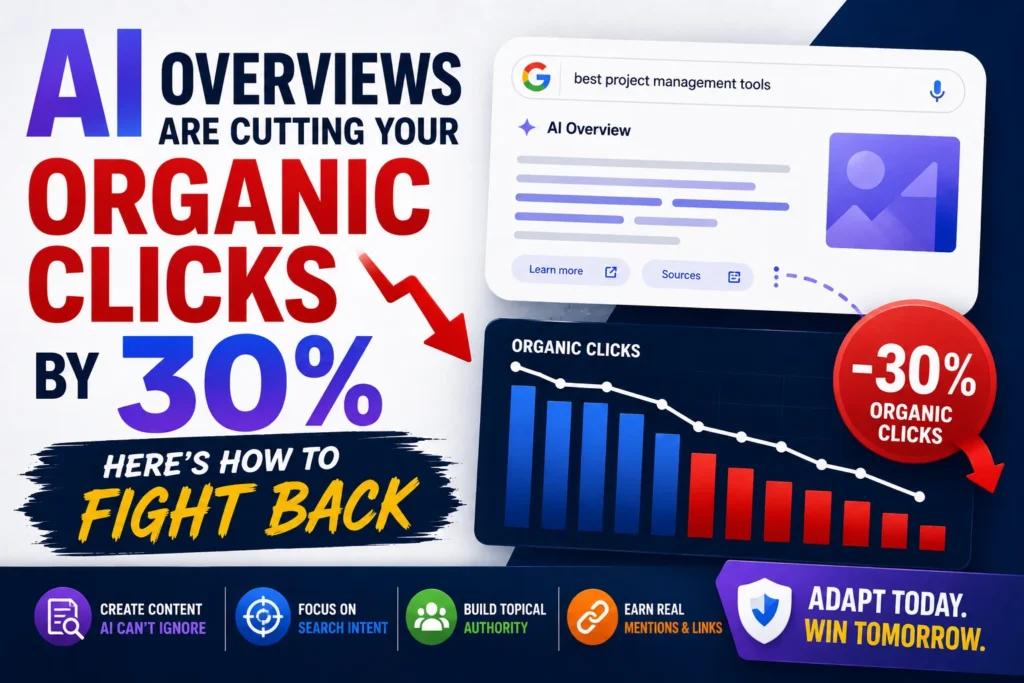
The numbers behind this are stark. Organic CTR on queries where AI Overviews appear has dropped from 1.76% to 0.61% – a 61% decline – based on Seer Interactive’s analysis of 3,119 search terms across 42 organisations. Paid CTR on the same queries fell even harder, down 68%. And even on queries without AI Overviews, organic CTR has dropped 41% as users increasingly expect AI-mediated answers before they see a single link.
But here is the part most panic-driven reports leave out: brands cited inside AI Overviews earn approximately 120% more organic clicks per impression than uncited brands on the same queries. The traffic didn’t disappear. It redistributed – to the 3 to 5 sources Google’s AI chose to trust.
At Search Savvy, this is the central challenge we are helping clients navigate right now: stop competing for rankings alone, and start competing for citations. This post gives you the data, the framework, and the exact steps to do it.
What Is the Google AI Overviews CTR Drop and How Bad Is It Really?#
Google AI Overviews CTR drop refers to the measurable decline in organic click-through rates that occurs when Google’s AI-generated summary appears at the top of a search results page. The mechanism is simple and devastating in its logic: when the AI answer is complete and satisfying, the click becomes optional. Users read the summary and move on without visiting any source.
The data from multiple independent studies in 2025 and 2026 is unambiguous:
- 61% organic CTR decline on AI Overview queries (Seer Interactive, September 2025 – 25.1M organic impressions)
- 48% of all Google searches now trigger an AI Overview as of March 2026, up from 31% a year earlier (BrightEdge)
- 64.82% of Google searches now end without any click – up from 50% in 2019
- Position-one organic CTR on AI Overview-heavy queries has dropped to as low as 11% on some query types (SISTRIX data, March 2026)
- AI Overviews appear on up to 88% of healthcare queries, 83% of education queries, and 82% of B2B tech searches
Is there any good news? Yes – and it is critical to understand. While the CTR data through Q4 2025 was at its most severe, Seer’s April 2026 update documented a tentative stabilisation: organic CTR for AI Overview queries climbed from 1.3% in December 2025 to 2.4% in February 2026. The floor appears to have been reached. The situation is not getting meaningfully worse – but the clicks that remain are now concentrated among cited sources, not distributed across the top ten results.
Why Are Brands Cited in AI Overviews Winning More Traffic, Not Less?#
Google AI Overviews CTR drop is a story about redistribution, not destruction. The total number of clicks on AI Overview queries has fallen – but the clicks that survive are flowing disproportionately to sources that appear inside the overview, not just below it.
The citation advantage is quantified:
- +120% more organic clicks per impression for brands cited in AI Overviews vs. uncited brands on the same queries (Seer Interactive, 2026)
- +35% more organic clicks and +91% more paid clicks for cited vs. uncited brands (earlier Seer data, corroborated by 2026 follow-up)
- Only 1% of users click on links within the AI Overview answer itself – but the brand visibility and authority signal from appearing in those citations drives downstream search, branded queries, and direct traffic
Sundar Pichai confirmed on Google’s Q4 2025 earnings call that “AI Overviews continue to perform very well” and are “driving greater usage.” Alphabet revenues exceeded $400 billion for the first time. The AI Overview is not going away. For Google, it is working exactly as intended.
For your brand, the strategic implication is this: being cited inside the AI Overview is now worth more than holding position three in classic organic listings. The goal has shifted from ranking to citation.
How Does Google Decide Which Sources to Cite in AI Overviews?#
Google AI Overviews CTR drop affects uncited brands almost exclusively. So what determines citation? Research across hundreds of thousands of AI Overview appearances in 2026 has converged on five signals that consistently separate cited pages from ignored ones:
Signal 1: Extractable Answer in the First 100 Words#
Google’s AI extracts best from concise, self-contained passages of around 134–167 words that directly answer a query. Pages that bury their answer in preamble, backstory, or qualification fare poorly. The opening section of every page targeting an informational query should deliver a clear, direct answer in plain language – before any supporting detail.
Actionable step: Rewrite the opening paragraph of your top informational pages to answer the target query within the first 100 words, using definitive rather than hedged phrasing.
Signal 2: Structured Data and Schema Markup#
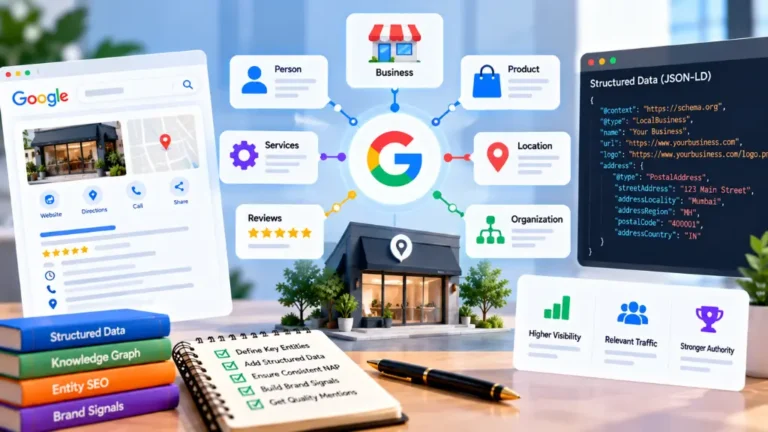
Google AI Overviews CTR drop is significantly more damaging to pages without schema. Structured data tells AI crawlers not just what your page says, but what type of content it is, who wrote it, and what entities it covers. Pages combining FAQPage, Article, and Organization schema with strong body content see meaningfully higher citation rates.
Critically – only 38% of pages cited in AI Overviews rank in the top 10 organic results for the same query, down from 76% just seven months earlier. This is the most important statistic in the 2026 AI Overview landscape: you do not need to rank #1 to be cited. You need the right signals.
Actionable step: Implement FAQPage schema on Q&A content, Article schema with named authors on editorial pages, and Organization schema site-wide. Use Google’s Rich Results Test to validate.
Signal 3: Topical Depth and Content Clusters#
Google AI Overviews CTR drop disproportionately affects thin, standalone pages. AI citation systems favour sources that demonstrate deep expertise across a subject area – not just one well-optimised page, but an interconnected cluster of content that signals sustained, expert coverage.
Building topical authority through pillar pages and content clusters is one of the most reliable paths to consistent AI citation. The pattern is clear: sites cited in AI Overviews typically have comprehensive, interlinked content on the same subject rather than a single high-ranking article.
Actionable step: Audit your highest-traffic topics and identify content gaps. Build supporting articles that explore your core topics from multiple angles and link them back to a central pillar page.
Signal 4: Brand Mentions and Entity Recognition#
Google AI Overviews CTR drop is lower for brands that Google’s Knowledge Graph recognises as authoritative entities in their field. When AI systems can independently verify who you are – through external brand mentions, Wikidata or Wikipedia entries, LinkedIn profiles, and industry citations – your content earns a higher baseline trust score.
Unlinked brand mentions near relevant keywords contribute to entity recognition almost as much as formal backlinks. Getting mentioned in trade publications, cited by journalists, or quoted in industry roundups builds the kind of external validation that AI systems use to confirm authority.
Actionable step: Pursue digital PR placements that generate brand mentions in contextually relevant publications. Prioritise quality and relevance over volume.
Signal 5: Content Freshness#
Google AI Overviews CTR drop is consistently worse for outdated content. AI systems prioritise pages that are clearly current – with recent dateModified timestamps, updated statistics, and evidence that the information reflects the present state of the topic. A page that nails four citation signals but was last updated two years ago will lose to a competitor that nails three signals and updated last month.
Actionable step: Build a quarterly content refresh cycle for your top-performing pages. Update statistics, replace outdated references, and add a visible “Last Updated” date.
What Queries Are Most Affected by the AI Overviews CTR Drop?#
Google AI Overviews CTR drop is not uniform across all query types. Understanding where the impact is concentrated allows you to prioritise your response:
Highest AI Overview appearance rates (and therefore highest CTR impact):
- Healthcare and medical queries: 88% of searches trigger AI Overviews
- Education content: 83%
- B2B technology: 82%
- Informational queries generally: 39.4% and rising
Lowest AI Overview appearance rates (lower CTR risk):
- Transactional queries (“buy”, “price”, “shop”) – AI Overviews appear less frequently because user intent demands a destination
- Navigational queries (branded searches, direct URLs)
- Local intent queries (“near me”, location-specific searches)
- Highly specific long-tail queries with limited authoritative sources
The strategic implication: commercial intent content is your most defensible traffic source. If your content strategy is heavily weighted toward informational and educational content, your CTR exposure to AI Overview cannibalisation is significant. Shifting investment toward transactional and conversion-focused content, or toward becoming a cited source in informational queries rather than just ranking for them, is the 2026 priority.
How Should You Measure AI Overview Impact on Your Site?#
Google AI Overviews CTR drop is often invisible in standard Google Analytics reporting. Traffic falls, but it looks like a gradual organic decline rather than a specific, identifiable cause. The correct measurement approach uses Google Search Console, not Analytics.
At Search Savvy, the AI Overview impact audit we run for clients follows this sequence:
Step 1: Identify AI Overview-affected queries In Search Console, filter the Performance report to show queries where impressions are high but CTR has fallen significantly over the past 6–12 months. These are likely AI Overview-affected queries.
Step 2: Separate ranking loss from CTR loss If your average position is stable but CTR is falling, the cause is AI Overview cannibalisation, not a ranking drop. These require different responses – AI visibility strategy vs. content improvement.
Step 3: Check citation status Search your most important affected queries in Google and note whether an AI Overview appears and whether your brand is cited. If you rank in the top five but are not cited, your page has a citation gap – not a ranking problem.
Step 4: Track AI share of voice Beyond Search Console, use tools like Semrush’s AI Toolkit, Ahrefs, or BrightEdge to monitor your citation frequency across AI Overview-heavy queries. AI share of voice is becoming the primary KPI for content performance in 2026.
What Metrics Should Replace CTR as Your North Star in 2026?#
Google AI Overviews CTR drop has made traditional CTR an increasingly unreliable measure of content performance. According to Search Savvy’s content strategy framework for 2026, the success metrics that matter now are:
- AI Overview citation frequency – how often your pages appear as cited sources in AI Overviews for target queries
- Brand mention share of voice – your brand’s presence in AI-generated answers across Google, ChatGPT, and Perplexity relative to competitors
- Click quality over click quantity – clicks that survive AI Overview queries convert 23% better than pre-AIO clicks, because users who click have already read a summary and are seeking deeper engagement
- Branded search volume – a strong indicator that AI Overview appearances are building brand awareness even without direct clicks
- AI referral traffic – Gemini’s share of referral traffic is rising rapidly through Q1 2026; track this as a separate channel
Semrush projects that AI search visitors will surpass traditional search visitors by 2028. The brands building citation authority now will hold those positions before competitors react.
FAQ: Google AI Overviews and CTR Drop#
Q: How much has Google AI Overviews reduced organic CTR?
Organic CTR on queries with AI Overviews has dropped from 1.76% to 0.61% – a 61% decline – based on Seer Interactive’s analysis of 25.1 million organic impressions tracked from June 2024 through September 2025. However, a tentative stabilisation was observed in early 2026, with CTR recovering from 1.3% in December 2025 to 2.4% by February 2026. The floor appears to have been reached, but CTR remains significantly below pre-AI Overview levels.
Q: Do I need to rank #1 to appear in AI Overviews?
No – and this is one of the most important strategic shifts in 2026. Only 38% of pages cited in Google AI Overviews rank in the top 10 organic results for the same query, down from 76% just seven months earlier. Citation is determined by content quality, E-E-A-T signals, structural clarity, and schema markup – not ranking position alone. A well-structured page ranking #15 can be cited above a #1 result that lacks the right signals.
Q: What type of content is most at risk from AI Overview CTR drop?
Informational and educational content carries the highest risk – AI Overviews appear on up to 88% of healthcare queries, 83% of education queries, and 82% of B2B tech searches. Transactional, navigational, and local intent queries have significantly lower AI Overview appearance rates and are more defensible from a traffic perspective.
Q4: How long does it take for AI Overview optimisation to produce results?
For existing pages with strong domain authority, structural optimisations – adding direct answers, FAQ sections, and schema markup – can produce AI Overview appearances within 2–6 weeks. For newer sites building authority from scratch, the realistic timeline is 3–6 months of consistent content development and digital PR investment.
Q: Should I try to block my site from appearing in AI Overviews?
Generally no. While Google’s nosnippet meta tag can prevent your content from being extracted into AI Overviews, this also removes your chance of appearing in featured snippets and reduces your overall Search visibility. Given that cited brands earn 120% more clicks per impression than uncited brands, blocking AI Overview access trades a small content control benefit for a significant traffic disadvantage.
Q: What’s the most impactful single change to improve AI Overview citation chances?
Rewriting the opening section of your target pages to deliver a direct, concise answer to the primary query within the first 100–150 words is consistently the highest-leverage structural change. Combine this with FAQPage schema and a visible, credentialed author bio – these three changes together address the most common citation gaps without requiring a full content rebuild.
The Bottom Line#
Google AI Overviews CTR drop is real, it is significant, and it is not reversing. The fundamental mechanic – a complete AI answer making the click optional – is built into how AI-mediated search works. Waiting for the situation to normalise is not a strategy.
But the brands treating this as a crisis are misreading the data. The clicks that remain are higher quality, converting 23% better than pre-AIO clicks. The cited sources are earning 120% more traffic per impression. And only 38% of cited pages even rank in the traditional top ten – meaning the opportunity to earn AI visibility is genuinely open to brands willing to build content the right way.
The strategy is not complicated. Structure your content to answer questions directly. Add the schema markup that tells AI crawlers what they’re reading. Build topical authority through content clusters. Get your brand mentioned by sources Google trusts. Refresh your content regularly. And measure AI share of voice, not just rankings and clicks.
If you want to know exactly where your site stands in AI Overview visibility today – and what it would take to become a cited source in your category – reach out to the Search Savvy team. This is what we do.