


NAP Consistency is one of those local SEO fundamentals that sounds deceptively simple – just your business name, address, and phone number being the same everywhere online. Yet it’s one of the most commonly neglected ranking factors, and one of the most silently damaging. A dental franchise lost an estimated $2.3 million in revenue due to NAP errors. 73% of consumers lose trust in a business with inaccurate online information. And inconsistent NAP can drop your local rankings by 2–3 positions and cost up to 68% of potential customers before they ever contact you. At Search Savvy, we audit local businesses every week – and NAP inconsistencies appear in the vast majority, silently undermining all the other SEO work those businesses have invested in.
This guide explains exactly what NAP Consistency is, why it matters so much for local SEO in 2026, how AI search has raised the stakes even further, and the step-by-step process to audit and fix your NAP across the web.
What Is NAP Consistency – and What Does NAP Stand For?
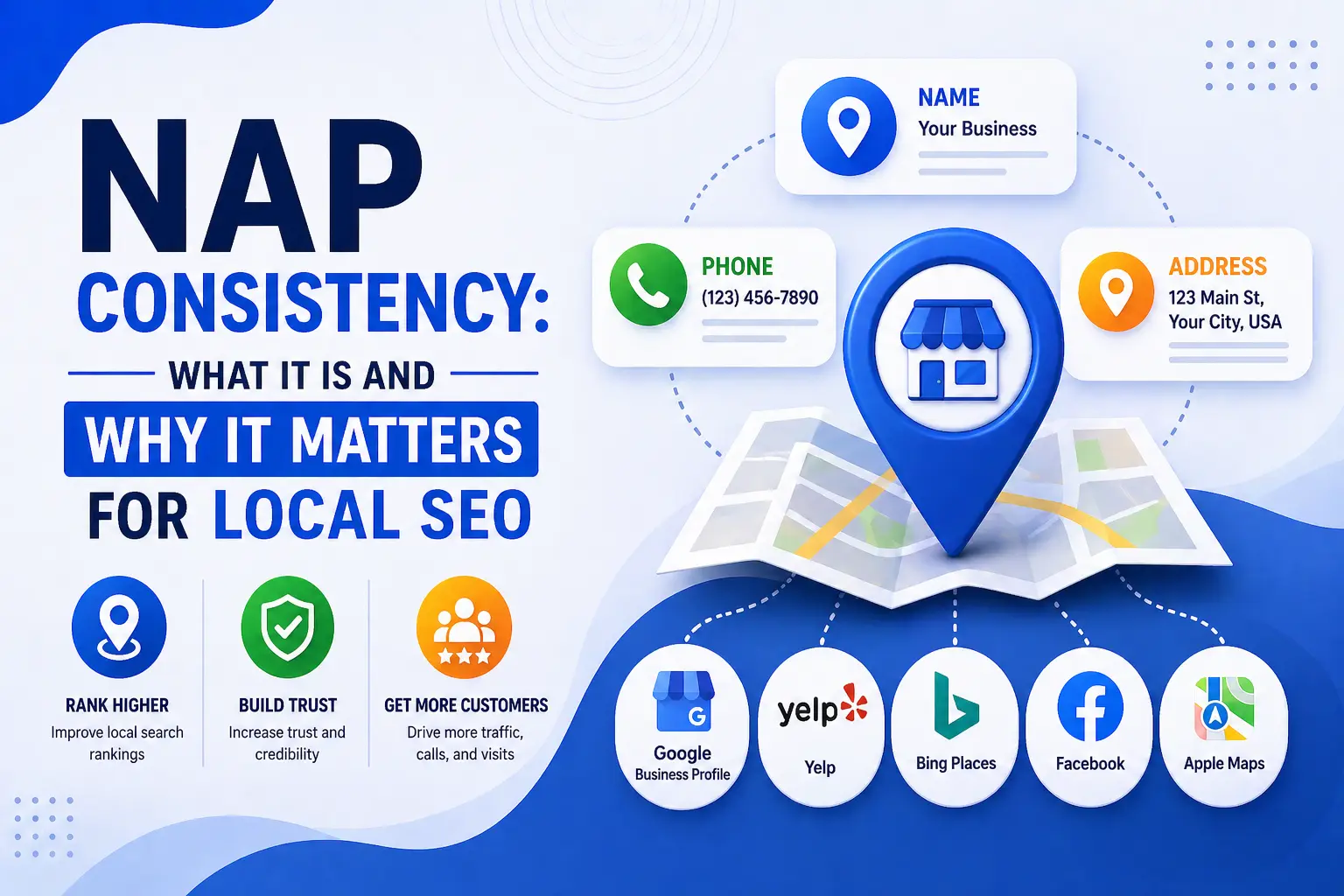
NAP Consistency refers to the practice of maintaining identical Name, Address, and Phone number information across every platform where your business appears online – your Google Business Profile, website, business directories, social media profiles, and every citation across the web.
The three elements are simple enough in isolation:
- N – Name: The exact legal or trading name of your business (e.g., “Search Savvy Digital” – not “Search Savvy” on one platform and “SearchSavvy” on another)
- A – Address: Your full address, including street number, street name, floor or unit number, city, state/region, and postcode – formatted identically everywhere
- P – Phone Number: Your primary business phone number, in a consistent format across all platforms
NAP Consistency means not similar across platforms – it means identical. Not “St.” on one listing and “Street” on another. Not “Level 2” on your website and “Floor 2” on Yelp. Not a mobile number on Google and a landline on JustDial. These seemingly tiny variations matter enormously to how search engines verify and trust your business identity.
In 2026, many businesses have also expanded NAP to NAPW – Name, Address, Phone, and Website – treating the website URL as an equally critical fourth signal. At Search Savvy, we recommend including your website URL in every citation and directory listing as standard practice.
How Does NAP Consistency Affect Local SEO Rankings?
NAP Consistency works as a trust signal within Google’s local ranking algorithm. When Google evaluates whether to show your business in the Local Pack (the map and three-business block that appears at the top of local search results), it cross-checks your business information across multiple sources – your GBP, your website, major directories, citation platforms, and social profiles – to verify that they all point to the same real-world business.
Here’s what happens when they match: Google gains confidence that your business is legitimate, established, and geographically anchored where you claim to be. This confidence translates directly into ranking strength.
Here’s what happens when they don’t match: Google’s algorithm encounters conflicting signals and cannot reliably confirm your business identity. This uncertainty reduces trust – and reduced trust reduces rankings.
The data quantifies this impact clearly. According to industry research:
- Citation signals (including NAP consistency) contribute approximately 11% of local ranking factors
- Businesses maintaining consistent NAP across at least 15 platforms were 23% more likely to appear in the Google Maps 3-Pack
- Businesses in the Google 3-Pack see 126% more traffic and 93% more user actions than those ranked lower
- Businesses with consistent NAP data across platforms see up to 73% higher visibility in AI-generated search results compared to those with inconsistencies
NAP Consistency doesn’t work in isolation – it amplifies every other local SEO signal you build. A strong Google Business Profile is weakened by conflicting NAP. A backlink from a local directory is diminished if the NAP on that directory doesn’t match your GBP. Reviews on one platform may not be properly attributed if the business details don’t match. NAP Consistency is the foundation that makes all other local SEO effort compound correctly.
Why Does NAP Consistency Matter Even More in 2026?
NAP Consistency has become more critical in 2026 for two powerful reasons: the rise of AI search and the growth of voice search.
NAP Consistency and AI Search
Google AI Overviews, ChatGPT, Perplexity, and Gemini all pull local business data from across the web when answering local queries. AI systems are essentially performing the same cross-referencing task Google’s local algorithm has always done – but at greater scale, across more platforms, and with less tolerance for ambiguity.
When an AI system encounters conflicting NAP signals, it has two choices: present uncertain information (which it won’t do) or skip your business in favour of one with clear, consistent data. Research shows businesses with clean, consistent NAP information see up to 73% higher visibility in AI-generated search results. Inconsistent NAP doesn’t just hurt your Google Maps ranking in 2026 – it makes you invisible to the AI engines that are increasingly becoming the first point of local business discovery.
NAP Consistency and Voice Search
Voice search has grown significantly in 2026, with a substantial proportion of local queries now coming through voice assistants – Google Assistant, Siri, Alexa, and Bixby. Voice search is uniquely demanding about NAP accuracy because the AI assistant must provide a single, confident answer to the user. It cannot present three different phone numbers and ask the user to choose.
When someone asks “What’s the phone number for [your business]?” the voice assistant queries its data sources, compares them, and if they conflict – gives the user a competitor’s information instead. Format matters for voice, too. A phone number formatted as +91-98765-43210 and the same number formatted as 098765 43210 on different platforms creates a data conflict even though they’re numerically identical.
What Are the Most Common NAP Consistency Mistakes?
NAP Consistency errors don’t always come from carelessness – many are a natural result of business evolution that creates legacy data problems online.
The most common NAP Consistency mistakes we see:
- Business name variations – trading as one name legally but using abbreviations, shortened forms, or DBA names inconsistently. Example: “Johnson & Sons Electricals Pvt Ltd” vs “Johnson & Sons” vs “Johnson Electricals”
- Address abbreviations – “Road” vs “Rd”, “Nagar” vs “Ngr”, “Floor” vs “Fl”, “Suite” vs “#”
- Old address persistence – a previous business location still listed on directories you’ve forgotten about, JustDial, IndiaMart, or data aggregators
- Multiple phone numbers – a personal mobile number used during setup now living on old directory listings while your business landline is on Google
- Different website URLs – some platforms listing http:// while others list https://, or www.yourdomain.com vs yourdomain.com
- Duplicate listings – two or more listings for the same business on the same platform, splitting reviews and confusing search engines about which is authoritative
- Rebranding without a full NAP audit – a business that changed its name without systematically updating every listing across the web
How Do You Audit Your NAP Consistency? (Step-by-Step)
NAP Consistency auditing is the systematic process of finding every place your business appears online and checking whether the information matches your master NAP record.
Step 1: Create Your Master NAP Record
Before you can audit anything, you need a single, definitive reference document. Open a spreadsheet and record:
- Business Name: The exact name as it appears on your GST registration, legal documents, or trademark
- Address: Full address, formatted exactly as it should appear everywhere
- Phone Number: Your primary business number in a consistent format (e.g., +91 98765 43210)
- Website: Your canonical website URL (https://yourdomain.com – with or without www, pick one and stick to it)
- Email: Your primary business email for directories that require it
- Business Hours: Consistent across all platforms
Treat this as your ground truth. Every listing on every platform must match this document exactly.
Step 2: Discover All Your Existing Listings
NAP Consistency auditing requires finding listings you may not even remember creating. Use these methods:
- Google Search operators: Search “Your Business Name” + “Your City” to surface existing listings
- Phone number search: Search your phone number in quotes – “9876543210” – to find listings that used your number even without your name
- Old address search: Search your previous address to surface ghost listings from your previous location
- Tools: Use BrightLocal, Moz Local, or Semrush Listing Management for automated discovery across hundreds of directories simultaneously
Priority platforms to check first (in order of importance):
- Google Business Profile
- Bing Places
- Apple Maps Connect
- Your own website (contact page, footer, About page)
- Facebook Business Page
- JustDial, IndiaMart, Sulekha (for Indian businesses)
- Industry-specific directories relevant to your sector
Step 3: Correct All Discrepancies
NAP Consistency correction follows a tiered approach:
- Claim the listing (if unclaimed) using the platform’s verification process
- Update the information to match your master NAP record exactly – every field, not just the ones that are wrong
- Complete the profile while you have access – add photos, categories, hours, and website URL
- Contact the operator for directories that don’t allow direct editing
- Document uncorrectable listings – some abandoned directories, locked listings, or slow-responding platforms may not be fixable immediately. Focus on high-authority platforms first; as you build more consistent, authoritative citations, low-quality inconsistent ones matter progressively less
Step 4: Add LocalBusiness Schema to Your Website
NAP Consistency on your website should be reinforced with LocalBusiness Schema – structured data in your website’s code that communicates your NAP information directly to search engines and AI crawlers in machine-readable format.
Key schema properties to include:
{
“@type”: “LocalBusiness”,
“name”: “Your Business Name”,
“address”: {
“@type”: “PostalAddress”,
“streetAddress”: “123 Example Road”,
“addressLocality”: “Mumbai”,
“addressRegion”: “Maharashtra”,
“postalCode”: “400001”,
“addressCountry”: “IN”
},
“telephone”: “+91-98765-43210”,
“url”: “https://yourwebsite.com”,
“openingHours”: “Mo-Fr 09:00-18:00”
}
Validate your schema using Google’s Rich Results Test.
Step 5: Schedule Quarterly NAP Audits
NAP Consistency is not a one-time task. Business details change – new phone numbers, relocated offices, rebranded names – and every change creates a fresh wave of inconsistencies across platforms that don’t update automatically. Set a calendar reminder to run a full NAP audit every 90 days, and run an immediate audit any time your business details change.
People Also Ask: NAP Consistency Questions
Does NAP formatting matter – or just the content?
For the core content (name, address, phone number), consistency is what matters most. A phone number formatted as +91 98765 43210 vs 098765 43210 represents a potential mismatch for automated systems, but Google’s algorithm focuses primarily on actual content changes rather than cosmetic formatting variations. That said, pick one format and apply it everywhere – consistency in formatting eliminates any ambiguity for both search engines and customers.
How quickly does fixing NAP inconsistencies improve rankings?
After correcting NAP inconsistencies and claiming/updating listings, most businesses see measurable Local Pack ranking improvements within 4–8 weeks. The speed depends on how quickly the affected directories re-crawled and updated, and how many high-authority platforms were corrected. GBP and website updates take effect fastest; lower-authority directories may take longer to refresh.
Does NAP Consistency affect AI search engines like ChatGPT and Perplexity?
Yes – and increasingly so in 2026. AI search engines including Google AI Overviews, ChatGPT, and Perplexity all aggregate business data from multiple sources before generating local answers. Businesses with consistent NAP across high-authority platforms are significantly more likely to be cited in AI-generated local answers. Inconsistent NAP creates data conflicts that AI systems resolve by favouring competitors with cleaner data signals.
Frequently Asked Questions (FAQ)
Q1: How many platforms do I need consistent NAP on to see a local SEO benefit?
Research shows businesses maintaining consistent NAP across at least 15 authoritative platforms are 23% more likely to appear in the Google 3-Pack. Focus on the top-tier platforms first (GBP, Bing Places, Apple Maps, Facebook, your website, and the top 5–7 industry-relevant directories), then expand outward. Quality of citation source matters more than raw quantity.
Q2: Is “St.” vs “Street” really enough to hurt my local rankings?
For Google’s core algorithm, minor abbreviation differences carry less weight than actual content mismatches (different phone numbers, different addresses). However, for AI systems and voice search, even minor format discrepancies can create data uncertainty. The safer practice is always to use your master NAP format exactly – it eliminates all ambiguity and gives every platform the strongest possible signal. Search Savvy recommends applying your master format character-for-character, not “close enough.”
Q3: What should I do if I can’t edit a listing to fix a NAP error?
First, try contacting the directory operator directly via their support form or email. Provide your correct business information and request the update. For directories that are completely unresponsive or abandoned, document the listing and move on. As you build more consistent citations on high-authority platforms, the influence of a single low-quality inconsistent listing diminishes. Some platforms also allow you to flag listings as incorrect, which may prompt automated correction.
Q4: Does NAP Consistency matter if I don’t have a physical storefront?
Yes. Service-area businesses (plumbers, electricians, delivery services, consultants) still benefit from NAP Consistency. Your business name and phone number must be consistent across all platforms even if your address is hidden on your GBP. Inconsistencies in name or phone number still undermine trust signals. If you’ve recently changed from a physical storefront to a service-area business model, a thorough NAP audit is particularly important to remove or update any listings that still show your old address.
Q5: What tools are best for managing NAP Consistency at scale?
For auditing and correcting citations across multiple platforms, BrightLocal and Moz Local offer comprehensive discovery and management tools. Semrush Listing Management provides automated distribution and monitoring. Yext is a premium option that pushes NAP updates to 100+ directories simultaneously. For Indian businesses, manually checking JustDial, IndiaMart, Sulekha, and Google Business Profile directly is essential alongside any automated tool.
Q6: Can duplicate listings hurt my local SEO even if they have correct NAP?
Yes. Duplicate listings on the same platform – two GBP listings for the same business location, for example – create confusion for Google’s algorithm about which listing is authoritative. Reviews and authority signals are split between the duplicates, weakening both. If you discover duplicate listings, report the non-primary one for removal through the platform’s support process or flag it as a duplicate directly in Google Business Profile.
Final Thoughts
NAP Consistency is not a glamorous local SEO tactic – it’s meticulous, detail-oriented work that requires ongoing attention. But in 2026, with AI search engines aggregating data from dozens of sources to generate local answers, and with voice search demanding a single confident response to every query, the cost of neglecting it has never been higher.
The businesses dominating local search in 2026 aren’t only producing great content or earning strong reviews – they’ve built a consistent, trustworthy data foundation that Google, AI Overviews, and voice assistants can verify without ambiguity. NAP Consistency is that foundation. Every other local SEO effort you invest in compounds on top of it – or leaks through the cracks of inconsistency beneath it.
Search Savvy helps businesses audit, correct, and maintain NAP Consistency as part of comprehensive local SEO strategies – turning one of the most overlooked local ranking factors into a durable competitive advantage.