

Local SEO in India is no longer a background consideration for small businesses – it is the front line of customer acquisition. When someone in Koramangala needs a dentist, a family in Pune needs a plumber, or a startup in Hyderabad is looking for a digital agency, they do not scroll through a national directory. They open Google, type “near me” or “[service] in [city],” and call whoever appears in the top three map results within 30 seconds.
Those three spots – the Google Local Pack – capture 44% of all clicks on the page. And yet, most Indian businesses are invisible there. Not because they are bad businesses, but because their local SEO signals are incomplete, inconsistent, or simply untouched.
At Search Savvy, we audit local SEO presence for Indian businesses across service categories, cities, and tiers – and the gaps we find are remarkably consistent. A well-run business with genuinely happy customers is invisible on Google Maps while a competitor with half the quality but a fully optimised Google Business Profile takes every call. The fix is not complicated. It is just not being done.
This guide covers every local SEO signal that matters in India in 2026 – and the specific, India-context mistakes that are costing businesses customers right now.
Why Is Local SEO in India Different from Global Best Practices?
Local SEO in India operates in a context that generic international guides simply do not account for. India is not just one of the world’s largest internet markets – it is uniquely local in how customers search, trust, and decide.
The scale of the opportunity is enormous:
- 46% of all Google searches have local intent – almost half of all search activity is looking for something nearby
- 88% of local mobile searches lead to a call or visit within 24 hours
- 83% of people in India use Google to read reviews before visiting a local business
- More than 80% of searches in India happen on mobile phones – Google’s mobile-first indexing is not just a technical consideration; it is the primary experience most Indian users have
But here is what makes India specifically challenging for local SEO:
The tier-2 and tier-3 city gap. Local SEO best practices are designed for markets where businesses, directories, and review platforms have significant digital penetration. In Tier-2 cities like Nashik, Coimbatore, Rajkot, and Mangaluru – where some of India’s fastest-growing consumer markets exist – the local citation landscape is thin, competition is lower, and the businesses that get their fundamentals right have an outsized first-mover advantage.
The language and transliteration challenge. A business in Chennai may be searched in Tamil, in English, or in transliterated Tamil using Roman script. A restaurant in Lucknow may be searched as “biryani place in Lucknow,” “Lucknow biryani,” or with the Hindi phonetic equivalent. Local SEO in India requires deliberate multilingual signals that most global tools do not address.
The WhatsApp-first discovery pattern. Indian customers increasingly confirm business details via WhatsApp before visiting. A Google Business Profile without a WhatsApp button, without up-to-date hours, and without a current phone number creates a drop-off point between interest and action that is uniquely prevalent in the Indian market.
How Does the Google Local Pack Algorithm Work in India in 2026?
Local SEO in India is now evaluated through a specific set of ranking signals that Google weights differently from traditional organic search. Understanding these signals – and their relative importance – is what separates businesses that appear in the Local Pack from those that do not.
Google’s three primary local ranking factors are Relevance, Distance, and Prominence. In 2026, the weighting and mechanisms behind each have evolved:
Relevance (Does your business match the search intent?) Google Business Profile signals now carry approximately 32% of the total local ranking weight in 2026. Your primary and secondary business categories, your service list, your business description, and your Google Posts all contribute to how well Google can match your profile to a query. A business categorised as “General Contractor” will be outranked for “kitchen renovation near me” by a business that has specifically listed kitchen renovation as a service.
Distance (How close are you to the user?) Distance is a straightforward calculation, but its influence is more nuanced than simple proximity. Google adjusts its distance weighting based on query type – for high-urgency queries (“emergency plumber near me”), proximity carries extreme weight. For lower-urgency discretionary queries (“best biryani restaurant in Hyderabad”), Google will show businesses that are 10–15km away if their signals are significantly stronger than those nearby.
Prominence (How well-known and trusted are you?) In 2026, prominence is driven primarily by review signals, citation consistency, and backlinks from local and authoritative sources. The businesses consistently appearing in Local Pack for competitive Indian city keywords have – without exception – more reviews, more recent reviews, and higher ratings than competitors.
One addition in 2026 changes the equation for every Indian business: AI Overviews for local queries. Google’s AI Overviews increasingly pull business information directly from Google Business Profiles for local searches. An incomplete or unmanaged profile means you may not appear in AI-generated answers for local searches at all – making your absence extend beyond Maps into the AI summary that appears above the Map Pack.
What Are the Most Common Local SEO Mistakes Indian Businesses Make in 2026?
Local SEO in India fails in predictable patterns. These are the mistakes that consistently block visibility, even for businesses with strong reputations and genuinely satisfied customers:
Mistake 1: Creating a Google Business Profile Once and Never Updating It
The single most common mistake across Indian businesses of every size and category. A Google Business Profile is not a directory listing – it is an active ranking asset. Google’s algorithm actively evaluates profile freshness, Post activity, Q&A responses, and photo recency.
Profiles that receive regular activity signal an active, engaged business. Profiles created two years ago with no updates, no Posts, and no new photos signal neglect – and Google ranks them accordingly.
The minimum active maintenance standard in 2026:
- At least 2 Google Posts per month (offers, events, updates, or news)
- New photos added monthly (exterior, interior, team, products, or services)
- All Q&A questions answered within 48 hours
- Business hours, holiday hours, and service list reviewed quarterly
Mistake 2: Ignoring or Mishandling Reviews
Local SEO in India is significantly influenced by review velocity and review response rate – yet most Indian businesses treat reviews as passive outcomes rather than active signals.
83% of people in India use Google to read reviews before visiting a local business. That number alone makes review management a direct revenue function. But reviews also carry algorithmic weight: Google evaluates both the volume of reviews and the recency of reviews when calculating prominence scores.
The most underused, highest-impact local SEO action for Indian businesses: asking every happy customer to leave a Google review. This costs nothing. It requires no technical skill. And it directly increases your Local Pack ranking competitiveness.
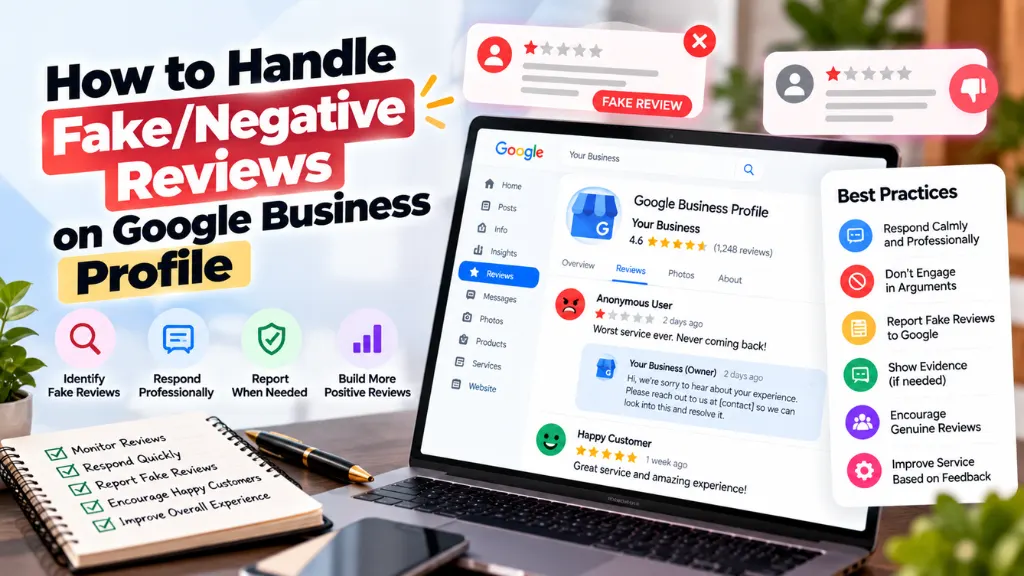
The response component is equally important. Responding to every review – including negative ones – within 48 hours signals active management to Google and builds trust with prospective customers reading your profile. A business with 50 reviews and 100% response rate consistently outranks a business with 200 reviews and 0% response rate in moderately competitive Indian local markets.
Mistake 3: NAP Inconsistency Across Indian Directories
Local SEO in India requires consistent Name, Address, and Phone (NAP) data across every directory and platform where your business is listed. Google cross-references your NAP data across the web as a trust signal. Inconsistencies – different phone numbers, abbreviated vs full address formats, old addresses from a previous location – create conflicting signals that reduce your prominence score.
The key Indian directories for NAP citation building:
- JustDial – remains the highest-authority Indian local directory for most categories
- Sulekha – strong in service categories (home services, education, healthcare)
- IndiaMart – critical for B2B and trade businesses
- Practo – essential for healthcare and wellness providers
- MagicBricks / 99acres – for real estate businesses
- Zomato / Swiggy – for food service businesses (these are citation sources even for businesses not heavily reliant on delivery)
- Bing Places and Apple Maps – frequently overlooked but increasingly relevant as voice search on iOS devices queries Apple Maps
Mistake 4: No Hyperlocal Content on the Website
Local SEO in India requires that your website sends strong location signals – not just from your Google Business Profile. A service area page or location page with genuine, specific, locally-relevant content is a ranking asset that most Indian business websites lack entirely.
The effective hyperlocal content framework for Indian businesses:
- Service area pages – a dedicated page for each city or neighbourhood you serve, with specific service details, area-specific context, and genuine local information (not the same content duplicated with a city name swapped)
- Local FAQ content – questions specific to your category in your city: “What are the best materials for kitchen cabinets in Mumbai’s humidity?” tells Google your relevance to Mumbai kitchen renovation queries far more effectively than a generic service page
- Google Posts that reference local context – a Post about “Ganesh Chaturthi special hours” or “Our Connaught Place office is open on Sundays” builds local relevance signals over time
Mistake 5: No Google Business Profile Service List
Local SEO in India misses a significant relevance signal when businesses leave their GBP service list empty. Google uses your service list to match your profile to specific queries beyond your primary category.
A homeopathy clinic that lists “skin allergies,” “chronic fatigue,” “hormonal imbalances,” and “paediatric homeopathy” in its service list will appear for all four query types. The same clinic with only its primary category filled in will compete on category alone – a much narrower matching signal.
How Should Indian Businesses Structure Local SEO for AI Overviews in 2026?
Local SEO in India now requires a dual-layer approach: optimising for the traditional Local Pack and optimising for AI Overview citations, which appear above the Map Pack for a growing percentage of local queries.
Google’s AI Overviews for local searches pull directly from:
- Google Business Profile content – your description, services, and Q&A
- Review summaries – the AI synthesises your reviews into themes (fast service, affordable pricing, experienced team)
- Your website’s local pages – especially FAQ content and service area pages structured with clear, factual answers
The AI-readiness checklist for Indian local businesses:
- Google Business Profile description uses specific service keywords and city names – not generic marketing copy
- At least 10 answered Q&A entries on your GBP – these are directly extracted into AI answers
- Website service pages have an FAQ section with location-specific questions and answers
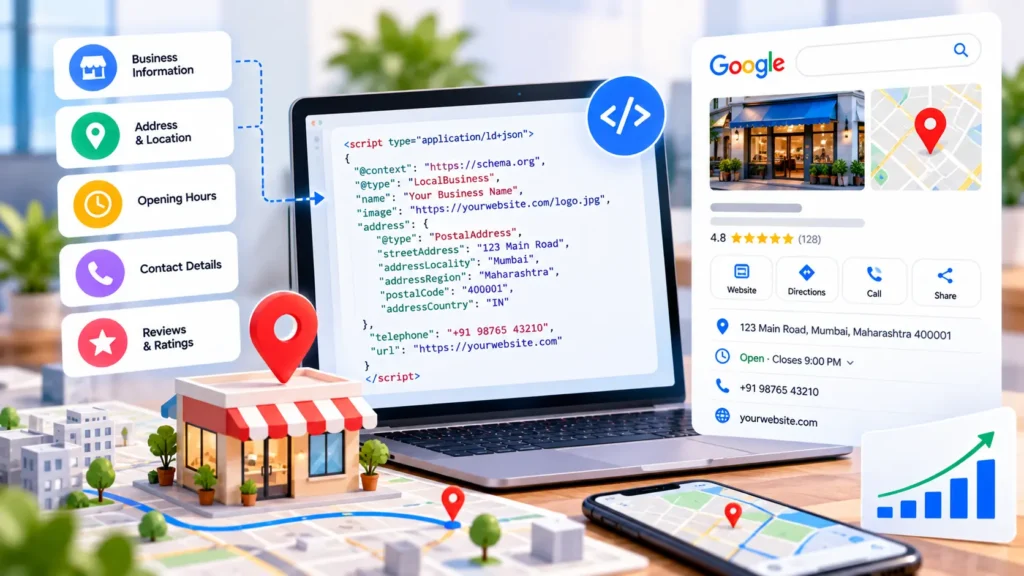
- LocalBusiness schema markup deployed on your website with accurate address, phone, service, and operating hours data
- Your business is listed on Wikidata if you are an established brand – entity recognition significantly improves AI citation eligibility
At Search Savvy, we treat local AI visibility as a parallel strategy to traditional Map Pack ranking – the signals overlap substantially, but the AI citation layer requires deliberate content structuring that pure GBP optimisation alone does not address.
What Does the Complete Local SEO Fix Look Like for an Indian Business in 2026?
Local SEO in India is a 90-day correction, not an overnight change. Here is the prioritised implementation sequence, ordered by impact:
Week 1–2: Foundation
- Claim and fully complete your Google Business Profile – every field, every category, every service
- Verify your listing if not already verified (postcard: 5–14 days; phone or video verification if available: faster)
- Audit and correct your NAP data across JustDial, Sulekha, IndiaMart, and the 3–5 most relevant category-specific directories
- Upload a minimum of 10 high-quality photos – exterior, interior, team, products, or work samples
Week 3–4: Review and Engagement
- Create a simple, direct review request process – a WhatsApp message template, an email follow-up, or a printed QR code at point of contact
- Respond to every existing review – positive and negative – with a genuine, personalised response
- Answer or create 5–10 Q&A entries on your GBP covering your most common customer questions
Month 2: Content and Citations
- Create or improve your website’s location/service area pages with genuine hyperlocal content
- Add an FAQ section to your homepage and service pages targeting local query patterns
- Implement LocalBusiness schema markup on your website – use Google’s Rich Results Test to validate
- Build citations on the 5–10 most relevant Indian directories for your category
Month 3: Authority and Consistency
- Pursue at least 2–3 local backlinks – from your local Chamber of Commerce, business associations, local news coverage, or neighbourhood community platforms
- Establish a weekly GBP Post cadence – one Post per week with a specific offer, update, or local event reference
- Set up monthly monitoring via Google Business Profile Insights and Google Search Console to track call clicks, direction requests, and local query impressions
FAQ: Local SEO in India in 2026
Q1: How long does it take for local SEO to show results in India? Most Indian businesses see measurable improvements in Local Pack visibility within 30–60 days of completing a full Google Business Profile and building consistent citations on major Indian directories. Review velocity – adding new reviews consistently – is the factor that most directly accelerates ranking improvement. Competitive markets (Mumbai, Bengaluru, Hyderabad for popular categories) typically require 90 days of consistent optimisation before significant movement. Tier-2 and Tier-3 city markets often show results faster due to lower competition.
Q2: Is Google Business Profile free for Indian businesses? Yes – Google Business Profile is completely free for Indian businesses. You need a Google account and business verification. Verification typically takes 5–14 days via postcard delivery to your business address, though phone or video verification may be available and faster. Despite being free, GBP is the single most important local SEO tool available to any Indian business and should be the first local SEO investment of time and attention.
Q3: How many Google reviews does an Indian business need to rank in the Local Pack? There is no fixed number. The requirement is to have more recent, higher-quality reviews than your direct competitors in your category and service area. In Tier-1 city competitive categories (e.g., dentist in Bengaluru), businesses in the Local Pack typically have 80–200+ reviews. In Tier-2 cities and less competitive categories, 20–50 reviews with strong recency and a high average rating can be sufficient to appear consistently in the top three. Review velocity – gaining new reviews every month – matters as much as total count.
Q4: Does NAP consistency really affect local rankings in India? Yes – significantly. Google uses NAP (Name, Address, Phone) consistency across directories as a prominence and trust signal. Inconsistent NAP data – different phone numbers, old addresses, or abbreviated business names on different platforms – creates conflicting signals that reduce your prominence score. For Indian businesses that have changed phone numbers, moved locations, or rebranded, auditing and correcting NAP across JustDial, Sulekha, IndiaMart, and other relevant directories is one of the highest-priority local SEO corrections available.
Q5: What is the Local Pack and how do I get my business into it? The Local Pack (also called the Map Pack) is the set of three business listings that appears at the top of Google Search results for local intent queries – “plumber near me,” “best restaurant in Koramangala,” “CA in Andheri West.” It captures 44% of all clicks on those search pages. Getting into it requires: a fully completed and verified Google Business Profile, consistent NAP citations across Indian directories, a strong and growing review profile, and a website with local signals (service area pages, LocalBusiness schema, and hyperlocal content). Appearing in the Local Pack for even 5–10 competitive local keywords can generate significant, consistent lead flow without any ad spend.
Q6: How does Local SEO in India connect to AI Overviews? Google’s AI Overviews increasingly pull business information directly from Google Business Profiles for local queries. An incomplete or unmanaged profile means your business may not appear in AI-generated answers for local searches – making your absence extend beyond the Map Pack into the AI summary that now appears above traditional results. Businesses that want AI Overview visibility for local queries should focus on: a complete GBP description with specific service and location keywords, answered Q&A entries that Google’s AI can extract, and LocalBusiness schema markup on their website.
The Bottom Line
Local SEO in India is deciding your business’s growth trajectory right now – whether you are paying attention or not. Every day your Google Business Profile is incomplete, your NAP data is inconsistent, and your reviews are going unanswered is a day your competitor is capturing the customers who were looking for exactly what you offer.
The fixes are not complicated. They are not expensive. They do not require a full website redesign or a significant technical investment. They require attention to a specific set of signals – GBP completeness, review velocity, NAP consistency, hyperlocal content, and schema markup – that most Indian businesses simply haven’t prioritised.
The brands that build genuine local SEO authority in 2026 will hold positions that compound over time – positions that take years and thousands of reviews for a competitor to displace. The investment required to establish those positions now is a fraction of what it will cost once the market catches up.
According to Search Savvy’s local SEO practice, the highest-leverage single action for most Indian businesses right now is the one that costs nothing: ask every happy customer for a Google review this week. Not next month. This week.
If you want a complete local SEO audit that shows exactly where your business’s online visibility is leaking – and the specific fixes that would move you into the Local Pack for your most valuable keywords – reach out to the Search Savvy team.