Your Website Ranks But Nobody Converts. Here’s the Real Gap
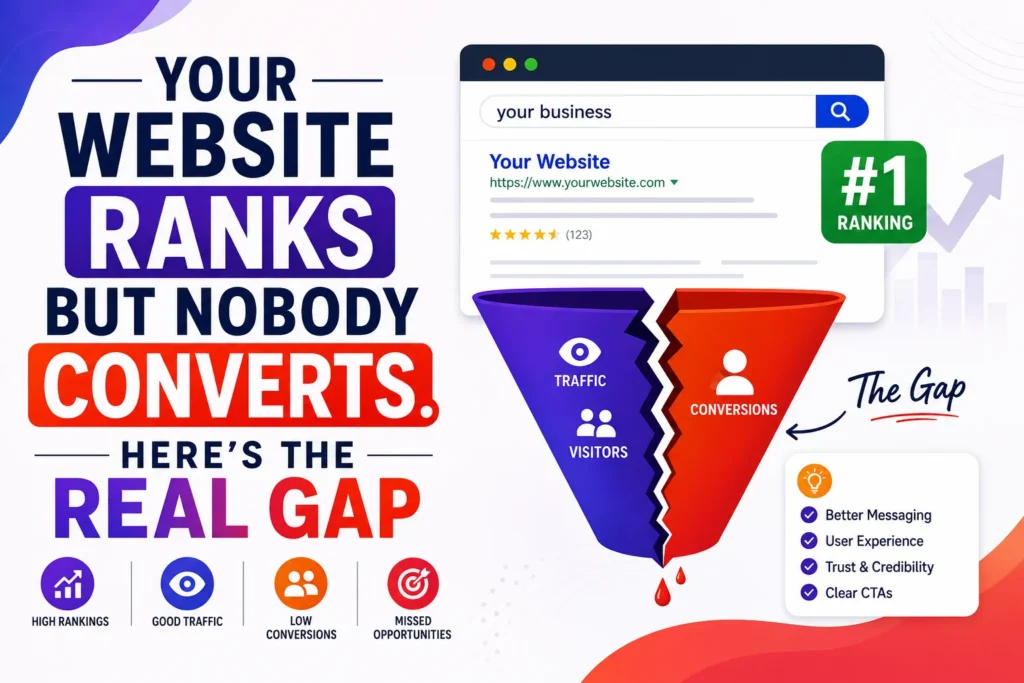

Website Conversion Rate is the metric that determines whether your SEO investment is actually building a business – or just building traffic reports that look good in a monthly presentation. If your site ranks on page one of Google but your phone isn’t ringing, your enquiry form is collecting dust, and your revenue hasn’t moved, you have a problem that more backlinks and better title tags will not fix. The uncomfortable truth in 2026: only 1.7% of website visitors across all industries convert – leaving 98.3% of traffic generating zero revenue. At Search Savvy, we see this pattern repeatedly in audits. A business celebrates hitting position one for their target keyword, watches their traffic double, and then waits. And waits. And the revenue doesn’t follow. That’s not an SEO failure. It’s a conversion failure – and they’re two very different problems with very different solutions.
In this article17 sections
This post identifies the real gap between ranking and converting, and gives you the specific fixes that turn traffic into revenue in 2026.
What Is the Difference Between an SEO Problem and a Conversion Problem?#
Website Conversion Rate problems are frequently misdiagnosed as SEO problems – and vice versa. Understanding which you’re dealing with changes everything about how you fix it.
You have an SEO problem if:
- Your pages have low impressions (nobody is finding them at all)
- Your average position is below page two for all target keywords
- Google Search Console shows minimal crawl and index coverage
- Traffic is consistently declining month over month
You have a conversion problem if:
- Traffic is steady or growing, but leads/sales/enquiries are flat or falling
- Bounce rate is high despite low average position
- Users visit, but no one fills the form, clicks the CTA, or calls
- Google Analytics 4 shows sessions but near-zero goal completions
Most businesses with a conversion problem keep investing in SEO – buying more traffic into a leaky bucket. The fix isn’t more traffic. It’s patching the holes that are letting the traffic you already have drain away unused.
Why Is This Problem More Urgent in 2026?#
Website Conversion Rate has become the defining metric of 2026 for a specific and pressing reason: traffic is more expensive and less predictable than at any previous point in digital marketing history.
Google’s AI Overviews are answering a growing proportion of informational queries directly on the search results page – meaning organic clicks that previously flowed freely to top-ranking pages are now retained by Google’s own interface. As a result:
- Businesses that rank for informational keywords are seeing organic traffic volume decline even when their rankings hold
- Paid search CPCs (cost-per-click) have increased across most verticals, making paid traffic acquisition increasingly costly
- The traffic that does reach your website in 2026 is therefore more valuable – and wasting it through poor conversion infrastructure has a higher cost than it did even two years ago
The arithmetic is brutal but simple: if your current conversion rate is 1% and you double your traffic through expensive SEO or paid campaigns, you now have 2% of a larger number. But if you double your conversion rate on your existing traffic through CRO (Conversion Rate Optimisation), you’ve doubled your revenue without spending another rupee on acquisition.
Scaling traffic before fixing conversion inefficiencies amplifies waste. Optimising first improves every future marketing investment.
What Are the Real Reasons Your Website Ranks But Doesn’t Convert?#
Website Conversion Rate failures almost always trace back to one of six root causes. Identifying which one applies to your site determines the fix.
Reason 1: You’re Ranking for the Wrong Keywords#
The most common and most damaging conversion gap is a keyword intent mismatch – ranking for informational queries when your business needs transactional ones. This is the most common reason websites rank but don’t convert: targeting the wrong keywords.
If your content ranks for “what is digital marketing,” those visitors are learning – not buying. They will read your post, learn what they came to learn, and leave. No conversion occurs because none was ever likely.
The three intent categories – and what converts:
| Keyword Intent | What the Searcher Wants | Conversion Likelihood |
| Informational | An answer or explanation | Very Low |
| Commercial | Comparison, options, evaluation | Medium |
| Transactional | To hire, buy, or contact someone | High |
Most businesses have an overabundance of informational content (blog posts, guides, explainers) and a severe shortage of commercial and transactional content – comparison pages, service pages, pricing guides, case studies, and testimonial pages that serve buyers who are ready to act.
The fix: Run a content audit with intent mapping. For every page driving significant traffic, categorise its keyword intent. Then identify the bottom-of-funnel content gap – the comparison pages, use case pages, and clear service pages that are either missing or poorly optimised. Most sites have plenty of top-of-funnel traffic and a gaping hole in the middle and bottom of the funnel.
Reason 2: Your Landing Page Doesn’t Match What You Promised in the SERP#
Website Conversion Rate drops when visitors arrive on your page and immediately experience what UX experts call a “commitment mismatch” – the page they land on doesn’t deliver what your title tag and meta description implied.
A real-world example of what fails: A blog post titled “10 Reasons Your Website Isn’t Converting” with the only CTA being “Schedule Your Free Consultation.” The visitor reading that post is learning about conversion problems, not ready to hire someone. The commitment gap is too large.
If your title promises “How to choose an SEO agency in Mumbai” and your landing page opens with a pitch for your services without first addressing the comparison guide the user expected, they leave. Google’s algorithm is increasingly aware of this – high bounce rates from specific queries signal that your content isn’t satisfying the intent, which eventually affects rankings too.
The fix: For every high-traffic page, check the alignment between:
- What your title tag / meta description promises
- What the user expects based on that promise
- What your page actually delivers in the first 3 seconds of the user experience
The landing page must immediately confirm: “Yes, you’re in the right place, and what you’re looking for is right here.”
Reason 3: Weak or Missing Calls-to-Action#
Website Conversion Rate cannot improve if visitors don’t know what you want them to do next. This sounds obvious – yet heatmap analysis consistently shows that a significant proportion of website visitors never see the primary CTA, and those who do see it frequently don’t click it.
The most common CTA failures in 2026:
- Generic CTAs – “Submit,” “Click Here,” “Learn More” give visitors no reason to act. A CTA is a micro-promise. “Get Your Free SEO Audit” is a micro-promise. “Submit” is not.
- Single CTA per page – not every visitor is at the same decision stage. A visitor reading a blog post may not be ready to book a call, but they might be ready to download a resource, subscribe to a newsletter, or read a case study. Multiple CTAs matched to different intent levels capture more of the visitor journey.
- CTAs buried below the fold – Microsoft Clarity’s heatmap data consistently shows that most visitors never scroll to where the primary CTA is placed. If your main CTA is at the bottom of a 3,000-word page and nowhere else, the majority of your traffic never sees it.
- No urgency or specificity – “Contact us when you’re ready” is not a CTA. “Book a free 30-minute SEO audit this week – limited slots” is.
The fix: Audit every page that receives significant traffic. Ensure a relevant CTA appears above the fold, mid-page, and at the end. Match CTA language to the intent of the page – not to what you want, but to what the visitor is ready to do next at that stage of their journey.
Reason 4: Your Site Lacks Trust Signals#
Website Conversion Rate is directly tied to trust – and in 2026, visitors are more sceptical, more informed, and faster to make trust judgements than at any previous point in digital history. A visitor who finds you through a Google search has never heard of you. They’re evaluating your business in seconds.
Trust signals that directly affect conversion:
- Reviews and testimonials – not text-only testimonials, but named, attributed quotes with photos, company names, and (where possible) linked Google reviews. Generic “Sarah from Mumbai loved working with us” builds zero trust. “Rajesh Mehta, CEO of Kiran Foods, increased organic leads by 340% in 6 months” builds significant trust.
- Case studies with real numbers – traffic is meaningless without revenue correlation. Show the before-and-after in specific, measurable terms.
- Trust badges and credentials – relevant certifications, industry memberships, media mentions, and partner logos provide the external validation a first-time visitor needs.
- Real contact information – a physical address, a phone number that answers, a name behind the business. Businesses that hide their identity convert poorly because trust requires accountability.
- Recent activity – a blog last updated in 2022, testimonials from 2021, and a copyright footer that says “© 2020” all signal neglect. Trust requires evidence of an active, attentive business.
The fix: Use Microsoft Clarity or Hotjar to watch session recordings of users who bounced. Identify at what point they left and whether they reached your trust signals at all. In most cases, visitors bounce before they ever reach testimonials or case studies placed deep in the page.
According to Search Savvy’s conversion audit framework, moving trust signals above the fold – placing a single, specific, attributed client result directly below the hero section – is the single highest-impact change available to service businesses converting below 2%. We’ve seen this single repositioning increase enquiry rates by 40–60% within two weeks, without changing a single word of the page’s content.
Reason 5: Poor Mobile and Page Speed Experience#
Website Conversion Rate drops measurably for every second of additional load time – and in 2026, with over 60% of web traffic coming from mobile devices, a poor mobile experience doesn’t just hurt conversions. Google’s mobile-first indexing means it also eventually hurts rankings.
The data is unambiguous:
- A page that loads in 1 second converts 3x better than a page that loads in 5 seconds
- Every 1-second delay in load time reduces conversions by approximately 7%
- Pages with Core Web Vitals in the “Poor” range show measurably lower conversion rates than those in the “Good” range
A visitor who waits more than 3 seconds for a page to load on mobile has already decided your business isn’t worth their time before they’ve read a single word. You’ve lost the conversion before it had a chance to begin.
The fix: Test every key landing page using PageSpeed Insights on mobile. Address the specific issues flagged – typically: image compression, render-blocking JavaScript, server response time, and layout stability (CLS). Also test your site on a mid-range Android device on a 4G connection – which is how the majority of your visitors are actually accessing your site.
Reason 6: No Bottom-of-Funnel Content#
Website Conversion Rate failures frequently stem from a content gap that’s invisible from the outside: the complete absence of content designed for buyers who are ready to make a decision.
Most websites have plenty of top-of-funnel content (informational blog posts, guides, explainers). But most sites have a critical shortage of:
- Comparison pages – “Search Savvy vs [Competitor]” or “SEO agency vs in-house SEO team”
- Pricing pages – even a starting-from price point removes friction for buyers evaluating affordability
- Use case pages – “SEO services for e-commerce businesses” or “local SEO for restaurants in Mumbai”
- Case studies – specific results, specific industries, specific timelines
- FAQ pages – answering the objections that prevent buyers from contacting you
A visitor who has already decided they want SEO services and is evaluating whether to choose you needs comparison content, pricing context, and social proof – not another blog post explaining what SEO is.
The fix: Map your content against the three funnel stages. Identify which commercial and decision-stage pages are missing. Create them with clear intent – these pages should answer “why us?” and “why now?” – not “what is SEO?”
How Do You Diagnose Your Conversion Problem? (Free Tools)#
Website Conversion Rate diagnostics don’t require expensive software. Three free tools cover the essential analysis:
1. Google Analytics 4 Check your goal completion rate by landing page. Which pages drive the most traffic but the fewest conversions? These are your highest-priority optimisation targets – pages with a large traffic volume and a conversion problem generate the fastest ROI when fixed.
2. Microsoft Clarity Free heatmap and session recording tool. Watch real users navigate your site. Identify where they stop scrolling, what they click, and at what exact point they leave. Most businesses discover that their CTA is invisible to the majority of their visitors – a problem invisible in analytics but obvious in session recordings.
3. Google Search Console Identify which queries drive traffic to which pages. For each high-traffic page, evaluate whether the query intent is commercial/transactional or purely informational. Pages driving informational traffic will rarely convert – knowing this prevents you from misattributing the problem to your CTA or design.
People Also Ask: Website Conversion Questions#
What is a good website conversion rate in 2026?#
The average website conversion rate across all industries is 1.7% in 2026. A “good” conversion rate varies significantly by industry: B2B services typically see 2–5% as strong performance; e-commerce averages 1–3%; lead generation pages for high-intent queries can achieve 5–15% when properly optimised. More important than comparing to an average is improving your own baseline – even a 0.5% improvement in conversion rate on existing traffic generates significant additional revenue without increasing acquisition costs.
Why is my traffic increasing but my leads are staying the same?#
This is almost always a keyword intent problem. Your growing traffic is likely coming from informational queries that attract readers, not buyers. Check Google Search Console to see which queries are driving the new traffic – if they’re informational rather than commercial or transactional, the additional visitors were never likely to convert regardless of what your page contained. The solution is building more bottom-of-funnel content targeting commercial and transactional keywords.
Does improving conversion rate help SEO rankings?#
Indirectly – yes. Google’s algorithm uses user behaviour signals (engagement rate, bounce rate, session duration, pages per session) as indirect quality indicators. A page with a high bounce rate and low engagement tells Google the content isn’t satisfying the searcher’s intent, which over time can reduce rankings. Improving conversion rate through better content alignment and user experience simultaneously improves these engagement signals, providing a reinforcing SEO benefit.
Frequently Asked Questions (FAQ)#
Q1: How long does it take to see results from conversion rate optimisation? Most CRO improvements produce measurable results within 2–8 weeks, depending on the change’s scale and your traffic volume. Quick wins – repositioning trust signals, improving CTA specificity, fixing mobile speed – can show results within days on high-traffic pages. More comprehensive changes like funnel restructuring or content overhaul follow a timeline consistent with SEO: 8–12 weeks for significant measurable improvement. Research from WiderFunnel based on 100+ client engagements shows most CRO programmes deliver statistically significant sustained improvements within 3–6 months.
Q2: Should I fix my conversion rate before investing more in SEO? Yes – in most cases. If your current conversion rate is below 2% and you’re spending on SEO to drive more traffic, you’re pouring water into a bucket with holes. Every additional visitor you bring in at a 1% conversion rate is 99 missed opportunities. Fix the conversion problems first – intent alignment, trust signals, CTAs, mobile speed – then scale traffic. Every rupee you invest in SEO or paid acquisition after fixing your conversion rate delivers a higher return.
Q3: What is the fastest fix for a website that ranks but doesn’t convert? For most service businesses, the fastest and highest-impact fix is trust signal repositioning – moving your most specific, attributed client result (a named case study with numbers) above the fold on your highest-traffic landing pages. This single change addresses the most common conversion barrier (insufficient trust in the first 3 seconds) without requiring new content, redesign, or technical changes. Search Savvy consistently finds this repositioning generates conversion improvements of 40–60% on service pages within the first two weeks of implementation.
Q4: How do I know if my CTA is the problem? Install Microsoft Clarity (free) and watch session recordings for your top 5 traffic pages. If the majority of users are not scrolling to where your CTA is placed, the CTA isn’t the problem – the placement is. If users are scrolling past the CTA without clicking, the issue is the CTA’s language, specificity, or relevance to that visitor’s stage in the buying journey. Session recordings consistently reveal that most websites’ primary CTAs are invisible to the majority of visitors – either placed too far down the page or visually de-emphasised to the point of being overlooked.
Q5: Is low conversion rate always the website’s fault? Not always. Sometimes the conversion problem is upstream – the business is targeting the wrong audience at the traffic acquisition stage, meaning the visitors who arrive are simply not the right buyers. Other times, the barrier to conversion is price, not page design. And occasionally, the offer itself needs refinement. A conversion audit should always include an honest assessment of whether the traffic being sent is genuinely qualified, whether the offer is competitive, and whether the sales process that follows the web enquiry is frictionless. A website can only convert the right visitors – if the wrong visitors are being sent, no amount of CRO will fix the fundamental mismatch.
Q6: Can SEO and CRO work together without conflicting? Yes – and in 2026, they must. The foundational elements of both disciplines are now aligned: content that matches user intent ranks better and converts better. Pages that load fast rank better and convert better. Pages with clear structure and answer-led content rank better in AI Overviews and convert better with human visitors. The old tension between SEO (optimise for the algorithm) and CRO (optimise for the human) has largely dissolved – because Google’s algorithm in 2026 is specifically designed to reward pages that genuinely serve the human. The best-performing pages in 2026 are the ones that do both simultaneously – by default.
The 2026 Conversion Gap Checklist#
Website Conversion Rate improvements become systematic when you work through the checklist that covers every major failure point:
Intent Alignment
- ☐ Every high-traffic page is mapped to a specific keyword intent (informational / commercial / transactional)
- ☐ Commercial and transactional pages are fully built out, not just blog posts
- ☐ Page content matches what the SERP title and meta description promised
CTA Optimisation
- ☐ Primary CTA appears above the fold on every key page
- ☐ CTA language is specific, action-oriented, and benefit-led (“Get Your Free Audit” not “Submit”)
- ☐ Multiple CTAs match different visitor intent stages throughout longer pages
Trust Signals
- ☐ Named, attributed testimonials with specific results are above the fold
- ☐ Case studies with measurable outcomes are easily discoverable
- ☐ Contact information is complete, visible, and real
Technical Performance
- ☐ Mobile load time under 3 seconds (tested on PageSpeed Insights)
- ☐ Core Web Vitals are in “Good” range across all key pages
- ☐ Site functions correctly on mid-range mobile devices
Funnel Coverage
- ☐ Comparison pages exist for top competitor alternatives
- ☐ Pricing page or pricing guide is accessible without requiring contact
- ☐ Use case pages serve specific industries, business sizes, or locations
Final Thoughts#
Website Conversion Rate is the metric that connects your SEO investment to your business outcomes – and closing the gap between ranking and converting is the most leveraged work available to any business already generating organic traffic.
The companies that grow in 2026 are not the ones with the most traffic. They’re the ones that have built a system where SEO brings qualified visitors and CRO turns them into customers. Both are required. Neither works as well without the other.
Ranking is table stakes. Converting is the game.Search Savvy builds conversion-focused SEO strategies that treat ranking and revenue as a single connected objective – diagnosing the full gap between visibility and growth, and fixing it with data-driven precision at every stage of the funnel.