Google Is Ignoring Your Backlinks. This Is Why

You have spent weeks – maybe months – building backlinks. You have guest-posted, done outreach, secured placements on high-DA sites, and watched your link count grow. Yet your rankings sit still. The traffic does not move. The needle refuses to budge.
In this article13 sections
Why backlinks not working is one of the most frustrating questions in SEO today. And the answer is harder to swallow than most people expect: Google may simply be ignoring them.
At Search Savvy, we have audited hundreds of link profiles for businesses across India and globally, and the pattern is unmistakable. More links do not equal more rankings in 2026. The rules have fundamentally changed – and most SEOs are still playing by the old playbook.
This article breaks down exactly why Google ignores backlinks, what signals have taken their place, and what you should do differently starting today. According to Search Savvy’s insights, understanding this shift is the single most important SEO move you can make this year.
Why Are Backlinks Not Working in 2026?#
Why backlinks not working is no longer a niche complaint – it is an industry-wide reality. The core reason comes down to one simple truth: Google has quietly deprioritised links as a ranking signal over the last several years.
Google’s Gary Illyes stated in 2024 that “we need very few links to rank pages.” He went on to say that links are no longer in Google’s top three ranking factors. In March 2024, Google even removed the word “important” from its official documentation about links. And by 2026, industry analysis shows backlinks now account for roughly 13% of algorithm weight – down from over 50% historically.
That is a seismic shift. And it explains a lot.
People Also Ask: Are backlinks still a ranking factor in 2026? Short Answer: Yes, but they carry far less weight than before. Google now prioritises E-E-A-T, topical authority, and content quality. Backlinks matter, but only when they are editorially earned, topically relevant, and contextually placed.
How Does Google Evaluate Backlinks Today?#
Why backlinks not working for your specific site often comes down to how Google reads links in 2026 – which is very differently from how it did in 2015.
Google’s current system, powered by SpamBrain (its AI-based spam detection model), does not just count links. It analyses:
- Topical relevance – Does the linking site cover the same subject area as yours?
- Editorial context – Was the link naturally earned, or does it exist solely to pass PageRank?
- Link velocity – Did your link profile grow organically, or did 50 domains appear overnight?
- Anchor text distribution – Is your anchor text varied and natural, or stuffed with exact-match keywords?
- Domain diversity – Do you have 200 links from 5 domains, or 200 links from 200 domains?
According to data from the 2025 spam update rollout, SpamBrain can now flag suspicious link patterns in real time – meaning algorithmic devaluation can begin within hours of a manipulative pattern appearing in your link profile.
People Also Ask: What is SpamBrain and how does it affect my backlinks? Short Answer: SpamBrain is Google’s AI-powered spam detection system. It identifies unnatural link patterns at scale and devalues – or completely ignores – links that appear manipulative, irrelevant, or part of link networks, often within hours of detection.
What Are the Most Common Reasons Google Ignores Your Backlinks?#
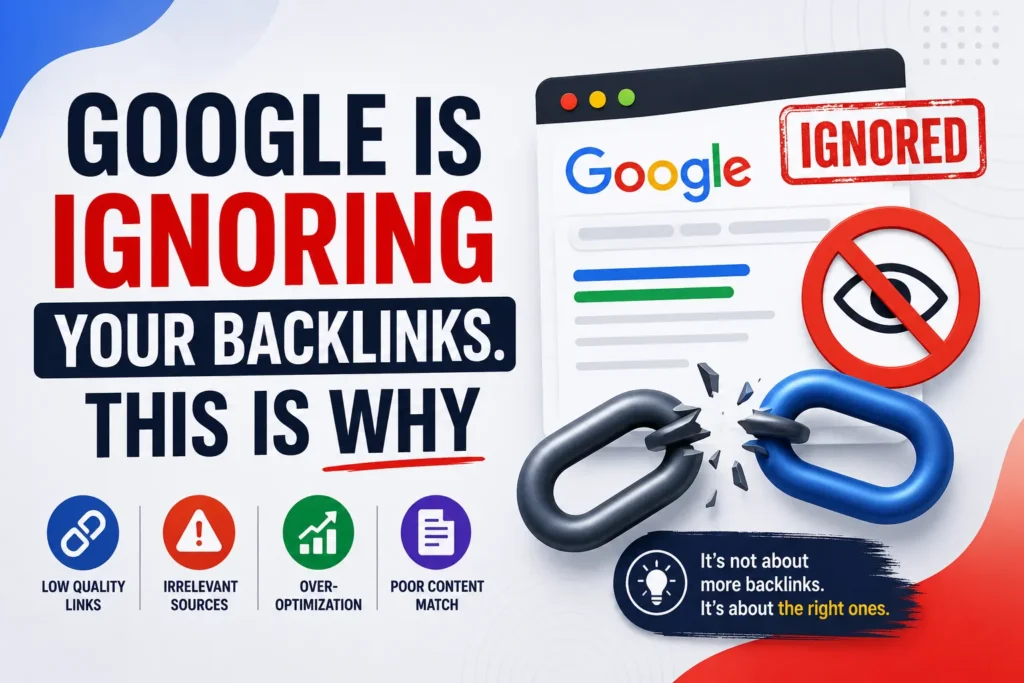
Why backlinks not working for your site usually falls into one (or several) of these root causes. Review each one honestly before drawing conclusions from your link data.
1. Your Links Come From Irrelevant Sites#
A link from a fashion blog to your B2B software company is essentially worthless in 2026. Google’s ranking framework now weights topical alignment and editorial placement far above domain authority scores. One strong, contextually relevant link from a respected industry publication is worth more than 50 generic directory placements.
2. You Are Relying on Duplicate Domain Links#
Why backlinks not working often traces back to a simple counting problem. Analysis of 11.8 million Google search results confirms that the number-one result has roughly 3.8x more referring domains than positions two through ten – not more total links. A single domain linking to you 50 times adds almost no incremental value after the first or second link.
3. Your Anchor Text Is Over-Optimised#
Why backlinks not working can come down to a pattern that appears in just a few words. Using exact-match keywords in the majority of your backlinks is a manipulation signal that modern algorithms are specifically trained to detect. Natural anchor text profiles mix branded terms, generic phrases, partial matches, and bare URLs. If 60% of your anchors say “best SEO agency in Mumbai,” that is a red flag – not a ranking advantage.
4. Google Has Algorithmically Devalued Your Links#
Why backlinks not working can sometimes be invisible in your toolset. Algorithmic devaluation means Google simply discounts spammy links automatically without any notification in Search Console. You will not receive a warning. Your Search Console will show no manual action. Your rankings will simply plateau or decline – and your auditing tools will still show those links as “active.”
5. You Built Links Faster Than You Built Authority#
Why backlinks not working is frequently a sequencing problem. Google expects link growth to reflect real-world interest in your content and brand. A sudden 20% or greater jump in new referring domains within a single month triggers pattern recognition in Google’s systems. Organic growth that mirrors genuine audience engagement is what earns trust – not bulk outreach campaigns.
6. Your Site Lacks Topical Authority#
Why backlinks not working becomes clearer when you zoom out. Topical authority is now Google’s primary trust signal for relevance and sustained rankings. If your site does not demonstrate deep, comprehensive coverage of your niche – through content clusters, internal linking, and consistent publishing – even strong inbound links fail to convert into rankings. Google’s March and April 2026 core updates specifically re-weighted topical coherence and content originality.
People Also Ask: Does topical authority matter more than backlinks in 2026? Short Answer: For sustained rankings, yes. Topical authority is now the foundation Google builds trust upon. Backlinks amplify authority you have already established – but they cannot create it from scratch.
Why Is This Topic So Important in 2026?#
Why backlinks not working has become so critical because the SEO industry is at an inflection point. The most influential SEO factors in 2026 are E-E-A-T signals, topical authority, Core Web Vitals performance, content comprehensiveness, and AI-citation-ready structure – not raw link counts.
Here is why this matters beyond rankings:
- AI Overviews and Generative Search are now primary touchpoints for users. These systems cite sources based on topical depth and authority – not link profiles.
- Budget misallocation is a real risk. Teams spending thousands per month on link acquisition may be generating zero ROI if those links are being ignored.
- Recovery is slow. Once you have built a link profile full of algorithmically devalued links, cleaning it up is a multi-month project with no guaranteed timeline.
At Search Savvy, we consistently advise clients to audit link quality before scaling quantity. A smaller, cleaner, more topically coherent link profile almost always outperforms a large, diluted one.
How Can You Tell If Google Is Ignoring Your Backlinks?#
Why backlinks not working becomes diagnosable once you know what to look for. Here are the signals worth monitoring:
- Flat or declining organic traffic despite a growing referring domain count
- No ranking improvements after securing new placements on high-DA sites
- Search Console showing steady impressions but no CTR improvement
- Linking domains with no topical overlap making up the majority of your profile
- Anchor text reports showing exact-match keyword concentration above 30–40%
Use tools like Google Search Console, Ahrefs, or Semrush to run a full referring domain audit. Look at the actual content of linking pages, not just their DA scores. Relevance is the filter Google applies – your audits should apply it too.
People Also Ask: How do I know if my backlinks are being ignored by Google? Short Answer: Watch for stagnant rankings despite growing link counts, no organic traffic movement, and a link profile dominated by irrelevant or low-context domains. Google does not notify you when it devalues links – you infer it from the absence of results.
What Should You Do Instead? The 2026 Link Strategy That Actually Works#
Why backlinks not working is only half the story. The more important question is: what does work?
Here is what the data points to in 2026:
Focus on editorial relevance first. Earn links from publications that genuinely cover your topic area. A link in an article written specifically about your niche, from an author with demonstrated expertise, carries exponentially more weight than a link in a generic roundup.
Build topical authority through content clusters. Websites that establish topical authority rank 3–5x faster for new keywords within their topic cluster. Build pillar pages and supporting articles before you build outbound relationships.
Diversify your link sources naturally. Aim for a link profile where no single domain accounts for a disproportionate share of your backlinks. Prioritise diversity of referring domains over volume from the same sources.
Strengthen E-E-A-T signals. In 2026, E-E-A-T SEO is the foundation of sustainable rankings. This means named authors with demonstrable expertise, transparent sourcing, real credentials, and a brand presence that extends beyond your own website.
Use digital PR over traditional link building. Coverage in credible news outlets, industry journals, and authoritative platforms earns the kind of links Google trusts – because they reflect genuine real-world relevance.
At Search Savvy, our recommended approach is always: build content authority first, then amplify it with strategically earned links. The era of buying your way to the top is effectively over.
FAQ: Why Backlinks Not Working – Common Questions Answered#
Q1: Why are my backlinks showing in Ahrefs but not improving my rankings? A: Ahrefs tracks all detected backlinks – Google evaluates and weights them separately. A link that appears healthy in a third-party tool may be algorithmically devalued or ignored by Google if it lacks topical relevance, appears in a link network, or displays unnatural patterns. Tool data and Google’s actual signals are not the same thing.
Q2: Should I use Google’s Disavow Tool if my backlinks aren’t working? A: Probably not immediately. Since Penguin 4.0 (2016), Google automatically ignores most low-quality links. The Disavow Tool is recommended only if you have received a manual action in Search Console, have a legacy history of paid link schemes, or are experiencing a confirmed negative SEO attack. Using it incorrectly risks disavowing links that were actually helping you.
Q3: How long does it take for Google to recognise new backlinks? A: Googlebot typically discovers and indexes new backlinks within days to a few weeks, depending on the crawl frequency of the linking domain. However, ranking impact – when it occurs – often takes 4–12 weeks to become visible. If you see no movement after three months, the link quality or contextual relevance is likely the issue.
Q4: Does the number of backlinks still matter in 2026? A: Volume matters far less than quality. The most actionable benchmark is referring domain diversity – how many unique, topically relevant domains link to you – not the total number of individual links. One high-quality referring domain typically outperforms 20 low-relevance ones in terms of ranking impact.
Q5: Can social media shares and brand mentions replace backlinks? A: Not directly – brand mentions and social signals are not confirmed ranking factors in the same way backlinks are. However, they contribute to brand authority and can lead to organic link acquisition when your content reaches the right audiences. They are valuable, but they are a complement to a solid link strategy, not a replacement.
Q6: Is it still worth investing in link building in 2026? A: Yes – but the investment needs to be in quality, not quantity. Focus your budget on digital PR, topically aligned editorial outreach, and genuine relationship-building within your industry. The return on a well-placed editorial link from a credible source compounds over time in a way that bulk link packages never will.