Information Gain Is Google’s New Ranking Signal. Your Content Strategy Needs a Rewrite
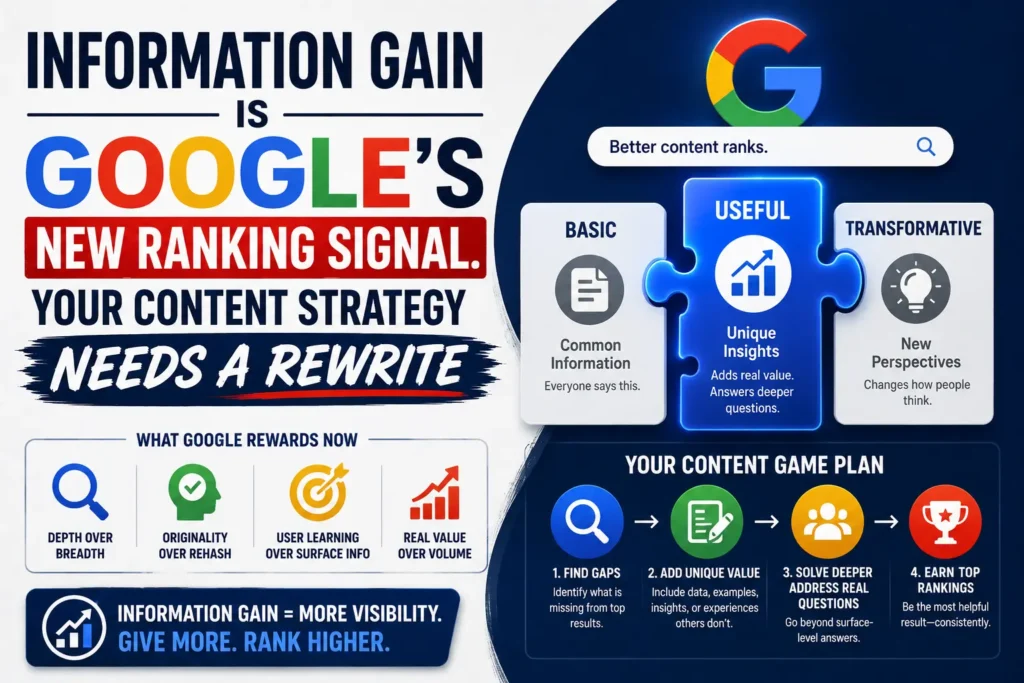

Information gain SEO is the concept that is separating the winners from the losers after Google’s March 2026 Core Update – and almost no one is optimising for it deliberately. If you are still producing content by looking at what ranks, matching the format, covering the same subtopics, and making yours “better” by making it longer – you are following advice that is now actively dangerous. That playbook was the dominant SEO strategy for a decade. In April 2026, it is one of the fastest ways to lose rankings.
In this article13 sections
The March 2026 Core Update data is unambiguous. Sites publishing original research, proprietary data, and first-hand case studies gained 15–25% in organic visibility. Sites running templated, rewritten content dropped 30–50%. Generic AI content farms lost 60–80% of their visibility. The Semrush Sensor peaked at 8.7/10 – higher than the August 2024 Core Update – marking one of the sharpest quality-driven reshuffles in recent algorithm history.
At Search Savvy, this is the shift that underpins every content recommendation we make in 2026. Not keyword density. Not content length. Not topical cluster architecture, though that still matters. The primary filter Google’s systems now apply to content quality is this: Does this page tell me something I cannot already find expressed in identical or near-identical form across the thousands of pages that already cover this topic?
If the answer is no – even for well-written, well-structured, technically-sound content – the information gain score is low, and the ranking ceiling is hard.
What Is Information Gain SEO and How Does It Work?#
Information gain SEO is built on a precise, technical concept: the measure of genuinely new, unique, and verifiable insight your content adds to the existing web. It is not a measure of length, keyword density, or comprehensiveness in general terms. It is a measure of whether your content introduces original data, first-person observations, or non-obvious conclusions that are not already present in similar or identical form across competing pages.
Google’s systems compare your content against the existing corpus of documents that rank for the same queries. They assess what a user who has already read the top five results would learn from your page that they could not have learned from those other five pages. If the answer is nothing materially different – your information gain score is effectively zero.
This is not a 2026 invention. Google has held a patent on this concept since 2018, titled “Contextual Estimation of Link Information Gain” (US10776471B2), granted in 2022. The patent describes a machine learning model that calculates how much additional information a document provides beyond what is already known from the documents that precede it in a result set.
What changed in March 2026 is the weight. Information gain was always one quality signal among many. The March 2026 Core Update – completed April 8 – moved it from a secondary signal to the dominant content-quality evaluator. It is now operational at scale across essentially every English-language query. And it is the natural counter-weight to the AI-content saturation that reached its peak in late 2025: paraphrasing, by definition, generates zero new information, so zero information gain.
Why Did Google Make Information Gain the Dominant Signal in 2026?#
Information gain SEO became the primary quality evaluator because Google’s existing signals were no longer sufficient to distinguish genuinely valuable content from well-structured repetition.
By late 2025, a significant share of newly published content across the web was AI-paraphrased – competently written, technically correct, E-E-A-T signals artificially boosted, but offering nothing that the top five ranking pages had not already said. Traditional quality signals – topic coverage, keyword relevance, backlink profiles, page experience – could not cleanly separate this content from the genuinely original work it was imitating.
Information gain is the counter-weight that those other signals cannot replicate. A model trained to recognise novelty can detect the difference between a page that introduces an original dataset and a page that restates what everyone else already knows – regardless of how polished the prose is.
Google’s March 2026 Core Update elevated this signal at the same time as two other ranking priorities:
- Author expertise – whether the person behind the content has a verifiable track record in the subject area that E-E-A-T signals can confirm across multiple platforms
- Topical coherence – whether the domain has earned consistent authority within a defined subject area over time, rather than opportunistically publishing across many unrelated topics at shallow depth
Information gain SEO, author expertise, and topical authority are not separate strategies in 2026. They are three dimensions of the same quality framework – and all three were re-weighted simultaneously in the March update.
What Are the Five Dimensions of Information Gain That Google Rewards?#
Information gain SEO can be operationalised through a five-dimension rubric that maps onto the signals Google’s systems evaluate. According to analysis of the March 2026 update’s winners and losers, the pages that gained visibility shared these five characteristics:
Dimension 1: Proprietary Data (0–2 points)#
Information gain SEO rewards content built on data that no one else can replicate because you collected it. Survey results from your own customers. Analytics data from your own campaigns. Benchmark numbers from your own testing. Even small proprietary datasets – a survey of 50 practitioners, a comparison of performance data across 20 client accounts, a before/after measurement from your own implementation – provide information gain that no amount of competitor research synthesis can match.
Score 2: Original dataset with specific numbers, methodology, and sample size. Score 1: Aggregated third-party data with original interpretation or categorisation. Score 0: Restated statistics from other sources with no original framing.
Dimension 2: First-Hand Evidence (0–2 points)#
Information gain SEO values the direct account of someone who has done the thing. Not “here is how you might approach this.” Not “experts recommend this approach.” The specific, dated, described experience of encountering a real problem and navigating it. Screenshots. Error messages. Decisions made. Outcomes measured. Client examples – even anonymised – with enough specific detail to distinguish them from a hypothetical.
Score 2: Named or clearly detailed first-hand case study with specific outcome data. Score 1: General personal experience without specific outcome metrics. Score 0: Third-person hypothetical or synthesised practitioner advice.
Dimension 3: Original Framework (0–2 points)#
Information gain SEO rewards named, original conceptual structures – ways of thinking about a problem that didn’t exist before you named and described them. A framework is not a list of tips. It is a repeatable process with named stages, clear decision points, and a logic that the reader can apply to their own situation. Original frameworks are highly citeable by both human editors and AI systems because they introduce a concept that can be attributed to a specific source.
Score 2: Named, original framework with clear stages and replication logic. Score 1: Original structure without formal naming or replication guidance. Score 0: Standard industry structure restated in new language.
Dimension 4: Expert Attribution (0–2 points)#
Information gain SEO rewards content whose authorship is verifiable and whose expertise is externally confirmable. Not just a name in an author bio – a named author with a visible professional history, credentials, published work, or client outcomes that a third party can independently verify. The expert attribution dimension connects directly to E-E-A-T: the more verifiable the expertise, the higher the confidence score the content earns from AI evaluation systems.
Score 2: Named expert with verifiable credentials, external profile links, and demonstrable track record. Score 1: Named author with some external presence but limited verifiable expertise signals. Score 0: Anonymous or clearly non-expert authorship.
Dimension 5: Freshness Hook (0–1 point)#
Information gain SEO rewards content anchored to current conditions. A freshness hook is a specific, dated reference that connects your content’s insights to the present moment – a recent study, a current platform update, a 2026 statistic, a recent case outcome. The freshness hook signals that the content is not a timeless evergreen piece (which may have lower information gain against an already-saturated topic) but a current, updated, or forward-looking perspective that captures conditions competitors have not yet addressed.
Score 1: Specific dated reference to current events, data, or conditions within the content. Score 0: No temporal anchor; could have been written at any point in the last two years.
Total possible score: 9 points. The 2026 threshold: Ship only pages scoring 7 or above. Content scoring below 7 has a high probability of being treated as low information gain and ranking poorly regardless of other optimisation factors.
How Do You Audit Your Existing Content for Information Gain in 2026?#
Information gain SEO auditing is a specific workflow that differs fundamentally from traditional content audits. A traditional content audit asks: Is this page optimised for the right keyword? Does it cover the topic comprehensively? Does it have the right word count? An information gain audit asks: What does this page say that the top five ranking pages for this query do not already say?
The practical steps:
Step 1: The Gap Read Select your most important content pages – prioritise those with high impressions but declining clicks, or pages where you are ranking 8–15 and want to move up. For each page, read the top three currently-ranking competitor pages for the same target query. Do not skim them. Read them. Then read your page.
Ask one question: What specific insight, data point, or framework does my page provide that a reader of those three pages would not already have?
If you cannot identify something specific, your information gain score for that page is close to zero – regardless of how well-written it is.
Step 2: The Dimension Scoring Apply the five-dimension rubric to each priority page. Score honestly. A page with a total score below 7 is a candidate for rewrite or consolidation, not minor optimisation.
Step 3: The Rewrite Decision Pages scoring 3 or below are typically better consolidated into higher-value pages or replaced with genuinely original content. Pages scoring 4–6 can be improved through targeted additions – adding one original dataset, conducting one customer interview, or developing one named framework based on your existing experience.
Step 4: The Competitive Differentiation Audit For your highest-priority pages, identify the single “insight gap” – the specific question the top-ranking content does not answer, the specific data point no existing page contains, the specific perspective no current author brings. That insight gap is your information gain opportunity for that page.
At Search Savvy, the information gain content audit is now the primary lens through which we evaluate content performance – because it is the lens Google’s systems are now applying at scale.
What Types of Content Generate High Information Gain in 2026?#
Information gain SEO is not industry-specific or format-specific. It rewards a specific type of knowledge contribution that can come from any brand willing to document what they actually know from doing their work. These are the content types that consistently score high on the information gain rubric:
1. Original research and surveys Your own data, collected from your own audience or customer base, about a question that the existing published research does not specifically address. Even a sample of 50–100 responses from the right population is more valuable for information gain than restating Gartner or HubSpot data for the 10,000th time.
2. Documented case studies with specific outcomes Real client or customer stories with specific before/after metrics. The specificity is what generates information gain – not just “we helped a client improve their rankings” but “a Bengaluru-based D2C brand with 15,000 monthly organic sessions improved their category page rankings from position 14 to position 4 within 90 days by implementing these three changes.”
3. First-person implementation accounts Step-by-step documentation of actually doing something – including what went wrong, what surprised you, and what you would do differently. The friction and specificity of a real implementation account is irreplicable by paraphrase.
4. Named frameworks with replication logic Conceptual structures you have developed through repeated professional experience and formalised into a named process. The naming matters – it makes the framework attributable, citable, and searchable in ways that an unnamed “here’s how we approach this” description is not.
5. Contrarian positions backed by specific evidence A data-supported case that a widely-held belief in your industry is incorrect, incomplete, or context-dependent. Not hot-takes or provocation for its own sake – but a clearly argued, specifically evidenced position that the mainstream coverage of a topic has not explored.
How Does Information Gain SEO Connect to AI Overview Citation in 2026?#
Information gain SEO is not only a traditional search ranking signal in 2026. It is also the primary filter that determines whether your content is selected as a citation source by AI systems.
Google AI Overviews, ChatGPT, and Perplexity are all citation-based systems – they do not synthesise from a generic knowledge base but pull from specific pages that they assess as credible, relevant, and informative. The AI citation decision is a retrieval confidence question: Can this source answer this query with high confidence and low risk of error?
High information gain content answers this question affirmatively on multiple dimensions:
- Proprietary data provides verifiable specificity that AI systems can cite with high confidence
- Named frameworks provide attributable concepts that AI systems can reference precisely
- Expert attribution signals trust and verifiability that increases AI citation confidence
- Freshness hooks signal current relevance, which AI systems favour for recent-conditions queries
The correlation between information gain signals and AI Overview citation rates is high because the same qualities that distinguish original content from paraphrased content are the qualities that make a source worth citing rather than just reading.
Content that scores high on the information gain rubric is – by design – the kind of content that AI systems are built to cite. Content that scores low is – by design – the kind of content that AI systems have no reason to cite, because it adds nothing to what they could synthesise from the pages that already rank above it.
FAQ: Information Gain SEO in 2026#
Q1: What is information gain in SEO? Information gain SEO is the measure of how much genuinely new, unique, and verifiable insight your content adds relative to what already ranks for the same query. Google’s systems compare your content against the existing corpus of pages covering the same topic and assess what a user who has read the top competitors would learn from your page that they couldn’t have learned elsewhere. High information gain content earns rankings and AI citations. Low information gain content – even if well-written – is treated as redundant and receives reduced visibility.
Q2: When did Google make information gain a major ranking factor? Google has held a patent on information gain as a concept since 2018 (US10776471B2, granted 2022). The March 2026 Core Update – completed April 8, 2026 – elevated it from one signal among many to the dominant content-quality evaluator, operational at scale across essentially all English-language queries. It was the natural response to the AI-paraphrased content saturation that reached its peak in late 2025. Sites with original research gained 15–25% visibility in the update; templated content dropped 30–50%.
Q3: Can AI-generated content score well on information gain? Yes – if it contains genuinely novel information. AI tools can assist in content production without destroying information gain, provided the content includes original data, frameworks, or first-hand perspectives that the AI is helping to communicate, not generating from scratch. AI-paraphrased content – which repackages existing information without adding anything new – scores zero on information gain by definition, because paraphrasing adds no new information to the information space the AI crawlers are evaluating.
Q4: What is the fastest way to improve information gain on an existing page? Conduct a Gap Read: read the top three competing pages for your target query, then identify one specific question they all leave unanswered or one data point none of them contain. Add your answer to that question – ideally backed by your own data, client experience, or directly observed outcome – to your page. A single well-documented proprietary data point or first-hand observation can move a page from a 4 to a 7 on the information gain rubric and meaningfully change its ranking trajectory.
Q5: Does information gain apply to short-form content, or only long-form pages? Information gain applies to content of any length. A 300-word page that introduces a genuinely original dataset or non-obvious conclusion scores higher than a 3,000-word page that thoroughly covers what every competitor has already covered. Length does not generate information gain; novelty does. In 2026, the publishing frequency strategy – “post three times a week” regardless of original value – is explicitly counterproductive. One high-information-gain post consistently outperforms fifty low-information-gain posts.
Q6: How does information gain SEO connect to E-E-A-T? Information gain and E-E-A-T are reinforcing dimensions of the same quality framework. E-E-A-T asks whether the content comes from a source with genuine experience, expertise, authoritativeness, and trustworthiness. Information gain asks whether the content adds genuinely new knowledge. A page with high information gain from a poorly credentialed source earns lower trust scores. A page from a highly credentialed source with zero information gain earns lower relevance scores. Google’s March 2026 Core Update elevated both signals simultaneously – because the highest-quality content in 2026 has both: it comes from genuinely expert sources and it says something those sources uniquely know that has not been said before.
The Bottom Line#
Information gain SEO is not a new tactic to bolt onto your existing content strategy. It is a fundamental reorientation of what content is for. The SEO that worked from 2015 to 2024 – identify a keyword, research what ranks, produce a better version – was always a commoditisation strategy. It worked when Google’s systems could not distinguish between the original and the copy. Google’s March 2026 Core Update confirmed that those systems can now make that distinction, reliably, at scale.
The content strategy that works in 2026 starts from a completely different question: What do we know from actually doing our work that nobody else has documented yet? That question leads to surveys, case studies, implementation accounts, and named frameworks. It leads to content that a competitor cannot replicate simply by reading it and rewriting it, because the information gain comes from doing the thing, not from describing what others have said about doing the thing.
The brands that build content libraries around that question will hold positions in both traditional search and AI citation systems that compound over time. The brands that continue producing well-optimised restatements of existing knowledge will find their floors getting lower with every core update.
According to Search Savvy’s content strategy practice, the highest-priority action for most brands right now is not to produce more content – it is to audit what they already have against the information gain rubric, identify the pages closest to the scoring threshold, and invest in the specific additions – one original dataset, one documented case study, one named framework – that move those pages from invisible to cited.If you want an information gain audit for your content library and a prioritised rewrite roadmap, get in touch with Search Savvy. We’ll tell you exactly which pages need to change, what kind of original content they need, and what the ranking impact is likely to be.