
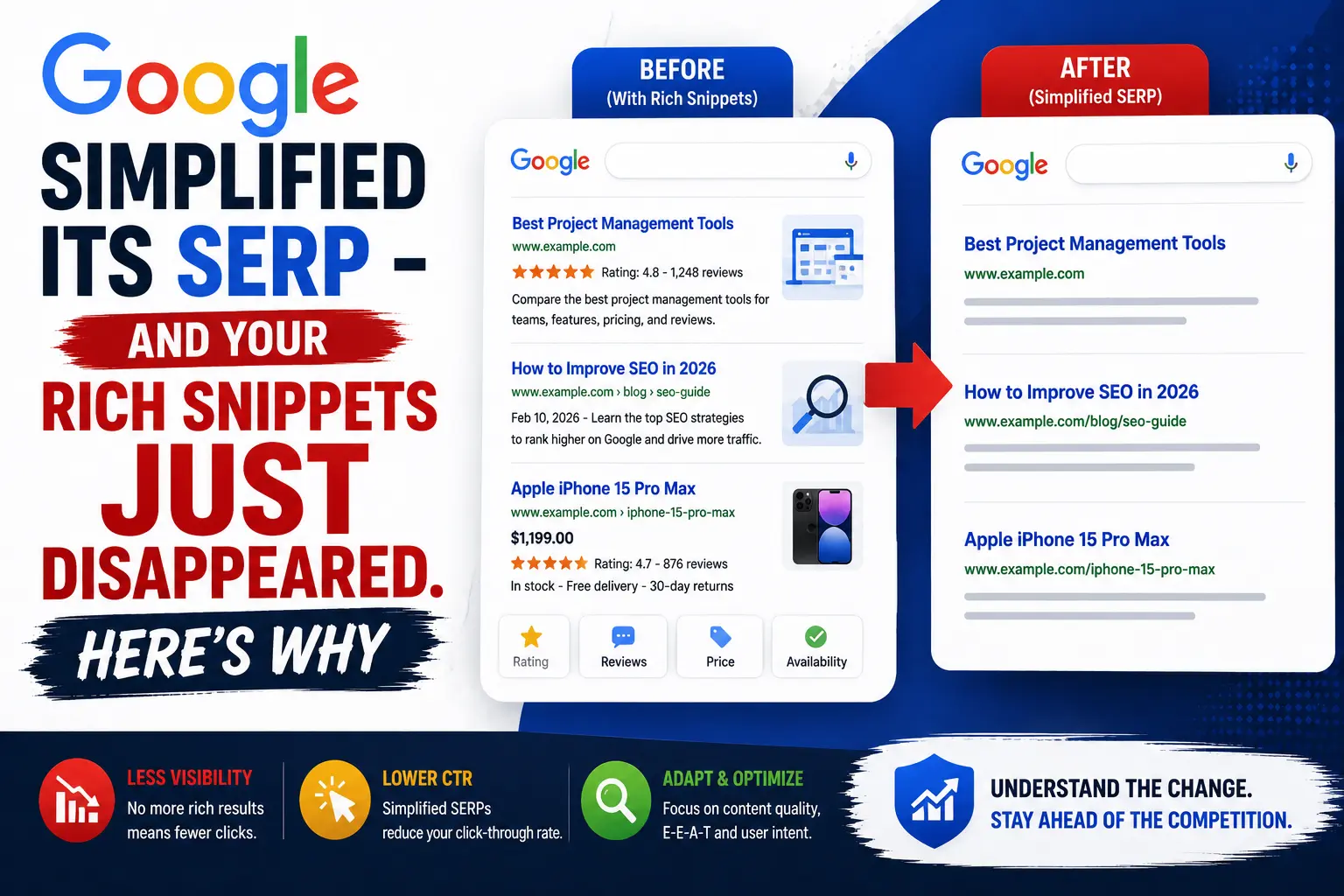

Google structured data simplification has been accelerating for two years – and if you logged into Search Console this month expecting to see your FAQ rich results report and found nothing, you are not alone. On May 7, 2026, Google officially ended FAQ rich results across all search surfaces. The expandable accordion that added several extra lines to your search listing – showing your questions and answers directly in the SERP – is gone. Not reduced. Not narrowed. Gone.
Search Console’s FAQ reporting ends in June 2026. API support ends in August 2026. If you have dashboards or reporting integrations that pull FAQ rich result data, they will break before the end of summer.
This is the second major act in a deliberate, multi-year simplification of Google’s rich result portfolio. HowTo rich results went first in 2023. FAQ rich results followed in 2026. And alongside those headline removals, Google has quietly retired seven other structured-data-driven SERP features – learning video enhancements, SpecialAnnouncement schema displays, automotive listing enrichments, nutrition facts panels, nearby offers and events, local bikeshare station status, and the TV season selector.
At Search Savvy, we want to be direct about what this change means – and what it doesn’t. The SERP feature is gone. Your structured data strategy is not. These are very different things, and conflating them leads to equally bad decisions in either direction: panic-removing all your schema, or ignoring the shift entirely.
What Is Google Structured Data Simplification and Why Is It Happening?
Google structured data simplification is Google’s deliberate, multi-year reduction of visual rich result formats in Search results pages. It is part of a broader SERP evolution: as Google’s AI systems become more capable of synthesising content into AI Overviews, the visual complexity of the traditional SERP has become counterproductive.
The reason is straightforward. For years, a single search results page could show featured snippets, AI Overviews, Knowledge Panels, video carousels, People Also Ask boxes, product listings, and FAQ accordion blocks simultaneously. The cumulative effect – especially when multiple results on the same page had FAQ dropdowns – was a cluttered, overwhelming page where individual results were harder to scan.
As Google’s own documentation framed the 2023 decision to narrow FAQ visibility: too many pages were deploying FAQ schema as a SERP real estate strategy – a way to make a listing physically larger – rather than as genuine Q&A content for users. The result was a SERP full of low-quality accordion content that degraded the experience.
The 2026 removal completes that pattern. John Mueller confirmed the removal represents “a visual and functional refinement, not an algorithmic penalty.” Sites using deprecated schema won’t see ranking drops. This is about SERP presentation – not about organic ranking or content quality evaluation.
Understanding this is critical: Google structured data simplification removed a display feature, not a ranking signal. Those are different things.
What Exactly Changed on May 7, 2026 – and What Comes Next?
Google structured data simplification reached a new milestone on May 7, 2026. Here is the complete, confirmed timeline:
May 7, 2026: FAQ rich results stop appearing in Google Search on all surfaces and all devices. The expandable accordion that showed questions and answers beneath your search listing no longer displays – for any website, any schema implementation, any query type.
June 2026: The FAQ rich results report in Search Console is retired and removed from the Rich Results Test tool. From this point forward, you cannot check FAQ schema implementation through Google’s official tools.
August 2026: Search Console API support for FAQ rich results data ends. Any reporting integrations pulling FAQ structured data from the API must be updated before this date.
Also confirmed (from the schema.org v30.0 update and Google I/O 2026):
- HowTo rich results are fully retired – no display on any surface as of May 2026 (following their August/September 2023 retirement from mobile and desktop respectively)
- Both FAQPage and HowTo schema types remain valid at schema.org – they produce no validator errors – but they now produce zero visible SERP enhancements from Google
- The FAQPage schema type continues to be parsed by AI crawlers including GPTBot, PerplexityBot, and Google’s AI Overview systems
- Google has confirmed: “Structured data that’s not being used does not cause problems for Search”
The historical context matters here. When Google first narrowed FAQ rich results in August 2023, SISTRIX reported that almost half of FAQ snippets had already disappeared by mid-June that year, with the rest following shortly after. For most commercial websites, the 2023 change had already eliminated FAQ rich results three years ago. The May 2026 announcement finished the job for the last remaining category – primarily government and official health sites – that retained eligibility after 2023.
What Did Google Remove and What Is Still Supported in 2026?
Google structured data simplification has produced a substantially leaner rich result portfolio. Understanding exactly what is gone versus what remains – and what still delivers value for AI and traditional search – is the core strategic question.
Confirmed Removed in 2025–2026
| Schema Type | Rich Result Status | Year Removed |
| FAQPage | No SERP display | May 2026 |
| HowTo | No SERP display | Aug/Sep 2023 (finalised 2026) |
| SpecialAnnouncement | No SERP display | 2025 |
| Learning Video enhancements | No SERP display | 2025 |
| Automotive listings (enriched) | No SERP display | 2025 |
| Nutrition facts panels | No SERP display | 2025 |
| Nearby offers & events | No SERP display | 2025 |
| Local bikeshare station status | No SERP display | 2025 |
| TV Season Selector | No SERP display | 2025 |
Still Fully Active in 2026
| Schema Type | Rich Result Status | Value Delivered |
| Product (with Merchant Feed) | Active | Shopping results, price, availability |
| Review / AggregateRating | Active | Star ratings in search listings |
| Article / NewsArticle | Active | Top Stories, date display, author |
| Recipe | Active | Recipe cards with image, time, rating |
| Event | Active | Event rich results with date/location |
| JobPosting | Active | Job listing display in search |
| VideoObject | Active | Video thumbnails and duration |
| BreadcrumbList | Active | URL breadcrumb display in results |
| LocalBusiness | Active | Local Pack, Knowledge Panel signals |
| Organization | Active | Knowledge Panel, AI entity recognition |
| Person | Active | Author entity, AI citation signals |
| Course | Active | Course listing enhancements |
The pattern in the removed list is visible immediately: Google removed schema types that were being abused as visual SERP real estate tools – ways to make a listing larger without adding genuine informational value that justified that space. The retained list is weighted toward types where the structured data directly enables a useful, non-gameable display format (a recipe card with cooking time, a star rating from genuine reviews, a video thumbnail with duration).
Why Did Google Remove FAQ Rich Results Specifically?
Google structured data simplification targeted FAQ rich results for several compounding reasons that accumulated over their seven-year history:
Reason 1: SERP Clutter Reached a Visual Breaking Point
Multiple results on the same page each carrying three to five expandable FAQ items created an accordion-stacked SERP that was genuinely harder to use than a clean listing page. When the feature designed to improve user experience begins to degrade it, removal becomes the logical outcome.
Reason 2: The Quality Problem Was Structural
FAQ rich results were used primarily as a SERP space strategy. Websites added FAQ sections not because their users needed Q&A format content but because accordion blocks made their search listings larger and pushed competitors lower. Google’s quality raters consistently flagged FAQ content that was not genuinely helpful – generic questions, obvious answers, or content that duplicated the page’s main text.
Reason 3: AI Overviews Made the Feature Redundant
This is the most important strategic reason. Google structured data simplification is happening in the context of an AI-first SERP redesign. AI Overviews – appearing in approximately 48% of all searches as of May 2026 – already answer the questions that FAQ rich results were designed to surface. An expandable FAQ block below a blue link competes with the AI-generated summary above it. As AI Overviews expand in scope and quality, the traditional FAQ accordion becomes increasingly redundant as a user experience feature.
Reason 4: The Schema Was Being Deployed Incorrectly
A significant portion of FAQPage schema on the web was implemented incorrectly – schema in JSON-LD that didn’t match the visible page content, answers that existed only in the schema but not in the page HTML, or FAQ schema deployed on pages where there was no genuine question-and-answer content. Google’s structured data policies prohibit this practice, and enforcement through removal is more practical than policing millions of individual implementations.
What Does This Mean for Your Existing Schema Strategy?
Google structured data simplification does not mean structured data has become less important. It means the purpose of structured data has fundamentally shifted – and the teams that understand this shift will have a significant advantage over those still treating schema as a SERP features checklist.
Before 2023: Schema markup → SERP visual enhancements → more clicks from larger listings.
2026 and forward: Schema markup → machine-readable content signals → AI Overview citations, Knowledge Graph entity recognition, AI chatbot citability.
In March 2025, both Google and Microsoft publicly confirmed they use schema markup for their generative AI features. ChatGPT confirmed it uses structured data to determine which products and sources appear in its results. Microsoft confirmed at SMX 2025 that schema markup helps its LLMs understand and cite content.
The use case changed. The value did not.
According to Search Savvy’s structured data strategy framework for 2026, the shift requires three specific recalibrations:
Recalibration 1: Stop measuring schema ROI by rich result appearances If you have been tracking the number of FAQ rich results your pages earn as a schema performance metric, that metric is now meaningless. Replace it with AI Overview citation frequency, featured snippet appearances, and presence in People Also Ask boxes.
Recalibration 2: Prioritise entity schema over display schema Organization, Person, and LocalBusiness schema – which tell AI systems who you are rather than just what your content says – are now the most strategically important schema types in most accounts. These types directly influence Knowledge Panel eligibility, AI Overview citation trustworthiness, and the entity resolution that determines whether AI systems treat your brand as a verified source.
Recalibration 3: Keep FAQPage schema for AI citation value, not SERP display value FAQPage schema still delivers a 3.2x multiplier on AI Overview eligibility and a median 22% citation lift in AI-generated search results. The display feature is gone. The AI citation benefit is not. Keeping FAQPage schema on pages with genuine Q&A content costs nothing and continues to provide AI visibility value across ChatGPT, Perplexity, and Google’s AI systems.
What Should You Actually Do With Your Schema After These Changes?
At Search Savvy, the post-simplification schema action plan we recommend is ordered by impact and urgency:
Immediate actions (before June 2026):
- Export your Search Console FAQ rich results data before the June 2026 report retirement – this historical data shows which pages had active FAQ schema and may have been generating click-through lift from the accordion display
- Audit your schema inventory – run a crawl with Screaming Frog or Sitebulb to produce a complete list of every schema type deployed across your site
- Update Search Console API integrations before August 2026 to prevent reporting breakage
Schema types to prioritise (high AI visibility value, still supported):
- Organization schema with SameAs links to Wikidata, LinkedIn, and Crunchbase – the highest-leverage entity signal for AI citation eligibility
- Article / BlogPosting schema with named author (linked to Person schema) – critical for E-E-A-T signals and editorial authority
- Product schema with complete offers, aggregateRating, and image – especially important as AI shopping agents become mainstream
- LocalBusiness schema for businesses with physical locations – significant Local Pack and AI local query value
- BreadcrumbList schema – actively displayed in search results, low implementation cost, high structural clarity benefit
Schema types to maintain without expectation of SERP display:
- FAQPage schema – keep it where genuine Q&A content exists; the AI citation benefit justifies the implementation cost even with zero SERP display
- HowTo schema – same logic; valid schema.org type with AI parsing value despite zero Google SERP display
Schema types to audit and potentially remove:
- Any SpecialAnnouncement, LearningResource video enrichment, or automotive listing schema from the removed list – these produce no SERP value and add page weight for no benefit
- FAQPage schema on pages where the Q&A content is not genuinely present and visible in the HTML – this creates a content/schema mismatch that violates Google’s policies
How Does This Connect to AI Overview Optimisation in 2026?
Google structured data simplification is the SERP-facing consequence of the same underlying shift that is driving AI Overview expansion: Google is moving from a visual, click-based search model to an AI-mediated answer model.
The two changes are interconnected:
- FAQ rich results removed because AI Overviews answer the same questions more efficiently
- HowTo rich results removed because AI Overviews synthesise how-to guidance directly
- Structured data retained because AI systems need machine-readable signals to know which sources to trust and cite
The entities and schema types that tell AI systems who you are and what you are authoritative about – Organization, Person, Article, LocalBusiness – are the ones Google’s AI citation systems weight most heavily. The schema types that were primarily about making listings larger are the ones being retired.
This is not a coincidence. It is Google’s AI-first SERP architecture being built in stages – each stage reducing the old visual features and expanding AI-mediated answer surfaces.
FAQ: Google Structured Data Simplification in 2026
Q1: Did Google remove FAQ schema entirely in 2026? No – Google removed the FAQ rich results display feature, not the FAQPage schema type itself. As of May 7, 2026, FAQ rich results (the expandable accordion under search listings) no longer appear in Google Search. However, FAQPage schema remains a valid schema.org type, continues to be parsed by Google’s AI systems, and continues to be used by AI crawlers including GPTBot and PerplexityBot. FAQPage schema delivers a 3.2x multiplier on AI Overview eligibility. The visual SERP feature is gone; the AI citation value remains.
Q2: Should I delete my FAQPage schema after the May 2026 change? Only if the FAQ schema does not match genuine Q&A content visible in your page HTML. Google has confirmed that structured data not being used for rich results does not cause problems for Search. FAQPage schema that accurately reflects real question-and-answer content on your page retains AI citation value and should be kept. FAQPage schema that doesn’t match visible content, or that was added purely for SERP display purposes on pages with no genuine Q&A content, should be removed to avoid policy violations.
Q3: Why did Google remove FAQ rich results? Google’s structured data simplification removed FAQ rich results primarily because the feature was being widely abused as a SERP real estate strategy – making listings physically larger without adding genuine user value. Additionally, as AI Overviews now answer questions directly above organic results, the FAQ accordion had become functionally redundant for most queries. Mueller confirmed the change is a “visual and functional refinement, not an algorithmic penalty.”
Q4: What happens to Search Console FAQ reporting in 2026? The FAQ rich results report in Search Console was retired in June 2026 following Google’s May 7 SERP removal announcement. Support in the Rich Results Test tool was also removed in June. Search Console API support for FAQ rich results data ends in August 2026 – any reporting integrations or dashboards pulling FAQ rich results data must be updated before that date. Export historical FAQ data from Search Console before June if you want to retain the performance record.
Q5: What structured data types still produce visible SERP enhancements in 2026? The schema types with active SERP display support in 2026 include: Product (with shopping feed), Review/AggregateRating, Article/NewsArticle, Recipe, Event, JobPosting, VideoObject, BreadcrumbList, LocalBusiness, and Sitelinks Search Box. Organization and Person schema do not produce visible SERP display but are critical for Knowledge Panel eligibility and AI citation signals. The full list of supported types is maintained in Google’s Rich Results documentation.
Q6: Is structured data still worth investing in after Google simplified its SERP? Absolutely – but the strategic rationale has shifted. Before 2023, schema’s primary value was visible SERP enhancements (larger listings, star ratings, expandable accordions). In 2026, the primary value is AI visibility: Google, Microsoft, and ChatGPT have all confirmed they use structured data for generative AI features. Pages with FAQPage schema are 3.2x more likely to appear in AI Overviews. Organization schema with SameAs links drives Knowledge Graph entity recognition that determines AI citation trustworthiness. Structured data is more valuable than ever – just for a different job than the one most teams have been using it for.
The Bottom Line
Google structured data simplification is not the end of schema strategy. It is the end of schema as SERP real estate manipulation – and the beginning of schema as AI visibility infrastructure.
The FAQ accordion that added visual bulk to your search listing is gone. The structured signal that tells AI systems your content contains authoritative answers to specific questions is not. FAQPage schema continues to deliver measurable AI citation lift. Organization and Person schema continue to determine whether AI systems treat your brand as a verified, trustworthy entity. Product, Article, and LocalBusiness schema continue to drive the SERP features that are still active.
What changed is the measurement framework. If you were tracking schema success by counting rich result appearances in Search Console, you were measuring a channel that was already narrowing since 2023. The teams that recognised this shift early started measuring AI Overview citation rates, entity recognition strength, and AI search share of voice – the metrics that reflect where schema’s value actually lives in 2026.
The simplification is not done. Based on the pattern established by HowTo (2023) and FAQ (2026), further rich result categories may follow as Google’s AI Overview coverage expands. The correct response is not to disinvest from schema – it is to invest in the right schema types for the right reasons.
According to Search Savvy’s structured data audit practice, the schema types with the most underinvested value across Indian and international brand websites right now are Organization (with entity links), Person (for author attribution), and LocalBusiness (for AI local query visibility). These are the areas where implementation effort delivers the clearest, most measurable AI visibility returns in 2026.
If you want a structured data audit that shows exactly which schema types on your site are earning AI citation value and which are noise, reach out to the Search Savvy team.