What Is Topical Authority and How to Build It Fast

Topical Authority is the concept that changed everything about how SEO works in 2026 – and most businesses still don’t know it exists. It’s the reason a brand-new website with zero backlinks can outrank a domain that’s been publishing content for a decade. It’s why one well-structured content ecosystem consistently beats 200 scattered blog posts. And it’s the primary reason your competitors are pulling ahead in search rankings even when their domain authority scores are lower than yours. At Search Savvy, we’ve seen this play out across hundreds of client campaigns: the sites that win in 2026 are not the biggest sites. They’re the most specifically authoritative sites – the ones Google and AI engines trust as the definitive resource on a focused topic. This guide explains exactly what topical authority is, why it matters more than ever in 2026, and the step-by-step process to build it faster than your competitors expect.
In this article20 sections
What Is Topical Authority – and How Is It Different From Domain Authority?#
Topical Authority means becoming the most comprehensive, structured, and useful resource on a very specific subject – to the point where Google treats your site as the default authority for that topic. It’s measured not by the strength of your backlink profile, but by the depth and coherence of your content coverage across an entire subject area.
Domain authority (DA) is a metric invented by Moz to estimate a site’s overall ranking potential based on its backlink profile. It’s a proxy for trust built through links. Topical authority, by contrast, is Google’s internal assessment of how completely your site covers a topic – built through content breadth, content depth, and the semantic coherence of your internal structure.
According to a SearchAtlas analysis of 400+ SEO campaigns, sites focusing on topical authority first see ranking gains up to 3x faster than those chasing domain authority through link building alone. In 2026, most websites achieve faster and more sustainable results by building at least 25–30 high-quality, interlinked articles within a single content cluster before investing heavily in link acquisition.
One striking real-world example: a niche site stuck at 5,000 monthly visitors despite publishing 200+ scattered articles shifted to a topical authority strategy using content hubs and semantic SEO – and reached 180,000 monthly organic visitors in 14 months without building a single new backlink. That’s the compounding power of topical authority done right.
Why Is Topical Authority So Critical in 2026?#
Topical Authority has become the dominant ranking signal in 2026 for three compounding reasons:
1. Google’s Algorithm Now Evaluates Topic Coverage, Not Just Keywords#
Topical authority is rewarded by Google’s Helpful Content system, which evaluates whether your site answers not just one query, but all connected questions users may have around a topic. Publishing random articles across unrelated subjects weakens trust. Demonstrating comprehensive coverage of a single topic builds it.
Google uses entity-based retrieval and semantic analysis to assess topical authority – evaluating the entire content ecosystem of a site, not individual pages. A site with 20 interconnected articles on a topic will consistently outrank a site with one 5,000-word guide, even if the single article is technically superior on its own.
2. Websites With Strong Topical Authority Rank Faster, With Fewer Links#
Topical authority compounds rankings – each new page added to a cluster strengthens the entire ecosystem. When your site is trusted for a topic, new pages rank faster and with fewer backlinks than they would on a site without that established authority. Older pages gain additional stability as new cluster content reinforces their relevance. The competitive moat widens over time.
3. Topical Authority Directly Feeds AI Search Visibility#
Topical authority is now a critical AI search signal. Semrush research confirms that AI Mode and LLMs pull data straight from Google’s top 10 results – meaning sites that rank well due to topical authority are simultaneously the sites being cited by ChatGPT, Google AI Overviews, Perplexity, and Gemini. Building topical authority is, in 2026, the single most efficient way to gain visibility across both traditional and AI-powered search simultaneously.
The top 10 domains in any topic take 46% of all ChatGPT citations for that subject area. The top 30 take 67%. This means that being recognised as a topical authority doesn’t just help you rank on Google – it makes you the default source AI systems cite when answering questions about your topic.
How Does Topical Authority Work?#
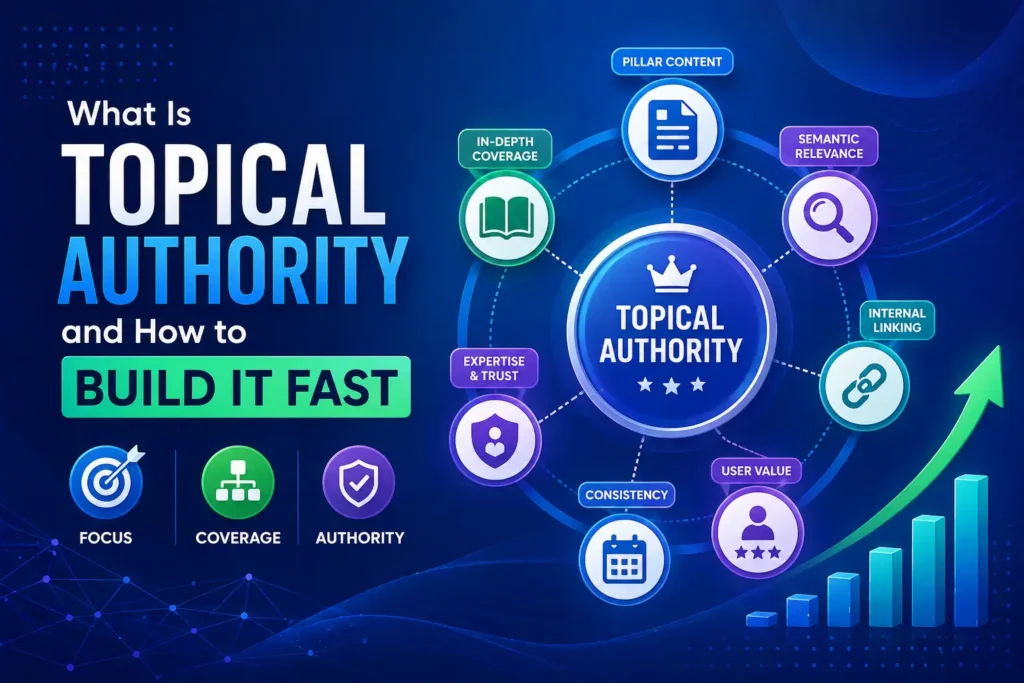
Topical authority works through what SEO professionals call the Hub-and-Spoke Model – a structured content ecosystem of one central pillar page surrounded by multiple supporting cluster pages, all interconnected through deliberate internal linking.
The pillar page (the Hub): A comprehensive, 3,000–5,000 word guide covering a broad topic at a high level – answering the foundational questions and linking out to every cluster page. The pillar page establishes the topical claim: “This site is the authority on [topic].”
The cluster pages (the Spokes): Individual, in-depth articles each covering one specific sub-topic or micro-intent related to the pillar. Each cluster page goes deeper than the pillar on its specific angle, targets a distinct long-tail keyword, and links back to the pillar using keyword-rich anchor text.
Internal links (the nervous system): Every cluster page links back to the pillar. The pillar links to every cluster page. Related cluster pages link to each other where topics naturally intersect. This bidirectional linking architecture creates a semantic web that Google’s crawlers recognise as evidence of genuine, structured expertise – an encyclopedia, not a blog.
How Do You Choose the Right Topic to Build Authority On?#
Topical authority building begins with the most important and most frequently skipped step: choosing the right topic.
The three rules for choosing your authority topic:
1. Choose narrow over broad. Most businesses make the mistake of going too broad. “Digital marketing” is not a topical authority opportunity – it’s an ocean with established giants in every direction. “Local SEO for restaurants in India” is a niche where focused, comprehensive content can build genuine authority faster than any broad strategy.
The narrower your initial focus, the faster your authority builds. Once you dominate a narrow topic, you can expand outward. Trying to establish authority across five topics simultaneously dilutes your signal everywhere.
2. Choose topics aligned with genuine expertise. Google’s March 2026 Core Update amplified E-E-A-T signals significantly – rewarding first-hand experience and penalising content published outside a site’s genuine knowledge domain. Your topical authority must be grounded in real expertise or you risk the algorithm recognising the disconnect.
3. Choose commercially connected topics. The best topical authority investments cover the subjects your customers actively search while evaluating, comparing, and purchasing your services. Authority that doesn’t connect to business outcomes doesn’t compound as effectively.
How Do You Build Topical Authority Fast? (Step-by-Step)#
Topical authority is built through focused, systematic execution – not overnight, but far faster than traditional link-building strategies when done correctly.
Step 1: Build Your Topical Map#
Topical authority starts with a topical map – a structured inventory of every question, angle, and sub-topic your audience could possibly ask about your chosen topic.
How to build your topical map:
- Open Google Keyword Planner or Ahrefs Keywords Explorer and enter your core topic
- Collect every related keyword, question, and related search
- Mine People Also Ask boxes for the sub-questions Google surfaces for every related query
- Check Reddit threads, Quora, and YouTube comments for the questions real users are asking
- Use Semrush’s Topic Research Tool to surface sub-topics and trending angles
Group your findings by theme. Each theme becomes either your pillar page topic or a cluster page topic. A comprehensive topical map for a focused niche typically yields 30–60 content opportunities – more than enough to establish meaningful authority.
Step 2: Create Your Pillar Page First (or Last)#
Topical authority building can start with the pillar page or with cluster pages – both approaches work, with one important consideration.
Starting with cluster pages first is the strategy most SEO experts recommend in 2026 – particularly for new sites. Building out your cluster content first means your internal linking architecture is already in place when you publish the pillar, making it immediately powerful as the cluster’s central hub from day one.
Starting with the pillar page makes sense for established sites where a comprehensive overview can begin earning rankings and backlinks while cluster pages are built out systematically.
Whichever order you choose, your pillar page must:
- Cover the broad topic comprehensively (3,000–5,000 words)
- Contain question-based H2/H3 headings for every major sub-topic
- Include a direct answer within the first 100 words (AI extraction requirement)
- Link to every cluster page as it’s published
- Use Article schema with a current dateModified timestamp
Step 3: Publish Cluster Content on a Consistent Schedule#
Topical authority builds through publishing velocity and consistency – not sporadic bursts. Google’s algorithm rewards sites that demonstrate sustained, long-term commitment to a topic over those that publish 20 articles in one week and nothing for three months.
At Search Savvy, we recommend a publishing cadence of 2–4 cluster articles per week during the initial authority-building phase, for the first 90 days. This gives Google a consistent signal of topical commitment without triggering quality filters from publishing too much too quickly.
Each cluster page must:
- Target one distinct long-tail keyword (3–5 words) not covered by any other cluster page
- Answer its specific question completely in 1,500–2,500 words
- Lead with a direct answer in the first 100 words
- Include a contextual link back to the pillar page
- Use FAQPage schema on its FAQ section
- Contain a dateModified field in Article schema – AI engines show a strong recency bias, preferring content updated within the past 90 days
Step 4: Build Your Internal Linking Architecture#
Topical authority without systematic internal linking is like building a web with no strands connecting the nodes – Google cannot navigate or map your expertise.
Internal linking rules for topical authority:
- Every cluster page links back to the pillar using anchor text containing the pillar’s primary keyword
- The pillar page links to every cluster page from a contextually relevant section – not just a footer list
- Related cluster pages link to each other where topics naturally intersect
- New cluster pages are linked to from existing high-authority pages on your site from the moment they publish
- Never use generic anchor text like “click here” – use descriptive, keyword-rich text that tells Google exactly what the linked page covers
A SearchPilot A/B test confirmed that expanding internal linking produced a 5% uplift in organic traffic for linked destination pages – compounding across an entire cluster, this effect is significant.
Step 5: Add “Information Gain” to Every Piece#
Topical authority in 2026 requires more than comprehensive coverage – it requires information gain: providing unique insights, data, or angles not found in any of the currently ranking pages.
Google’s 2026 algorithms (and AI systems) prioritise content that adds value beyond synthesis and summarisation. AI-cited articles cover 62% more facts than non-cited articles. If your content simply reorganises what’s already available, it won’t build authority – it will blend into the noise.
How to create information gain:
- Conduct original research or surveys – even a small dataset is uniquely citable
- Include first-hand examples from your own work or client results
- Take a specific stance on a contested question in your niche
- Add proprietary frameworks or models with your own terminology
- Cite primary sources and link to original research – this signals to Google that your content is evidence-based, not derivative
Step 6: Track Topical Authority Signals Monthly#
Topical authority growth is measured differently from individual keyword ranking – you’re looking for patterns across an entire topic cluster, not movement on a single page.
What to track:
- Topical visibility score – use Semrush or Ahrefs to track your rankings across the full cluster keyword group
- Indexing speed – as topical authority builds, new pages should index faster (days, not weeks)
- Cluster-wide impressions in Google Search Console – a rising tide of impressions across multiple pages signals increasing authority
- AI citation rate – monitor referrals from chatgpt.com and perplexity.ai in Google Analytics 4
- Featured snippet acquisition – sites with strong topical authority consistently earn more featured snippets across their clusters
People Also Ask: Topical Authority Questions#
How long does it take to build topical authority?#
Initial signals typically appear within 3–6 months of consistent publishing. Top 10 rankings for primary keywords typically emerge at 6–12 months for competitive niches. The first 90 days of focused, cluster-based publishing typically produces the most dramatic relative movement – particularly for newer sites or businesses entering a niche with thin existing competition.
Can a new website build topical authority?#
Yes – and this is one of the most important insights in modern SEO. A new website with zero backlinks can outrank established sites with high domain authority by focusing entirely on topical authority from day one. Focus on one narrow topic, build a complete content cluster, publish consistently, and interlink everything correctly. Domain authority matters less than topical coherence for niche-specific queries in 2026.
Is topical authority more important than backlinks in 2026?#
For niche and long-tail keywords: yes. Sites focusing on topical authority first see ranking gains up to 3x faster than those chasing domain authority through link acquisition alone. However, for highly competitive head terms (single-word or two-word keywords), domain authority still plays a significant role. The 2026 best practice is building topical authority first, then amplifying with targeted link building – not the reverse.
Frequently Asked Questions (FAQ)#
Q1: What is the minimum number of articles needed to build topical authority? There’s no universal minimum, but industry data from SearchAtlas suggests 25–30 high-quality, interlinked articles within a single content cluster as the threshold where meaningful topical authority signals begin to emerge. Below that, the semantic web is too thin for Google to confidently classify your site as authoritative on the topic. One pillar page plus 8–10 cluster pages is the minimum viable cluster for initial authority signals.
Q2: Does topical authority help with AI search visibility? Significantly. Semrush research confirms that AI Mode and major LLMs pull citations predominantly from Google’s top 10 results – which are dominated by sites with strong topical authority. Sites recognised as topical authorities are far more likely to be cited by ChatGPT, Google AI Overviews, Perplexity, and Gemini when users ask questions within their topic area. Building topical authority is, in 2026, the most efficient path to visibility in both traditional and AI-powered search simultaneously.
Q3: Should I build topical authority on one topic or multiple topics at once? One topic at a time. Search Savvy strongly recommends focusing all content effort on a single core topic until you’re consistently ranking in the top 10 for your primary cluster keywords – then expanding to adjacent topics. Spreading effort across multiple half-built clusters dilutes your authority signal everywhere and produces slower results than concentrated, single-topic execution.
Q4: How is topical authority different from keyword targeting? Keyword targeting optimises individual pages for specific search terms. Topical authority optimises your entire site’s content ecosystem for comprehensive coverage of a subject. Keyword targeting is page-level; topical authority is site-level. In 2026, keyword-level thinking produces diminishing returns – Google increasingly evaluates your site’s collective coverage of a topic, not just whether a specific page contains specific words.
Q5: What role does E-E-A-T play in topical authority? E-E-A-T (Experience, Expertise, Authoritativeness, Trustworthiness) and topical authority are complementary, not identical. E-E-A-T concerns who is producing the content and how credibly they do it. Topical authority concerns how comprehensively a topic is covered. Both are required for sustained rankings in 2026. Strong topical coverage without E-E-A-T signals (named authors, first-hand examples, cited sources) will underperform its potential. Strong E-E-A-T on scattered, unrelated content won’t build topical authority.
Q6: Can I retrofit topical authority onto an existing website? Yes – and this is one of the highest-ROI SEO activities for established sites with existing content. Conduct a content audit to identify pages that cluster naturally around a core topic. Consolidate cannibalising pages. Designate the strongest existing post as the pillar page (expanding it to full pillar depth). Add the required internal links. Then identify and publish the missing cluster pages. This retrofitting approach typically produces measurable ranking improvements within 4–8 weeks of implementation.
Final Thoughts#
Topical authority is not a tactic – it’s a structural decision about how your entire content programme is built and organised. And in 2026, it’s the most reliable path to fast, durable rankings without needing to outspend competitors on link building.
The shift Google has made is permanent: from rewarding individual keyword battles to rewarding sites that demonstrate they genuinely understand a topic from every angle. The sites that accept this reality and reorganise their content accordingly are pulling away from the competition month after month.
The good news is that the window of competitive advantage is still open. Most businesses in most niches have not yet built systematic topical authority. The cluster structure that will dominate local search, niche consulting, and B2B content for the next three to five years is still being built – by the businesses willing to do the focused, sustained work now.
Search Savvy builds topical authority strategies for businesses that want to lead their niche in search – designing content clusters, executing pillar and cluster pages, and building the internal linking architecture that makes topical authority compound month after month.