Revenue Attribution Modelling for Blog Content: Tracking Assisted Conversions Accurately
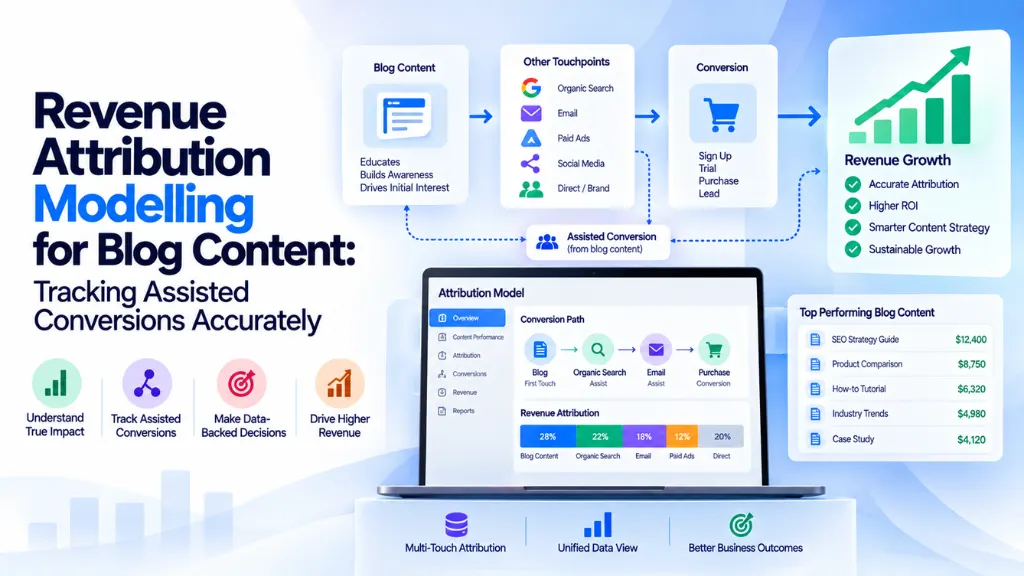

Ask most marketing dashboards which channel deserves credit for a sale, and blog content routinely comes back looking worthless – not because it didn’t work, but because last-click attribution structurally can’t see it. A reader finds an article three months before buying, closes the tab, and eventually converts by typing the brand name directly into Google. Revenue attribution modelling for blog content is the discipline of correcting that blind spot – using multi-touch and data-driven models to capture content’s real, upper-funnel contribution, while being honest about what even the best attribution setup still can’t measure.
In this article11 sections
This guide covers how attribution models actually differ, how GA4’s default data-driven model and its newer assisted-conversion reporting apply specifically to content, and – because no attribution model tells the whole story – how to pair it with incrementality testing and a layered measurement framework that gives content marketers a defensible answer when leadership asks what a blog is actually worth.
Why Blog Content Is Structurally Undervalued by Last-Click Attribution#
Last-click attribution assigns 100% of conversion credit to the final touchpoint before a sale, which is exactly the wrong model for how blog content typically functions in a buyer’s journey. Content is overwhelmingly a top-of-funnel or mid-funnel influence – the article that introduces a problem, builds initial trust, or answers a research question weeks before the buyer is ready to act. By the time that same person converts, they’ve often returned through a branded search or a direct visit, and last-click hands 100% of the credit to that final, low-effort step while the article that actually did the persuading gets recorded as if it never happened.
This isn’t a hypothetical distortion. In B2B specifically, buying journeys with dozens of touchpoints spread across many months are common, and last-click attribution in that context can credit as little as one out of every seven meaningful touches, systematically undercounting everything earlier in the journey – which, for most content marketing programs, means undercounting the blog almost entirely.
What Revenue Attribution Modelling Actually Means for Content#
Attribution modelling is the set of rules used to distribute conversion credit across the touchpoints in a customer’s journey. Each model answers the underlying question – “which touchpoints mattered?” – differently:
| Model | How Credit Is Assigned | Effect on Blog Content |
| First-click | 100% to the first touchpoint | Can overstate a single early-discovery article’s value |
| Last-click | 100% to the final touchpoint before conversion | Systematically undervalues upper-funnel content |
| Linear | Equal credit across every touchpoint | Fairer to content, but doesn’t reflect real influence differences |
| Time-decay | More credit to touchpoints closer to conversion | Still biased against early-stage content, just less severely than last-click |
| Position-based (U-shaped) | Heavier credit to the first and last touchpoints, smaller shares to the middle | Recognises content’s role in initial discovery specifically |
| Data-driven (algorithmic) | Machine-learning-assigned credit based on actual incremental contribution across observed converting and non-converting paths | Generally the most accurate reflection of content’s real influence, when eligible |
Data-driven attribution has become the standard recommendation for most multichannel programs precisely because it doesn’t force every journey into a fixed rule – it evaluates real conversion paths and assigns fractional credit based on observed patterns, which tends to recognise upper-funnel and mid-funnel content in a way rule-based models structurally can’t.
GA4’s Default: Data-Driven Attribution, and What “Eligible” Actually Means#
Data-driven attribution is GA4’s default model, but it isn’t automatically available to every property. It requires at least 400 conversions for the specific key event being measured, and at least 20,000 total conversions across all key events within the applicable lookback window, before GA4 has enough observed data to model credit reliably. Smaller sites or newer content programs that haven’t cleared this threshold fall back to a rule-based model instead, which is worth checking directly rather than assuming data-driven attribution is active by default.
Three GA4 settings materially change how content gets credited, and none of them are cosmetic:
- Attribution model – data-driven versus a fixed rule-based alternative.
- Lookback window – how far back GA4 looks for prior touchpoints when crediting a conversion, which directly determines whether a blog post read two months before a purchase gets any credit at all.
- Reporting identity – whether GA4 stitches a user’s journey across devices (Blended) or reports each device separately, which affects how completely a cross-device research journey gets reconstructed.
Changing any of these mid-quarter without documenting the change is a common, avoidable cause of confusing “why did our channel mix suddenly shift” conversations – the shift often reflects a settings change, not an actual change in buyer behaviour.
Tracking Assisted Conversions for Blog Content in GA4#
GA4 introduced a Conversion Attribution Analysis report in beta in February 2026, specifically built to surface the kind of upper-funnel contribution blog content typically makes. It includes an Assisted Conversions view, which highlights touchpoints that helped lead to a conversion without being the final click, and a Refined Funnel Analysis view, which categorises touchpoints into Early, Mid, and Late stages using the underlying data-driven attribution model.
For content teams, this is the most direct way inside GA4 to answer the specific question a blog-focused attribution effort needs answered: not “did this article get the last click,” but “how often did this article appear as an early-stage touchpoint in journeys that eventually converted.” Reviewing content performance through this lens, rather than through a standard last-click channel report, is usually the single biggest correction available for demonstrating a blog program’s real contribution.
Setting Lookback Windows That Match How Content Actually Gets Consumed#
A default lookback window configured for a short-consideration ecommerce purchase will silently exclude a large share of blog-driven influence if your actual buying cycle runs longer. If a meaningful share of your customers research for six to eight weeks before converting, but your lookback window is set to 30 days, content read in week one of that research period gets no credit at all – not because it didn’t matter, but because the measurement window closed before the conversion happened.
The practical fix: estimate your typical consideration period from CRM or sales cycle data, and set the lookback window to genuinely cover it, rather than leaving a platform default in place that was never chosen with your actual buyer journey in mind.
What Attribution Still Can’t See: Dark Social and the Limits of Click-Based Models#
Even a well-configured, data-driven, appropriately windowed attribution setup has a hard ceiling: it can only credit what it can observe, and a meaningful share of how content actually influences buyers happens entirely outside trackable channels. A reader who screenshots an article and sends it to a colleague, discusses it in a private Slack channel, or simply remembers it weeks later and returns by typing the brand name directly into a search bar generates no attributable touchpoint at all – the resulting conversion shows up as “direct” or “branded search” with zero credit flowing back to the content that actually drove it.
This gap is particularly pronounced in longer B2B buying cycles, where research covering many months and dozens of touchpoints is common, and a large share of that research activity happens in channels no attribution platform can see. One consistent pattern found across multiple 2026 industry analyses: multi-touch attribution tends to over-credit trackable digital channels relative to a marketing-mix-modeling-plus-holdout baseline, precisely because it can only assign credit where it has visibility – a bias worth treating as a directional warning sign in your own reporting rather than a fixed, universal correction factor.
A Practical Three-Tier Framework for Content Attribution#
Given these limits, the most defensible approach uses attribution as one input among several rather than the single source of truth:
- Tier 1 – Budgeting. GA4’s data-driven attribution serves as a neutral baseline for deciding how to allocate content production effort across topics and formats, since it captures relative contribution better than any rule-based model.
- Tier 2 – Optimisation. Platform-level and content-level engagement data (time on page, scroll depth, assisted conversion counts by article) guides day-to-day decisions about what to publish more of.
- Tier 3 – Truth. CRM and actual closed-revenue data remains the final check, since content marked as an assist in GA4 needs to be reconciled against whether those leads genuinely closed and at what value, rather than treating platform-reported credit as the final answer.
Complementing Attribution with Incrementality Testing#
Attribution alone answers “which touchpoints were present in converting journeys,” not “did this content actually cause additional conversions that wouldn’t have happened otherwise.” Incrementality testing closes that gap through controlled experiments – a common approach for content is a geo-holdout test, where a specific market or segment is deliberately withheld from seeing new content or a distribution push while a comparable segment receives it, then comparing conversion outcomes between the two. This is a heavier lift than pulling an attribution report, but it’s the only method that isolates genuine causal lift from content that merely happened to appear in a lot of converting journeys without truly driving them.
For most content programs, this level of testing is worth reserving for higher-stakes questions – whether a major content investment or a new topic cluster is worth its cost – rather than running for every individual article.
Common Mistakes in Content Attribution#
- Defaulting to last-click without questioning it. It remains the default in many analytics tools and dashboards, which keeps content chronically undervalued in reporting even when it’s genuinely driving the pipeline.
- Leaving a default lookback window in place that doesn’t reflect your actual consideration period, silently excluding early-stage content touchpoints from credit.
- Changing attribution models or reporting identity mid-quarter without documenting it, then mistaking the resulting shift in channel mix for an actual change in buyer behaviour.
- Treating GA4’s attribution output as the final word on content ROI, rather than reconciling it against CRM and actual closed-revenue data.
- Ignoring dark social and branded-search conversions entirely, rather than acknowledging them as likely undercounted content influence worth investigating qualitatively, even without a precise attribution figure.
- Never testing for incrementality, relying solely on correlational attribution data even for large, high-stakes content investment decisions.
Frequently Asked Questions#
Which attribution model gives blog content the fairest credit? Data-driven attribution generally reflects content’s real contribution most accurately, since it evaluates actual converting and non-converting paths rather than applying a fixed rule. Position-based attribution is a reasonable fallback for properties that don’t yet qualify for data-driven attribution, since it explicitly credits the first touchpoint in a journey.
Why doesn’t my GA4 property show data-driven attribution as an option? Data-driven attribution requires at least 400 conversions for the specific key event and 20,000 total conversions across all key events within the applicable lookback window. Properties below that threshold fall back to a rule-based model until conversion volume grows.
What is an “assisted conversion,” and why does it matter for content? An assisted conversion is one where a touchpoint contributed to the customer journey without being the final click that triggered the conversion. Since blog content overwhelmingly plays this upper-funnel role, tracking assisted conversions specifically – rather than only last-click credit – is essential to seeing content’s true contribution.
Can attribution fully account for word-of-mouth and private sharing of content? No. Content shared through private channels, messaging apps, or screenshots generates no trackable touchpoint, so any resulting conversion shows up as direct or branded traffic with no credit flowing back to the original content. This gap is a known, structural limitation of all click-based attribution, not something a better model configuration can fully solve.
How does incrementality testing differ from attribution? Attribution assigns credit to touchpoints that were present in a converting journey. Incrementality testing uses controlled experiments, such as geo-holdouts, to measure whether a channel or piece of content actually caused additional conversions that wouldn’t have happened otherwise – a stronger, causal answer that attribution alone can’t provide.
Should small content teams bother with data-driven attribution and incrementality testing, or is that overkill? Data-driven attribution is worth enabling as soon as a property qualifies, since it requires no additional testing infrastructure. Incrementality testing is more resource-intensive and is generally worth reserving for evaluating larger, higher-stakes content investments rather than running continuously for every piece of content.
The Bottom Line#
Revenue attribution modelling for blog content isn’t about finding one perfect model that finally proves content’s worth – it’s about recognising that last-click structurally hides content’s real contribution, using data-driven attribution and GA4’s assisted-conversion reporting to correct for that as much as the data allows, and being honest that dark social and long consideration cycles mean some of content’s real influence will never show up in any dashboard. Pairing attribution with periodic incrementality testing and a CRM-anchored “truth” layer gives content teams a genuinely defensible answer, rather than a single number that overstates its own precision. Search Savvy’s content marketing services and performance marketing services build this kind of layered measurement approach directly into content and campaign reporting, and the analytics and reporting glossary is a useful reference for the attribution terminology covered throughout this article.