A Google Core Update Just Completed. The Next One Is Coming. Do This Now
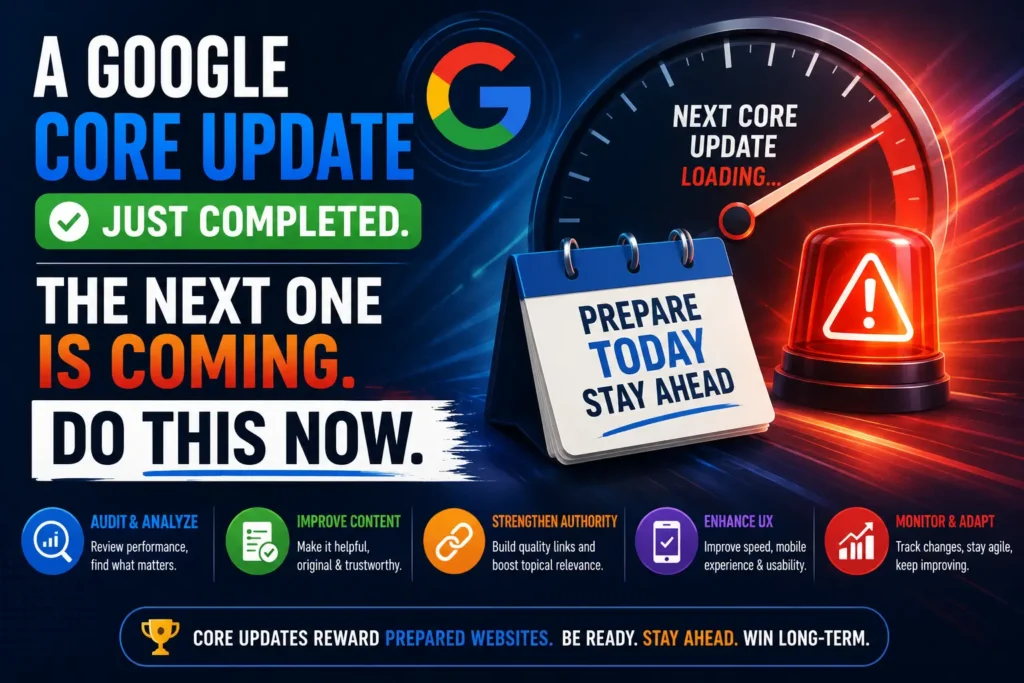

The May 2026 Google Core Update started on May 21 – the same day as Google I/O – and completed on June 2, 2026. Eleven days and twenty-one hours of ranking volatility. Some sites gained 15–25% visibility overnight. Others lost half their organic traffic in the same window.
In this article15 sections
And already, the SEO community is watching the calendar. Google’s 2026 update cadence has been quarterly – March 2026 (12 days, April 8 completion), May 2026 (12 days, June 2 completion), and a June or July window now open for what follows. The next broad core update is the deadline that gives this sequence its urgency.
The window between Google core updates is the highest-leverage period in SEO. It is the only time you can make meaningful changes before the next evaluation – and have those changes fully processed by Google’s systems before rankings redistribute again.
Google June 2026 core update preparation is not guesswork. The signals from the March and May 2026 updates are documented, consistent, and actionable. What Google rewarded and penalised in those two updates tells you exactly what to do right now – before the next algorithm recalibration decides whether your site moves up, stays flat, or gets passed by.
At Search Savvy, we have been monitoring both updates closely across client portfolios – and the pattern is clear enough to act on. This article explains exactly what the 2026 updates have revealed about Google’s current priorities, what is at risk in the next cycle, and the specific preparation steps that protect and improve your rankings before the next update rolls.
What Did the May 2026 and March 2026 Google Core Updates Actually Change?#
Google June 2026 core update preparation requires understanding what the previous two updates actually evaluated – because core updates are not random volatility. They are deliberate re-weightings of quality signals that reflect where Google’s priorities have moved.
The May 2026 update started May 21 and completed June 2, 2026 – 11 days and 21 hours. Google’s official description was identical to prior updates: “a regular update designed to better surface relevant, satisfying content for searchers from all types of sites.” This statement tells you almost nothing. The actual pattern across the 2026 updates tells you much more.
The March 2026 Core Update (March 27 – April 8, 2026):
The March update re-weighted Information Gain – a ranking signal measuring how much genuinely new knowledge a piece of content adds relative to what already ranks for the same query. The March 2026 update re-weighted what the SEO community calls Information Gain. If your content disappeared from the internet tomorrow, would anyone lose access to information they couldn’t find somewhere else? For a significant portion of the web, the answer is no.
The impact was immediate and measurable. Pages with proprietary data and first-hand case studies gained 15–25% visibility. Templated and rewritten content dropped 30–50%. Generic AI content farms lost 60–80% of organic visibility.
The May 2026 Core Update (May 21 – June 2, 2026):
The May update continued in the same direction with additional volatility in YMYL (Your Money, Your Life) categories. Serious volatility in gambling, healthcare, and finance niches – described as hyper-YMYL categories seeing major volatility during major updates. E-E-A-T (Experience, Expertise, Authoritativeness, Trustworthiness) signals were heavily weighted across all evaluated categories.
Both updates shared the same underlying theme: Google is promoting a higher standard of what deserves to rank. The sites that drop aren’t being punished. They’re being passed by content that better satisfies the signals Google has decided matter more.
People Also Ask: When was the last Google core update in 2026? Short Answer: The May 2026 Core Update began on May 21, 2026 (the same day as Google I/O) and completed on June 2, 2026 – running 11 days and 21 hours. The March 2026 Core Update ran from March 27 to April 8 (12 days). Before that, the December 2025 Core Update ran 18 days. Google’s 2026 cadence has been roughly quarterly, placing the next broad core update window in June–August 2026.
What Signals Is Google Rewarding in 2026 Core Updates?#
Google June 2026 core update preparation must target the specific quality signals that the algorithm has been consistently rewarding – not the signals that mattered in 2023 or 2024.
The 2026 update pattern has made three signals dominant:
1. Information Gain and Genuine Originality#
Google June 2026 core update preparation begins with the most fundamental question about your content: does it add something to the world that does not already exist?
Content produced at volume, optimised for keywords and assembled from the same sources as the top five competing pages does not clear Google’s 2026 bar. What the March and May core updates favoured is original research, proprietary data, first-hand testing, case studies built from real client outcomes, and analysis that requires access or expertise the reader doesn’t already have.
The practical test: search your target keyword and read the top three results. If your page would tell a user who has already read those three results nothing new – your information gain score is effectively zero. This is not a creative judgement. It is a structural one. The content brief, the research process, and the sources used all need to change before the writing does.
2. E-E-A-T Signals at the Author and Site Level#
Google June 2026 core update preparation must address E-E-A-T systematically – because the 2026 updates applied it at both the page level and the site level simultaneously.
Google’s core updates are broad recalibrations that use page-level and site-wide signals. That means a site can no longer rely on a handful of strong pages while the rest of the domain drifts into duplication, low-value clustering, or unfocused publishing.
E-E-A-T in 2026 requires:
- Experience – First-hand, documented knowledge. “In our experience” without specifics is zero-signal. Named clients, measured outcomes, specific decisions and their results – these are Experience signals.
- Expertise – Author credentials that are verifiable. Named authors with linked professional profiles, demonstrable subject matter credentials, and a publishing history in the topic area.
- Authoritativeness – Third-party citations that confirm your expertise. Being mentioned in, linked from, or featured by other recognised sources in your field.
- Trustworthiness – Site-level transparency. About pages with named team members, clear contact information, privacy policies, editorial standards, and a business identity that can be independently verified.
Sites that clearly demonstrate who they are, why they’re credible, and how they operate fairly tend to be more resilient across core updates.
3. Topical Authority and Content Coherence#
Google June 2026 core update preparation must also address the coherence problem – because a likely pattern from both 2026 updates is stronger weighting of topical coherence.
Sites that maintain a clear centre of gravity benefit. Sites that publish loosely across unrelated subjects in pursuit of traffic struggle. This does not mean every site must be narrow – but it does mean that unfocused publishing across disconnected topic clusters creates a quality signal problem that cannot be fixed page by page.
People Also Ask: What does Google reward in core updates in 2026? Short Answer: The March and May 2026 core updates consistently rewarded: Information Gain (content that adds genuinely new knowledge not available in competing pages), E-E-A-T signals (Experience, Expertise, Authoritativeness, and Trustworthiness at both page and site level), topical authority and content coherence (a clear subject matter focus rather than unfocused multi-topic publishing), and page experience signals (Core Web Vitals, mobile usability, and fast loading). Generically assembled, AI-synthesised, and volume-first content was the primary losing category in both updates.
What Sites Are Most at Risk in the Next Google Core Update?#
Google June 2026 core update preparation is most urgent for sites that fall into the risk categories identified by the 2026 update pattern.
The specific site profiles that have shown the greatest vulnerability across the 2026 updates:
Thin content at volume. Sites that have been publishing regularly but broadly – covering many topics superficially rather than specific topics deeply – are vulnerable to topical coherence signals. If your blog covers ten different subject areas with 200-word posts and no clear niche authority, the 2026 algorithm treats this differently from a focused publisher with 30 deep articles in a single cluster.
AI-synthesised content without differentiation. Google has made clear that the issue is not whether content used AI in the process. The issue is whether the content is helpful, reliable, and made for people rather than mainly for rankings. AI-generated content that synthesises existing sources without adding proprietary data, first-hand experience, or original frameworks is the profile that lost the most visibility in both 2026 updates.
YMYL sites with weak E-E-A-T signals. Healthcare, legal, financial, and other YMYL categories face the strictest E-E-A-T evaluation. Any site in these categories with anonymous authorship, no author credentials, or no transparent business identity is at elevated risk. Serious volatility in hyper-YMYL categories confirmed this pattern in the May 2026 update.
Sites with stale, uncredited content. A possible next update pattern is stronger weighting of freshness and accuracy maintenance. Changing dates without meaningful updates is not a strategy. At the same time, leaving update-sensitive pages untouched for a year while competitors improve them is also a problem.
Sites with unresolved Core Web Vitals failures. Technical accessibility shapes whether your content can be properly evaluated. If your important content depends on fragile rendering, blocked assets, or poor performance scores, it reaches the algorithm in a weakened form regardless of its quality. 47% of websites still fail Google’s Core Web Vitals thresholds – sites in this category face a compounding disadvantage.
People Also Ask: Which types of websites are most affected by Google core updates in 2026? Short Answer: The most at-risk site profiles in 2026 core updates are: YMYL sites (health, finance, legal) with weak E-E-A-T and anonymous authorship; sites publishing thin content at high volume without topical focus; sites with AI-synthesised content that adds no information gain over existing results; sites with outdated or stale content; and sites with unresolved Core Web Vitals failures. The May 2026 update showed particular volatility in the gambling and finance niches, confirming the YMYL vulnerability pattern.
What Should You Do Right Now to Prepare Before the Next Core Update?#
Google June 2026 core update preparation has a specific sequence. Making changes in the wrong order – or making changes that do not address the signals Google is actually evaluating – produces minimal impact.
Here is the preparation framework, ordered by priority:
Priority 1: Snapshot Your Current Baseline Immediately#
Google June 2026 core update preparation starts with measurement – because without a clean baseline captured now, you will have no reference point to diagnose what the next update does to your site.
Open Google Search Console and capture your current Performance Report data: total clicks, impressions, average position, and CTR for the last 28 days. Export this by page and by query. Open Google Analytics 4 and export organic traffic by landing page for the same period.
A pre-triage snapshot taken now is your only clean reference point before algorithmic fluctuation obscures the true movements when the next update rolls. A ranking change you see after the next update begins may reflect a different facet of the algorithm than one that appears mid-rollout. Your baseline is the diagnostic tool that makes this distinction possible.
Priority 2: Audit Your Content for Information Gain#
Google June 2026 core update preparation’s highest-impact content action is running an information gain audit on your top 20 organic pages.
Score each page across five dimensions:
- Proprietary data – Does the page contain original statistics, benchmarks, or research not available from other sources?
- First-hand evidence – Does the page document specific outcomes, named cases, or personal experience with measurable results?
- Original framework – Does the page introduce a unique way of organising or approaching the topic?
- Expert attribution – Does the page cite named, credentialed individuals with verifiable expertise?
- Freshness signal – Does the page contain recently updated data with a visible date?
Pages scoring below 5 out of 10 across these dimensions are your highest-risk content and your highest-ROI improvement targets.
Priority 3: Strengthen E-E-A-T Signals Across the Site#
Google June 2026 core update preparation requires site-level E-E-A-T improvements, not just page-level ones.
The specific changes that strengthen E-E-A-T at the site level:
Author attribution: Every piece of content should have a named author with a linked About page or professional profile. Generic “Staff Writer” or “Editorial Team” attribution does not satisfy the Experience or Expertise components. Each author’s bio should include verifiable credentials, relevant experience, and links to independent professional profiles (LinkedIn, industry publications).
About and transparency pages: Your About page should name specific team members, include professional histories, and explain your editorial process or subject matter expertise. A business identity that cannot be independently verified is a trust deficit in every core update.
Contact and verification signals: Business address, phone number, GST registration for Indian businesses, and consistent NAP data across your site and Google Business Profile all contribute to Trustworthiness signals.
Third-party validation: Seek coverage, links, and citations from recognised sources in your industry. Being mentioned by established publications in your niche is an Authoritativeness signal that on-site changes cannot replicate.
Priority 4: Conduct a Content Quality and Coherence Audit#
Google June 2026 core update preparation requires an honest assessment of your content library’s topical focus and quality distribution.
Map every page on your site to a topic cluster. Identify clusters where you have depth (5 or more interconnected articles on related subtopics) versus clusters where you have a single isolated page. A possible next update pattern is stronger weighting of topical coherence – the algorithm distinguishes between genuine topic expertise and surface-level coverage.
For pages that are thin, outdated, or lack any information gain advantage: consolidate into stronger pages, update with current data and original insights, or remove and redirect. Volume of thin content is a site-wide quality signal – it creates a drag on the overall quality assessment that affects your stronger pages.
Volume alone is not carrying sites the way it once could. The March 2026 spam update, which accompanied the core update, confirmed that Google is actively cracking down on low-quality and manipulative practices.
Priority 5: Resolve Core Web Vitals Failures#
Google June 2026 core update preparation has a technical layer that completes the picture. Technical accessibility shapes whether your content can be properly evaluated by Google’s systems.
Run your most important pages through Google PageSpeed Insights on mobile. Check Google Search Console’s Core Web Vitals report for pages with failing LCP, INP, or CLS scores. Every page flagged as “Poor” in the Core Web Vitals report is a page where your content quality improvements are reaching the algorithm in a weakened form.
Target the standard 2026 thresholds: LCP under 2.5 seconds, INP under 200ms, CLS under 0.1. The highest-impact mobile performance fixes – hero image optimisation, deferred JavaScript, explicit image dimensions – typically resolve the majority of Core Web Vitals failures without significant development investment.
According to Search Savvy’s insights from monitoring the March and May 2026 update impacts across client portfolios, the sites that recovered fastest after the March update and held their positions through the May update share two consistent characteristics: they had strong information gain content that existed before the update hit, and they had no unresolved Core Web Vitals failures. Neither of those improvements can be made quickly after an update has started. They must be in place before.
People Also Ask: How do I prepare my website for a Google core update? Short Answer: The highest-impact preparation steps for a Google core update in 2026 are: (1) capture a baseline snapshot in Search Console and GA4 now, (2) audit your top 20 organic pages for information gain and strengthen the lowest-scoring ones, (3) add named author attribution with verifiable credentials to all content, (4) consolidate or remove thin content that lacks topical depth, and (5) resolve Core Web Vitals failures in Search Console. These changes are most effective when made between updates – during an active rollout, improvements still count, but the algorithm is recalibrating across thousands of signals simultaneously.
How Long Does Recovery Take After a Google Core Update Hits?#
Google June 2026 core update preparation also requires realistic timing expectations – because misunderstanding the recovery timeline leads to premature decisions and counterproductive emergency changes.
Google’s own documentation makes one important point repeatedly: improvements to pages and sites don’t guarantee that pages will be restored to prior positions – it just makes them worthy of consideration at the next major recalibration.
The most honest timeline framework for 2026:
During the rollout (Days 1–12 approximately): Rankings are actively fluctuating. Some changes represent direct algorithm reassessment of your pages. Others represent collateral movement from competitors around you. Do not interpret mid-rollout volatility as your final position. Document, monitor, and do not make emergency changes based on a snapshot from day 3.
Rollout completion to next update: This is your preparation window. Improvements made and indexed during this period are your evidence package for the next evaluation. A site that publishes substantive E-E-A-T improvements and fixes Core Web Vitals on Day 4 of the rollout has a meaningfully different signal profile than one that makes those same changes on Day 30 after the rollout is complete.
The next core update: Google’s standing documentation is clear that improvements should be recognised at the next broad core update. Sites that made substantial content and technical improvements during the March–May window saw recovery or advancement in the May update. The same pattern should hold for sites that improve meaningfully in the current June–August preparation window.
At Search Savvy, we advise treating every window between core updates as a preparation sprint with a defined deadline: the next scheduled update, whenever Google confirms it. Right now, that deadline is unknown but predictable – and the preparation steps are identical regardless of exact timing.
What Does the May 2026 Update Tell You About the Next One?#
Google June 2026 core update preparation benefits from understanding the pattern across consecutive updates – because each one builds on the signals established by the previous one.
The sequence across the 2026 updates is coherent. March re-weighted Information Gain. May continued that signal while adding YMYL E-E-A-T volatility. The direction is clear: Google is systematically raising the quality bar on every dimension that distinguishes genuinely helpful, expert content from volume-optimised, algorithmically assembled content.
The next update will likely continue this trajectory. Several signals worth watching:
Freshness maintenance. A possible next update may expose sites that either over-fake freshness (changing dates without meaningful updates) or under-maintain genuinely time-sensitive content. Leaving update-sensitive pages untouched for a year while competitors improve them is a documented vulnerability.
Topical coherence at scale. The algorithm’s push toward topical authority suggests that sites with large, unfocused content libraries face increasing pressure. A focused publisher with 30 deep articles in one cluster is better positioned than a general publisher with 300 shallow articles across 20 topics.
AI search citation alignment. The convergence between traditional rankings and AI Overview citations creates a dual validation requirement. Pages that qualify for AI Overview citation are, by definition, satisfying the quality signals Google’s systems have been consistently elevating. Treating AI visibility and traditional ranking as the same quality investment is the correct strategic framing.
At Search Savvy, we build core update preparation into every ongoing SEO engagement as a quarterly cadence – not an emergency response. The businesses that maintain the preparation checklist continuously have the shortest recovery timelines when updates hit and the highest frequency of ranking improvements when they complete.
People Also Ask: How quickly do rankings recover after a Google core update? Short Answer: Google’s documentation states that improvements should be recognised at the next broad core update – typically the subsequent quarterly update, which was 6–8 weeks after both the March and May 2026 updates. Mid-rollout fluctuations are not final positions. Complete recovery from a damaging update requires substantial improvements to the specific quality signals that caused the drop – Information Gain, E-E-A-T, topical coherence, or Core Web Vitals – and these improvements take time to implement and index. Sites that began improving immediately after March 2026 showed the clearest recovery in May 2026.
FAQ: Google June 2026 Core Update Preparation – Your Questions Answered#
Q1: Has a June 2026 Google core update been announced yet? As of June 9, 2026, Google has not announced a June 2026 core update. The May 2026 Core Update completed on June 2, 2026 – making June the current preparation window. Google’s 2026 cadence has been quarterly: December 2025, March 2026, and May 2026. The next broad core update is expected in the June–August 2026 window based on this pattern, but Google does not announce updates in advance. Monitor the Google Search Status Dashboard and the @googlesearchc X account for official confirmation. Use the current window to prepare – updates do not arrive with sufficient warning to act reactively.
Q2: What is the most important thing I can do before the next core update? The highest single-priority action is an information gain audit of your top 20 organic pages. Score each against five dimensions: proprietary data, first-hand evidence, original framework, expert attribution, and freshness signal. The pages scoring lowest on this audit are both your highest-risk content in the next update and your highest-ROI improvement opportunity. The March and May 2026 updates were both primarily information gain events – content that adds nothing new to what already exists is the specific profile Google has been systematically deprioritising.
Q3: Should I stop publishing new content and focus on improving existing content before a core update? For most sites that have been publishing for over a year, yes – shifting 60–70% of content effort toward improving existing pages is the higher-ROI strategy in the current pre-update window. New content published today will not have enough user behaviour signal data by the time the next update evaluates it. Existing pages with history, backlinks, and established rankings respond faster to quality improvements because the algorithm already has a baseline assessment to update. The exception is new content that fills a genuine information gain gap – something that does not exist anywhere else and addresses a documented search need.
Q4: How do I know if my site was negatively affected by the May 2026 core update? Compare your Google Search Console performance data for May 21–June 2 against an equivalent period before the update (April 21–May 7, for example). Sort by largest drops in clicks and impressions by page. If specific pages show drops of 20%+ during the rollout window with no corresponding drops in the comparison period, these pages were likely impacted. Cross-reference with your GA4 organic landing page data to confirm. The Glenn Gabe “battery of issues” framework recommends investigating multiple quality signals on affected pages – thin content, missing author attribution, weak E-E-A-T, stale data – rather than attributing drops to a single cause.
Q5: Does using AI to write content put my site at risk in core updates? Not if the output adds genuine information gain. Google has made clear that the issue is not whether content used AI in the process – the issue is whether the content is helpful, reliable, and made for people rather than mainly for rankings. AI-assisted content that incorporates original data, first-hand expertise, and named attribution can perform well. AI-generated content that synthesises existing sources without adding anything new performs poorly – not because of the tool, but because of the output quality. The test is simple: does this page tell users something they could not have found from the pages already ranking for this query?
Q6: Should I file a reconsideration request after a core update impact? No. Reconsideration requests are for manual actions – human-reviewed penalties applied to sites for specific policy violations. Core update impacts are algorithmic and cannot be addressed through reconsideration. Google’s process is to recover core update visibility through the quality improvements its own documentation specifies – better content, stronger E-E-A-T, improved technical health – and wait for the next update to re-evaluate those improvements. If you received a manual action notice in your Search Console in addition to traffic drops, that is a separate issue requiring a separate response. Algorithmic drops from core updates require content and technical improvement, not appeals.
Has the May 2026 core update already moved your rankings – or are you preparing your site before the next one hits? Visit Search Savvy for a post-update SEO audit that identifies exactly what changed, why it changed, and the specific improvements that will perform best when Google re-evaluates your site in the next core update window.