Internal Linking Strategy: How to Do It Correctly

Here is the internal linking reality most websites are living with in 2026: blog posts get published, a link gets dropped in wherever it feels convenient, and the rest of the site is left to fend for itself. There is no architecture. No system. Just scattered links that do little to move rankings.
In this article14 sections
An internal linking strategy is what separates that scattered approach from a site structure that actually compounds authority over time.
Roughly 25% of web pages on the average website receive zero internal links, and large-site log analysis suggests fewer than half of pages get enough internal links to be reliably discovered by crawlers (JetOctopus, 2026). That is not a marginal inefficiency – it is the difference between a site Google fully understands and one where your best content quietly goes undiscovered.
But links without a plan are not a strategy. Dropping internal links randomly while writing – without a clear pillar structure, defined anchor text rules, or a regular audit habit – produces exactly the cannibalisation-and-orphan-page pattern that keeps most sites stuck below their ranking potential. A handful of deliberate, relevant links is miles more effective than dozens of forced ones.
An internal linking strategy is the system that makes that authority distribution achievable without making every new post a guessing game.
At Search Savvy, internal linking strategy is the foundation of every SEO engagement we run – not as a technical checkbox, but as the practical lever that decides whether your best content actually gets crawled, indexed, and ranked. This article walks through exactly how to build one that works, with current 2026 data throughout.
What Is an Internal Linking Strategy and Why Does It Matter in 2026?#
An internal linking strategy is a planned system of hyperlinks connecting pages within the same website, helping both users and search engines understand how your content relates and which pages matter most.
It is not a random scattering of links added after a post is finished. It is a framework – built around pillar pages and topic clusters – that prevents orphan pages and keyword cannibalisation while guiding readers toward genuinely related content.
In 2026, the case for a deliberate internal linking strategy has strengthened for two specific reasons.
First, Google and AI-driven search engines now evaluate topical coherence, not just keyword matches. Internal links help AI systems understand the structure, relevance, and context of your content, which directly affects whether your pages get surfaced in AI Overviews and generative answer tools.
Second, sites are publishing more content than ever, and crawl budget has not scaled to match. A JetOctopus large-site case study found Googlebot crawl coverage rising from 40% to 70% after a revised internal linking strategy – a roughly 30-percentage-point shift that came entirely from restructuring links, not new content.
People Also Ask: What is an internal linking strategy and do I really need one? Short Answer: An internal linking strategy is a planned system of hyperlinks connecting pages on the same site, organised around pillar and cluster content rather than random placement. You need one if your pages are hard to find, your rankings have plateaued, or new posts take weeks to get indexed. Roughly 25% of pages on the average site receive zero internal links, and that gap is often the single biggest reason content underperforms.
How Does Internal Linking Strategy Work?#
An internal linking strategy works by distributing what SEOs call “link equity” through your site, much like water flowing through pipes. Your homepage and your most-linked pages act as reservoirs of authority. When they link to other pages, some of that authority flows downstream.
An internal linking strategy also works as a discovery mechanism. Google’s crawlers use internal links to discover and index new content, meaning a page with zero internal links pointing to it – an orphan page – may never get indexed properly, no matter how good the content is.
How Do You Build a Correct Internal Linking Strategy Step by Step?#
An internal linking strategy is built in six sequential steps. Skipping the first two – pillar architecture and page prioritisation – is the most common reason internal linking efforts get abandoned within weeks of a site audit.
Step 1: Build Pillar Pages and Topic Clusters#
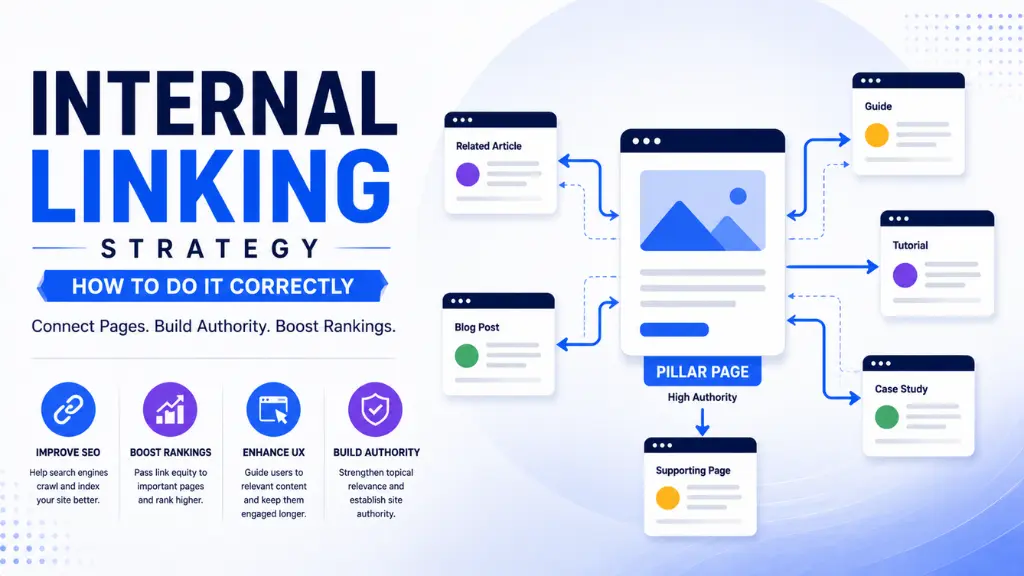
An internal linking strategy needs a content architecture before it can be linked correctly. The pillar-and-cluster model is the dominant 2026 standard: a broad pillar page covers a topic comprehensively, while tightly-focused cluster pages each handle a subtopic and link back up to the pillar.
Without this structure, your links drift toward whatever feels relevant on a given day, and authority gets scattered instead of concentrated. With it, every new post has a clear home within a network that makes sense to both Google and your readers.
Example pillar-cluster setup for a digital marketing site:
- Pillar page – “Complete Guide to SEO for Indian Businesses”
- Cluster: Local SEO (links back to the pillar) – Justdial and IndiaMART listing optimisation
- Cluster: Technical SEO (links back to the pillar) – Core Web Vitals and crawl budget
- Cluster: Content strategy (links back to the pillar) – topic clusters and content calendars
- Cluster: AI search (links back to the pillar) – GEO and AI Overview optimisation
Step 2: Prioritise Your Most Important Pages#
An internal linking strategy should give priority to money pages, cornerstone guides, and conversion pages such as service or pricing pages. Pages you want to rank for competitive keywords should receive more internal links than less important supporting content.
An internal linking strategy also requires identifying orphan pages through a site audit. Adding contextual internal links to these isolated pages boosts their authority and makes them easier for search engines to crawl.
Step 3: Use Descriptive, Varied Anchor Text#
An internal linking strategy depends heavily on anchor text quality. Avoid generic phrases like “click here” or “read more”; instead, use descriptive text that tells both users and Google what the destination page covers, while varying the phrasing across pages to avoid over-optimisation.
An internal linking strategy is weakened by exact-match anchor text repeated everywhere. Natural, varied anchors that flow within a sentence perform better and look less manipulative to Google’s algorithms.
Step 4: Keep Key Pages Within Three Clicks#
An internal linking strategy works best with a pyramid-style site structure: broad pillar pages at the top, supporting cluster content below, and every important page reachable within three clicks of the homepage. Pages buried deeper often miss out on link equity and struggle to rank.
| Link Quantity Benchmark | Recommendation | Notes |
| Per 1,000 words | 2–5 contextual links | Quality and relevance over volume |
| Total links per page | Under 150 | Protects link equity per link |
| Click depth | Within 3 clicks of homepage | For all priority pages |
| Audit frequency | Monthly or quarterly | Catches broken/orphan links early |
Step 5: Maintain an Optimal Link Quantity#
An internal linking strategy should aim for roughly 2 to 5 contextual internal links per 1,000 words, or about one link every 200 to 300 words for longer content. Keeping total links on a page reasonable preserves the value each individual link passes.
An internal linking strategy that overloads a single page with links resembles keyword stuffing in Google’s eyes and dilutes the authority each link carries. Restraint outperforms volume here.
Step 6: Audit Regularly for Broken and Orphan Links#
An internal linking strategy is not a one-time project. Regular audits using tools such as Google Search Console, Screaming Frog, or Ahrefs help identify broken links, orphan pages, and redirect chains before they quietly erode rankings.
An internal linking strategy also breaks down when robots.txt accidentally blocks crawler access to linked sections, effectively turning well-linked pages into orphans from Google’s perspective. Google’s own guidance on crawlable links is a useful technical reference during every audit.
People Also Ask: How many internal links should a blog post have? Short Answer: Aim for roughly 2 to 5 contextual internal links per 1,000 words, or one link every 200 to 300 words. Keep total links on any single page under 150 to avoid diluting link equity. Relevance always matters more than hitting an exact number.
What Tools Help Manage Internal Linking Strategy?#
An internal linking strategy benefits enormously from automation once a site grows beyond a few dozen pages. Tools like Google Search Console, Ahrefs, SEMrush, and Screaming Frog show which pages have too few or broken links, identify orphan pages, and reveal new linking opportunities.
An internal linking strategy on WordPress sites is often easier to maintain with plugins like Link Whisper or Yoast SEO, which suggest relevant internal links automatically as you write new content.
For solo bloggers and small teams:
Google Search Console plus a simple spreadsheet tracking pillar pages and their linked clusters covers the essentials at no cost.
For growing content sites:
Screaming Frog’s Internal Link Opportunities report and Ahrefs’ Site Audit tool together flag orphan pages, broken links, and anchor text patterns at scale.
For agencies managing multiple client sites:
Sitebulb’s visual link diagrams make internal linking strategy easy to explain to non-technical stakeholders during reporting.
What Internal Linking Mistakes Should You Avoid?#
An internal linking strategy fails most often because of a handful of repeated mistakes rather than a flawed overall plan.
- Using vague anchor text such as “click here” or “read more”
- Linking for keyword stuffing instead of genuine topical relevance
- Leaving new pages as orphans with zero internal links pointing to them
- Letting multiple pages compete for the same keyword (cannibalisation)
- Forgetting to update old posts with links to newer, related content
- Blocking sections in robots.txt without realising it orphans linked pages
People Also Ask: What is the biggest mistake in internal linking strategy? Short Answer: The most common mistake is leaving new content as an orphan page with no internal links pointing to it, which delays or prevents indexing entirely. The second most common mistake is keyword cannibalisation, where multiple pages compete for the same term instead of one authoritative page being reinforced by the others.
How Does Internal Linking Strategy Help Indian Businesses Specifically?#
An internal linking strategy is especially valuable for Indian businesses competing in crowded digital categories. A well-linked blog can route authority from a high-traffic guide – on WhatsApp Business marketing or UPI payment integration, for example – toward a service page targeting a competitive commercial keyword.
An internal linking strategy also supports multilingual and regional SEO efforts common in India, since cluster pages targeting Hindi or Hinglish search queries can link back to a comprehensive English pillar page, consolidating authority across language variants.
According to Search Savvy’s insights from auditing internal linking structures across Indian D2C, SaaS, and service-business clients, the single highest-impact fix is almost always the same: connecting orphaned service pages back to the blog content that already ranks. That one change routinely moves stalled pages onto page one within 60 to 90 days.
How Do You Measure Whether Your Internal Linking Strategy Is Working?#
An internal linking strategy is a structural tool, not a guarantee – and measuring its impact requires tracking the right metrics over a sufficient time window before drawing conclusions.
Compare metrics month over month: organic traffic to newly linked pages, bounce rate, time on page, and keyword ranking movement for the pages receiving more internal links. A working internal linking strategy should show gradual improvement in these metrics over a 60- to 90-day window.
The metrics that matter most by objective:
- Crawlability – Indexed pages vs. total pages in Google Search Console
- Authority distribution – Ranking movement for previously orphaned pages
- Engagement – Time on page and pages per session
- Conversions – Goal completions on pages receiving new internal links
At Search Savvy, we treat internal linking strategy as one of the first things to fix in any SEO audit, because the results show up faster than almost any other on-page change – often within a single crawl cycle.
FAQ: Internal Linking Strategy – Your Questions Answered#
Q1: What is the ideal number of internal links per blog post? Aim for roughly 2 to 5 contextual internal links per 1,000 words, or about one link every 200 to 300 words. Focus on relevance over volume, and avoid forcing links where they do not genuinely help the reader. Keeping total links on a page under 150 helps preserve the link equity each one passes.
Q2: Does internal linking strategy help with AI Overviews and ChatGPT visibility? Yes. Internal links help AI-driven search engines understand the structure, relevance, and context of your content, strengthening topical authority. Sites with clear pillar-cluster architecture are easier for AI Overviews, Perplexity, and similar tools to summarise accurately and cite as a source.
Q3: How often should I audit my internal linking strategy? A monthly or quarterly audit using tools like Google Search Console or Screaming Frog is enough for most websites to catch broken links and orphan pages early, before they affect rankings. Larger sites with thousands of pages may need more frequent log-file analysis.
Q4: Can too many internal links hurt my SEO? Yes. Excessive links dilute relevance and can resemble link stuffing in Google’s eyes. Keeping total page links under roughly 150 and maintaining 2 to 5 contextual links per 1,000 words helps preserve the authority each link carries.
Q5: What is the difference between internal linking strategy and backlinks? Internal links connect pages within the same website and are fully within your control, while backlinks come from external websites linking to yours and depend on outreach, PR, or organic mentions. Internal linking strategy is often the faster, more reliable win because no external cooperation is required.
Q6: Should I update old blog posts with new internal links? Yes. Strategic internal links from existing, already-indexed pages help new content get discovered and indexed within hours or days rather than weeks. A quarterly pass through your top-performing older posts to add links to newer, related content is one of the highest-leverage habits in any internal linking strategy.
Sitting on months of blog content with no internal linking plan – or unsure whether your pillar pages and clusters are actually structured correctly? Visit Search Savvy for an internal linking audit that maps exactly where your authority is leaking and how to fix it.