How to Share Blog Posts on Social Media to Maximize Traffic
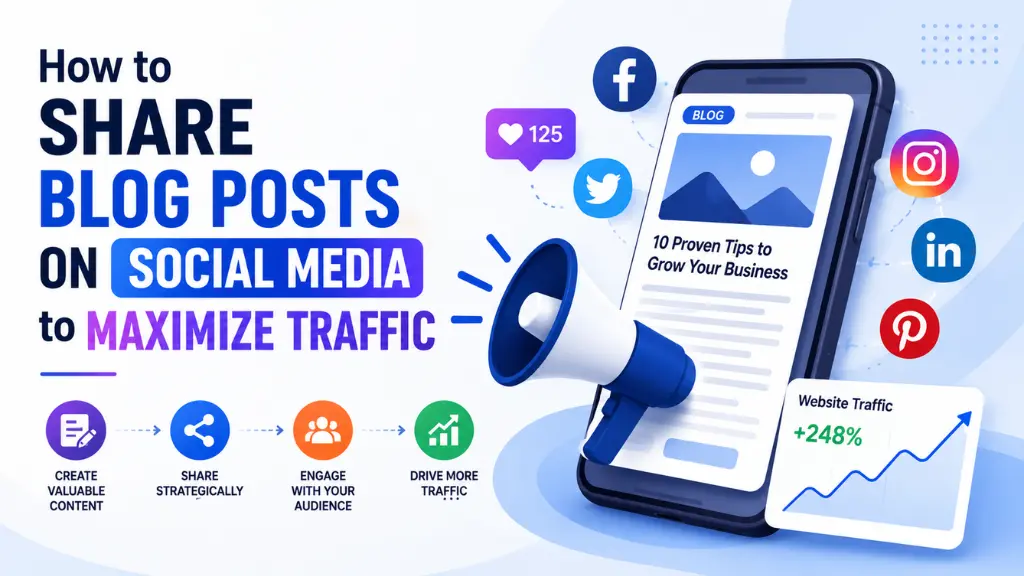

When you share blog posts on social media, you are making one of the most consequential decisions in your content marketing workflow – and most brands are making it the same way they did in 2019. One share on the day of publication. A link in the caption. Maybe a hashtag stack. Then nothing.
In this article10 sections
That approach produces a predictable result: a 24-hour traffic spike that fades to baseline, while the blog post sits earning whatever organic search traffic it manages without any ongoing promotional lift. Meanwhile, the same content – reframed, reformatted, redistributed, and republished – could be generating consistent referral traffic for weeks across multiple platforms.
At Search Savvy, content distribution is as central to our content strategy framework as content creation itself. We consistently see brands invest heavily in producing blog posts and minimally in promoting them. The ratio that actually drives sustainable blog traffic is closer to the reverse: for every hour spent writing, you should plan at least 30–45 minutes on distribution – and that distribution should extend well beyond the day of publication.
This guide gives you the platform-specific tactics and distribution systems that make social media blog promotion work in 2026 – not the “copy and paste your link” approach that every algorithm has been trained to deprioritise.
Why Is It Important to Share Blog Posts on Social Media in 2026?#
When you share blog posts on social media in 2026, you are doing more than generating referral traffic. You are creating the engagement signals – saves, shares, comments, DM forwards – that contribute to organic reach on every platform and that signal topical authority to Google’s quality evaluation systems.
The data from 2026 makes the urgency clear:
- Long-form blog posts get 56% more social media shares than content under 1,000 words (Backlinko/BuzzSumo analysis)
- 35.1% of marketers are actively repurposing content across channels in 2026 (HubSpot State of Marketing 2026)
- 40.6% of marketers are updating their social media SEO strategy in response to AI-driven search changes
- Blog posts promoted through social media generate meaningful backlink signals – social shares increase the probability that a post is seen by other content creators who may link to it
But the most important reason to share blog posts on social media in 2026 is not about referral traffic alone. Every AI crawler that indexes your blog post looks at entity signals, author credibility, and topical authority when deciding whether to cite it. Social media shares contribute to the brand visibility and third-party mention signals that AI citation systems use to evaluate trustworthiness. A blog post shared and engaged with across LinkedIn, Threads, and Instagram by a credible brand is more likely to appear in AI Overview citations than an identical post with no social distribution signal.
What Stops Most Blog Post Shares from Driving Traffic?#
Before building the right distribution system, it helps to understand why the default approach underperforms. When you share blog posts on social media without a deliberate strategy, these patterns consistently suppress the result:
The link-first problem. Every major platform’s algorithm suppresses posts that include external links in the caption – because the platforms want to keep users on-platform, not drive them away. A post that leads with a link in the first line is algorithmically disadvantaged before the first user ever sees it. Facebook’s organic reach for link posts is significantly lower than for text or image posts. LinkedIn’s algorithm has explicitly confirmed it deprioritises posts with external links in the body.
The direct repost problem. Posting the same content – same image, same caption, same hashtags – across Instagram, LinkedIn, Facebook, and Twitter simultaneously is recognisable to every platform’s algorithm and to users. Broken image dimensions, copy that references one platform’s features on another platform, and the same generic caption on every network all signal automation and low intent. Algorithms reduce distribution for content that reads as cross-posted from another platform.
The once-and-done problem. A single share on publication day reaches the fraction of your audience that happens to be online that day. Most social algorithms show any given post to 1–6% of your followers. One share reaches 1–6% of your audience – once. A structured promotion sequence reaches the same audience across multiple touch points over multiple weeks, dramatically increasing the probability of a click.
The no-hook problem. A link and a caption that reads “New blog post: [title]” provides no reason to click. It does not identify who the post is for, what problem it solves, or what the reader will know after reading it that they don’t know now. In an attention-scarce feed environment, “new post” is not a hook.
How Should You Share Blog Posts on LinkedIn in 2026?#
LinkedIn is where you should invest the highest energy when you share blog posts on social media – particularly for B2B brands, professional service businesses, and agencies. LinkedIn’s algorithm rewards text-forward, educational content from personal profiles more than from company pages, and organic reach on LinkedIn is substantially higher than on equivalent Meta properties.
The LinkedIn blog promotion format that drives clicks in 2026:
Do not post a link in the body. LinkedIn’s algorithm deprioritises posts containing external links. Instead, use this sequence:
- Open with the insight or hook – not “I wrote a blog post about X” but the most compelling, specific thing a reader will learn from the post. The opening line is visible in full before the “See More” fold and must compel the user to expand the post.
- Deliver value in the post itself – summarise 2–3 key points from the blog. LinkedIn users get value from the post directly; they do not click unless the post makes them want more.
- Add the link in the first comment – place the blog post URL in the first comment rather than the post body. This is the most widely-used LinkedIn distribution hack and it works. The post gets algorithm distribution without a link penalty; interested users find the link in the comments.
- Tag your post with 3–5 relevant hashtags at the end of the caption – LinkedIn hashtags serve as algorithm topic signals in 2026 (not discovery mechanisms; see the hashtag strategy post for context).
The redistribution sequence for LinkedIn:
- Day 1: LinkedIn post with insight hook + key takeaways (link in first comment)
- Week 2: LinkedIn carousel repurposing the blog’s framework or checklist
- Week 4–6: LinkedIn article (Pulse) – a shortened native version of the post for the users who prefer reading within LinkedIn rather than clicking out
How Should You Share Blog Posts on Instagram in 2026?#
Instagram is an image and video-first platform where direct blog links in captions do not drive clicks – because Instagram does not make caption links clickable. When you share blog posts on social media via Instagram, the strategy must acknowledge this constraint and work around it creatively.
The Instagram blog promotion formats that actually drive traffic in 2026:
Carousel format (highest engagement): Transform the blog post’s key points into a 7–10 slide carousel. Each slide covers one insight, framework step, or data point from the post. The final slide includes a clear CTA: “Full post in link in bio” or “DM me the word [keyword] and I’ll send you the link.” The carousel format generates the saves and swipe-throughs that trigger Instagram’s re-serve algorithm, extending the post’s reach beyond the initial 24-hour window.
Reels format (highest non-follower reach): A 30–60 second Reel that summarises the blog post’s central insight – not the full content, but the “why this matters” hook that makes a user want to read more. On-screen text overlays reinforce the key point for sound-off viewing. End with a strong CTA: “Link in bio for the full breakdown.” Reels get 3–5x more distribution to non-followers than any other Instagram format.
Instagram bio link management: Use a link-in-bio tool (Linktree, Beacons, or a custom landing page) that lists your 3–5 most recent blog posts rather than a single URL. This maximises the conversion rate on Instagram’s single-link allowance. Update it with every new post and each time you redistribute an older post.
The redistribution sequence for Instagram:
- Day 1: Reel (hook video) + bio link update
- Day 3: Carousel (key takeaways)
- Week 2: Story series (3–5 story slides with polls, questions, or opinion asks tied to the post’s topic)
- Week 4+: Repurpose as quote graphics, stat visuals, or “hot takes” from the post’s findings
How Should You Share Blog Posts on Facebook in 2026?#
When you share blog posts on social media via Facebook in 2026, the highest-ROI channel is Facebook Groups, not your business Page. Business Page organic reach averages 1–6% of followers. Group posts routinely reach 20–40% of members.
Facebook Groups blog promotion strategy:
If you manage or participate in relevant Facebook Groups, share blog posts as genuine community contributions – not promotional announcements. Frame the share around the community’s interest, not your publication:
“Been seeing a lot of questions in this group about [topic]. I wrote a breakdown of [specific insight] – sharing here in case it’s useful. The key finding was [one specific data point or insight]. Happy to answer questions in the comments.”
This framing works because it starts with community value and uses the blog post as the evidence, not the other way around.
Business Page sharing still matters for brand consistency and the secondary distribution that comes from followers sharing – but adjust expectations. Facebook Page posts with a direct link see minimal organic reach. The best-performing Page shares in 2026 use a native video or image post as the primary content, with the blog link in the first comment.
Employee amplification: Encourage team members to share blog posts on their personal Facebook profiles with their own commentary. Personal profile reach is significantly higher than business Page reach on Facebook, and an employee’s endorsement of company content reaches their personal network – an audience your business Page cannot access directly.
How Should You Share Blog Posts on Threads and X in 2026?#
When you share blog posts on social media across text-based platforms, both Threads and X serve different distribution functions.
Threads: Threads’ algorithm rewards conversational engagement – replies and genuine back-and-forth. The best format for blog promotion on Threads is a standalone opinion post or question that references the blog’s central insight, with the link in a reply to your own post:
“Hot take: most Indian brands are treating long-form content like a vanity project rather than a traffic asset. The data on what actually drives blog shares in 2026 is pretty different from what most content calendars assume. Thoughts?”
Follow that with a reply containing the blog link + one-sentence summary of the post. This structure gets the algorithm distribution of a link-free post while giving interested users the path to the full content.
X (Twitter): Post as a native thread – a multi-tweet breakdown of the blog’s key points – which generates 4.3x more impressions than single posts. The final tweet in the thread contains the blog link with a “Full post:” label. This format delivers the blog’s value natively on the platform while driving motivated readers to the source.
What Is the Blog Post Social Media Distribution Calendar?#
According to Search Savvy’s content distribution framework, a single blog post should follow a structured multi-week promotion sequence rather than a single-day share. This is the template we use:
Publication Day:
- LinkedIn text post (insight hook + key takeaways, link in first comment)
- X/Twitter thread (key points breakdown, link in final tweet)
- Instagram Reel (30–60 second hook video, link in bio)
- Bio link update (add post to link-in-bio tool)
- Threads text post (opinion/question framing, link in reply)
Day 3–5:
- LinkedIn carousel (visual breakdown of the blog’s framework or checklist)
- Instagram carousel (key insights from the post, CTA on final slide)
- Facebook Group share (community-value framing, if applicable)
Week 2:
- LinkedIn article (shortened Pulse version for in-platform readers)
- Instagram Story series (3–5 slides with interactive elements: polls, questions)
- Pinterest pin (relevant for evergreen how-to or tutorial content)
Month 1 and ongoing:
- Reshare on LinkedIn: a follow-up post with “what I’ve learned since writing this” angle
- Reshare updated statistics or insights as standalone posts
- Include in email newsletter with a new angle or commentary
- Repurpose key stats or quotes as standalone visuals for Instagram, LinkedIn, or Threads
This distribution calendar turns a single blog post into 10–15 social media pieces across a 30-day window – dramatically extending the traffic window beyond the initial publication spike.
How Do You Write Social Media Captions That Get Clicks on Blog Posts?#
When you share blog posts on social media, the caption determines whether users engage or scroll past. These are the caption structures that consistently drive clicks in 2026:
The Stat Hook: Lead with a specific, surprising data point from the blog. The stat creates cognitive curiosity – “I didn’t know that” – which is the most reliable clickthrough motivator.
“56% more social shares. That’s the difference between long-form and short-form blog content according to new research. Here’s what it means for your content calendar…”
The Contrarian Take: Open with a position that challenges a common belief. Disagreement is one of the strongest engagement triggers on every social platform.
“Most content marketing advice tells you to post more. But the brands generating the most blog traffic in 2026 are posting less – and distributing better. Here’s the difference…”
The Specific Outcome Promise: Lead with the result the reader achieves by reading the post. Specificity is credibility.
“After testing 200 blog post distribution sequences, this is the format that generated 3x more referral traffic than the standard ‘link-in-caption’ share…”
The Question Hook: Open with the specific question the blog answers – framed as the reader’s question, not the brand’s announcement.
“How do you get consistent traffic from blog posts you published six months ago? Here’s the distribution strategy that keeps older posts generating clicks…”
FAQ: How to Share Blog Posts on Social Media in 2026#
Q1: How often should you share a blog post on social media? A single blog post should be shared multiple times across a 30-day window, not just on publication day. A well-structured distribution sequence produces 10–15 platform-specific posts from a single blog post over a month – each formatted natively for its platform. Different formats (text post, carousel, Reel, story, thread) deliver different parts of the same content to the same audience across multiple touchpoints, dramatically increasing the probability of a click compared to a single share.
Q2: Should you put the blog link directly in your LinkedIn caption? No – LinkedIn’s algorithm deprioritises posts with external links in the body. The most effective LinkedIn distribution strategy places the blog link in the first comment rather than the caption. This preserves the algorithm’s organic distribution for the post while giving interested users a clear path to the full content. Use the caption to deliver genuine insight from the blog – a specific data point, key framework, or direct takeaway that makes the post valuable even without clicking.
Q3: Why don’t blog link posts on Instagram drive traffic? Instagram does not make caption links clickable – users cannot tap a URL in a caption and be redirected. The only clickable link is in the bio. The most effective Instagram blog promotion formats use visuals (carousels, Reels) to deliver key content insights from the post, with a consistent CTA directing interested users to the “link in bio.” A well-structured Reel or carousel can drive significant bio link clicks from users motivated by the in-post value to read more.
Q4: What type of caption drives the most clicks on social media blog posts? Specific, curiosity-generating hooks consistently outperform generic “new post” announcements. The most effective caption formats in 2026 are: stat hooks (a specific surprising data point from the post), contrarian takes (a position that challenges a common belief), specific outcome promises (the result the reader achieves), and question hooks (the specific question the post answers, framed from the reader’s perspective). The caption should deliver standalone value – not just describe the post, but give the reader a reason to want more.
Q5: Does sharing blog posts on social media improve SEO? Indirectly – and significantly in 2026. Social media shares increase the probability that a post is seen by other content creators who may link to it, contributing to backlink acquisition. Shares also contribute to the brand visibility and third-party mention signals that AI citation systems evaluate when deciding whether to cite a page in AI Overviews. Additionally, social engagement signals (saves, shares, time on page from social traffic) contribute to the user engagement metrics that Google evaluates as content quality signals. Social distribution and SEO are not separate strategies – they reinforce each other.
Q6: What is the best time to share blog posts on social media? Optimal posting times vary by platform and audience, but general 2026 benchmarks: LinkedIn performs best on Tuesday–Thursday mornings (8–10 AM in your audience’s time zone); Instagram peaks on Monday–Wednesday and Friday afternoons; Facebook sees highest engagement on Wednesday at 11 AM and 1 PM; Threads is less time-sensitive and rewards conversational engagement throughout the day. More important than time is consistency – a post published at the “wrong” time that earns high engagement will be distributed by the algorithm regardless of the hour.
The Bottom Line#
When you share blog posts on social media effectively, you are not just promoting a piece of content – you are building the distribution infrastructure that makes your content strategy compound over time. Every blog post that gets distributed across multiple platforms in multiple formats reaches more of your audience, generates more engagement signals, creates more backlink opportunities, and contributes more to the AI citation signals that determine whether your content appears in AI Overviews.
The brands generating consistent blog traffic in 2026 are not the ones publishing the most content. They are the ones treating distribution as a system rather than an afterthought – a structured sequence of platform-specific formats, strategic caption hooks, and deliberate redistribution windows that extract the full traffic value from every post they publish.
Publishing without distributing is like printing a magazine and not putting it on shelves. The content is there. The audience just never finds it.
At Search Savvy, the content distribution calendar we build for clients consistently doubles the traffic impact of their blog content within 90 days – not by publishing more, but by promoting what already exists with the platform intelligence that the 2026 algorithm environment demands. If you want a customised blog distribution strategy for your brand, reach out to the Search Savvy team.