

Someone asked ChatGPT a question about your industry this week. It gave a confident, detailed answer, citing three sources. Your brand was not one of them – even though your website ranks on page one of Google for the exact same query.
This is happening to businesses across every industry right now, and most have no idea it is occurring because it leaves no trace in their analytics. Research shows that only 10% of what ChatGPT cites for a given query appears in Google’s top 10 organic results. Ranking well on Google and being cited by AI are no longer the same achievement – and the gap between them is where Generative Engine Optimization (GEO) lives.
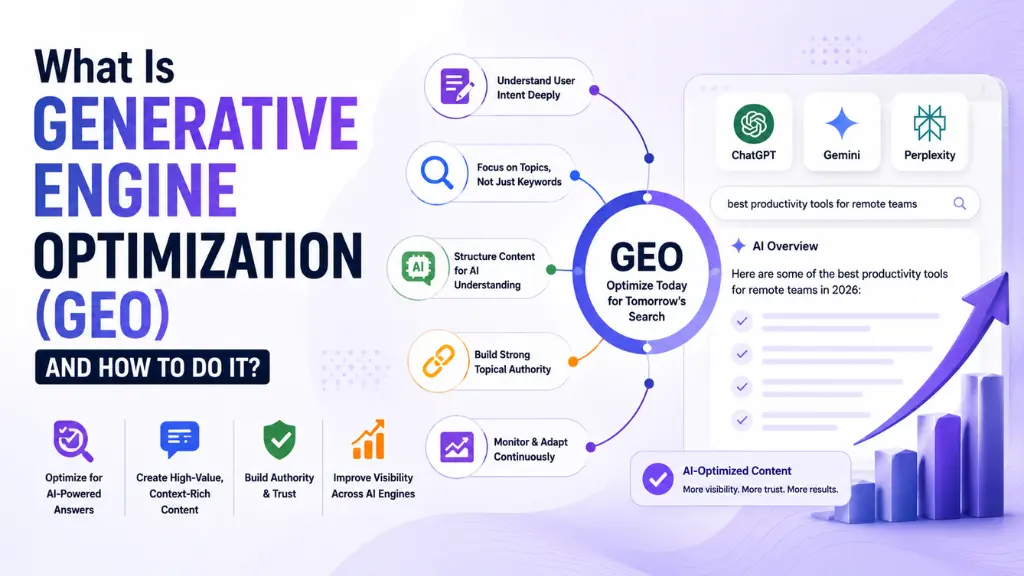
Generative Engine Optimization (GEO) is the practice of structuring content so AI engines like ChatGPT, Perplexity, Gemini, Claude, and Google’s AI Overviews retrieve, cite, and recommend it inside their generated answers. It is the next evolution of organic visibility – not a replacement for SEO, but a parallel discipline with its own rules, its own evaluation criteria, and its own measurement framework.
At Search Savvy, we have watched Generative Engine Optimization (GEO) move from a niche technical curiosity to a board-level marketing priority within about eighteen months. This article explains exactly what GEO is, why it has become urgent in 2026, and the specific, actionable tactics that determine whether AI engines cite your brand or quietly cite your competitor instead.
What Is Generative Engine Optimization (GEO)?
Generative Engine Optimization (GEO) is the practice of optimizing content to appear as a source and citation in AI-generated responses from platforms like ChatGPT, Perplexity, Google AI Overviews, and Claude – rather than optimizing purely for ranked positions on a traditional results page.
The fundamental distinction from SEO is structural. Traditional SEO optimizes for rankings and clicks. GEO optimizes for mentions, citations, and recommendations inside AI-generated answers. Where SEO wins by ranking on a results page, GEO wins by becoming the citation inside an AI-generated answer. A page can rank poorly in Google and still be cited heavily by an AI engine, or rank well in Google and never be cited at all – these are genuinely separate evaluation systems, even though they share underlying content quality principles.
Generative Engine Optimization (GEO) is also known by several overlapping names in the industry – AEO (Answer Engine Optimization), LLMO (Large Language Model Optimization), GSO, or AIO – though GEO has become the most widely adopted term. AEO, which originally focused specifically on voice search and featured snippets, is now largely subsumed by GEO, since most voice queries today route through AI systems using the same generative response mechanisms that power chat-based AI search.
The engines in scope for Generative Engine Optimization (GEO) span a genuinely wide ecosystem: ChatGPT, Perplexity, Gemini, Microsoft Copilot, Claude, Grok, Meta AI, DeepSeek, and Google’s AI Overviews and AI Mode. Each of these platforms retrieves and evaluates content somewhat differently, which is why a comprehensive GEO strategy cannot optimise for a single model or interface – the goal is being seen, trusted, and reused wherever people search for answers.
People Also Ask: What does GEO stand for in digital marketing? Short Answer: GEO stands for Generative Engine Optimization – the practice of structuring content so that AI engines such as ChatGPT, Perplexity, Gemini, and Google AI Overviews retrieve, cite, and recommend it within their generated answers. It is also sometimes called AEO (Answer Engine Optimization), LLMO (Large Language Model Optimization), or AIO, though GEO has become the most widely used industry term as of 2026.
Why Is Generative Engine Optimization (GEO) Important in 2026?
Generative Engine Optimization (GEO) has become urgent in 2026 because the scale of AI-mediated search has crossed a threshold that businesses can no longer treat as a future concern.
The data behind this shift is substantial. ChatGPT now processes over 1 billion queries per week, with its integrated browsing and citation features turning it into a primary research tool for consumers and professionals alike. Google AI Overviews appear on more than 47% of all Google searches, pushing traditional organic results below the fold for a significant share of queries. Perplexity has established itself as a dedicated “answer engine,” growing to over 150 million monthly active users who rely specifically on its cited, synthesised answers rather than a traditional list of links.
This shift represents a structural change in buyer behaviour, not a passing trend. Gartner projects traditional search volume will decline 25% by 2026 as queries shift toward conversational AI interfaces. For B2B specifically, a significant and growing share of buyers now use AI tools like ChatGPT or Perplexity during vendor research – meaning a brand absent from AI-generated answers is invisible to a growing share of buyers at the exact moment they are deciding who to consider.
Generative Engine Optimization (GEO) also carries a distinct strategic advantage right now that will not last indefinitely: early movers capture citation share while competition is low. Citation authority, much like domain authority before it, compounds over time – meaning brands that establish strong citation patterns in 2026 are positioned to remain the AI’s preferred source well into 2027 and 2028, simply because of how reinforcement and consistency work within these retrieval systems.
People Also Ask: Why is GEO becoming more important than traditional SEO in 2026? Short Answer: GEO is not replacing SEO – it is becoming equally important alongside it because AI-mediated search now represents a substantial and growing share of how people find information. Google AI Overviews appear on more than 47% of all Google searches, ChatGPT processes over 1 billion queries weekly, and Gartner projects traditional search volume will decline 25% by 2026 as queries shift to conversational AI. Businesses absent from AI-generated answers are losing visibility at exactly the research moment that increasingly determines buyer decisions.
How Does Generative Engine Optimization (GEO) Actually Work?
Generative Engine Optimization (GEO) functions through a retrieval mechanism fundamentally different from how traditional search engines rank pages – and understanding this mechanism is the foundation for every tactic that follows.
Most modern AI engines use RAG (Retrieval-Augmented Generation): they first retrieve relevant documents from the web or an indexed corpus, then generate a response that cites selected sources from that retrieved set. Factors influencing which sources get selected for citation include content comprehensiveness, structural clarity, factual specificity with verifiable data, source credibility, and consistency of information across multiple platforms.
A critical mechanism specific to how AI engines process complex questions is the concept of fan-out queries. When someone asks an AI a complex, multi-part question, the AI breaks it into smaller sub-queries and searches for each one separately. For example, a question like “What is the best email marketing platform for a small e-commerce business with under 10,000 subscribers?” might internally generate separate searches for “best email marketing platforms 2026,” “email marketing e-commerce features,” and “email marketing pricing small business.” This means Generative Engine Optimization (GEO) requires content that ranks for these shorter, more specific sub-queries individually – not just the long, complete question a user actually typed.
AI systems that use real-time retrieval, like Perplexity and Google AI Overviews, evaluate a page’s relevance heavily based on its opening content – meaning the first few sentences or paragraphs of a page carry disproportionate weight in citation decisions, since the retrieval system needs to quickly assess relevance before committing to citing a full source.
People Also Ask: What are fan-out queries and why do they matter for GEO? Short Answer: Fan-out queries are the sub-queries an AI engine internally generates when breaking down a complex user question before searching for an answer. For example, a long question about the best software for a specific business scenario might be broken into several shorter, separate searches covering different aspects of that question. Generative Engine Optimization (GEO) requires content that can be retrieved for these individual sub-queries – not just the complete original question – meaning comprehensive content covering each component of a topic separately tends to perform better for AI citation than content addressing only the broad, combined question.
What Are the Core Pillars of Generative Engine Optimization (GEO)?
Generative Engine Optimization (GEO) is generally built around six core pillars – content structure, schema markup, entity optimization, authority signals, semantic coverage, and citation building – and mastering each one positions a business as the kind of authoritative source that AI systems trust and recommend.
Content Structure for Extraction
Generative Engine Optimization (GEO) rewards content that is structurally easy for an AI system to parse and extract. Keep paragraphs short – two to three sentences maximum. Long blocks of text are harder for AI to parse and less likely to be extracted as a citation. This is one of the areas where GEO differs most clearly from traditional SEO writing conventions, which historically tolerated longer paragraphs for human readability.
Clear headers, Q&A formatting, structured data, and quotable statements increase both traditional rankings and AI citations simultaneously – meaning well-structured content is not a trade-off between human readers and AI systems, but a genuine improvement for both when done correctly.
Schema Markup and Technical Infrastructure
Generative Engine Optimization (GEO) depends partly on the same technical foundation that supports traditional SEO. Structured data – Organisation schema, Article schema with named author attribution, FAQ schema, and Product schema where relevant – helps AI systems understand exactly what your content represents and who is responsible for it, supporting both citation eligibility and the entity-recognition systems increasingly important to AI search.
Entity Optimization
Generative Engine Optimization (GEO) requires that your brand exists as a clearly defined, verifiable entity across the web – not just as text on your own website. This means consistent business information (name, description, key facts) across your website, Wikipedia or Wikidata entries where applicable, LinkedIn, Crunchbase, and industry directories. AI systems cross-reference entity information across multiple sources when evaluating whether a brand is a credible, citable authority on a topic.
Authority Signals
Generative Engine Optimization (GEO) is built on language, entity recognition, and the ability of AI models to confidently cite your content as a source of truth – and confidence requires verifiable authority signals. Named author attribution with demonstrable expertise, original data and research that did not exist elsewhere before your publication, and a consistent publishing history in a specific topic area all contribute to the authority signal that distinguishes a citable source from a generic one.
Semantic Coverage
Generative Engine Optimization (GEO) rewards content that comprehensively covers a topic’s full semantic range – not just the primary keyword, but the related concepts, terminology, and sub-questions a knowledgeable person discussing that topic would naturally address. This directly supports the fan-out query mechanism described earlier: covering a topic’s full semantic breadth increases the likelihood your content is retrieved for any of the multiple sub-queries an AI might generate from a single complex question.
Citation Building
Generative Engine Optimization (GEO) is reinforced when other credible sources reference your content or brand – similar in principle to backlinks in traditional SEO, but extending to mentions, citations, and references across the broader web that AI systems use as cross-validation signals when assessing source credibility.
People Also Ask: What are the six core pillars of GEO? Short Answer: The six core pillars of Generative Engine Optimization (GEO) are: content structure (short paragraphs, clear headers, Q&A formatting), schema markup (structured data supporting AI content understanding), entity optimization (consistent brand information across the web), authority signals (named expertise, original data, publishing consistency), semantic coverage (comprehensively addressing a topic’s full conceptual range), and citation building (earning mentions and references from other credible sources).
How Does Each Major AI Platform Evaluate Content Differently?
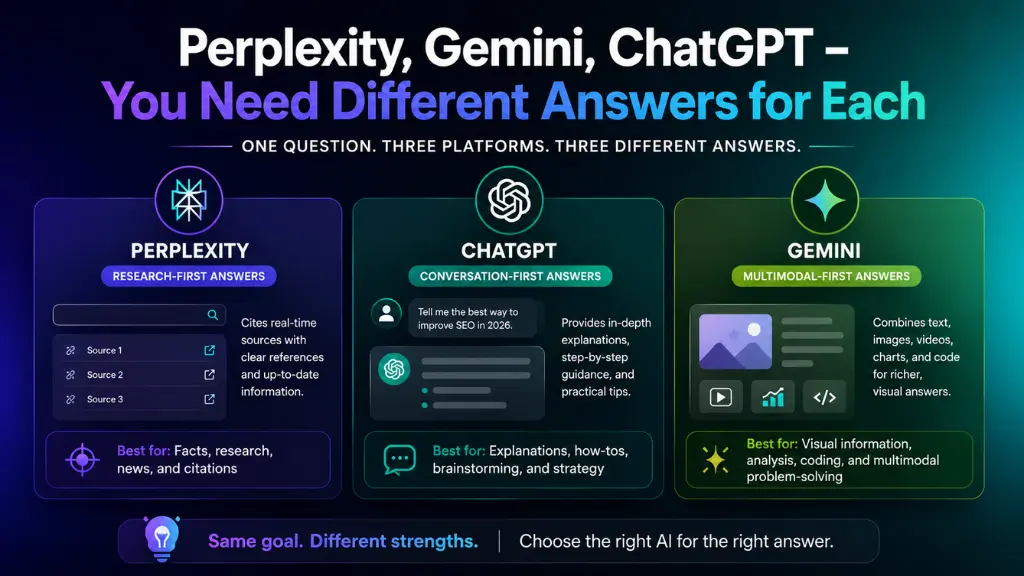
Generative Engine Optimization (GEO) cannot use a single, identical strategy across every platform, because each major AI engine retrieves and evaluates sources somewhat differently.
ChatGPT with integrated browsing draws heavily on a combination of its training data and live web retrieval, with citation patterns that are less publicly documented than some competitors but generally favour comprehensive, well-structured content from established sources.
Perplexity is heavily citation-focused and uses real-time web retrieval as its core mechanism – meaning fresh, frequently updated content with clear, extractable answers performs particularly well on this platform specifically, since Perplexity’s entire product positioning is built around transparent, visible sourcing.
Google AI Overviews and AI Mode draw from Google’s existing search index and ranking systems, meaning strong traditional SEO performance remains a meaningful (though not exclusive) advantage for AI Overview citation – pages that rank poorly in Google often struggle in AI citations too, reinforcing that GEO should layer on top of solid SEO fundamentals, not replace them.
Claude and Gemini also cite sources when generating answers, though their citation patterns are less extensively documented publicly compared to ChatGPT and Perplexity, making consistent, broad-based GEO practice (rather than platform-specific gaming) the more reliable long-term strategy.
Agentic search is an emerging and increasingly important category. AI-powered agents – such as OpenAI’s Operator, launched in January 2026 – go beyond simply answering questions; they browse the web, compare options, and complete tasks on behalf of users. As agentic search matures, content with structured, machine-readable information – clear pricing tables, feature comparisons, step-by-step instructions – becomes increasingly important for inclusion in these agent-driven workflows specifically.
People Also Ask: Do I need a different GEO strategy for ChatGPT versus Perplexity? Short Answer: The core principles overlap significantly, but some platform-specific nuance matters. Perplexity is heavily citation-focused with real-time retrieval, rewarding fresh, frequently updated, clearly sourced content particularly strongly. Google AI Overviews draw substantially on existing Google search rankings, meaning traditional SEO performance remains a meaningful advantage there specifically. ChatGPT and Claude favour comprehensive, well-structured, authoritative content more generally. A strong, broad-based GEO foundation performs reasonably across all platforms, with platform-specific refinements adding incremental advantage rather than requiring entirely separate strategies.
How Do You Actually Implement Generative Engine Optimization (GEO)?
Generative Engine Optimization (GEO) implementation follows a structured, repeatable process. The tactics are genuinely accessible – they do not require entirely new skills, only a shift in how existing content practices are applied.
Structure content to answer questions directly. Lead with the direct answer to the implied question in the first one to two sentences of any section, before providing supporting context and detail. This “answer-first” structure is the single highest-leverage formatting change for GEO, since it matches exactly how AI systems extract concise, citable answers from longer content.
Include original data wherever possible. Original research, internal benchmarks, proprietary survey data, and first-hand case studies are significantly more citable than synthesised summaries of information that already exists across the web – because AI engines specifically value the kind of factual specificity with verifiable data that only original sources can provide.
Build named author authority. Every piece of content should be attributed to a real, named individual with demonstrable expertise and a linked professional profile. This supports both the authority signal AI systems evaluate and the broader E-E-A-T principles that increasingly govern both traditional SEO and GEO simultaneously.
Earn third-party citations and mentions. Actively pursue genuine references from other credible sources in your industry – guest contributions, expert quotes in other publications, and citations from research or news outlets all reinforce the cross-source validation signal AI systems use when assessing credibility.
Publish consistently in a defined topic area. Consistency of information across platforms and over time builds the kind of established authority pattern that AI systems learn to trust and return to repeatedly, rather than treating each new piece of content as an isolated, unverified claim.
Maintain SEO fundamentals alongside GEO-specific tactics. Pages that rank poorly in Google often struggle in AI citations too. GEO should be layered on top of strong technical SEO, quality content, and credibility signals – not pursued as a separate, disconnected discipline.
According to Search Savvy’s insights from implementing GEO strategy across client content programmes, the single highest-impact starting point for most businesses is restructuring their existing highest-traffic content into the answer-first, short-paragraph format that AI systems extract most readily – before investing in entirely new content production. Much of the GEO opportunity in 2026 lies in re-engineering content that already exists, not exclusively in creating new content from scratch.
People Also Ask: What is the fastest way to start with Generative Engine Optimization (GEO)? Short Answer: The fastest, highest-impact starting point is restructuring existing high-traffic content into an answer-first format – leading each section with a direct, concise answer in the first one to two sentences, followed by supporting detail, with paragraphs kept to two to three sentences maximum. This single structural change significantly improves how readily AI systems can extract and cite your existing content, often before any new content production or technical implementation is required.
What Should You Avoid When Implementing Generative Engine Optimization (GEO)?
Generative Engine Optimization (GEO) has a documented failure mode that businesses should actively avoid: content overly structured for AI extraction – endless bullet points, robotic phrasing, repetitive formatting – frustrates human readers who find it through any other channel.
This is a meaningful and practical warning. The same content needs to genuinely serve both human readers arriving through traditional search and AI systems retrieving content for citation. Optimising exclusively for one audience at the expense of the other ultimately undermines both – content too robotic to read naturally will also see weaker engagement signals that feed back into traditional ranking, while content written purely for human flow without any structural clarity will be harder for AI systems to extract cleanly.
The other critical discipline Generative Engine Optimization (GEO) requires is ongoing monitoring rather than treating it as a one-time project. AI platforms continuously update their models, retrieval systems, and citation patterns – what works today may be less effective tomorrow. Building systems for ongoing monitoring and optimisation, rather than a single GEO “project” with a defined endpoint, reflects the genuinely dynamic nature of how these platforms evolve.
People Also Ask: Can GEO content be too optimised, and does that hurt performance? Short Answer: Yes. Content overly structured purely for AI extraction – excessive bullet points, robotic phrasing, repetitive formatting patterns – can frustrate human readers who arrive through traditional search or direct links, even if that same structure technically improves AI citation eligibility. The most effective Generative Engine Optimization (GEO) content balances clear, extractable structure with genuinely natural, readable prose – serving both human and AI audiences rather than optimising exclusively for one at the expense of the other.
How Do You Measure Whether Generative Engine Optimization (GEO) Is Working?
Generative Engine Optimization (GEO) requires its own measurement framework, distinct from traditional SEO analytics, because a citation inside an AI-generated answer often produces brand exposure without any corresponding click or session in your website analytics.
A page might generate significant brand influence through AI citations without driving direct traffic – meaning relying purely on GA4 traffic data will systematically undercount your actual AI visibility. The GEO-specific measurement framework includes:
- Citation frequency tracking – Manually or through specialised tools, regularly testing how often your brand or content is cited when relevant queries are posed directly to ChatGPT, Perplexity, Gemini, and other major platforms.
- Brand mention tracking – Monitoring whether your brand name appears in AI-generated responses even without a direct link or citation, since unlinked brand mentions still carry meaningful awareness value.
- Sentiment analysis in AI responses – Understanding not just whether you are mentioned, but how positively or accurately your brand is represented when it does appear, since AI systems can summarise or characterise a brand inaccurately even while citing it.
- GA4 referral tracking – Where AI platforms do drive click-through traffic (Perplexity and ChatGPT both can generate referral traffic when users click through a citation), tracking this segment separately from traditional organic search traffic provides a partial, supplementary data point.
These metrics together help you understand not just whether you are visible to AI systems, but how your brand is being positioned inside their generated responses – distinct questions that traditional SEO reporting was never built to answer.
People Also Ask: How do I measure if my content is being cited by AI engines like ChatGPT? Short Answer: Since AI citations frequently do not generate trackable website traffic, measurement requires a combination of manual and tool-assisted testing: regularly querying ChatGPT, Perplexity, and other major AI platforms with questions relevant to your industry to observe whether and how your brand is cited, tracking brand mention frequency even without a direct citation link, and monitoring any referral traffic that does flow through from AI platforms in GA4. Dedicated GEO monitoring tools have also emerged in 2026 to automate and scale this tracking process.
FAQ: Generative Engine Optimization (GEO) – Your Questions Answered
Q1: Is Generative Engine Optimization (GEO) replacing traditional SEO? No – GEO and traditional SEO work together rather than competing. Strong SEO creates the foundation (technical accessibility, quality content, credibility signals) that AI systems rely on when deciding which brands to reference. Pages that rank poorly in Google often struggle in AI citations too. The clearest way to frame the relationship is as a hierarchy: GEO sits inside the broader discipline of AI SEO as one specific way to improve visibility within generative systems, building on top of – not replacing – established SEO fundamentals.
Q2: How long does it take to see results from Generative Engine Optimization (GEO)? There is no universally fixed timeline, but the competitive dynamic of GEO in 2026 favours early movers specifically because citation authority compounds similarly to domain authority – meaning brands that begin investing now are positioned to remain the preferred AI source over time, with the advantage growing rather than diminishing the longer consistent practice continues. As with traditional SEO, content that is freshly published or recently restructured for GEO typically requires several weeks to months before AI platforms’ retrieval and citation patterns reflect the changes, depending on how frequently each specific platform refreshes its indexed content.
Q3: Does GEO require completely different content from what I already publish for SEO? Not entirely – much of the highest-impact GEO work involves restructuring existing content rather than creating entirely new material. Reformatting current high-traffic pages into shorter paragraphs, answer-first sections, and clear Q&A structures, while adding schema markup and named author attribution, can meaningfully improve AI citation eligibility without a full content rebuild. New content investment becomes more important specifically for adding original data, research, and case studies that genuinely do not exist elsewhere – content that purely restructures existing publicly available information has a lower ceiling for AI citation than content offering genuine information gain.
Q4: Which industries benefit most from investing in Generative Engine Optimization (GEO) right now? Industries where buyers conduct significant research before a purchase or decision – B2B software, professional services, healthcare, financial services, and considered-purchase consumer categories – see particularly strong GEO returns, since these are exactly the research-heavy moments where AI tools like ChatGPT and Perplexity are increasingly used for vendor and product comparison. However, the competitive window argument applies broadly across nearly all industries in 2026: most brands in most sectors have not yet invested meaningfully in GEO, meaning early movers in almost any category can capture disproportionate citation share while competition remains comparatively low.
Q5: Can small businesses realistically compete with larger brands for AI citations? Yes, more realistically than many assume. Unlike traditional domain authority, which heavily favours older, larger sites with extensive backlink histories, AI citation evaluation weighs factors like content comprehensiveness, structural clarity, and factual specificity quite heavily – meaning a smaller business with genuinely original data, clear expert authorship, and well-structured content can compete for citations on specific, well-covered topics even against larger competitors with broader but less specific content. Niche focus and genuine first-hand expertise are particularly strong GEO assets for smaller businesses.
Q6: What tools are available to help execute Generative Engine Optimization (GEO) in 2026? The GEO tools market has matured rapidly through 2026, with dedicated platforms now offering AI-readiness audits scoring content structure, citation-worthiness, and technical factors, alongside citation tracking tools that monitor brand mentions across ChatGPT, Perplexity, Gemini, and other platforms automatically. Beyond dedicated GEO tools, much of the implementation work overlaps with existing SEO infrastructure – schema markup tools, content structure analysis, and standard analytics platforms like GA4 all remain relevant, supplemented by manual testing across AI platforms as a reliable, accessible starting measurement approach for businesses not yet ready to invest in dedicated GEO software.
Wondering whether your brand is actually visible to ChatGPT, Perplexity, and Google’s AI Overviews – or quietly invisible while your competitors get cited? Visit Search Savvy for a Generative Engine Optimization (GEO) audit that tests your current AI visibility and builds a clear roadmap to earn the citations your content deserves.