Perplexity, Gemini, ChatGPT – You Need Different Answers for Each
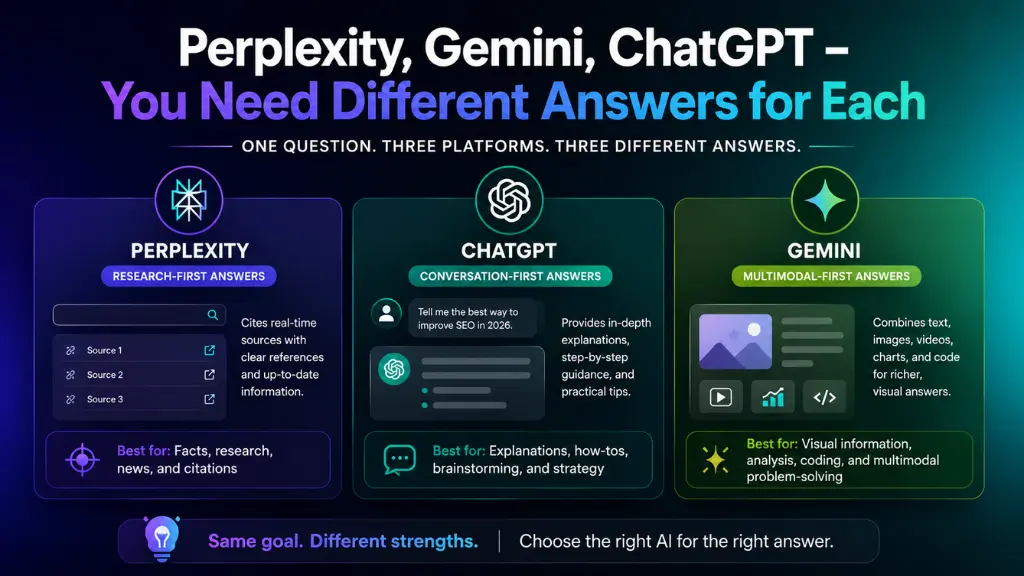

A multi-platform GEO strategy is no longer optional for brands that care about discoverability – and in 2026, that means every brand. ChatGPT now serves 800 million weekly active users. Gemini surpasses 750 million monthly users – plus 2 billion additional users reached through Google AI Overviews. Perplexity handles roughly 780 million monthly queries. Claude reaches 30 million users with the highest average session value ($4.56) among all AI assistants. Together, these four platforms represent a discovery layer that reaches more people than most traditional search strategies are built to compete in.
In this article12 sections
And here is the part most content strategies miss entirely: each of these platforms cites content for completely different reasons. A piece of content that ranks highly in ChatGPT responses may be invisible in Perplexity. A brand that Google Gemini treats as authoritative may not appear at all in Claude’s answers. Optimising for one platform without understanding the others is not a partial strategy – it is a strategy that guarantees partial invisibility.
At Search Savvy, Generative Engine Optimisation (GEO) is now a standard component of content and technical strategy work – because the clients who ask “why isn’t our brand appearing in AI answers?” almost always have the same root cause: they are either optimising for none of the AI platforms, or they are treating all of them as one system when they are four fundamentally different citation engines.
This post covers what each major AI platform actually rewards, how a multi-platform GEO strategy accounts for those differences, and the measurement infrastructure that tells you whether it is working.
What Is Multi-Platform GEO Strategy and How Does It Work?#
Multi-platform GEO strategy is the practice of structuring, writing, and distributing content to earn citations across multiple AI search engines simultaneously – recognising that each platform uses different data sources, different authority signals, and different content preferences to decide what to include in its generated answers.
The academic foundation of GEO was established in a November 2023 Princeton University research paper. The strategic evolution since then has been rapid: ChatGPT Search now captures 18% of all queries according to Similarweb 2026 data. AI-referred visitors convert at 23x higher rates than organic search visitors. 47% of B2B buyers use AI for vendor research. Sites with comprehensive schema markup appeared in 47% more Perplexity responses than unstructured competitors in documented testing.
The goal of GEO is different from traditional SEO in a specific and important way: SEO optimises for ranked link positions in search results. GEO optimises for inclusion in an AI-generated answer – a citation, a mention, a quoted response. Success is not measured by click-through rate but by citation frequency and brand mention share of voice across AI platforms.
But the critical 2026 insight is that GEO and SEO are not separate disciplines. AI platforms pull from indexed web content – meaning crawlability, content quality, and authority signals from traditional search remain the foundation that multi-platform GEO extends, not replaces.
How Does ChatGPT Decide What to Cite in 2026?#
Multi-platform GEO strategy for ChatGPT requires understanding a citation model built around domain reputation, readability, and conversational alignment.
ChatGPT’s knowledge base is a combination of its training data (with a knowledge cutoff) and, for ChatGPT Search, real-time web retrieval via Bing and its own web browsing capability. This creates two distinct citation pathways:
For ChatGPT’s base knowledge responses (non-search mode): The content that influenced ChatGPT’s training was selected heavily on the basis of domain authority, citation by other credible sources, and breadth of online coverage. Brands with strong Wikipedia entries, Wikidata entity pages, academic or industry citations, and wide third-party brand coverage are disproportionately present in ChatGPT’s knowledge base.
For ChatGPT Search (real-time web retrieval): ChatGPT Search uses Bing’s crawling infrastructure. The key citation signals are:
- Domain authority – established, high-DA domains are preferred over newer sites
- Clear, direct answer passages in the first section of the page – ChatGPT extracts short, factual passages
- Readability – sentence length, active voice, and 8th-grade reading level
- Content freshness – recently updated pages receive higher retrieval priority for time-sensitive queries
What to optimise specifically for ChatGPT citations:
- Build a Wikipedia or Wikidata entity entry for your brand – this is the single most reliable way to establish existence in ChatGPT’s base knowledge
- Ensure third-party coverage in publications that Bing indexes well (industry blogs, press, trade publications)
- Structure each page with a clear, direct answer to the primary query in the opening paragraph – conversational, plain language, under 150 words
- Ensure high Bing SEO performance – ChatGPT Search is powered by Bing; ranking well on Bing is ranking well in ChatGPT Search
How Does Perplexity Decide What to Cite in 2026?#
Multi-platform GEO strategy for Perplexity is the most citation-transparent optimisation target available – because Perplexity explicitly shows its sources alongside every answer. This transparency makes it the most direct feedback mechanism for GEO performance.
Perplexity is a real-time web search engine that performs fresh web searches for every query, synthesises results into an answer, and shows sources. It is not operating from a static training corpus – it searches now, evaluates now, and cites now. This means:
- Content freshness is a primary signal – Perplexity has a preference for recent, updated content and has faster indexation (1–2 weeks for fresh content) than some competing platforms
- Verifiable citations are rewarded – Perplexity’s users are sophisticated; they check sources. Pages that cite primary data, link to original research, and contain specific, verifiable claims earn higher trust scores
- Clear attribution signals matter – pages with named authors, credible publication identities, and explicit publication dates are preferred
- Source quality weighting – Perplexity has a documented preference for specialist content: specialist blogs (39%), news outlets (26%), professional opinion (35%) according to 2026 analysis
Perplexity is described as the most accessible platform for specialised content creators – meaning brands that publish deep, niche-specific content in a specific domain consistently outperform broad-topic generalist sites in Perplexity citation rates.
What to optimise specifically for Perplexity citations:
- Publish content that contains specific, verifiable data with source links – Perplexity rewards citations that themselves cite sources
- Update your most important pages regularly – freshness is a stronger signal on Perplexity than on ChatGPT’s knowledge base
- Build domain expertise signals: a specialist blog covering a focused topic area in depth consistently outperforms a broad website covering many topics shallowly
- Ensure your site is crawlable without JavaScript-dependent content (Perplexity’s crawler does not execute JavaScript)
- Structure content with clear factual passages, numbered lists, and defined terms – Perplexity’s answer synthesis prioritises structured information extraction
How Does Google Gemini Decide What to Cite in 2026?#
Multi-platform GEO strategy for Gemini is the most familiar territory for traditional SEO practitioners – because Gemini inherits Google’s core ranking infrastructure. If you rank well in Google Search, you have the strongest possible foundation for Gemini citation eligibility.
Gemini is Google’s AI assistant, powered by Google’s Gemini model and integrated with Google’s search index. Its citation behaviour follows Google’s quality evaluation framework closely:
- E-E-A-T signals – Experience, Expertise, Authoritativeness, and Trustworthiness signals that have underpinned Google’s quality evaluation since 2014 are the primary filter for Gemini citation eligibility
- Knowledge Graph entity recognition – Gemini’s answers are heavily shaped by Google’s Knowledge Graph. Brands with strong entity signals (Wikipedia, Wikidata, Organisation schema with SameAs links, Google Business Profile) are treated as verified, trustworthy sources
- Schema markup – Gemini uses structured data extensively. Organization, Person, Article, and FAQPage schema directly influence how Gemini categorises and cites your content
- Core Web Vitals and page experience – as a Google product, Gemini inherits Google Search’s preference for fast, well-structured, mobile-friendly pages
Gemini uses a distributed source preference: specialist blogs contribute about 39% of citations, news outlets 26%, and professional opinion content 35%.
What to optimise specifically for Gemini citations:
- Traditional SEO and technical optimisation is the primary GEO strategy for Gemini – rank well in Google, get cited by Gemini
- Ensure comprehensive schema markup: Organization (with SameAs links to Wikidata and LinkedIn), Article (with named author and Person schema), and FAQPage for Q&A content
- Build your Google Knowledge Panel presence through Wikipedia entity creation, Wikidata entry, and consistent NAP data across authoritative directories
- Update pages with dateModified timestamps – Gemini evaluates content freshness as part of its quality assessment
- Target AI Overviews specifically: a citation in Google AI Overviews is a Gemini citation – the same signals that earn AI Overview inclusion earn Gemini citation
How Does Claude Decide What to Cite in 2026?#
Multi-platform GEO strategy for Claude operates on a fundamentally different principle than the other three platforms. Claude uses Brave Search as its retrieval infrastructure and has the most distinctive citation philosophy of any major AI assistant.
Claude’s citation signals:
- Multi-source verification – Claude has a strong preference for claims that can be corroborated across multiple independent sources. Content that makes a specific claim well-supported by other credible sources is cited more reliably than equally well-written content making the same claim in isolation
- Non-promotional content – Claude actively deprioritises content that reads as promotional, marketing-focused, or brand-forward. It prefers balanced, informational content that presents multiple perspectives
- Brave Search indexation – Claude retrieves content from Brave’s independent web index, not Google’s or Bing’s. For brands optimised only for Google and Bing, significant technical gaps in Brave’s coverage can exist. Ensuring your site is crawlable and well-structured for Brave’s crawler is a GEO-specific technical action
- Session value alignment – Claude has the highest average session value ($4.56) of any AI assistant, indicating its user base is more research- and decision-oriented than the average AI user. This amplifies the value of being cited in Claude responses for B2B and high-consideration B2C brands
What to optimise specifically for Claude citations:
- Write with balance and objectivity – promotional tone is the fastest way to be excluded from Claude’s citation set
- Build corroboration: multiple credible sources citing your brand’s specific claims dramatically increase Claude’s citation confidence
- Ensure Brave Search crawlability – verify your site appears in Brave Search for your key queries
- Present evidence: data-backed, cited content is preferred over assertion-based content
What Does a Complete Multi-Platform GEO Strategy Look Like in Practice?#
According to Search Savvy’s GEO framework, a complete multi-platform GEO strategy operates across four layers simultaneously – each layer contributing to citation authority across all four platforms while serving distinct platform-specific functions:
Layer 1: Entity Foundation (All Platforms)#
Entity authority is the new PageRank for AI search. Being recognised as a trusted, verified entity across third-party sources drives AI citation more reliably than any individual content tactic.
Entity foundation actions:
- Create and verify a Wikidata entity for your brand (essential for ChatGPT training data and Google Knowledge Graph)
- Build or claim a Wikipedia article if your brand meets notability guidelines
- Deploy Organization schema with SameAs links pointing to Wikidata, LinkedIn, and Crunchbase on every page
- Create Person schema for key authors with sameAs links to their professional profiles
- Ensure consistent NAP data across major directories – Google Business Profile, JustDial, LinkedIn, Crunchbase, and industry-specific platforms
Layer 2: Content Architecture (Platform-Adjusted)#
Content architecture for multi-platform GEO requires structure decisions that serve all four platforms simultaneously:
- Direct answer passages in the first 150 words of every informational page – serves ChatGPT’s conversational extraction and Perplexity’s real-time synthesis
- FAQPage schema on every Q&A page – serves Gemini’s structured data preference and ChatGPT’s FAQ extraction
- Named, credentialed authors on every page – serves Claude’s multi-source verification and Gemini’s E-E-A-T evaluation
- Specific, cited statistics with links to primary sources – serves Perplexity’s verifiable citation preference and Claude’s corroboration requirement
- Content freshness signals (dateModified in schema and visible on-page) – serves Perplexity’s recency preference and Gemini’s freshness evaluation
Layer 3: Third-Party Authority Building (All Platforms, Especially ChatGPT and Claude)#
Third-party brand mentions – not necessarily linked – across credible industry sources significantly increase AI citation probability across all platforms. This is entity authority built externally:
- Digital PR placements in industry publications
- Podcast appearances and expert quotes
- Conference speaking engagements documented online
- Industry association memberships with directory listings
- Academic or professional citations of your original research
Layer 4: Measurement Infrastructure#
Multi-platform GEO strategy without measurement is invisible work. The 2026 toolset for tracking AI citation performance:
- Semrush AI Toolkit – tracks brand citations and share of voice across ChatGPT, Gemini, and Perplexity
- Ahrefs Brand Radar – monitors unlinked brand mentions and AI citation tracking
- Otterly.ai – specialised AI citation monitoring
- Manual prompt testing – query ChatGPT, Perplexity, Gemini, and Claude with your 10 most important brand and product queries monthly; document whether your brand appears and how it is described
- Google Analytics AI referral traffic – segment traffic by referrer to measure visits arriving from ChatGPT, Perplexity, and Gemini as discrete channels
FAQ: Multi-Platform GEO Strategy in 2026#
Q1: What is GEO (Generative Engine Optimisation)? GEO – Generative Engine Optimisation – is the practice of structuring and optimising content to earn citations in AI-generated answers from platforms like ChatGPT, Perplexity, Gemini, and Claude. Unlike traditional SEO, which optimises for ranked positions in a list of search results, GEO optimises for inclusion in the AI’s synthesised answer – a citation, a quote, or a brand mention. It was first defined in a 2023 Princeton University research paper and has become a mainstream content strategy discipline in 2026 as AI search adoption has reached critical mass.
Q2: Do ChatGPT, Perplexity, and Gemini cite content from the same sources? No – each platform uses a different retrieval infrastructure and applies different signals. ChatGPT Search uses Bing’s web index and favours domain authority and readability. Perplexity performs real-time web searches with a preference for recent, verifiable content from specialist sources. Gemini inherits Google’s search infrastructure and E-E-A-T quality framework. Claude uses Brave Search and prioritises multi-source verification with non-promotional content. A brand cited consistently across all four platforms requires deliberately addressing each platform’s specific signals – not just optimising for one.
Q3: How is GEO different from SEO? SEO optimises for ranked positions in a list of links in search results; success is measured by rankings and click-through rates. GEO optimises for inclusion in an AI-generated answer; success is measured by citation frequency, brand mention share of voice, and AI referral traffic. In practice, GEO builds on SEO – AI platforms retrieve from indexed web content, so crawlability, content quality, and link authority from traditional SEO remain essential foundations. GEO extends those signals into the AI citation layer rather than replacing them.
Q4: Which AI platform should brands prioritise for GEO in 2026? The priority depends on your audience. ChatGPT has the broadest user base (800M+ weekly active users) and the strongest first-mover citation value for general awareness. Perplexity has the highest conversion rates for SaaS products and B2B consideration content – and is the most transparent platform for monitoring citation performance. Gemini is the most accessible for brands with strong traditional SEO foundations, since its citation signals closely mirror Google Search. Claude has the highest session value ($4.56) and is most valuable for research-oriented B2B and professional services audiences. A multi-platform GEO strategy targets all four rather than choosing one.
Q5: How do you measure GEO performance? Track AI citation frequency (how often your brand appears in AI answers for target queries), brand mention share of voice relative to competitors, AI referral traffic in Google Analytics, and sentiment of AI descriptions of your brand. Tools including Semrush’s AI Toolkit, Ahrefs Brand Radar, and Otterly.ai provide automated tracking across ChatGPT, Perplexity, and Gemini. Supplement with manual monthly testing: query each platform with your 10 most important brand and product queries and document results. Connect AI referral traffic to conversions to measure revenue attribution.
Q6: How long does it take to see GEO results in 2026? Entity-foundation improvements (Wikipedia, Wikidata, Organisation schema, third-party brand mentions) typically produce measurable citation improvement within 60–90 days for established brands with existing domain authority. Content-architecture changes (direct answer passages, FAQPage schema, fresh content signals) can produce Perplexity and Gemini citation improvements in as little as 2–4 weeks given those platforms’ preference for recent content. ChatGPT’s base knowledge updates on a training cycle that is less predictable – ChatGPT Search citations via Bing can improve within 4–8 weeks of content and authority improvements.
The Bottom Line#
Multi-platform GEO strategy is the logical extension of a decade of SEO work – not its replacement. The brands building AI citation authority now are the ones who will hold those positions before the rest of the market catches up. And the brands still optimising only for Google’s ten blue links are already invisible to the 47% of B2B buyers using AI for vendor research, the 800 million weekly ChatGPT users, and the Perplexity visitors who convert at rates 23x above organic search averages.
The strategic shift is not complicated. Build your entity foundation. Structure your content for AI extraction. Publish original, verifiable data. Build third-party corroboration. Measure citation frequency across platforms. And adjust for the specific signals each platform uses – because ChatGPT, Perplexity, Gemini, and Claude are not the same system in different packaging.
At Search Savvy, the multi-platform GEO audit we run for clients answers two questions: where does your brand currently appear in AI answers, and what specific content and technical changes would extend that presence to the platforms where you are currently invisible? If you want to know where you stand across all four major AI platforms – and the exact actions that would change it – get in touch with the Search Savvy team.